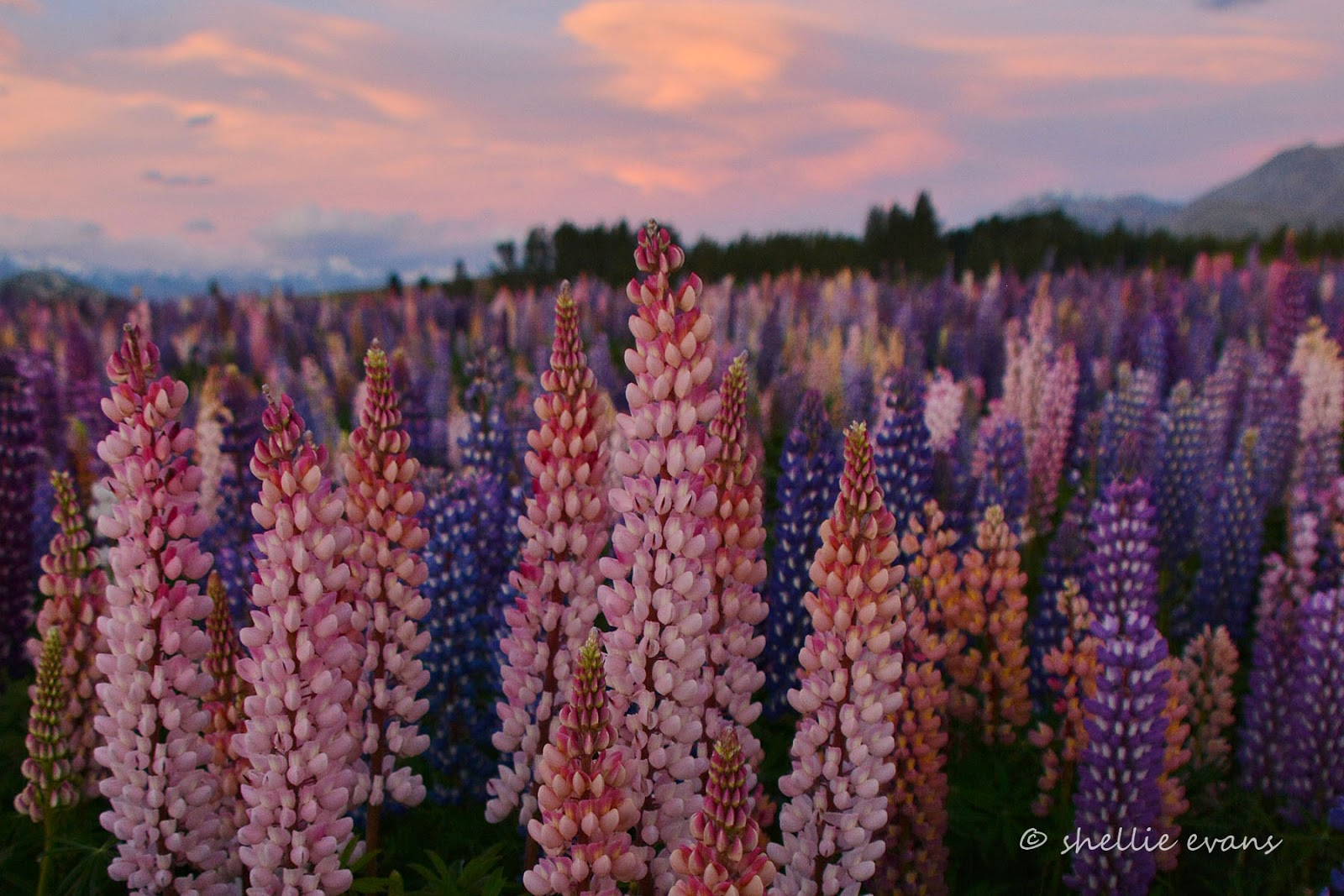
The wind drove us crazy while we were in Tekapo, not a gentle zephyr in sight. Most days it blew a gale and on the others, I’m sure a storm warning should have been issued. The infamous Nor’west arch cloud formation has a lot to answer for but makes a stunning photo above the Tekapo Canal. At least it was sheltered in the cab while we were tiki-touring even if the door was very nearly ripped off it’s hinges everytime I stepped outside to take a photo.
Our first port of call on this road trip was to check out an old favourite; the Patterson Ponds alongside the Tekapo River. We were hoping to freedom camp here so I could shoot some lupins (really?) and the night sky including an aurora if it was playing. And David could try his hand at catching one of the big Browns that are rumoured to be living in the ponds. The ponds looked totally different to our last visit and nowhere near
as spectacular without the beautiful autumn colours, still clear waters and stunning reflections. The willows and reeds were being beaten up by the wind and dust swirled and rose off the surrounding tracks. The weather would have to be very settled before we’d venture here for a night or two, it’s a very exposed site.
After the ponds we continued on down SH8 for a few kilometres and turned into Braemar Road, the back road to Lake Pukaki. The last time I stopped on this corner was in early June when I returned to the MacKenzie Basin after the big show dump. The road certainly looked a lot different this time round. The paddocks along the way were full of merino sheep and their lambs. Merino’s with their shabby appearance must be the most unattractive (ugly is a bit harsh) sheep out there. Personally I think they are gorgeous, their faces are so full of character and while the mums look like they are wearing ill-fitting coats, the lambs are too cute with their wrinkly skins they’ve yet to grow into.

The long and winding road- it’s 20kms of gravel road end to end and while it’s not so winding it’s very dusty. Clumps of lupins line the road here and there; lupins that are well behind their lake front cousins in flowering. Ahead of us is the Ben Ohau Range which runs up the far side of Lake Pukaki all the way to Aoraki/Mt Cook at the head of the lake.
I give a shout as we go flying past this wonderful little hut on the side of the road and we screech to a halt just as we’re about to cross a one land bridge that spans Irishman Creek.
Irishman Creek Station of Hamilton jet fame and also Irishman Creek Station, whose entrance, back on the main highway, has possibly the most photographed shelter and letterbox in New Zealand.
Irishman Creek Roadman’s Hut was built in approximately 1916 (it’s nearly a 100 years old) and is still in use today though not for roadmen but as a overnight stop for people walking the Te Araroa Trail (New Zealand’s walking trail from one end of the country to the other) or cycling the Alps to the Ocean cycling trail. There’s two wooden bunks, a bench seat, a fire place, a couple of shelves and a visitors book although it would seem most people like leaving their names on the wooden planks around the inside of the hut. If only the walls could talk, the stories they could tell. Outside the hut is tied down by wire, the winds are obviously ferocious here too.
We pass Mt Cox (837m) surrounded by the beautiful bronze colours of a high country tussock plain, this is also Defence Force land and entry is prohibited.
I also have to stop to check out what looks like a small kangaroo body hanging on a fence, David’s not so keen. Of course it isn’t a kangaroo, there are none of those in the country but there are wallabies, another introduced pest that is, luckily, localized to only a few areas of the country. This is one bloody big wallaby though and it’s a long way from it’s known territory in the Waimate area. They’re obviously spreading on right into the interior, coming up through the Hakataramea Pass, which is a worry.
Finally we come up over a hill and the beautiful aqua blue (choppy) waters of Lake Pukaki appear below us.
We’re now driving through the lush green farmland of Tasman Downs Station and I love that all the paddocks have welded metal names on their gates. Farmers always have names for their paddocks; the horse paddock, the dam paddock, the woolshed paddock, etc and mostly it’s just a spoken fact ‘put the sheep in the woolshed paddock’ a farmer might tell a worker. Here the worker would have no problem knowing which paddock was which. And with such a large station there would be dozens of paddocks. What a job welding up all the names!
We turn left onto Hayman Road which runs along the lake front back to the main highway and stop for lunch on a grassy bank overlooking the lake, where it is reasonably sheltered from the wind that is blasting down the lake.
On a clear day there’d be a fabulous view of Mt Cook at the head of the lake here; today it’s hiding beneath a haze of cloud and rain squalls.
Across the lake the wind is whipping up sand from the gravel beds of a rock slide off the mountains behind.
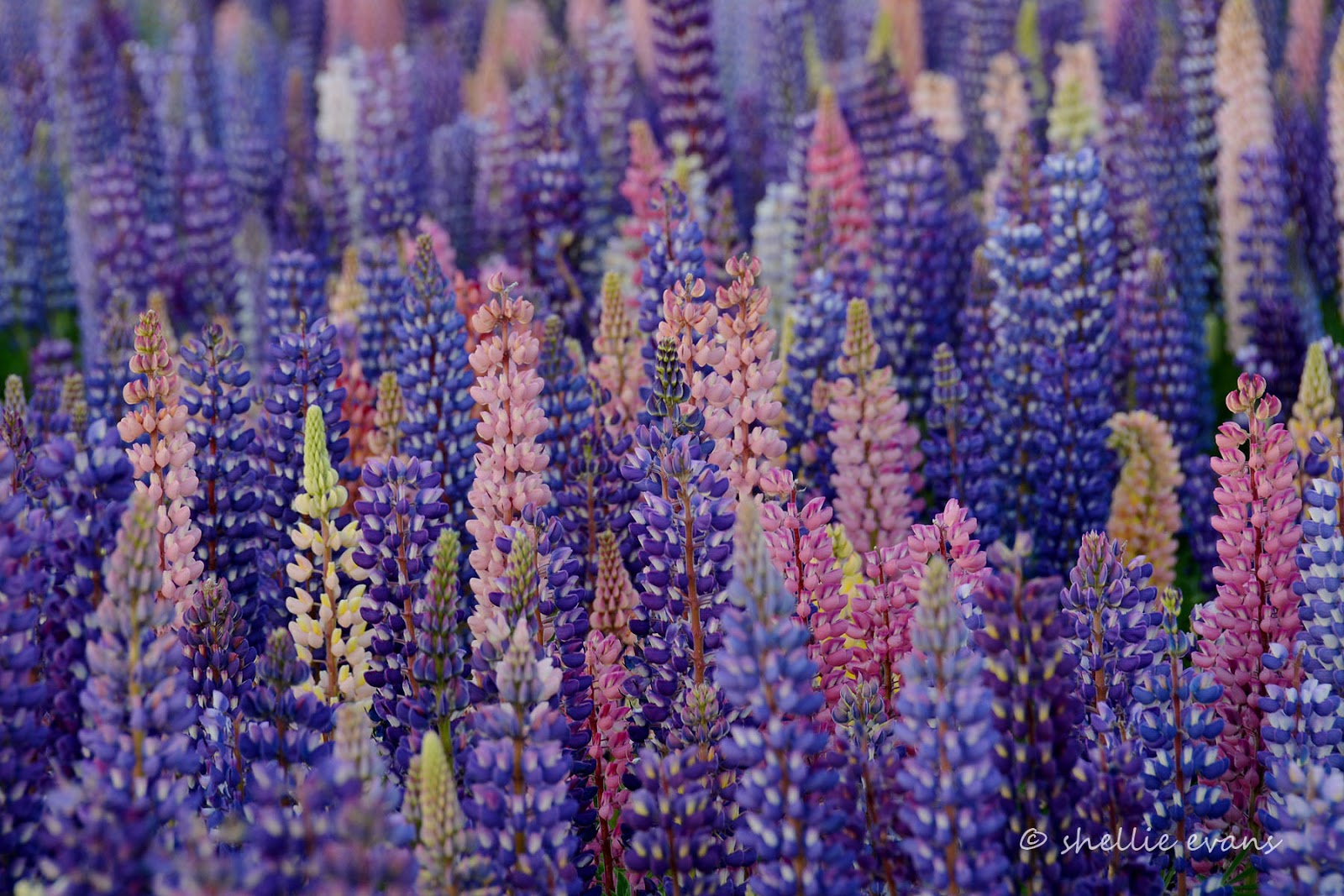
Not too far down the road flowering lupins start to appear along the road edge and around another entrance to Tasman Downs Station. We stop (of course) and it’s a big surprise to find a small pond over the bank and out of sight of the road. It’s a pity the pond isn’t the same colour as the lake but beggars can’t be choosers and it’s still a pretty little spot in an otherwise green, grey and blue landscape.
I disappear down the bank and spend the next 10 minutes scrambling about in the gravel shooting lovely lupins.
Ever patient, David stops again when this gorgeous scene comes into view a little further on down the road. It’s no wonder the lupins draw visitors from far and wide.
And I get an added bonus over the otherside of the road; another gate name hidden down the bank. I wonder at the story behind this one. I looked for a walnut tree or two but it was mainly swampy ground and willows surrounding a slow flowing creek. Of course the story is far more interesting than just having a nut tree in the paddock.
After a bit of quick research I found this (courtesy of Stuff.co.nz)-
The late Bruce Hayman lived almost all his life on Tasman Downs station in the Mackenzie Country and his family have honoured him with the title of the autobiography he wrote on a gate, `The Nut that Changed my Life'.
The title of the book came from a nut which was part of the instrument panel that became loose and alerted him to a fault. He was forced to make an emergency landing and pulled out of a bombing raid in Tunisia. His comrades in the accompanying planes were later shot down leaving him convinced the nut saved his life.
The war pilot led a remarkable life. In 1941, the 21-year-old hopped on his motorcycle and rode to the military recruiting office in Timaru. He signed up for the air force, training in New Zealand and Canada, with a view to flying Spitfires, but ended up in Wellington bombers.
It was in a bomber he was sent on a doomed mission during the Italian campaign of December 1943, where his plane crashed on Mt Etna. He was left badly injured sitting in the Wellington, its nose gone, and sliding down the mountain.
Two crew lay dead and when Mr Hayman went to get out, his leg collapsed, bones exposed. His jaw was badly cut, a finger tip was all but off, and he could smell aviation fuel.
The other crew went for help, leaving five remaining, one of whom died soon after. He took to his damaged middle finger with a pocket knife. He wrapped the stump in a handkerchief and straightened his broken leg. And then he waited for three freezing days, fighting sleep – and death – by reciting poems.
Help arrived in the form of Sicilian Mafiosa, who came to loot the plane. At one point a gun was put to his head and he was later half-dragged down Mt Etna, and then put on a donkey. Eventually, the survivors were picked up by an RAF jeep. Mr Hayman was shipped back to England, where he stayed in hospital for 18 months, fighting leg infections which ultimately resulted in his leg being amputated.
None of this slowed down his life back on the farm where he worked hard, eventually passing on the farm to his son Ian.
Mr Hayman died in May 2008.
What an incredible and brave man, just one of the many that came back from the war and got on with their lives without fuss or fanfare. At least he has a road named after him.
Sometimes it pays to have someone who is constantly on the lookout for photo opportunities because you’re never going to know what is going to appear next. It might just be some very rare birds on a small dirty non-descript farm pond. I let out another shout to stop when out of the corner of my eye I spotted a black bird across the far side of the pond as we went flying past. Could it possibly be a Black Stilt/Kakī?
David backs up and through our binoculars we see that sure enough it’s a rare and critically endangered Black Stilt, a first for us and another one off our virtual list. And not only is it a Black Stilt it also has a tiny chick with it.
During the 1980s the population fell as low as 23 birds, that has now risen to around 100 birds which includes captive birds that are intensively managed. For a bird with such spindly legs and a tiny body, this is one very hardy bird although obviously it doesn’t do well against introduced predators. Black Stilts are endemic to New Zealand (found only here) and do not migrate to warmer climes. They are only found in the MacKenzie Basin and spend the cold harsh winters on the braided rivers and alpine lakes of the area, although some of the smarter birds do head to the Canterbury coast for a bit of sunshine.
This is not the best of shots, the birds were at the extreme end of my lens and the photo has also been heavily cropped but still it’s a record!
Sadly it’s partner, who comes to warn us off even though we’re a good 300 metres away, is a hybrid stilt. A cross between a common Pied Stilt and a Black Stilt. This will most likely be the reason that Black Stilts will eventually be non-existent in the wild. The Black will be bred out and only hybrids and pied will be found.
We were on a high after seeing the stilts and while we’ve been watching them a couple on bikes rode past us again, we saw them go past while we were having lunch, then they disappeared only to pass us again while we were bird watching. With a tail wind it took us a long while to catch them up again.
They are cycling part of the Alps2Ocean cycle trail, at over 300kms long, it’s New Zealand’s longest continuous cycleway. The trail starts at Mt Cook but there is also an alternative start at Lake Tekapo which is the section these people are on. Riders can then choose to ride the 110km return side trip to Mt Cook when they get to the turnoff before continuing on to the finish at Oamaru.
Just a few kilometres from the main highway is the Tekapo B hydro power station, it’s here that the Tekapo Canal finally enters Lake Pukaki after it’s long journey from Lake Tekapo. It’s the canal that passes by the Patterson Ponds back in the photo at the beginning of this blog.
We drive to the top of the penstocks and around the head pond and along the canal road past the Mt Cook Salmon Farm, this is the farm that sells it’s salmon at the Lake Pukaki/Mt Cook Lookout. From here it’s just 9kms along the canal road to the highway (closer to Lake Tekapo and home) but unfortunately the road has been closed to through traffic, it’s also closed just past Patterson ponds at the far end. The canal is going through a major upgrade and is being relined. It was due to open in July 2015 but we’ve seen no major earthworks or any sign of it reopening yet although pedestrian and bike access is available.
We have to take the long way home, and drive back down to the lake. It adds an extra 15 kms to the trip but hey, we have all the time in the world…
And look what we would have missed; a ‘house’ on the move….a different type of mobile home than we're used to. And, is there anything in the rules that say “you must not drive a heavy vehicle holding a stop sign out the window”? Cell phone, stop sign, is there a difference?