Showing posts with label black stilt. Show all posts

Saturday, December 11

Winter in the High Country- Part 1

Just when you thought summer was on the door step, here I am to remind you how cold winter can be in the high country.

With both our holiday cottages booked for a few days in early July we vacated our park-up site beside one of the cottages and headed off for a few nights of freedom camping. And what better place to spend them than on the shore of beautiful Lake Pukaki with the perfect view of Aoraki/Mt Cook from our front door.


After a day of blue skies & crisp cool air the sun disappeared behind Ben Ohau Range and the soft colours of sunset crept over the sky.  (I note that the time on the photo file is 5.10pm, a few days after the longest day of winter. And here I am writing this a few days before the longest day of summer and the sun is setting at 9.40pm at the moment)


The next morning fog rolled in from the south end of the lake and we disappeared for a short time inside a thick cold damp blanket. It didn't take long for it to retreat back down the lake...


...and we were left with another brilliant blue sky day. We took a drive up Hayman Road and on to Mt Cook Station Road and right to the end; it's gravel all the way. 

If you look closely here at Landslip Creek you can see all the wilding pines that have been dealt too along both sides of the waterway. In fact there has been a massive clearing of wildings right along the lake edge & roadside from the main highway all the way to the end of the road. 

Landslip Creek & Lake Pukaki
We stopped frequently at different view points along the way and without a whisper of wind the lake looked stunning. 


Ben Ohau Range forms the backdrop to the lake on the west side and along it's base the very popular Mt Cook Road follows the lake for 45kms from the main highway all the way into the Aoraki/Mt Cook National Park.


I zoomed in across the lake here to Glentanner Station & up behind is Glentanner Peak.


And just to show you how insignificant we humans are in grand scheme of things, that small black dot in the water in the left hand photo is a fly fisherman fishing the shallows at the end of the Tasman River delta (click to enlarge the photo). 


Just over the single lane Jollie River bridge at the end of the road is Mt Cook Station. We can see Aoraki/Mt Cook peeping over the top of the slopes at the entrance to the station. 
 

A nearby track heads off out towards the Tasman River and up the Tasman Valley where there are tramping, birdwatching & mountain biking opportunities. It's here that the helicopter lands to offload A2O (Alps to Ocean) cyclists who have started the cycle trail from Mt Cook village instead of at the alternative, Lake Tekapo.


After a short chat with the retired Mt Cook Station owner (his daughter now runs the station) and a pat for his two elderly Golden retrievers who all came down on a quad bike to check who the visitors were, we headed back down the road stopping near where the fisherman had accessed the top of the lake. It wasn't fishing that I was interested though.
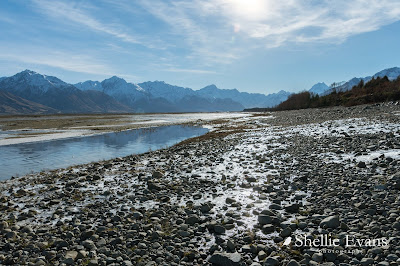

The fisherman's car was parked on the edge of the road near a track & as I passed close by the vehicle to reach it, I got the fright of my life when a woman's voice called out a greeting. She was watching movies in the front seat but had all the windows blacked out. I nearly fell down the bank as I stepped back in surprise. 

She called out a warning to watch for ice as I clambered over the fallen pines across the track and sure enough as soon as I reached the gravel it was like a rocky ice rink; treacherous! Any water seeping down towards the lake had frozen, you can see the ice glistening amongst the gravel in the photo above and it set between the rocks below. 


Before I climbed down the last bank and onto the gravel I had checked the nearby pools with my binoculars. And sure enough it didn't take me long to spot what I was looking for. Not just one but three rare & endangered Kaki/Black Stilts, a mature pair & their juvenile following along behind (on the far side of the pool in the left hand photo below). 

Unfortunately I couldn't get nearer without risking my life on the ice so I made do with watching them for a short time delicately picking their way along the icy edge of the pond before I returned to the ute. Sensible David came only as far as the bank to watch them. 


As I made my way back to the track I could see that the fog bank was still holding tight at the south end of the lake. Hmmm.....

Look at that ice...and fog!
Back at camp the fog weighed heavy on my mind, literally. It was late afternoon and it had been fogged out at that end of the lake for nearly 24 hours.  I wonder I thought... It didn't take me long to decide to check it out and sure enough as soon as I drove back along the main highway I disappeared into it and a little further along I could see that a hoar frost was forming! Yeehaa! 

Nearing Twizel River on the main highway
I drove through to Twizel, the fog getting heavier & thicker the closer I got. I was nearly down to crawl stage by the time I passed the town entrance, not very conducive for photography at all but I carried on to check out my favourite ponds. 


I did a quick circuit of Kellands Pond checking out my favourite spots and taking a few photos. 


It was dull, cold and miserable with no chance of the fog lifting- even a little- and with daylight fast fading I decided it wasn't going to be tonight that I'd get some good photos. 


No cup-of-tea stop here this afternoon!


But the ice crystals were building & I had my fingers crossed the fog would last until tomorrow.


I decided to head back to Lake Pukaki via Glen Lyon Road and the canal to check out two of my favourite photography subjects, passing the cottages on the way (guests really getting their money's worth 😁 ).

Ben Ohau Station stables were hidden behind the fog...


And Loch Cameron? Well that had disappeared altogether!


As I drove back into our camp site at Lake Pukaki it might as well have been another world, if you look closely you can see the layer of fog behind the lake and below Benmore Range, stretching across the Mackenzie Basin from Lake Benmore at the back left to Twizel on the back right  (click on the photo to enlarge). And as an aside if you are looking for Black Stilt/Kaki at Lake Pukaki, check out ponds like this, they are often feeding around the fringes.


Fog? What fog? Another stunning sunset over Aoraki/Mt Cook.


As I close up for the evening I'm hoping the fog holds and I can get back to it tomorrow.


To be continued....Part 2


Monday, February 15

Rarest Wader in the World

Catch-up

After visiting dozens of lakes and waterways around the MacKenzie Basin and seeing many different birds which included a Black Stilt family with a chick & one hybrid parent, another adult bird defending it’s nest/chick from a hawk and two juvenile Black Stilts up close, we had yet to see an adult Black Stilt up close.

So it was a great thrill when we finally managed to locate not one, but two very confiding adult Black Stilts/Kakī feeding in a shallow pond overflow on farmland not too far from Twizel.


Not only were they happy to carry on feeding but I managed to get very close without disturbing them.


Going by the flattened grass track leading to a fence that separated the birds from the road, I got the feeling that these two are very much used to weird humans crouching and crawling through the grass with a camera lens stuck to their face.


Intensive conservation management of the endemic (found nowhere else in the world) Black Stilt began in 1981 when the population had declined to just 23 adult birds. Despite this management the Black Stilt still remains the rarest wading bird in the world, with fewer than 100 breeding birds.


Over 150 captive bred juvenile black stilts (a season record) have been released into the MacKenzie Basin area this past breeding season which should increase the breeding adults over the next 2-3 years, providing they survive predation and the harsh winter environment they live in.


Unlike other birds that make the braided rivers of  the South Island home, the majority of black stilts don’t migrate to warmer climates for winter.


We visited the birds twice while we were staying at Lake Ruataniwha and I’ll certainly be checking in on them again the next time we pass through. We also located another two adults further down the road but they were a lot further away than these two.


That’s another bird we can tick on our virtual list. And it was well worth the wait and effort in finding them, they are a stunning bird.


Sunday, January 17

Around The Lakes- Part 2

This'll be the last post for a few days, we're heading off the radar again. We're going back down the Milford Road to complete a few of the walks we missed the last time we were there and also check out how Fiordland National Park looks in a different season...both weather wise and visitor wise- wish us luck!


Now, continuing on from Part 1

It's a hot, dry and dusty track down to the Lake Tekapo waterfront…


Below is a photo from the other day, taken looking down on the bays we’re heading to. You can see the caravans- white dots- in the trees at the bottom of the road, centre left (click to enlarge the photo). It’s a huge area to explore and once over a shingle bank that separates the dried mudflats from the lake, the going is rough, stones, big rocks and boulders most of the way. I start to think there can’t possibly be any life along the barren lake edge when…


…swimming towards us come two grebes! They’re quite close and not at all afraid and although they don’t stop, they do turn around and follow us back along the lake edge.


Ahead of us we can see two South Island Oystercatchers resting on the very edge of the lake and behind them what appears to be a couple of chicks sitting on the sand. It’s not until we move a little closer and check through the binoculars again, that we can see that they’re not Oystercatcher chicks at all but two rare juvenile black stilts!! Yeehaa!


They let us get quite close before deciding to stand up…


…stretch their wings, do a little rearranging of their feathers before slowly moving off, scanning the waters edge for tasty morsels. What a thrill and they weren’t that much worried by our presence either, obviously used to humans, having been bred in captivity before being released into the wild. Both birds had a serious amount of leg bling on. As you can see in the bottom photo the grebes stopped to check out the stilts too.


We getting closer; first it was the black stilt with the hybrid partner and a chick on a farm pond near Lake Pukaki, they were a good couple hundred metres away. Then it was another black stilt with a hybrid mate on the other side of the Cass River, we saw that one a little closer when it flew overhead. And now two juvenile black stilts very close, hopefully the next sighting will be of an adult kaki at close quarters too.

We walked a little further on along the bay before deciding we’d turn just before the next bay and head for home, it was getting hotter by the minute and we still had a fair way to walk. Both the bays we were exploring were a much more vivid aqua blue than the rest of Lake Tekapo.


'Rock flour'- ground up glacial rock which causes this beautiful colour when it's suspended in the water- must be very concentrated here in these shallow little bays. Until there’s heavy rain, there’s nothing to wash it through.

Across the lake, I can see, once again, the bright yellow ribbon of broom I visited the other day with Lisa.


I walk back along the lake edge hoping for another glimpse of the stilts but they and the grebes have disappeared. I catch sight of movement in the rocks ahead of me and see a little bird darting about. I think it’s a banded dotterel until it gets close and it’s a great surprise to  find out that it’s a Wrybill.

We’ve seen the Wrybills at the Miranda in the Firth of Thames in the North Island where they migrate for the winter but none in the South Island until now. Wrybrills are a small plover and are endemic(found only in NZ) to New Zealand. They also breed only in the braided rivers of the South Island which makes them particularly vulnerable when the braided rivers become clogged with lupins.


And here's why this tiny little bird is extra special. The Wrybill is the only bird in the world with a laterally curved bill- and always curved to the right- which it uses to reach insect larvae under the round riverbed rocks. This is possibly a male, their breeding plumage includes, but not always, a black line above the forehead. This guy has a slight hint of one.


Wrybills usually allow a close approach and this little guy was no exception, I had to keep winding my zoom in as he got closer and passed just a metre away from where I was crouched. 


Happy with our very fruitful birding afternoon we headed back over the road and along the otherside of Lake McGregor and past the drowned willow forest, checking for more waterfowl as we walk. That’s when we catch sight of  movement in one of the trees, something running along one of the fallen branches, jumping from one to the next, climbing higher and higher.

I wonder if you can guess what I failed to catch in the blurred photo on the right? It’s a blasted weasel and it has a large unidentifiable chick in it’s mouth- that’s it, the dark inverted V on top of the branch, the left hand red arrow points to the chick being dragged along the branch at speed, the right arrow is the weasel's head. We lost track of it within seconds, I cursed the fact that I didn’t have my camera ready to go and cursed the weasel too. Bloody introduced pests! It was not a happy note to end the afternoon on.


Of course I couldn’t resist another lupin shot as we neared home, this patch growing between the road and the lake at the entrance to the camp.


On the hill above the lupins I spotted something attached to a power pole- someone with a sense of humour has adorned a sheep skull with sunglasses and fixed it to the pole.


It faces away from the road and the campground so unless you see the horns out the side of the pole you’d not know it was there.


Back at the van, as the afternoon draws to a close, I track a magpie pair over the roadside fence and along the hill to see why they have been harassing a black back gull that circles the area each afternoon. I can see them from inside the van and they chase and attack the gull each time it passes overhead. There are no trees nearby so they haven’t got a nest but I’m sure they’ll have a fledgling nearby that they are protecting. And sure enough sunning itself under a matagouri bush while it’s parents feed nearby, I find a magpie chick who isn’t too perturbed that I am approaching him.


He squawks loudly as I get nearer and I expect the parents to come racing over but they’re not worried and carry on rummaging about in the grasses on the otherside of the fence. He waits awhile and then walks off towards the fence still squawking loudly.

He’s not too steady with his wings but manages to fly to the top of the wire, calling constantly for his parents who still ignore him. He balances precariously on the wire and then nose-dives to the ground running off to another bush where he settles down again waiting for his parents to bring dinner to him. He was rather a cutie (and yes, I know he's a pest too).


On the way back to the van I flush out another late afternoon/early morning visitor to the large grassed area between the road and the campground, another teddy bear! He heads for the hill as fast as he can, launching himself through the barb-wired fence like there are no tomorrows.

I’ve spotted him and his mate (hares always seem to come in pairs) a few times from inside the van. They have been feeding on the lupins in the middle of the field, and using a couple of deep grassed ditches as escape routes back to the safety of the hill. But no matter how many times I try to sneak up on them, I always get a shot of their rear ends!


One day...