Showing posts with label DC3. Show all posts

Thursday, March 31

Part 2- Warbirds Over Wanaka, 2016

Warbirds Over Wanaka, 2016 continued on from Part 1...

Air War in the Pacific; Avenger, Corsiar and the P40 Kittyhawks-


Grumman Avenger- one of the largest single engine fighters of its time. Used by the RNZAF in the Pacific campaigns of WWII.


Corsair FG-1D- The Corsair is my most favourite plane (ahead of the Harvards), I fell in love with it at the Tauranga Air Show a few years ago. 


I love the wing shape, how it dips down near the plane body. And although rather quiet, I also like the deep throaty grumble of the 2000hp Pratt & Whitney radial engine (I looked that up!) 


The Corsair was nicknamed "Whistling Death" by the Japanese because of it's stealthy approach.


I failed to get photos this time, of the wings folding on the Corsiar & the Avenger (I was just too far away) but here are photos I took of them during the 2014 Warbirds.


The Curtiss P-40N and P-40E Kittyhawks


The RNZAF operated 297 Kittyhawk fighters in the Pacific during WWII. 


Eventually replaced by the Corsiar, the Kittyhawks returned to NZ to be used as advanced fighter trainers.


Another iconic aircraft; the Douglas Dakota C-47 - DC3. The Dakota C-47 was a modified version of the civilian DC-3. This particular C-47 was delivered to the US Army Airforce in 1944. After being decommissioned in 1959 it was commercially used in the Phillipines, New Guinea and Australia before being retired and becoming a static display. The New Zealand Warbird Group then brought it to NZ and performed an extensive rebuild. It was repainted to represent the aircraft NZ3546 from No.42 Squadron of the RNZAF.


This DC3 has a 100%  New Zealand pedigree. Currently owned & flown by Air Chathams, it left the USA and flew to Hamilton, NZ in April, 1945. In May 1945, it became known as RNZAF Dakota NZ3543. Once decommissioned it was flown by our very own NAC (National Airways Corporation).


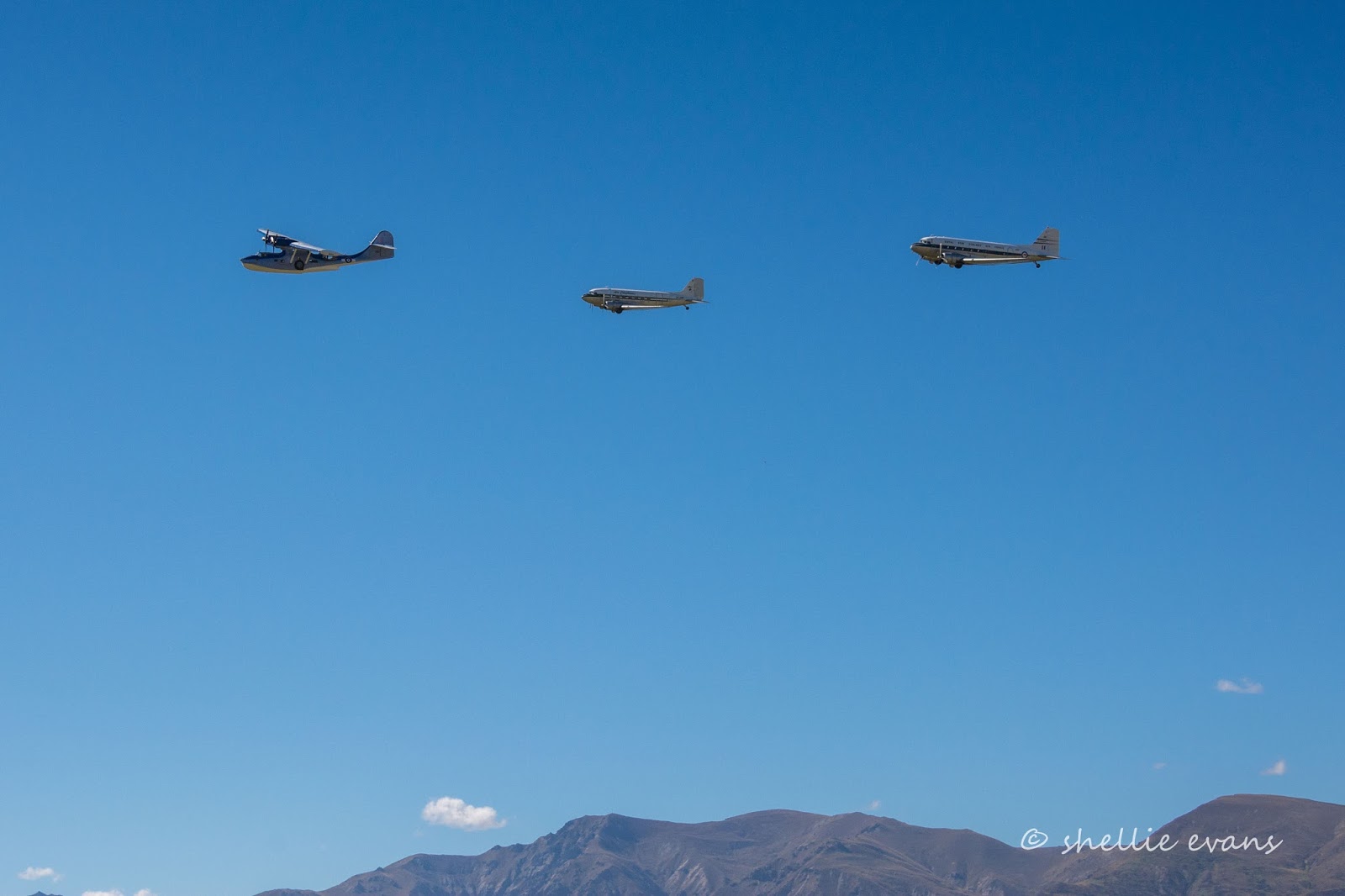
The Catalina Flying Boat and the DC3s put on a great flying display and took many visitors for the ride of their lives.

Often used as a bomber escort, the American built P51 Mustang was armed with six .50 calibre Browning machine guns.


It was fitted with long range fuel tanks and modified to perform at high altitudes.


The Mustang was a formidable game-changer in the latter stages of WWII.


The Mustang was known as the "Cadillac of the Skies" I think it looks like one of those model aircraft you make up; the air intake underneath looks like a clip that holds the wings in place! Add to that the little model man in the cockpit and it could have come straight out of a box.


Next up are the "Air Bandits", Jurgis Kairys & Rob Fry, and their aerobatic planes performing some death-defying maneuvers. These are two very brave men.


Jurgis Kairys, is a Lithuania national is one of the most experienced aerobatic pilots in the world. Jurgis is an aeronautical engineer and he helped develop the Sukhoi aerobatic aircraft (the blue plane flown by Rob). This Warbirds Jurgis has brought his very own aircraft; the Juka to perform in. The Juka weighs less than the lightest Sukhoi and is powered by a 400hp Russian M14PF engine.


That's an impressive eleven turn cork screw Jurgis is performing on the right.


Later in the programme Jurgis sneeked in on the DC3, tucking in under the belly as they flew passed the crowd and then barrell rolling around the large plane on their way back down the runway.


Two Strikemaster Jets put on a fast and furious display...


...highlighting the incredible skill level of their pilots.


They were then joined by two De Havilland Vampires for some precision flying.


The Vampire was considered highly experimental in its developmental stages and came on line too late to see any action in WWII.  


The Vampire was used as a training aircraft and remained in service in NZ until 1972. And they still look futuristic to me!


The grand finale saw the airfield under attack by enemy aircraft (poor lonely Messerschmidt) and the Fighters scramble to do battle.


Followed by a mass flypast and a massive explosion, that caught many on the hop.


And again on Sunday.... and that was Warbirds Over Wanaka for another two years. 


Here are a couple of other aircraft that took part in the Classic Flypast...


This one made me giggle...it looks like he's peering over the top of the screen... 


And in a paddock at the end of the runway; a plane park- for those that arrived by wing.


Sunday, February 22

A Place People Drop Into- Mokai Canyon

We took a little tiki-tour out the back of Managweka, it’s a chance to explore an an area that most people would not visit, even though they may pass through the town frequently on their travels from north to south and visa-versa.

The Rangitikei river gorge & it’s papa rock cliffs stretch off into the distance and across the farmland we see a large viaduct.


This is one of 3 viaducts on the Mangaweka deviation which opened in 1981. Known as the south viaduct, it has five twin-shafted piers. At 78 metres high, and 315 metres long, this viaduct is the fourth highest and second longest in New Zealand. The South Viaduct was the first in the world to use energy-absorbing dampers in the foundation of the piers. In the event of an earthquake the piers will step from side to side but not collapse (I wonder if that's been put to the test yet...)


Not much further on and still surrounded by high papa cliffs- even the river tributaries have worn their way through the soft clay- we stop near the old Mangaweka Power Station(1911) and after having a look at the remains of the Power Station we walk along a short track to the dam. This is the Mangawharaiki River and the narrow canyon it flows through is amazing. The problem is I can’t get a clear view of it because the bank is so overgrown but the top right photo gives a little bit of an indication. The river bed has been carved into hundreds of hollows, ridges and small caves. It reminds me of a crocodile or tuatara skin, the way it curves it's way down the gorge.


We’re not on our own when we get to the dam wall, this is obviously the local's swimming hole. There’s a dozen or so teenagers swimming in the deep hole that’s formed at the bottom of the dam. They’re not only swimming after hauling themselves up the wall on a rope, they’re then launching themselves off the cliff  hanging onto another rope & dropping into the depths below.


There’s a stone stairway and then a ladder which we climb to get us to the top of the wall. I was expecting a large lake behind the dam but it was only a small pool. The power station stopped working in 1937 and one of the main reasons can still be seen today- a large log stuck firmly in the outlet tunnel beside the stairway.


I take some slow shutter shots of the waterfall from up the top but I feel uneasy standing on a small square of concrete above rushing water & knowing I have to get back down the ladder to get to the bottom. I offload my camera to David, who goes ahead of me, before I begin to inch my way down the ladder holding on for dear life- why's it always easier going up? Trouble is once you’re up you got to come down.  I keep my eyes looking right, there’s more vegetation on that side rather than an open space into the pool below on my left. I think it’s more the noise than the height that scares me most, I don’t like the sound of loud rushing water.


We leave the dam and weave our way inland where there are many view points of the river and it’s white cliffs. The gorge would have been a huge barrier for farmers in the early days, not just the height but the fact that it’s a very meandering river. Just when you think you’re left it behind it appears in front of you again.


We’re not finished with the river just yet either. Our next destination is a well known tourist attraction and being 22kms from the main highway you’d think not too many people would take the time to visit it. But this is the home of the most popular extreme sport spots in the North Island. The Mokai Canyon is where you can bungy jump, giant swing or zipline/flyingfox to your heart’s content as long as you’re prepared to empty out your bank account at the same time.


The Mokai Canyon itself is truly amazing and there is no way these photos can show you actually how deep the canyon is. Believe me it’s incredibly deep. Part of the river and canyons were used as Anduin River in LOTR- The Fellowship of the Rings, and I can now see why.


We had a coffee on the deck and while we were sitting there we heard faint screams. By the time I rushed onto the viewing platform a person on the zipline/flying fox had roared by, passing under the bridge and flying off towards the far end of the canyon attached to a wire which is 175 metres above the river and 1.1 kilometres long. They reach speeds of 160kp/h along the way.

I thought that the person may have been hauled up to the end platform to finish their ride but no he was slowly pulled backwards back along the line all the way to the beginning. Unfortunately I sat back down to finish my coffee before I realised this and missed the photo opportunity as he passed by out front. To give you an idea of the size, I could not make out the person in the harness as they were hauled up the last section, all I could see was a blob. That was until I zoomed in with my camera and realised that in fact there were two people in the harness.

In the photo above I have circled the platform where they left from- yeah that tiny speck! You can also see the stairway that the zipline riders have to climb to get there, to the left of the circle- that’s after climbing through the bush up the side of the canyon for a fair distance too. And in the photo below I’ve circled the platform at the other end where the wire is fixed. I’m not too sure I’d have liked to be the guinea pig that had to try the wire for the first time.


Below is the platform and stairway, and also the two people in the harness as they were pulled back to the platform. They then had to make their way back down the stairs and track to the shop. I always thought maybe I’d like to give this a go sometime but now having seen it in the flesh, there’s no way on earth you’d find me harnessed up. Not surprising I think you’d say after reading about my fear just climbing a simple little ladder!


Across the road from the Mokai Gravity Canyon is the Makino DOC campground and who do you think we found camped up there? The little van on a big road trip! I love the tarpaulin awning- it was a stinking hot day and our friends obviously needed some shade.


We completed our little road trip by stopping in Mangaweka so I could take some photos of of the iconic ‘famous in NZ’ DC3 plane tearooms. Once upon a time this would have been a huge novelty for Kiwis passing by, maybe it still is for young children, but nowadays I think it’s a bit old hat and more of a symbol for Mangaweka, a bit like the large carrot in Ohakune, the gumboot in Taihape, the salmon in Rakaia, the fruit in Cromwell, the trout (& guitar) in greedy Gore. And there are plenty of others.


I also wanted some photos of the old historic buildings along the deserted main street- deserted except for one lone guy in his beanie who came out from his house to have a coffee & a smoke on the bench.


There looks to have been an attempt to revive the street at some stage since the main highway bypassed the township back in the ‘70s. Some buildings are occupied with a few small businesses running, the pub looks like it has accommodation available while other shops have been converted into homes.


There are a few wall murals on the sides of buildings and art works here and there to add a bit of interest but the town does look like it’s on it’s last legs. A lot like many of the small rural towns we’ve seen on our travels.


There are two things I’ve learnt while taking photos of historic buildings in some of our smaller towns- the Bank of New Zealand & the Catholic Church had a whole heap of money and not much taste- well the BNZ had a little more than the Church, but both of them built concrete monstrosities that dominate the townscape (and the people?). Here’s the rather grand Mangaweka Bank of New Zealand-


And here’s the Taihape Catholic Church-


I rest my case.