Showing posts with label boulders. Show all posts

Saturday, April 30

Boulders, Beaches & Big Trees- Northland's West Coast; Part 1

No, we've not returned to the North Island (yet). I thought I'd kill two birds with one stone. I wrote an article on Northland for the NZMCA magazine & thought I'd not waste my talent (haha, yeah right) & post it on here too.

I know some of you will have read it already but only the first part (and not with so many photos). The 2nd part won't be published for a few months so you'll get to see that before other members. I also know there are several followers who have been waiting (like forever) to read more about our Northland travels. Not looking anywhere in particular, aye Dad 😁

Koutu Boulders
Many people have heard of the Wairere Boulders Nature Park near Horeke at the head of the Hokianga Harbour in Northland but very few know of the Koutu Boulders, another collection of interesting rocks located on a remote Hokianga beach not too far from the harbour entrance. Both locations have unusual rock formations and both are well worth a visit.

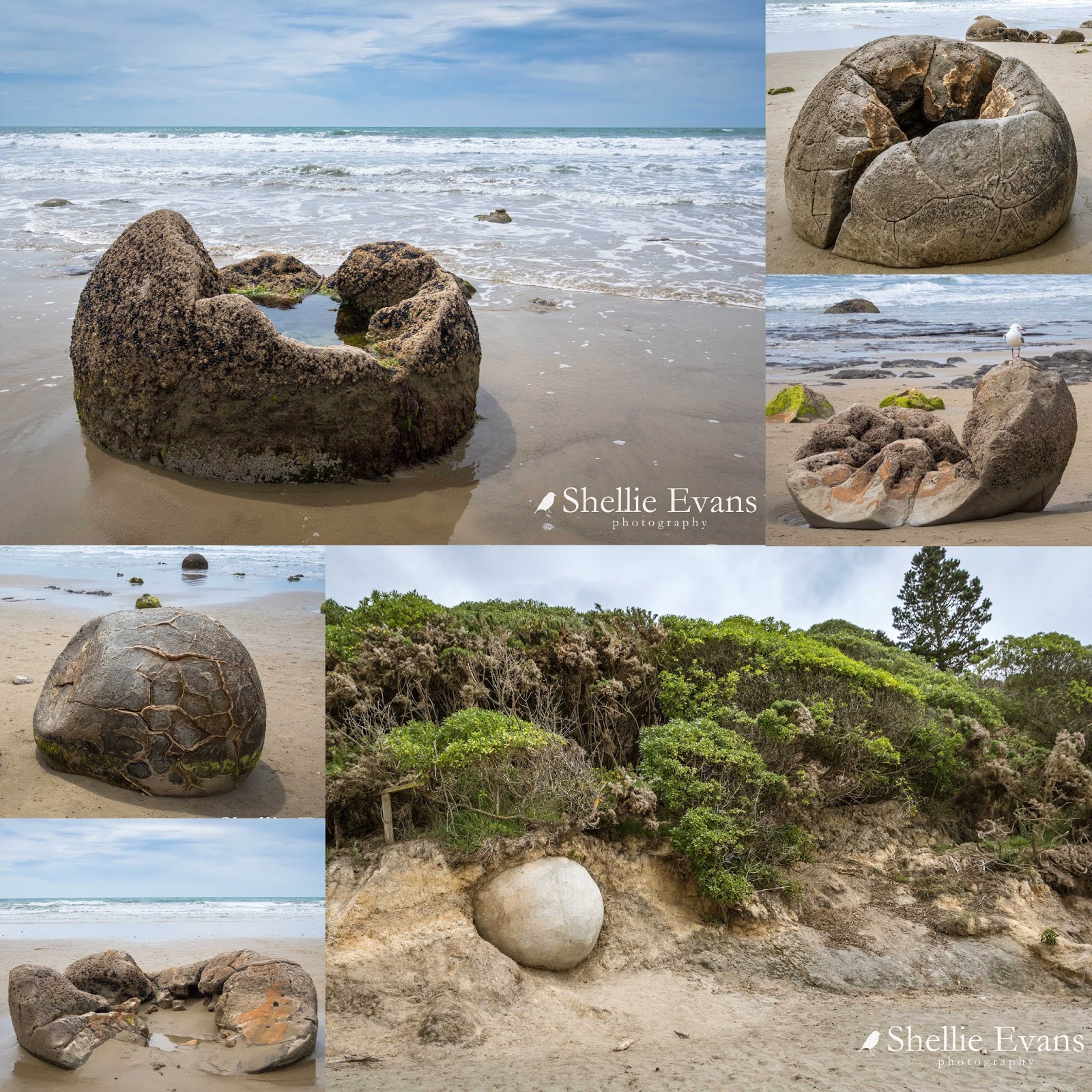
The Koutu boulders are concretions and are similar to the more famous Moeraki Boulders in the South Island. Boulders are formed from a hard core within sedimentary rocks, a cementing mineral binds the rocks together and their round shape is formed over millions of years, probably by being rolled around on the ocean floor. 

Bertha
Many of the boulders form interesting shapes and have been given sign boards with their name on them. 

Although many of the signs are now weathered & hard to read;  Dolphins (a group that do look like a pod of dolphins swimming by), Bertha, Plethora, Beached Whale, Turtle. You get the picture.  

Dolphins
Others might be described as giant cannonballs they are perfectly  spherical, one is huge and towers over me, another looks like a giant tomato complete with a stem dimple & creased top. Others have broken open and look like oranges with perfectly cut segments falling onto the sand. You could spend hours checking out the formations & letting your imagination run wild. 

Koutu Boulders are best accessed at low tide as they stretch for a kilometre or so along the beach and many are below the high tide mark. 

Beach access to Koutu Boulders
To get to the boulders, turn off SH12 onto Koutu Loop Road and then onto Waione Road. If coming from Kaikohe, the Koutu Loop Road is about 10kms past the Rawene turnoff or if you’re heading east the road is about 6km from Opononi. 

Nearby residents put their own sign up
There are two entry points to the beach, one is signposted off Waione Road, the other is at the far end of Cabbage Tree Bay Road which has limited parking & involves a short steep descent to the beach. 


The first entry point is level, with a good sized carpark, but involves quite a reasonable walk along the beach to get in amongst the best selection of boulders (though there are several groups along the walk), and you do need to keep an eye on the tide. 

Beach walk boulders
Whereas the Cabbage Tree Bay entry drops you right into the centre of the biggest & best boulders. The track down is relatively easy but it's a short steep haul back out.


I got distracted away taking macro shots of the wild flowers that grew alongside the track.


Not too far from the boulders, on a large grassy point overlooking the Hokianga Harbour is Koutu Mangeroa; a picnic & camping area owned & looked after by locals. 

Koutu Mangeroa Camping on the point, click to increase the size
The views are spectacular and there’s also easy access to the harbour to take a walk or throw out a fishing line. 

And as long as you’re fully self-contained (there are no services) campers are welcome to stay for a small fee ($10 per van per night, not on the app). 


The 'collection box' made me smile, they must expect hoards of campers, it's a shipping container!


If you head west along the beach below the camping area (at low tide), you'll come across these old piles. They make a great subject to draw your eye to the sun setting behind the giant Rangi Point sand dunes across the harbour from Opononi.

Wairere Boulders are further up the harbour, near the tiny settlement at Horeke. 

About 2km along the Taheke-Horeke Road turn onto McDonnell Road and you’ll find the entrance to the boulders 500m further on at the end of the road. 

It is best to visit these boulders from the Horeke direction as the road from Taheke to the boulders turnoff is long, narrow, winding & gravel.  A visit to the boulders can also be done if you’re cycling the Okaihau to Horeke section of the Twin Coast Cycle Trail.


The Wairere Boulders are not like the spherical concretions at Koutu, these boulders are generally larger and are a more  jumbled selection that at first glance seemed to have been tossed down a narrow valley by an incredible force. The Wairere Boulders are basalt rock, many of them are ridged and have deeply scored patterns on them. 

These rocks were formed by lava from an eruption at nearby Lake Omapere 2.5 million years ago. They once lay underneath a kauri forest but over time the acidic rain has eroded the rocks below the soil and they have cracked and broken apart The surrounding soil has then washed away exposing the stranded boulders, some nearly 10m high.

The Wairere Boulder Nature Park was formed in the early 2000s, the former owners built paths, bridges & boardwalks around, through, over and under (watch your head) the boulders and included quirky signs with information & directions. 

Also, hidden in amongst the boulders & rocks are painted fairy doors, houses and boulder ‘beasts’, seeking them out is a great activity for children on the walk.


The track weaves through lush tropical bush with the occasional glimpse & bridge crossing of the tumbling stream that dissects the valley on its way to the harbour. 


A side track leads to a beautiful swimming hole surrounded by Nikau Palms which  are reflected in the still dark water. 

The Boulder Loop walk takes about an hour and is relatively easy going although there are stairs to climb, bridges to cross and large boulders to duck under so you do need to be quite agile. The much longer Magic Rock Tramp & Lookout Track heads to the top of the valley leaving the loop track just as you turn to head for home. 

But it is a steep climb and on the day I visited it was slippery underfoot and scorching hot overhead so I only managed a few dozen metres before I decided I needed refreshments in the shade back at the café the latest owners have now added to the park...


... along with a large camping area (POP #383). Entry to the boulders is free if you stay overnight in the camp at Wairere Boulders.

Another place of interest near Horeke is the Mangungu Mission Station which overlooks the spectacular Hokianga Harbour (it’s also right at one end of Twin Coast Cycle Trail). 

The Wesleyan Mission station was established in 1828 and the Mission house built in 1838-1839. 


The largest signing of the Treaty of Waitangi in the country took place here on 12 February, 1840 with over 70 chiefs adding their approval while a crowd of up to 3,000 people watched on. Mangungu was also where honey bees were first introduced, providing a major contribution to the success of pastoral farming in New Zealand.

When Reverend John Hobbs and his family left Mangungu for Auckland in 1855, the house was moved to Onehunga where it was used as a Methodist parsonage and then sold to private owners.  The mission house was returned to the Mangungu site in the 1970s, restored on behalf of Heritage New Zealand, and opened to visitors in 1977.  

Historic Mangungu Mission Station Cemetery

To be continued... Part 2


Saturday, May 9

Koekohe Beach Boulders- Otago

Catch-up; November 2019

Our next stop is at the Koekohe Beach boulders, more well known as the Moeraki Boulders. Did I get you? Thought that might grab your interest more than the regular name. Moeraki Boulders is another one of those 'famous in New Zealand' attractions that are a must visit if you are passing. 


It's been six years since we last visited the Boulders and I wanted to see if they have changed. Haha, no of course not...they haven't changed in over 60 million years! No, I wanted to capture some sunrise shots of the Boulders. The tides were right and to make it even easier to access them at that time of the morning, the Red-Barn-By-The-Sea CAP (costs apply parking for NZMCA members) was right beside the Boulder carpark. We couldn't get closer if we tried!


But first things first. We visited another Kiwi icon, Fleurs Place in Moeraki village, a world famous seafood restaurant located right beside the harbour and where fresh fish is delivered daily.


We've also visited Fleurs before, in fact twice. On our last visit the dinner was so lovely we went back again the next day for lunch! We resisted doing that this time and only went for dinner and it was just as lovely as we remembered.


There's a new cafe/restaurant on the wharf since our last visit, The FishWife; with, of course, seafood as the main event including freshly caught crayfish. Sadly, it was closed otherwise we'd have visited there too.


From the village we headed over to Katiki Point, hoping to check out the local wildlife.


The historic 1878 Katiki Lighthouse sits at the entrance to a large reserve where... 


...if you're lucky, you'll see Hoiho/Yellow Eyed Penguins, Kekeno/NZ Fur Seals and several colonies of Black Backed & Red-billed gulls, many of them nesting if you're there at the right time of the year. 

We had an amazing experience with the penguins when we first visited here. One waddled right past David's nose as he was laying hidden off the track (although obviously it wasn't off the penguin's track!) Two penguins made an appearance on this day but they were quite a distance away although David saw a couple up close as they moved from 'Penguin Beach' up to their nests. He was frantically trying to locate me but I was out of sight at the end of the headland checking out a seal pup who was crying for his mum. 

That's Mum lounging on the rocks middle left (not the fat 'slugs' sleeping in the seaweed at the bottom of a cliff), and the pup hiding under a rock in the water. Mum got up and slid into the water to check on the pup and then hauled back out. He stayed in the water crying and kept peeping out to see if I was still there (bottom right). I backed off and left them to it. 


I walked to the Boulders in the middle of the afternoon and was immediately pleased that we were staying overnight; there were people everywhere. I did know this though because of the amount of cars and campervans that were parked in the carpark beside our camp. A lot of people were also accessing the beach from the cafe above the boulders, where you can pay $2 to use their stairway.


With so many people climbing on, lounging over and posing in front of the boulders I took single boulder photos as they became free of people. 


At least I would be able to come back later in the evening and the next morning. I did manage to capture one photo without anyone photobombing the shot.


Unlike this boulder which I was photographing when these people walked right into the shot, totally oblivious to me (I was a lot closer but stepped back to take this photo).


I gave up and headed home. I guess the boulders will be having a well earned break at the moment.


One morning a bus load of students arrived in the carpark and disappeared up the beach. An hour or so later a few came back to the bus and sat about on the grass waiting. It was quite some time before the rest of the students arrived and they all left. Later when I went for a walk along the beach, I found their sand, shell and driftwood artworks in the sand just through the track from the carpark.


Once it was high tide, the people disappeared & so did the rocks!


Although they still proved to be great subjects.


Luckily we stayed two nights 'just in case' it was cloudy at sunrise. The first morning was grey and miserable and I happily went back to bed. The second morning looked more promising when I lifted the blind at 4:45am to check the eastern horizon. I hurriedly dressed and was striding up the beach in the darkness shortly afterwards. 'Oh darn, was that head torches I could see ahead of me near the boulders?'. I wasn't going to have them to myself after all.


The tide was on it's way in and as I reached the boulders I had to weave in and out of a dozen photographers and their tripods lined up along the wave line; Americans on a New Zealand wide photography tour. Oh well if you can't beat 'em join 'em...


Although a few of them weren't too considerate, hogging prime spots to catch the sunrise ahead of me and their fellow tour members. This lady eventually got asked to move aside by one of the tour leaders so others could get in there. The boulder with the opening is a very popular rock.


I did have the last laugh though, I was wearing gumboots (Wellington boots) and able to wade into the waves ahead of them, while many of them danced and jumped about trying not to get wet. Most gave up in the end though and walked into the thigh deep water. My gumboots also filled up as the waves got larger. I felt a little sorry (a teeny wee bit) for them having to wear wet shoes and soaked pants for the rest of the day as they sped about the country looking for the next scenic photo stop.


And for the photographers out there, here are my settings for the photo below- f/10, 3 sec, ISO 50
You also need a heavy duty tripod and be prepared for the legs to be dunked in sea water and also have sand stuck in the telescopic parts (unless of course you have a lovely husband who cleans it all out for you).