Showing posts with label jacks bay. Show all posts

Friday, April 30

Perfect Purakaunui- Catlins

 Catch-up

The DOC camp at Purakaunui Bay is our next stop as we travel north through the Catlins.

Along the way, we stop at the Florence Hill Lookout for morning tea. The lookout overlooks the coastline which includes beautiful Tautuku Bay, where the native bush reaches right down to the edge of the dunes. This is one of the most well known & iconic views you'll see as you travel the Catlins. You can access the beach from a narrow track through the bush at the bottom of the hill, we've done this on one of our previous Catlins trips.


Our destination, Purakaunui Bay, is famous for being one of the locations for the film The Chronicles of Narnia; the Lion, The Witch & The Wardrobe. The towering bluffs along the north side of the bay were used in the film.


Although we've visited the bay before we've not stayed at the DOC camp (it's a basic camp with long-drop facilities). The camping area is large with several areas to park in, although the ground is quite lumpy and can be very boggy even in the middle of summer. There are a few gravel areas beside the road where you can park if you don't want to venture onto the grass. 


There's also a couple of grass patches where smaller vans or tents can camp closer to the beach. You do have to drive along the sand to access these areas though.


Once you turn off the Purakaunui Falls Road, there's 6kms of gravel road to travel to reach Purakaunui Bay, the last kilometre is very narrow & one way so proceed cautiously. We find that if you travel these roads late morning or early afternoon you'll usually miss the campers coming out that have stayed overnight or the day trippers heading home in the late afternoon. 


I say 6kms of gravel but that doesn't include the 8kms or so on the Purakaunui Falls Road once you leave the main highway at the Catlins River Estuary. This is the better road to take if you're coming from either direction, the others are also gravel, hilly & winding.


We stayed in early February and there weren't too many campers about. Unlike the January day when I visited several years ago when every available space was taken up by tents & motorhomes. 

The Purakaunui River past the camp & out to sea 

We arrived early afternoon and managed to park in one of the better spots, overlooking the beach and beside a small creek that joins the river, so no one could crowd us out.  


The road ends at the top of a hill just past the camp & overlooking the beach. I don't think many campers realise that the area at the top is also part of the camp and you can park up there too. 


A short vehicle track leads to a couple of reasonably flat areas that overlook the bay in one direction... 


...and the lower camp in the other.


I had seen a few vehicles drive through the camp and up the hill, and then return to park up. They probably thought they weren't allowed to stay up the top as there are no signs there but when I saw a DOC worker camped there, I checked the info board out to see that the area was included in the camp boundaries. 


I was actually a bit peeved off with the DOC guy to be honest as he had set up his tent in the one clear area I had sussed out the day before, for a sunrise shot. I felt a bit creepy tiptoeing around his tent the next morning trying not to make the grass crackle as I tried to shoot the sunrise. 


So I wandered further up the hill and when I returned he was up and had his billy on. I had a chat with him while he made his breakfast. He was on a week long job in the Catlins and while there was a nearby DOC house he could stay in, he preferred to camp here. And you can see why, what a view to wake up to.


Other campers had made their way to the beach to watch the sunrise, one person meditating, another doing yoga while others just stood in awe and watched the bay fill with beautiful colour & light.  


Many more had no idea what they were missing; by far the best part of the day!


The love bird couple in this tent probably thought all their Christmases had come at once when they secured the perfect spot right on the edge overlooking the beach. 


They went out for the day as we did too and when we returned later in the afternoon, a huge squall had blown through and obliterated their gazebo with all the piping buckled & bent and no sign of the top. There was broken china, upended chairs, clothes & shoes scattered far & wide. 

We offered them cups & plates to use but they made do with the remnants. I guess they won't do that again in a hurry, luckily their tent stayed in one piece although a few of the guy wires had come loose.  


The Purakaunui River flows out alongside the camp and across the beach to the sea. The tannin stained water provided the perfect place for the Red-billed Gulls to partake in their daily ablutions. 

It was fun to sit and watch them as they called to & squabbled amongst each other as they lined up to take the next available space when one departed. One gull in particular spent ages having a bath, getting annoyed at another one when it sat too close in front of him and finally leaving with a hop, skip & jump. 


Of course a visit to the Purakaunui Bay is not complete without a visit to the Purakaunui Falls, another top tourist attraction in the Catlins. We've been before, actually twice, but I enjoy visiting places more than once, you never know the different conditions you can find from visit to visit. And especially waterfalls as the flow can change dramatically. 
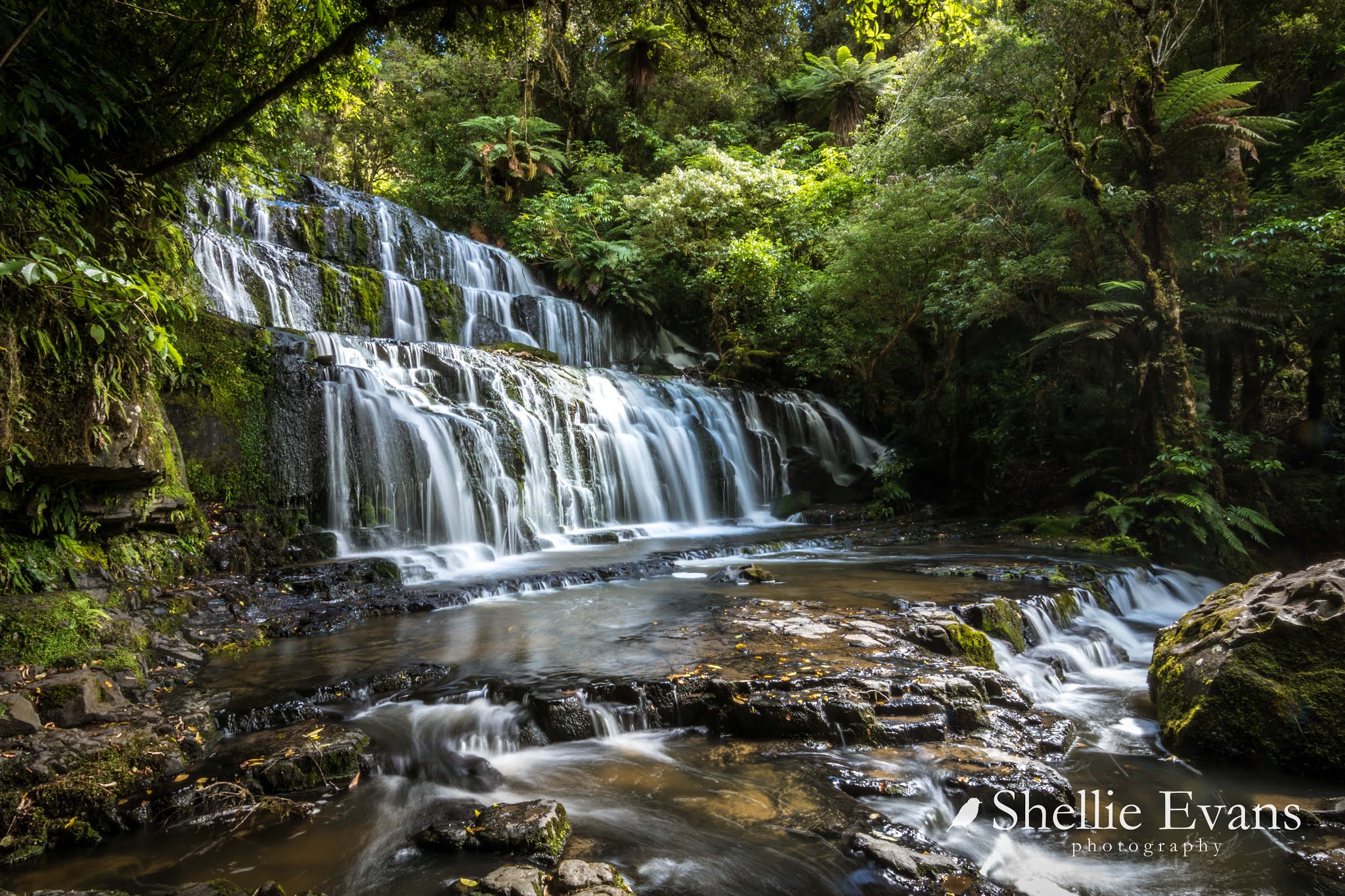

On this day there was a mediocre flow but with a slow shutter speed & my tripod (which I don't usually cart with me on walks, preferring to shoot on the run) I managed some half decent shots. And a bonus was that there were very few tourists crowding out the platform jostling for a clear spot & I didn't have to contend with people down on the rocks in front having in-depth discussions or their picnic lunch! One day I'll catch the falls in full flood. Now that would be a sight.


On the day of the squall we drove around to Jacks Bay to check for sealions. There hadn't been any haul ashore at Purakaunui while we'd been there, or none that I could see.

Jacks Bay cliffs are similar to Purakauni Bay

We'd seen a few at Jacks Bay before but not on this day, the beach was bare. So we took a right at the end of the road on the way out and headed to the outlet on the south side of the Catlins River Estuary. Again there was nothing about other than a couple of people gathering shellfish.

We turned around and headed for home looking for a lunch spot along the estuary & out of the wind. We pulled into a small clearing & when I scanned the sand dunes with the binoculars I saw what I thought was a sealion. I rugged up- it had turned cold- and trudged through the dunes in the gale force wind with stinging sand whipping my bare legs. 

As I got close this big old fella with his rheumy eyes & gummy mouth lifted his head to look at me.


I'm sure he was thinking "Where the heck did you come from?" as he looked from side to side & rose up onto his hind flippers. He did a couple of shuffles and then thought better of it and collapsed back into a heap on the sand & closed his eyes. I headed off back to the ute, now fighting the wind and sand head on while trying to keep my camera out of harms way, tucked into my jacket. You can see the sand flying past the front of the sealion in the photos. 


Back at the camp there was excitement down on the beach. Not only had two sealions hauled out onto the beach while we were out but one of them, a large male had chased a couple & their two children across the beach at a very fast pace and they had been quite terrified by the encounter. Those are his 'running' track marks below. In the background is another camper being very careful how close she got to him- the dark patch at the end of the tracks- to take photos.


He obviously wasn't too worried, he was soon fast asleep oblivious to the terror he'd inflicted, that's him bottom right.  I walked to the far end of the beach to check out the other large male dozing in a lump of seaweed (below left & top right).


And then in the rocks at the top of the bay where I located a female sealion, she's barely visible & hiding as best she can from marauding males. Males are relentless in their pursuit at this time of the year, they chase females trying to round them up into harems. Except on the mainland there aren't that many females so they can be the target of many males. 

Females are a third of the size of a fully grown male, they are also a creamy beige or grey colour whereas males are brown and have rough hair manes (hence the sealion name). Can you see her? Click the photo to enlarge. 


Perhaps this was why the first male wasn't happy to share his beach with humans, he was hunting for his female. I quietly backed off and left her to her hiding spot. 


Tuesday, January 24

'Monsters' From the Sea- Catlins; Part 2

Catch-up, I was thinking to myself - 'is this a catch-up post or a real time post?'  Because I am usually behind with the posts anyway so how far behind, is behind? So I made an executive decision and 'catch-up' is anything over two weeks old. And then I looked at the photos for this blog and they miss real-time by one day! You can't win.

As I mentioned in the previous post, David, and Peter, one of the other RVers staying at the Hinahina Reserve, were trying their luck fishing from the rock pile when they got the fright of their life when this little rat-bag came racing out of the depths of the channel at them.


And then wouldn't let them get anywhere near the water again as she skillfully ducked and dived along the edge of the murky water, popping up to surprise them as they moved along the rocks...


...growling and mock charging them everytime she emerged from the water.  


You'll remember me telling you about an aggressive leopard seal in the Pounawea Fishing blog. Well, I'm 99% sure this little girl is the aggressive seal the guys saw further down the estuary. 


I had contact with DOC at Owaka and was able to supply them with her tag number and it turns out that she is this female's last year's pup. This sealion is the one I wrote about which was resting on the bush track at Pounawea. She is indeed (as I thought) waiting to give birth and has weaned her last year's pup (our little monster) and set her loose all by herself.


Poor wee thing, no wonder she's mad with the world. She decided she not only owned the rock pile but the boat ramp too. 


It was great to hear from DOC that there were 4 pups born in the Catlins last year and they were all females. Which means they'll all be coming back to the mainland to breed. Great news for the endangered sealion, not so good for holidaymakers at Pounawea. Apparently the female due to pup had already been shooed away from under someone's deck where she'd settled in to give birth.

How cute is that look? 


As cute as she was, she was a feisty little madam; 


I couldn't work out whether she was being aggressive or just wanting some company, especially when she flopped down on the concrete and went to sleep. We all retired to our vans to give her some space and after a time she headed back down the ramp and off down the estuary.


I wanted to re-visit nearby Jacks Bay (after visiting there 3 years ago) to walk to the blowhole again and check for sealions on the beach. We couldn't wait any longer for the weather to fine up so headed there once the rain stopped.


There are expansive and impressive views out over the bay on the walk to the blowhole...


 ...including a view down into a secluded and rugged little cove where we saw Yellow-eyed penguins resting on a rocky ledge the last time we were here. We scanned and checked with our binos but saw none this time.


There were a steady stream of people walking to the blowhole...


...but unfortunately the sea (for once in a blue moon) was calm and the blowhole wasn't playing! We should have come when it was wild just a couple of days before. Can't win.


It's still impressive watching the swell rise and fall as the water's pushed 200 metres inland.


Jack's Bay is a well known place to visit if you're wanting to view sealions, especially if you're on a tight time-frame and only have a day or two to check out the Catlins.


What never fails to amaze me in places like Jacks Bay, is how many visitors, both domestic and foreign tourists, pull up in the carpark, go for a walk, maybe to the blowhole, scan the sign above, look up and down the beach, perhaps walk to the water's edge or a few meters along the sand hoping to see a sealion and then climb back in their vehicles and drive off. Can you see any sealions here?


No, and nor could I but I know they're mostly likely there and a quick scan with my camera on full zoom (my pseudo binos) and I spot a suspicious looking lump of driftwood about a third of the way along and up near the dunes. And way down the end of the beach a further two possible 'logs'. We drive back down the road and stop at the next track, near the first sighting; I can smell sealion before I see it and it looks like he has done the same (although I suspect the smell is coming from the resting areas other sealions have made in the flattened grasses above the beach). 


After taking a few photos I carry on to the end of the bay and sure enough there are more sealions; not two as I saw but 3, all fast asleep in the warm sand. Such cute faces, don't you think?


This is what you miss if you don't know what to look for or don't look hard enough.


After Jack's Bay we drove around to the entrance of the huge Catlins River Estuary, to the Owaka Heads part of what we could see across the water from the Pounawea Holiday Park.


It was very windy and there were dozens of waders sitting out the weather, roosting above the high tide line on the point; Bar-tailed Godwits, South Island Oystercatchers, Royal Spoonbills (bad-hair day), a few noisy Spur-winged Plovers and running around in amongst them all, dozens of tiny Banded Dotterels(no photos they move too fast).


And we spot another two 'monsters from the sea', a very big maned male who didn't look too friendly. He could smell another male but couldn't see him and sure enough as we scanned around the dunes we saw the second one resting further inland. It's quite scary walking through the dunes (as I was doing sneaking up on the birds), they're quite undulating and the grasses are very tall. You don't want to stumble on a sleeping sealion that's for sure. Luckily the 'nest' in the 3rd photo was empty.


The icing on the cake for our awesome nature experiences, and at the top of the 'monster from the sea' candidates, was this huge elephant seal. 


I received a 'hot tip' from the DOC office that an elephant seal had swum into the estuary the night before and hauled itself out of the tide beside the Newhaven boat ramp. We were due to leave Hinahina that morning but not before we raced around to the other side of the estuary to check out the sighting and hope that the seal was still there.


It was still there alright and if you didn't know about it beforehand, you certainly did when you stepped out of the car. Seals and sealions have nothing on the smell that was emanating from this big boy with the kind eyes.


One great big lump of lard with a number of battle scars and a little on the skinny side (according to DOC, he is probably quite old), you have to wonder who designed these guys and what's their purpose, they certainly can't move very well on land. Adult male elephant seals can measure 4-5 metres and weight 3600kg, females weigh a third of this and are 2-3 metres in length.

Here he's stretching out, or maybe relieving pressure?


The Southern Elephant Seal is a rare visitor to mainland New Zealand, their usual range is in the Southern Ocean around the Antarctic and sub-Antrarctic islands.

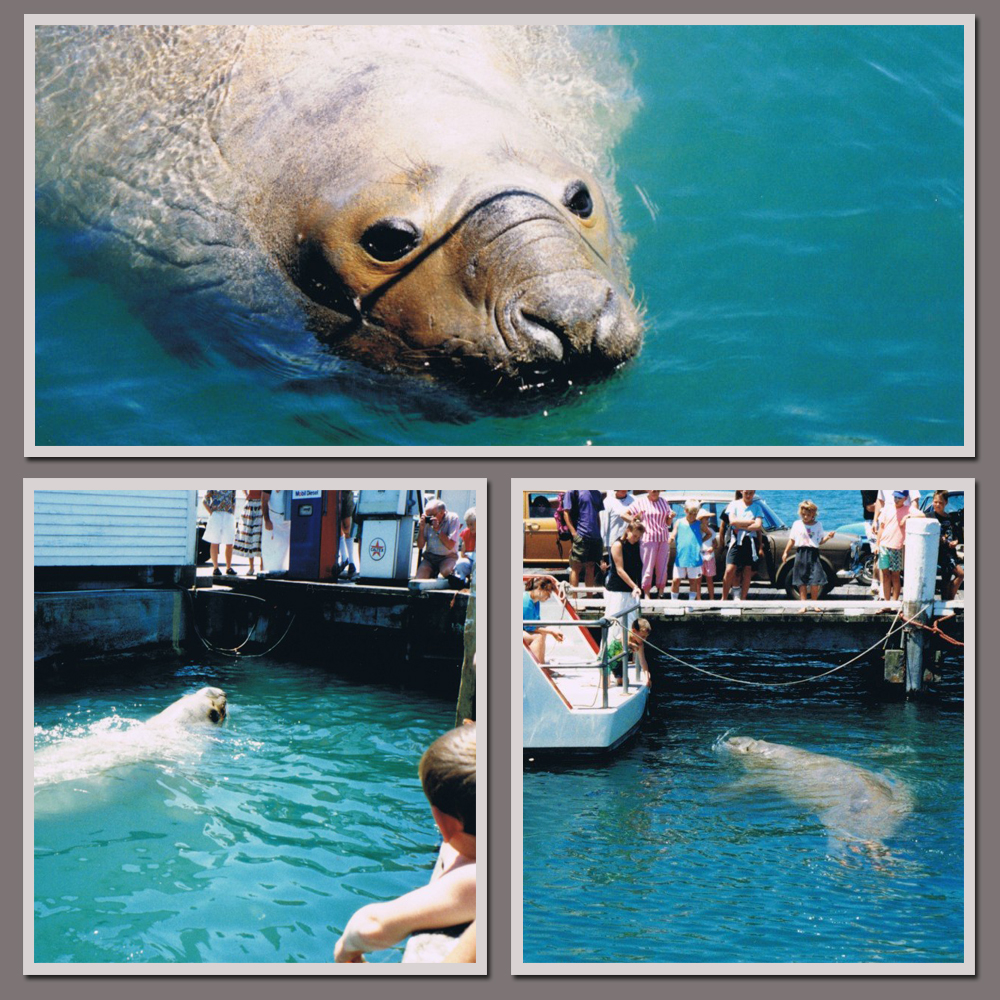
This is the second elephant seal I've been lucky enough to see; the first one was in Tauranga, 27 years ago, when Humphrey a young male came on a visit and decided to stay for a few months when he fell in love and tried to set home with a herd of dairy cows in Katikati, and where a sculpture of Humphrey now sits beside the stream he used as his private waterway from the ocean to his harem.


Humphrey also spent a few weeks (Christmas shopping?) lolling about at the The Strand carpark and wharf area in downtown Tauranga. My photography has come a wee way since these photos were taken.


Of course the most outstanding feature of the Elephant Seal is the inflatable proboscis, and inflate it certainly does. It's thought to increase the effectiveness of the bull's roar. I don't know about the roar but it certainly increased the snoring. I took a video of him, click to listen! That very loud bird you can hear is a Bellbird/Korimako. If it hadn't of been for the seal I'd have been hunting down the bird to photograph. And I'll not make a videographer anytime soon, excuse the clumsy filming.


Sweet dreams...is that a smile on his face?