Showing posts with label post office. Show all posts

Tuesday, September 17

But Wait There's More- St Bathans

Catch-up

While at St Bathans I was determined to catch a sunrise over the lake. It was the middle of winter so I didn't have to get up too early; about 6:30am to be up at the lake just after seven. But while the late start was a bonus the bitterly cold temperatures outside weren't.  

Spot the Paradise Ducks floating near the edge
Several times through the night I'd open the door to check on the weather and each time a blast of freezing cold air would hit me. Nearly always the sky was crystal clear and inky black with a mass of twinkling stars reaching from one side of the horizon to the other. Perfect weather for a heavy frost each morning but not great for a sunrise; I needed a few clouds for the colour to bounce off. Each morning we woke to an icy frost and outside temperatures of -2c to -6c. Brrrrr.....

On the first morning when it looked like I might get a decent sunrise; by the time I reached the lake, heavy grey cloud had swallowed up what remained of the blue sky and blotted out any hope of colour.

I was waiting for something to poke it's head out of that hole, hopefully not a rat!
The cloud was quickly followed by thick fog and the temperature dropped sharply, if it could drop anymore, it was already about -2c. There was nothing for it but to head home to the warmth of the van.


A couple of days later I tried again, the conditions still weren't ideal but at least there was a little bit of wispy cloud streaking across the sky. 


The colour wasn't as brilliant as I'd hoped for, I think much of the initial intense colour was lost as the sun rose behind the Hawkdun Range before it popped over the top and filled our little corner of the valley.


On this morning I waited patiently as the sun inched its way down St Bathans Range, knowing that if the breeze stayed away there'd be some lovely reflections on the lake once it was light enough. I walked to the clay cliffs that overlook the lake and track down to the lake's edge. Once you could camp down at the lake edge but that's not allowed any more. 


A pair of Paradise Ducks (the same ones that were swimming on the lake earlier- see the 1st photo) were being chased by other ducks and landed on a pile of clay nearby. And then they spent the whole time honking and squawking at me. There'd be no chance of sneaking around the lake with a dozen or so Paradise ducks in residence, they make as much noise as though pesky Spurwing Plovers.


Afterwards I drove down to the lake and walked carefully around the edge of the lake clambering over gravel slides and more sticky clay until I could go no further.


The sun hadn't quite reached the lake but the reflections were amazing.


I've usually taken reflection photos from the tops of these cliffs on the other side of the lake so it was great to see them from a different angle.


I clicked away until my Paradise Duck pair returned to the lake and in the process disturbed the water. Soon afterwards there was a minor skirmish as three or four other ducks flew in to claim their territory.


I walked back to the carpark taking a few more photos of the cliffs below the village. You can certainly see why mining was stopped when the 'Glory Hole' got so close to the town.


Those ducks are following me around but at least they're not fighting this time!


The next day I headed back up to the lake for the golden hour; that hour of light before the sun sets,  when the light is soft and the shadows long. Though I left my run a little late, not allowing for the fact that the sun was going to disappear ahead of time behind St Bathans Range.

I quickly made my way along the cliffs, catching more beautiful reflections... 


...and making sure I captured the Post Office again in this brighter light (than the previous one I shot)


The light was perfect, the dark Blue Lake certainly living up to its name in this light.


You would think after so many visits to St Bathans, I would have realised what those black 'sticks' were on the cliffs opposite by now. I've always thought they were logs and wondered how they ended up there - ruining my perfect photos! I thought perhaps they were wildling pines that had been felled on the cliffs above and the trunks had then rolled (or were pushed) over the edge. 


Duh! After getting up close to them this time I now realise that they are rusted metal pipes, left over from the gold mining era.


Here are a couple more reflection photos...


This cream rock formation always reminds me of a resting dog or cat. 
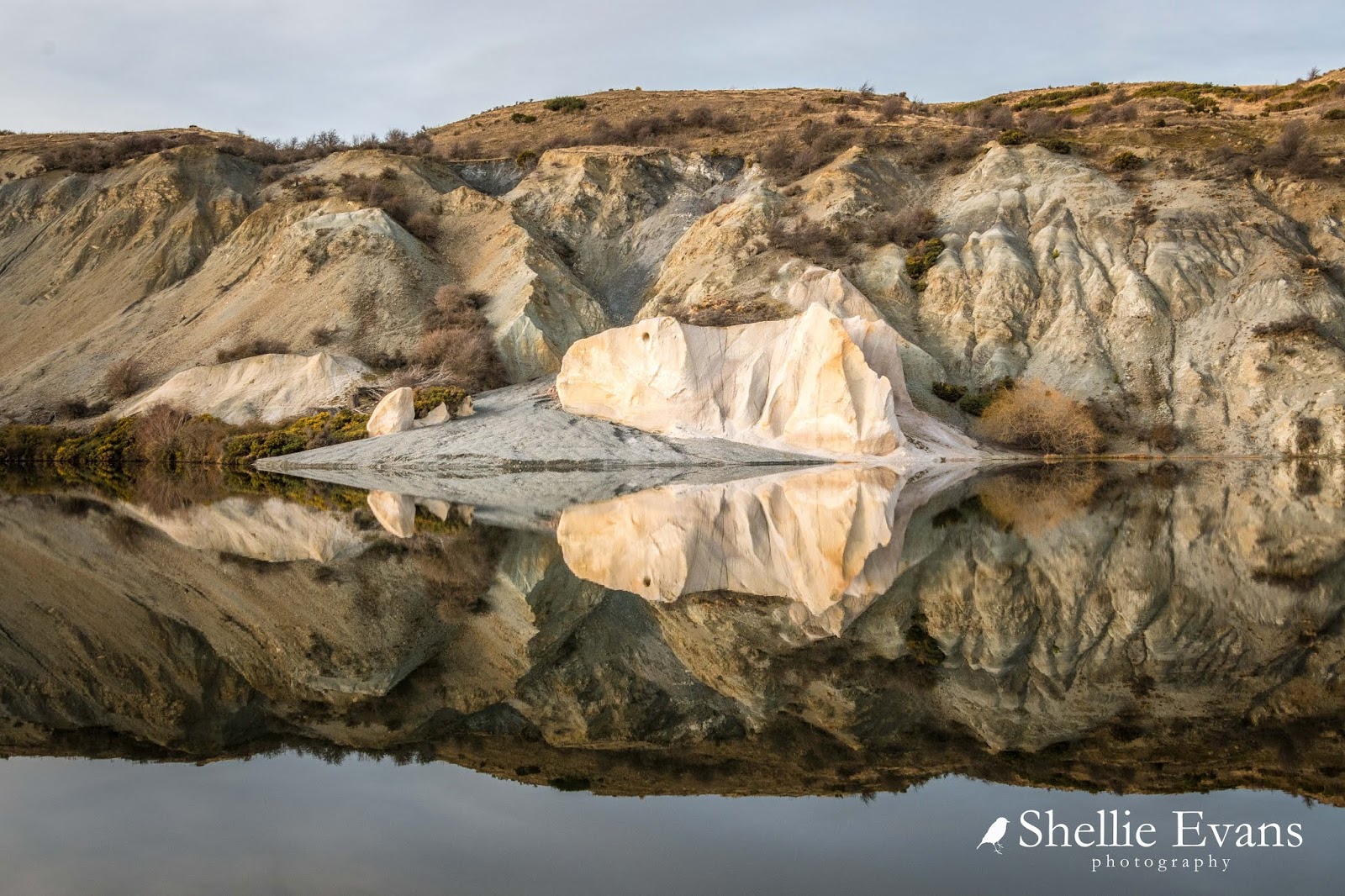

And to give you some perspective, that is a full size willow tree to the right of it (this photo was taken on my walk back after the sun had dropped)


I got about halfway down the lake before the sun finally disappeared behind the hills and it was time to turn around and head back to the ute.


But not before catching the last of the golden light at the top end of the lake.


And here's one last photo to make you smile. This is what happens when you set your self-timer too long.

'Are you going to click or what?'


Thursday, September 12

Blue Lake- St Bathans

Catch-up

The next few blogs are going to be a bit of a photofest (so don't forget to click on the photos to enlarge them) due to the fact that we spent seven days at one of my favourite Central Otago locations...

Blue Lake, St Bathans, Central Otago
... the tiny man-made Blue Lake at St Bathans. We set up in the nearby DOC Camp...


...once we managed to squeeze through the gate.


This is out third visit to the DOC Camp and once again we have it to ourselves. The Blue Lake and St Bathans village are just a short walk away (on the left up behind the ute). 

We woke to fog on a couple of mornings but we mostly had beautiful sunny blue sky days with several heavy frosts. We still had to wrap up warm when venturing outside as the temperatures hovered around 4-5c for most of the day before dropping back into the negatives again once the sun set. Our diesel heaters certainly earnt their keep, keeping us toasty warm during the day. 


A St Bathans' rugby scrum- 


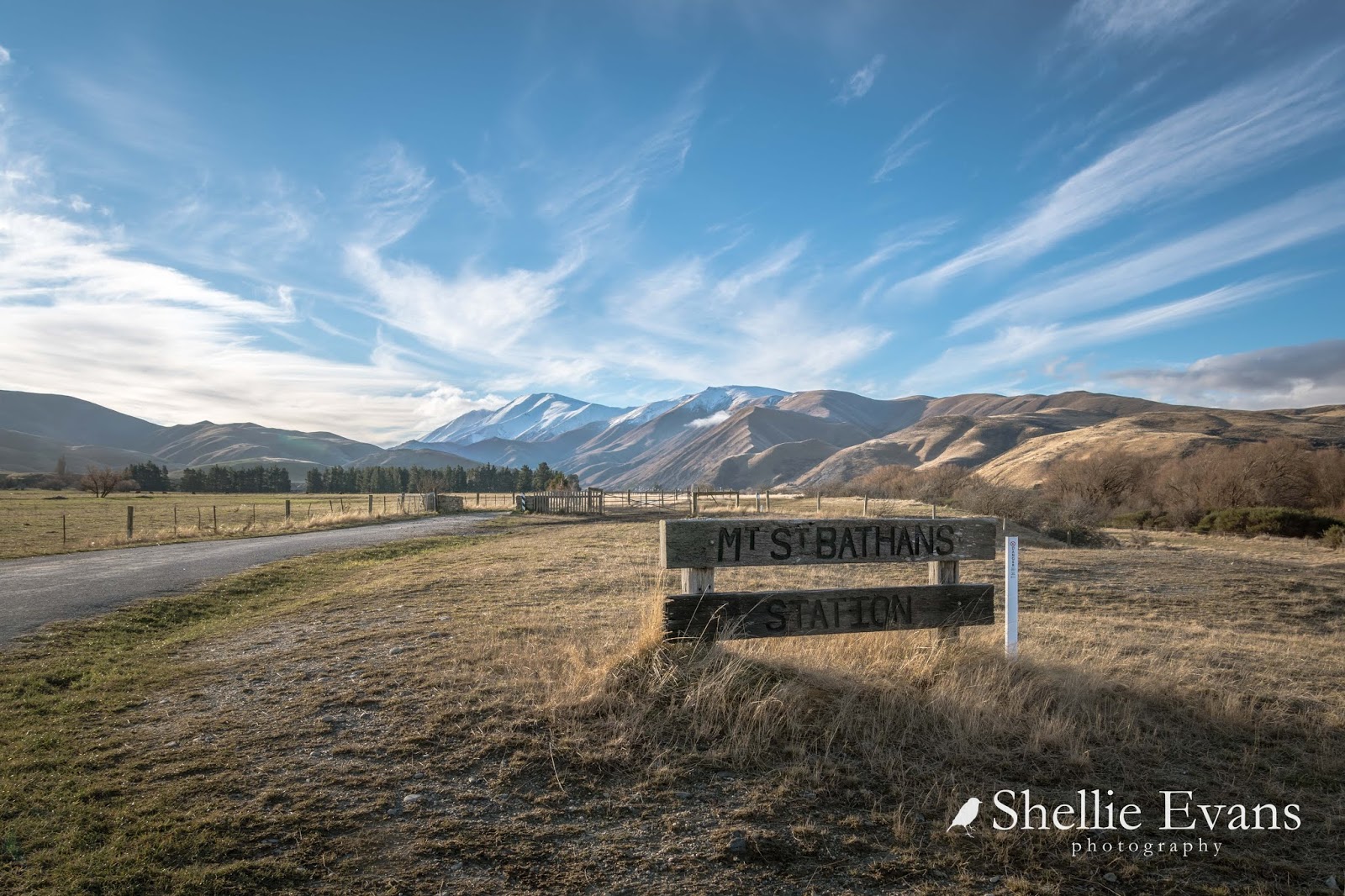
The DOC Camp is beside the St Bathans Domain where the rugby goalposts (from a bygone era) are still standing. A mob of sheep were being held in the paddock for a few days before being shifted to the St Bathans Station woolshed to be shorn. A large tractor & silage trailer did the rounds every morning dropping silage for these sheep and another lot across the road.


The snow dusted Mt St Bathans is a prominent feature in this quiet back corner of 
Manuherikia Valley.


Further down the road another mob of sheep that belong to a different station are being wintered over in a strip feed paddock. These are hardy merinos and in this light (late afternoon) they certainly blend into their surroundings.


And on another day they still blend in, this time with the soil. The snow covered Hawkdun Range forms a backdrop to the valley.


Present day St Bathans, now part of the Otago Goldfields Park administered by DOC, is a remnant of an old gold mining town originally named Dunstan Creek. The historic Vulcan Hotel is at the centre of the village; it's also for sale if anyone fancies themselves as a publican.

The shamrock on the front facade is a relic from the times of rivalry between the mainly Irish settlers from St Bathans and the Welsh settlers from Cambrian just down the road. The rivalry was known locally as “The War of the Roses” and at one time the acrimony between the villages was quite bitter. In the 1990s the hotel was put into a trust with shares owned by locals who lease out the hotel. There is also purported to be a friendly ghost in Room 1 of the hotel.


Gold was discovered here in 1863 and over 2834 kilos of gold was extracted from the three largest mining operations. By 1864 1000 people lived in Dunstan Creek with a further 1000 in surrounding area including around 50 Chinese miners who lived in caves excavated in the local cliffs.


Dunstan Creek was changed to St Bathans in 1866 after miners requested the original name, given by the first surveyor of the district, be re-instated. By the late 1860s St Bathans was well established with 15 hotels, a number of gambling and dance halls and many businesses. Nowadays the Vulcan Hotel is all that remains of the hotels.

This is one of the most unusual Post Office building I’ve seen in a small town, and rather an imposing one at that. This one opened in 1909 and replaced an earlier small ‘dog box’ that began business in 1864. The building is now owned by DOC.


St Alban of the Martyr Church sits up on a slope overlooking the 'Glory Hole'. The original church blew down in a severe gale in 1870 and it’s replacement met a similar fate in 1883 (the wind must really blow in these parts).


Frederick Dalgety, founder of the stock and station agency Dalgety & Co, and then owner of Hawkdun Station bought the quarter acre section on which the church stood. He then arranged for a new church to be shipped out in sections from Britain, one of the first prefabricated buildings in New Zealand. He imported every item for the church including altar cloths and kneelers. And yet looking at the church and it’s corrugated iron exterior you would swear it was totally kiwi.


It's amazing the things you find when you're walking the streets of a deserted village.


Of course the main subject of my visit was the Blue Lake. Before gold was discovered at St Bathans in 1863, the 120 metre high Kildare Hill stood where the Blue Lake is now located. 


The hill was named after their home country by the Irishmen who made the original find. Sluicing whittled the hill down to become first the Kildare Basin, and as it sunk further it became known as the Glory Hole, celebrating the riches it yielded.


The Kildare Hill Claim became the site of the deepest hydraulic elevating operation in the world, an operation that would eventually turn a 120 metre hill into a 68 metre hole over 800 metres long. 


The hydraulic elevator acted like a giant vacuum cleaner, sucking water and gravel out of the pit to where it could be worked for gold.


Mining was halted in 1934 because the sides of the pit were getting too close to the town and once abandoned, the Glory Hole filled with water that became a striking blue colour, due to the high mineral content of the surrounding tailings. Hence today’s Blue Lake. Although much of the colour has been lost now that the minerals aren't leeching quite so bad.


And when there's not a whisper of a breeze, the water's still and the right light catches the clay cliffs, the golden reeds and grasses and the bare trees, the lake provides perfect mirror reflections; one of my favourite photographic genres.


These photos were taken on the first evening when I thought I'd just drive up and reacquaint myself with the lake and just maybe the conditions might be right. And how right they turned out to be. On arrival there was a gentle breeze, if you look at the photo at the beginning of the blog you can see the slightly ruffled water.


I took a few shots from the top of the cliff near the carpark and then drove down to the lake edge and from there watched as the breeze departed and the lake became a millpond.


I quickly drove back up to the top and hurried along the path that winds it's way in and out of the tailings to the far end of the lake. And because I knew from previous visits where the best spots were to catch the reflections, I was able take a few short cuts right to the edge of the cliffs which involved in some cases, carefully climbing a slippery slope of wet tailings. Luckily I was wearing gumboots as anything off the gravel path was either a muddy bog or thick gluggy clay. 


I had to hurry from one spot to the next as the sun dropped behind the mountain range and the light began to fade.


Eventually I gave up on the chase and headed back to the carpark, stopping in the middle of the narrow stream that rushes down the edge of the reserve. No matter how hard I tried I could not budge the clay, in the end I had to rip some leaves off the Lamb's Ear and scrape the sticky stuff off, my hands immersed in the freezing water. 

As I headed back up the path I caught sight of one of the buildings in the village catching the last of the winter sunshine. What I love about this photo is the fact that this cute little cottage is in fact the side profile of the second storey of the post office!


Later on as the temperature took a tumble, the clouds  provided the perfect backdrop for a brilliant sunset.