Showing posts with label settlers. Show all posts

Sunday, February 10

History & Heritage, Bay of Island- Part 3

Catch-up

Continued on from Part 2

I had read about a camping site north of Kerikeri at Takou Bay, so we went for a drive to check it out.

Cavalli Islands on the horizon
Towards the end of the gravel road, a steep rough dirt track dropped down to the edge of the Takou River estuary with what looked like the camping area beside it but with not a camper in sight.


We drove a little further on and parked on the edge of a stunning beach. 


We had a wander along the beach...


...and explored the rocks and pools at the southern end of the beach.


Then made our way back to the ute parked on the dunes and started to head back up the track.


As we pulled away we saw another vehicle on the edge of the estuary; a man, his child and a pack of dogs going for a swim. He called out to us so we stopped.  And that's when we found out that this was private land and hadn't we seen the sign at the top of the track near the small settlement. Oops! David apologised profusely and we high-tailed it out of there.

Actually, David had seen a sign but he thought it was for a side road that passed through the settlement not the one we drove down on. And I totally missed it, looking through my camera at the beautiful coastline in front of us. It would seem that the road has been closed to the public for a number of years so perhaps they open the camping area to locals & regulars over the height of summer. But it definitely wasn't open when we were there.


We next drove to Lake Manuwai,  a manmade water reservoir which supplies Kerikeri's citrus & kiwifruit orchards and farmland with irrigation water. The lake is New Zealand's most northern lake holding trout and each year about 500 fingerlings are released by Fish & Game. Lake Manuwai is also used for whaka ama (outrigger canoe) training and racing.


And a Kerikeri public reserve wouldn't be complete without the obligatory colourful rooster strutting by with his girlfriend. 


From the lake we headed out towards the coast again, 20kms down a very long and mostly gravel road, out past the Kerikeri Inlet, skirting around the edge of the Te Puna Inlet, out to the far reaches of the north side of the Bay of Islands, out along the Purerua Peninsula.


Finally stopping just before the road ran out where we were greeted- after all the farmland we'd been passing through- by the slightly surreal sight of a huge bank of beautiful pink & white roses. 


The roses formed the carpark border for the Rangihoua Heritage Park and historic Marsden Cross Walkway, a kilometre long track that winds down the hill in front of us, passing a small wetland, then follows a short stream to Rangihoua Bay. Along the way there are numerous information panels which tell the life, times and loves of the local Maori and early settlers.


It was here on Christmas Day, just over 200 years ago, that Maori joined European missionary settlers including the Rev. Samuel Marsden, to celebrate the first Christian service in New Zealand. It was also here that the first European school was built and the first Pakeha child was born. Along with the information panels there are several metal map reliefs pointing out the historic sites.


This one has the names of all the visible islands in the Bay of Islands.


I was more interested in the beautiful park like grounds and private beach of this property along with their own tiny islands just off shore. The Landing has upmarket accommodation  available in several secluded villas ($5,500 - $15,500 per night!) including one on the beachfront tucked around the corner of the hill in front of us.


David sets off ahead of me while I take time to read the panels (ok, some of the panels)


This panel is interactive, there's a square cut in the panel and the view is of the Rangihoua Maori Pa on top of the hill across the valley.


Don't forget to click the photo to enlarge if you'd like to read the information (hopefully).


Towards the bottom of the walk many of the panels are about the people, both Pakeha & Maori who lived and worked at the Mission.


Once in the bay there are more panels showing the layout of the settlement and also a memorial to the settlers.


Just a couple of weeks ago, the bush on the small bluff in this photo was set on fire at night by some idiots, luckily a boat that was anchored in the bay, saw what was happening and was able to call for help.


The large Marsden Cross sits high on a terrace above the beach.


And a track through the bush beside the Cross leads to another memorial...


...erected by the descendants of Thomas Hansen, the first European non-missionary settler at Rangihoua.


We head back to the carpark after a very interesting and thought provoking visit to Rangihoua Bay.


Saturday, September 20

Time Standing Still- Rockville Museum

After stopping at Langfords Store we decided to make it an afternoon of nostalgia and call into the Rockville Machinery & Settlers Museum which we had passed earlier on, on our way up the Aorere Valley.

The museum is located in an old dairy factory and was pretty rustic to say the least. A country museum lacking in funds but trying hard to keep the local community’s history alive.


There were numerous brands of tractors lined up in the first section and this fibreglass horse all kitted out with suitable tack for the job of pulling farm machinery. The horse was located just around the corner in the entrance foyer. He gave me a bit of a fright as I pushed open the fly-screen tassels and he loomed out of the darkness. Later when I looked in the visitors book, he had given others a fright too!


I want to say “Lights, cameras, action!” when I look at this photo. There is no one attending the museum just a donation box and automatic lights that switch on as you move through the building.


The settlers part of the museum was behind a wire partition, I guess machinery is a lot harder to walk away with. A lot of this gear wouldn’t look out of place back at Langfords Store.


The Collingwood Hospital wire-wove bassinet grabbed my attention, I’m glad they were for new-borns. I could see a little hand or finger getting caught once they started moving about.


There was a good range of appliances on display including the first electric stove in Golden Bay (the one on the left) and the first electric washing machine (below right) What a beautiful piece of machinery that one was, two cylinders; the bigger one the washer and the smaller one the spin dryer, I bet the ladies of the house were over the moon when that arrived on their door step. The Hoovermatic twin-tub I had when newly married was nowhere near as stylie as that.


But I wouldn't mind this little number for the van; compact, easy to store and with a fold away ringer! Perfect for RV living. Not too sure about the Kermit green colour though….


The walls in this section of the dairy factory were covered in a mural made up of hundreds of drawings of different modes of transport.


These manual telephone exchange boards reminded me of my childhood. It always fascinated me that a party line could link dozens of people together. Out there somewhere there was a lady sitting ready to “join the dots” pull that lead out and plug it in there to connect people to talk to each other. I remember adults commenting on the fact that “Mrs Brown” at the exchange knew everybody’s business because she could, if she wanted to, over-hear their phone conversations. I also remember the distinctive “click” as someone on the party line lifted their receiver when you were talking on it.

Not much has changed, people can still spy on your conversations if they want.


Outside and around the building were numerous vehicles and machinery in various states of dilapidation. If we had a dollar for every abandoned vehicle, caravan, piece of machinery and house we've seen on our journey so far we’d be very wealthy people. I can’t imagine what will eventually happen to these but I guess they’ll slowly rot away, fall apart & disappear into the undergrowth that is rapidly overtaking most of them. In the meantime they are a terrible eyesore and a blot on our "clean-green" landscape.

A HQ Holden just a hold-en together?


And in a paddock behind the backyard was this bull and a couple of female friends. He looked rather skinny for his size and came running as soon as I approached. There was a trailer of loose hay in the museum yard so I grabbed a few handfuls and threw it over to him, his friends then came running over too. I wish I could have thrown the whole trailer load to them.


Sunday, June 15

A Drenching in Dunedin

We said our goodbyes  to the family & left Invercargill behind once again. Next stop, Dunedin, where we planned to catch up with my nephew Zak who is in his 2nd year at Otago University. Zak hails from Whangarei, which is right up the top of the North Island, so he is a long way from home. I haven’t seen Zak in a couple of years and I was looking forward to catching up with him and I’m sure he was keen to see some familiar family faces too. Being the good auntie that I am, I made him a couple of casseroles and took him two large bags of groceries which he was very appreciative of. I think his five flatmates may have been pleased too. After a brief tour of a typical student flat, we left to have dinner in town where we also managed to watch the first All Blacks test against England albeit without a commentary.

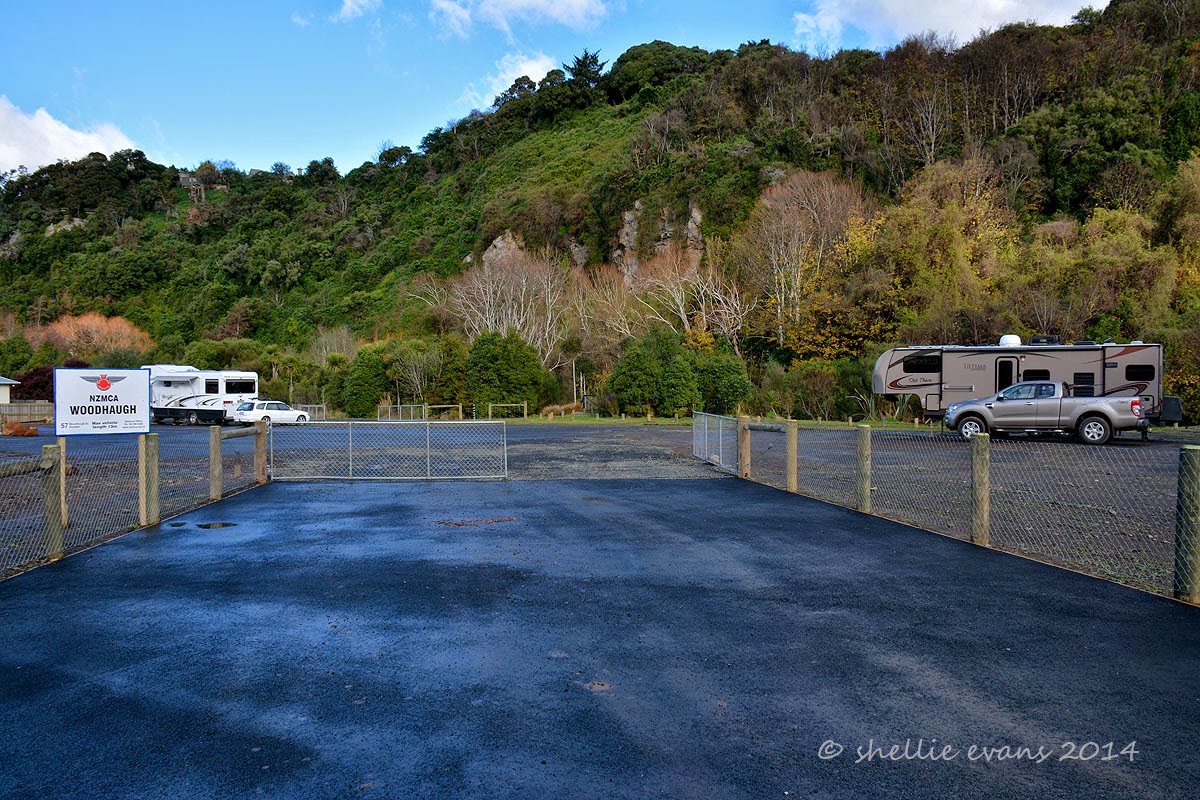
The NZMCA (Motorhome & Caravan Association) have a new Park in Dunedin, it opened just after Easter, we decided to park there for a couple of days while we caught up with Zak. At $3 per person per night it’s excellent value for NZMCA members. The Park is located in Woodhaugh and as it turned out is an ideal location. It’s just 4kms from the city centre & was only 1.8km from Zak’s flat near the university. The local NZMCA club members have a couple of working bees ahead of them to complete the site including some landscaping around the boundary and a concrete path to the water supply. The site is surrounded on three sides by houses but has a lovely stream and walkway on its rear boundary.


There were a couple of caravans parked up when we arrived but both left the next day and then for the next 5 days we had the site to ourselves. Yes that’s right. Five days. In fact we stayed the maximum 7 days allowed in the end because of the rain. We had rain & it was very cold for about 4 days solid but it was nowhere near as bad as the north of us was getting. We decided that there was no point in heading into the atrocious weather so we sat tight in Dunedin. A good decision as it turned out; Christchurch & Marlborough had severe flooding & gale force winds.
The rainy days proved ideal for us to catch up on computer work in the van during the morning and then in the afternoon we headed into the city to explore. We both thought the city centre and shops were great and enjoyed visiting some of the bigger arcades & department stores.

We spent one of the afternoons at Toitu Otago Settlers Museum. The museum recently reopened after major renovations that cost over $38 million dollars. This is the oldest and most extensive social history museum in New Zealand and what a fascinating place it was. You could quite easily get lost in nostalgia and spend many hours reminiscing about the good ol’ days here.

The Smith Portrait Gallery- Dunedin’s early settlers & pioneers


This beautiful gleaming black 1947 Buick 8 Roadmaster had a paper thin ply caravan on the back (designed & built by  Ralph Thompson in 1948) The height of sophistication in its day I would think.


I loved the way the cabinets were organised & backlit, displaying some great & unusual items from the past. You know you’re getting old when you recognise a lot of the exhibits, there were too many “blasts from the past” for my liking; a twin-tub washing machine just like the one I owned when I first went flatting, an aluminium frypan & Sunbeam cake mixer that were wedding presents.  And the black mobile phone; we had one at work & used to call it “the brick”.


There was even a cabinet with information on the long continuing debate between Australia & NZ about who invented the Pavlova, with the first recipe shown and when it was published (1929). The conclusion was that both countries named a meringue cake Pavlova in the same year, 1926 (the Russian ballerina Anna Pavlova was touring then) but NZ was the first to print the recipe with the name in 1929. Personally I think the squabble will continue, NZ definitely was the first!


I had to laugh when I saw the section on the introduction of microwave, there was my Alison Holst Microwave Cookbook! The very one I still use occasionally today, even if the silverfish have eaten a few pages! And the plastic muffin baking tray too, just like the one I had. Was it that long ago? It just seems like yesterday.


Typewriters, facsimiles, early computers & floppy disks!


And there was our first work computer, an IBM AT (Advanced Technology), the very first AT in Hawkes Bay that cost over $20,000 in the early ‘80s. And that did not include the screen which was an extra and then you only had a choice of green or amber writing. (Think what $20 grand could buy today). Oh and the storage capacity? It had an “impressive” 20mb. That’s right, 20 megabytes! To think that nowadays one of my photos alone is 24mb.


I’d highly recommend visiting the museum, but make sure you put aside a good few hours to explore, there’s much to see.

Beside the museum is the iconic and beautiful Dunedin Railway Station building. The sun was dropping (the one & only day it shone) but I managed to get a few shots just before the shadow moved onto the building.


As previously mentioned we also went to the Otago Museum (a natural history museum) to find Sultan & Sonia, the Lawrence Lions. They were up in the Animal Attic surrounded by hundreds of stuffed animals & birds from around the world. Something else in amongst the display had me carefully studying it, first in shock & disbelief and then a weird kind of fascination had me returning a couple of times to look at it further.

If you are a bit squeamish don’t read any further & definitely don’t look at the last photo………..

In a jar of formaldehyde was a Rat King. I wonder how many of you know what a Rat King is. They are actually not that common.

This from Wikipedia-

Rat kings are phenomena said to arise when a number of rats become intertwined at their tails, which become stuck together with blood, dirt, ice, faeces or simply knotted. The animals reputedly grow together while joined at the tails. The numbers of rats that are joined together can vary, but rat kings formed naturally from a large number of rats are rarer. The phenomenon is particularly associated with Germany, where the majority of instances have been reported.

Historically, there are various superstitions surrounding rat kings, and they were often seen as a bad omen, particularly associated with plagues.

Click on the photo to increase the size.
I think my fascination with the Rat King had a lot to do with a collection of similar subjects that Mum had when we were kids, not a Rat King but we did have single rats & mice along with pigs, calves, lambs, cats, dogs, possums and other mammals & even un-hatched birds. Unborn animals that were stored in jars of formaldehyde on a shelf in the kitchen cupboard.

That may seem a bit strange but it was the norm for us on a farm & there was a ready supply of subjects that came about by various means and from various people. I even remember taking the collection to school for a science project once, all the city kids totally intrigued and amazed at seeing unborn animals. I even think I won a prize. Anyway, if you’ve got this far then you’ll be ready to see Otago Museum’s Rat King.


All together now...... "EEUW!!"