Showing posts with label horses. Show all posts

June 06, 2019

Weather Woes for the Holidays- Far North

Catch-up

We packed up and left Houhora before the forecast heavy storm arrived. We'd decided it would be best to return to the NZMCA Park at Tokerau Beach, park up there and sit the wild weather out along with the Christmas/New Year busy holiday period. 

With the top half of the North Island on a wild weather alert we didn't expect too may campers to arrive at Tokerau over the next few days. And we were right, there was just one other caravan on site when we arrived two days before Christmas and a only a handful of others trickled in over the next few days. This time we parked in the top corner overlooking the horse paddock and with just a peep of the beach behind. Just as we finished setting up, big fat rain drops started to fall and rogue gusts of wind rocked the van. The rain became torrential and the wind more constant... 


...and that was how it was for the next two & half days, a solid wall of rain bucketing down on us from the heavens above. We watched as the creek filled the floodway up and quickly grew wider and wider as it flowed through the back of neighbouring sections and into the NZMCA Park drain. We saved a few trips to the local fire station to get fresh water by collecting bucket loads of it off the awning overflow. We'd only just empty one bucket and it'd be full again within seconds; in the end our water tank was overflowing and the ground around us started to flood too.

Christmas Day was wet although we did get to see a gap in the thick grey blanket of a sky late in the afternoon. And we actually had a lovely day even though we were by ourselves. Of course we missed the family scattered around the country & overseas but we enjoyed the relaxed pace of being forced to stay indoors and preparing and eating a smaller Christmas dinner than we'd normally have.
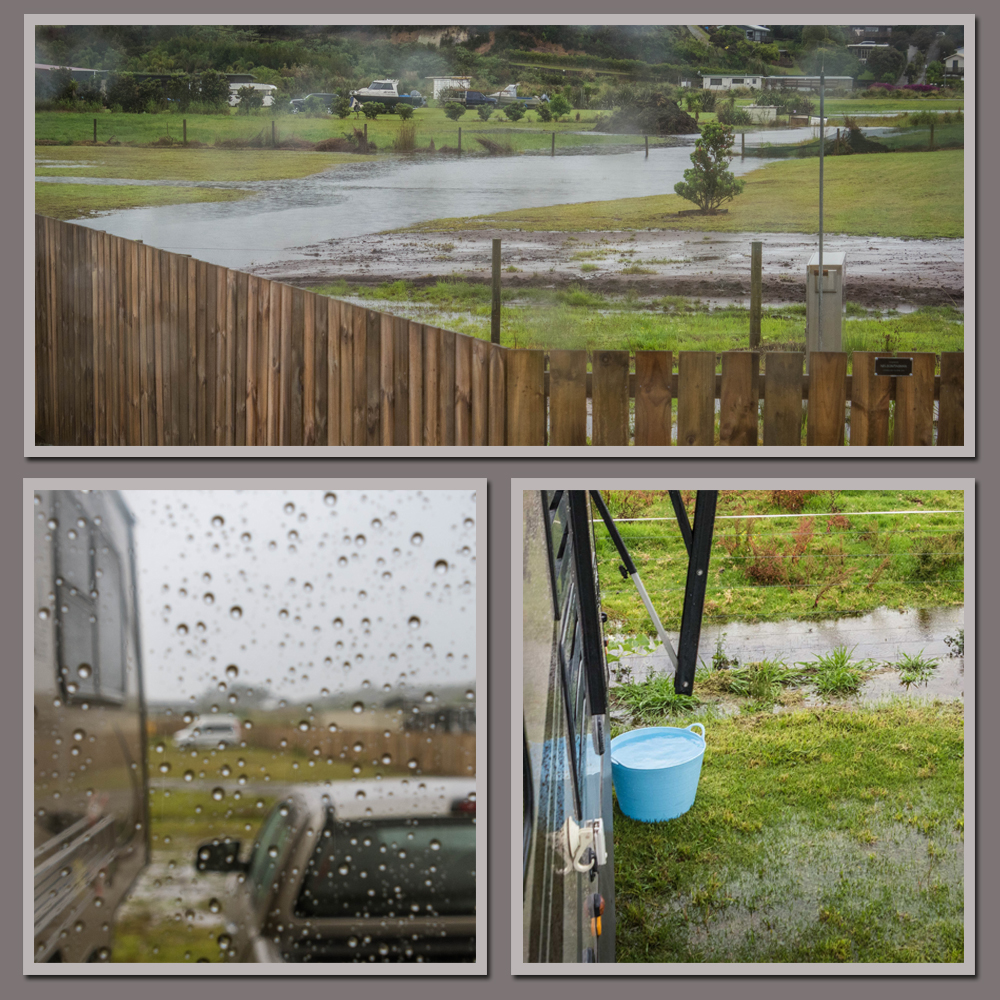

Before we knew it Boxing Day arrived, the rain moved on, summer resumed and a few more campers arrived. And in fact Christmas Day was the last day of any significant rain we had for nearly five months as we travelled around the Far North, Northland, the Coromandel, the Bay of Plenty and Hawkes Bay. 


Over the next few days an assortment of RVs arrived and, with plenty of space available on both sides of the drain, found themselves a spot in the sun.


Most were keen to check out Tokerau Beach as soon as they were set up and it didn't take them long to find the lovely wide grassed track that took them straight to the beach (a road separates the track entrance from the beach). The Park may not be quite beachfront but it's a pretty close second and I'd say it will quickly become one of many people's favourite parks. 


From the camp I managed to photograph a number of sunsets which were just as spectacular as the sunrises I captured from the beach on the last visit.


Released from our 'cabin fever' Christmas we decided to head into Mangonui and... 


... have another lovely fish 'n chip lunch at the 'famous in NZ' Mangonui Fish Shop again.

Lunch from our previous visit
Of course we didn't allow for a throng of holidaymakers who had the same idea! The queue came out the door and ran off down the footpath. 


We gave that idea away, purchased some of their delicious Raw Fish Salad for later and wandered back through the village, checking out the fishermen on the wharf and dodging people, dogs and vehicles along the narrow road through the village shops. All the cafes and the hotel were overflowing with people enjoying the holiday atmosphere. Before we left for home, I climbed the steep road and then several flights of steps up behind the village to photograph a church that had a fabulous view over the Mangonui Harbour. 


On the last day of 2018 we went on a tiki-tour around the Karikari Peninsula, calling in on some of the beaches we'd visited just a few weeks before. And what a transformation! The DOC camp at Maitai Bay had the full sign out although there were still a few spaces here and there. I guess some campers would have cancelled due to the weather and others were still to arrive after New Years Eve. 


The boat ramp and carparks were full and a small tent town had taken over all the camping bays at both the top & lower camps. When we stayed here at the beginning of the month there was just us and a couple of small tourist vans.


Waikato & Maitai Bays are side by side at the top of the Karikari Peninsula, both with beautiful golden sand crescent shaped beaches. There weren't too many people on the beach at Waikato Bay on this day but many more than the deserted beach we'd seen on our last visit.


And a sure sign that holiday makers & summer had arrived was the icecream van tucked up in the corner of the bay.


I did get the shock of my life when I climbed up to the top of the small ridge between the two bays...


...to see that Maitai Bay was full of people; swimming, sunbathing, picnicking and playing on the beach. 


A bit of a contrast to the last time I looked over the side. 


And even though the beach was busy (relatively so), there was still plenty of room at the north end of the bay.


We left Maitai to the masses and headed off back down the peninsula; I wanted to show David the stunning beach I had found when I went exploring during our last stay at Tokerau. This time we took a shortcut that I knew about but hadn't managed to drive last time because there was a large deep muddy bog blocking my way. I wasn't game enough to drive through it without David (to help get me out if I got stuck). 

You'll see it on the map below, Waimango Road is a public 'road' although there are a couple of unlocked gates to open & close. The surprise is at the end of the gravel straight where it has been left to the elements and farm vehicles.  From there on it's mostly a bumpy, dusty dirt track but a section of it skirts around the edge of a large swamp and that was where I'd come to a halt at the bog. This time the bog had mostly dried up (even with the recent rain) and I'm not so sure it was a 'shortcut' even though it  cut off about 10kms. It probably would have been quicker to take the longer route but hey, where's the fun in that?


The dirt track exited onto Puheke Road, the road that leads to one of my favourite beaches in the Far North. Last time I visited it there hadn't been a soul in sight; I had the whole beach to myself. Today I felt like, "Hey you guys get off my beach, you're spoiling the perfectness!"


In reality, there were just a few families enjoying a sunny day (and roughing up my perfectly smooth sand with their games). 


We drove up a gravel track to the top of the hill beside the beach (Mt Puheke- up here in the Far North where the sandy land is mostly flat, they call any sizeable hill a mountain). The carpark overlooked beautiful Puheke Beach in one direction...


...with a breath-taking view overlooking Karikari Moana (Bay) and the white sand and large dunes of Karikari Beach in the other. 


These are the large white sand dunes with the wetland and dune lake behind, that can be seen from the Maitai Bay road, and from the villas and hotel rooms of Carrington Estate (below).


We were amazed to see that a group of people had set up their tents (which looked to include the proverbial kitchen sink) on the slope below the carpark; a perfect spot overlooking the bay but I'm not so sure it would be comfortable sleeping on a slope. We were also surprised at how steep the track past the tents and down to the rocks below was, and then to see a ute and fishermen at the bottom. Hopefully they have good tyre grip to get back up the slope on the slippery grass.

And while I'm talking about being amazed, the next surreal sight was an ambulance arriving with it's lights flashing. What the heck? They were quick to ask if anyone had called 111, no one in the carpark had so they drove down to the tents, no one there had either. They'd come all the way from Mangonui, 40 minutes away and were just about to leave after checking back with base when over the rise from the direction of Karikari Beach came a young woman huffing and puffing.


The patient was stuck down in the rocks; he'd speared himself in the leg with his speargun while clambering over the rocks and he couldn't walk. The young woman found him and his mate on her way back up from the beach.

One of the ambulance officers set off down the track to find and attend to the guy while the other called back to base, a Mangonui firetruck would have to come out (another 40 minute trip), so the firefighters could stretcher the guy out. He'd be spending his New Years Eve in hospital, or at least in the out-patients no doubt.


And what were they looking at? (for those that follow my Facebook page), they were watching the paramedic heading off down the track.


On the way back down the road we stopped for one last photo overlooking Puheke Beach and then headed home (the long way round) for a quite New Years Eve.


On New Years Day  I was preparing dinner when I spotted out the back window, a tiny wisp of smoke on the otherside of Doubtless Bay around the Taipa area. It quickly grew and within a couple of hours smoke was billowing across the bay. I could see a couple of helicopters flying around and the orange glow of a large fire that had quickly spread through the tinder dry scrub. I later read that there were 5 fire trucks in attendance & 2 helicopters and it took over four hours to bring under control.


You may have noticed in the photos that between the NZMCA Park and the beach is a large horse paddock which held a dozen horses, most of them looked like retired race horses. Now, does this look the face of innocence? 


The horses provided quite a bit of entertainment each day as they made their way around the paddock grazing together, chasing each other, annoying each other, scratching each others back, checking any campers dogs out and generally being nosy.


So we couldn't stop laughing when we came home one day to see that one of the horses had ripped and chewed a great hole in the neighbours shirt which he'd hung on the fence. It does say in the shed not to hang washing on the fences (a standard rule in all NZMCA Parks), and it also said not to feed the horses! I chuckled even louder when the neighbour arrived later to see what had happened and commented that it was the only shirt he had with him! 

Wasn't me he said as he peered through the hole.


May 26, 2019

History at Houhora Heads

Catch-up

From the DOC Camp at Rarawa Beach we travelled 22kms south to our next stop at the Wagener Holiday Park at Houhora Heads.

Houhora Heads Sunset (looking east)
David was keen to go fishing, it had been a few weeks since he'd had the Takacat dinghy up, and as we had a week or so to fill in before Christmas, we decided to have a short break from exploring and make the most of the stunning weather. The boat ramp beside the camp allowed access to the beautiful Houhora Harbour with it's deep channels and shallow sand banks and further afield, out to the open ocean through the Heads.


The Wagener Holiday Park gave us a great deal for a week's stay, the park was virtually deserted although the managers & staff were in preparation mode getting the camp ready for the huge influx of holidaymakers due from December 24th onwards.  


The Park is a very popular and busy camping ground over the summer holiday period. We were hoping that we might have been able to take advantage of a late cancellation and be able to stay on longer but the best we could do was check-out on Boxing Day. This at least meant we wouldn't be moving on Christmas Day.

The Park is HUGE with several large open areas including one on the other side of the road where bigger rigs and campers with dogs are able to stay (middle right). The main camp itself has many areas for camping in amongst the dips and rises of the sandy ground along the edge of the harbour and overlooking a wide estuary that enters the harbour at the eastern end of the camp.

Dozens of  classic Kiwi baches and semi permanent caravans line up side by side under the huge pohutukawa trees or form a semi-circle around the main casual camping area and kitchen & ablution blocks. More baches line small alleyways behind the buildings and newer cabins have prime views looking down the harbour from the higher areas at the back of the camp...


...although there are still several prime sites available for those that prefer caravans & tents. This site would be my pick-of-the-bunch; a handkerchief sized platform right on the edge of a small cliff overlooking Mt Camel (which forms the northern side of the entrance to the harbour) and the estuary.


It's where I went to catch the sunrise one morning, it was quite dark as I waited and I could hear voices below me. I looked over the side to see a couple of small boats heading out fishing. Launching boats from the boat ramp and here, from below where this group were camping (tent city in the photo up above), was very tide dependent. A few minutes later and just as the sun was coming up I captured them returning; they must have forgotten something.


Huge gnarly old pohutukawa trees- many in flower and making a spectacular display- line the harbour's edge, their low limbs overhanging the mud flats and just skimming the salt water at high tide.


Commercial fishing boats regularly passed by as they headed out to their fishing grounds at sea or back to base further up the harbour at Pukenui (which most people refer to as Houhora). David also headed out to sea a few times but while it was calm and sheltered inside the harbour, an easterly wind whipped up a sizeable swell outside. So he spent much of his time fishing in the harbour where luckily, with a couple of tips from some obliging locals, he managed to catch a few fish.


The last time I visited Houhora Heads was on a family holiday when I was 12 years old (let's just say a very long time ago). The one abiding memory I have of the area was visiting the Wagener Museum. 

I recall that the museum was a rabbit warren with lots of rooms, narrow alleyways, nooks & crannies, pokie little corners, low ceilings, items hanging off the roof and out from the walls, display cases and loads of cabinets with drawer upon drawer of butterfly, shell and kauri gum collections. The museum seemed to hold an absolutely astonishing collection of 'stuff'. I remember being especially interested in the shell collection, easing each drawer out carefully to see what it held and being amazed at the variety of shells (we used to collect shells ourselves).  When I heard a few years ago that the museum was to shut and the collections sold and/or disposed of, I was a little sad that I'd not be able to visit again & refresh those memories. 

So it was with some dismay when I realised that this sad, sorry looking building sitting across the road from the camp and overlooking the harbour, was the same one that housed the museum. It definitely didn't ring any bells; I even asked around to double check and everyone I spoke to said yes, that was the museum building (although me being me, I'm still not convinced). I was very disappointed to have my childhood memories of the museum well and truly squashed (although I could possibly add it to my church collection, I'm sure it looks more like a church than a museum)


And the front view was just as unfamiliar although I suspect that this has been added on since my childhood visit. 


It's now a cafe that is open a few days a week and also hosts some of the Great Sights bus tours for lunch. It's certainly a spectacular setting for tourists especially on warm, sunny, blue sky days like this one.


And with the nearby pohutukawa in full bloom they made great photo subjects for the visitors.


At low tide I walked up the harbour a way and then made my way back along the top edge of the rocks and grassy bank behind the overhanging pohutukawa. Through a gap in the trees I spied this beautiful old homestead which I knew must be the historic Subrisky-Wagener Homestead.


I wasn't sure if it was private property or not but thought I'd get closer to see if there were any signs. I made my way around the outside edge past several old buildings...


...to the back of the homestead. Still no signs and no sign of anyone about either. I could see some of the campground and a few vehicles just through the trees and a vehicle track from the campground passed close by too. 


The house was obviously unoccupied, the gardens abandoned and there were several broken windows. I still felt a little apprehensive that I might be trespassing but justified my quick walk through with the fact that I was taking photos for the files of Heritage NZ. 


And that's when I saw the sign, at the entrance to the large open garden and grassed area that I'd just walked through from the other side. Phew, now I felt more comfortable and made my way to...


...the front gate of the homestead. The homestead was built in 1860 for the Subrisky family who were early settlers to the north. There are over 3500 descendants of Sophie Subrisky (who lived & died in the homestead), many of them notable New Zealanders. A list of them and the history of the homestead can be found in this link


It's such a shame but I have the feeling that without some serious repair work and ongoing maintenance this beautiful old & historic homestead will quickly deteriorate. I was pleased to have captured the homestead in it's still charming but slightly disheveled state. 


We did manage to do one spot of exploring while staying at Houhora Heads. I really wanted to drive a section of 90 Mile Beach and persuaded David (who is forever reluctant to drive on sand) that we could drive the 20km section from Hukatere to Waipapakauri Beach. What I forgot to tell him was that there was 10kms of gravel to drive before we reached Hukatere.


A 10km dusty, very corrugated gravel road through a large pine plantation interspersed regularly with great piles of horse dung. Ah-ha! I had found the famous wild horses of Aupouri Forest, or at least their calling cards. Now, not only were we playing pin-ball with the piles of horse poo but we had to slow as we neared each forestry side road so I could check to see if there were horses down them.


I was disappointed not to see any horses up the side roads but we did stop to have a look when we came across a roundabout! A very solid roundabout on a gravel road in the middle of a forest. Well, that's a first. But at least it had a sign pointing the way to 90 Mile Beach, we were beginning to wonder if we were on the right road.

And then when I looked up the side road I spotted them, hazy brown lumps on the side of the road. Grazing horses! (top right photo, zoomed in and cropped to within a inch of its life). They were too far up the road to creep up on them- they are wild and will take off when disturbed- so I made do with a distorted photo and we carried on to the end of the road. Which was just a short sandy section that disappeared onto the beach. Though there are two very rustic camping grounds in amongst the dunes, one on either side of the road. A wild and remote place to hang out and a place for Te Araroa walkers to stay overnight.


We drove out onto the beach (I'd already checked the tide times; it was not far from low tide), David wasn't too happy to see some heavy tyre marks disappearing off down the beach in the soft sand but I suggested we go lower down where it wasn't so soft...


...and we headed off, down a totally deserted beach for mile after mile until we spotted another vehicle approaching us out of the gloom. 


It really is a great way to travel; straight, smooth, scenic and with very little traffic. I can see why locals use the beach to get from A to B quickly, it would be a quick trip into town, either to Kaitaia or Ahipara to get groceries or visit friends.

Ninety Mile Beach is classified as an open road and as such the speed limit is 100kph although that is a bit ambiguous as there are signs saying 30kph at the entry points. This would make sense for a few hundred metres either side of the entries as there can be a few vehicles and people visiting the beach at these areas. But I can't see many vehicles sticking to 30kph on these deserted stretches, although 100kph seems way too fast as well. We stayed somewhere in the middle.


Half way along the beach we stopped for lunch, backing into the dunes and off the 'road'. Obviously someone came through when the tide was high as their tracks passed by at the foot of the dunes. While David finished his lunch I set about photographing my sparkly Christmas Tree for my Christmas Wishes blog post.


After lunch we headed off and once again the beach ahead was deserted (and the cloud cover dispersing)


But it wasn't long before we spotted several vehicles ahead moving in both directions and also people walking along the beach and in the sea. 


We thought we must be nearing one of the entry/exit ramps.


As we got closer to the activity this large truck came speeding past, obviously driven on the beach often going by the fat tyres it sported. And the people walking turned out to be TA Walkers laden down with their packs. They must have wondered at all the activity whizzing past them. 


And then there is was, the exit ramp to the Waipapakauri Beach settlement. We had to take a bit of fast run up at it as it turned out to be the only area with soft sand.


Once up and through the gap we stopped for the obligatory sign post photo and then it was back onto sealed roads and a 30km trip back to camp. Another great experience ticked off the list! 


As I mentioned earlier we were due to leave Houhora on Boxing Day but a major weather bomb was forecast to arrive on Christmas Day and we decided we'd rather not be packing up and leaving in the rain and possible flooding on Boxing Day, so we decided to bail early and get set up somewhere else before the rain set in. And for once, what a wise decision that turned out to be.

Sunset behind camp