Showing posts with label mavora. Show all posts

Friday, August 12

Takacat Inflatable Boat Review

Catch-up

Here's a first for my blog. Today I have a guest writer by the name of David Evans writing an article for me. David, as in husband, lover, best friend, chauffeur, photo model, dump station attendant and fisherman. Yes THAT David.

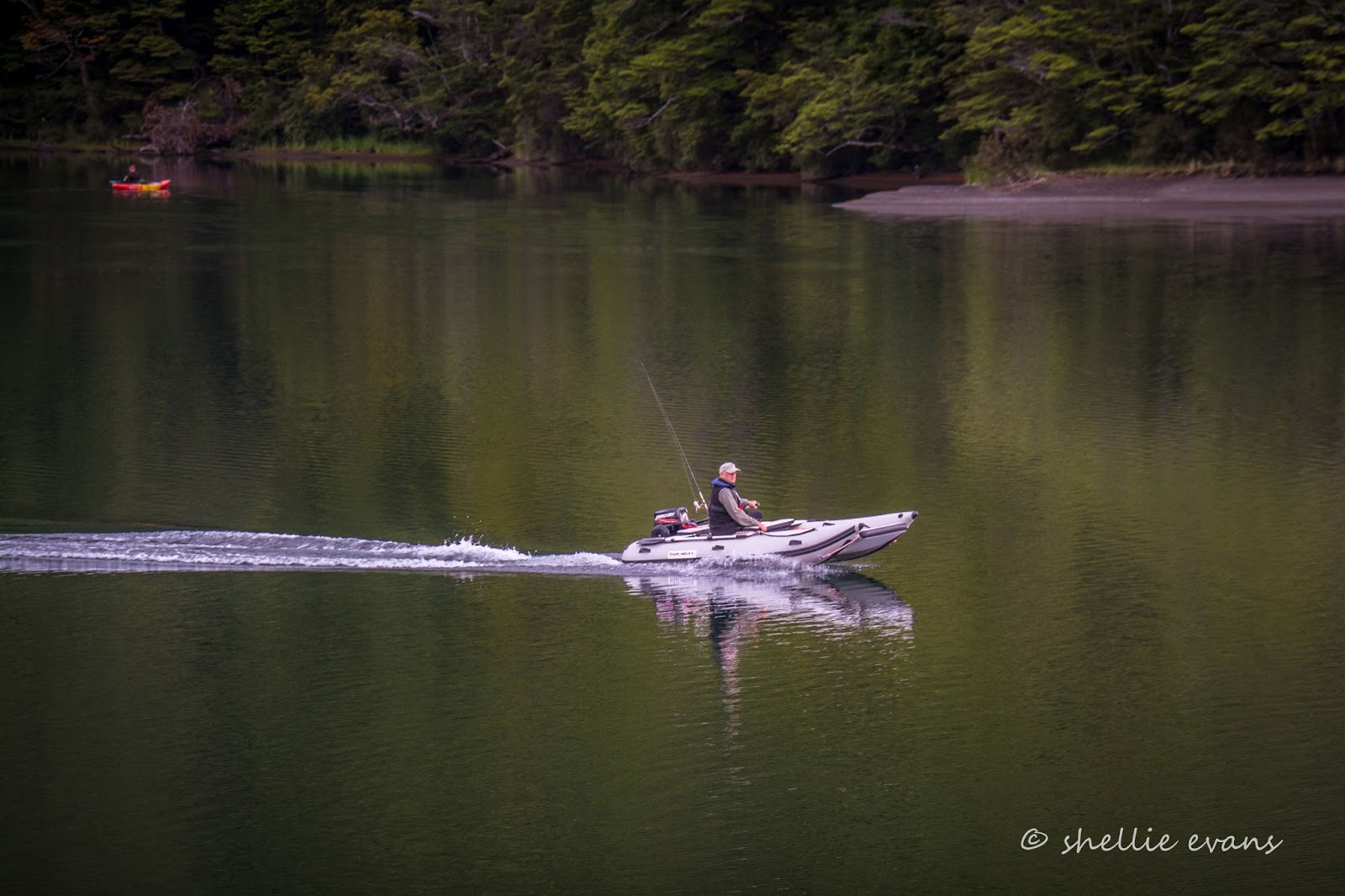
There have been many times over the last 3 years when we've been asked how we find our Takacat inflatable dinghy, so David decided to write a review of it for the blog. 

When we decided to follow our dreams of exploring New Zealand in our 5th Wheeler home, a boat of some kind was always going to be on my shopping list. Obviously it was going to have to fit the guidelines of minimum storage size and weight, easy assembly and practical transport for two people.


Iveagh Bay, Lake Brunner, West Coast
As a previous motor-launch owner I had experienced using an inflatable tender and was quite comfortable with the air boat concept so consequently, I spent a considerable time evaluating what was available and what would easily fit across the front of the wellside on our Ford Ranger utility.  


That's the boat; ahead of the gate separator. 
There are quite a few brands of inflatable on the market in the 3-4 metre range, most have blow up keels and mainly have, either partitioned marine ply or an aluminium floor. The Takacat inflatable, however, is different and comes with a very innovative separate air floor. This caught my attention and encouraged me to take a closer look.


It's also important to set your criteria as to what use you are going to require from your boat and in my case I wanted to be able to use it off the beach where practical and on the many lovely lakes that New Zealand is famous for. 


North Mavora Lake, Southland
Trout fishing was a top priority for me, as was exploring the lakes and also having a stable platform for Shellie's photography. 


Glendhu Bay, Lake Wanaka
Safety was also paramount as I am very often fishing in the boat on my own and usually a fair distance from home base. Performance at reasonable planing speeds was a must to cover ground quickly as conditions can often change very quickly, especially on the mountain lakes.


Taking all these things into account, the unique features of the Takacat Lite were starting to add up to being the ideal inflatable for our needs. Firstly, and most importantly, the ability to re-board by coming in over the front end (that actually comes down to meet you) after an accidental dip fully clothed or otherwise, had great appeal to me being an older boatie. 


Secondly the boat is very easily driven with its raised air floor and only the pontoons in the water which would also equate to less power and engine weight being required. It is exceptionally easy and pretty quick to inflate, or deflate for that matter, into a nice small manageable package. 


Finally, a big plus was the very helpful attitude extended by the owner of the company, Greg Sowden of Takacatto my many questions and queries. His genuine enthusiasm for his unique product was very infectious, well founded and easily absorbed into one's decision making. 

Consequently for me, little further thought was needed and a decision was made to purchase a Takacat Lite in the 3.4 metre configuration. My engine choice was a Mercury 8HP 2stroke which is light enough to manhandle on and off the boat and it also offered good all-round performance giving me a top speed of approximately 14 knots (25kms). 


With my first Takacat I also invested in a quality set of Beachmaster Dingy Wheels which transformed my life and made for simple launching and retrieving, even on very rocky beaches. Also for ease I purchased a 12volt electric pump to save my wife (haha) having to use the hand pump.


My time on the water in the Takacat to-date, whether in blustery or calm conditions, sea or lake, has been great and very pleasurable. I certainly have never been looking for more power although they are rated up to a higher 15hp. 


North Mavora Lake
I am often being asked whether water comes over the front and I can honestly say it never has in my case. However, I think I am a very prudent boatman and never push the boundaries. When planning in higher winds I always move my body weight into the centre of the boat using my tiller extension, even though in the worst conditions I have never felt it would flip backwards.


When Takacat inevitably introduced a newer model with optional beach wheels & built-in rod holders, I was very impressed with their decision to also run with an ‘open transom’ concept and a much modified, stiffer air floor. I have always been a great fan of open transoms since racing Sunburst sailing dinghies in my younger days. The open transom empties water very quickly after a capsize, through very large openings in the transom. Another excellent safety feature.


I loved the new features and it was an easy decision to upgrade. As already mentioned I have never taken any water into the boat but I feel even more relaxed now with the thought that I will never be required to hurriedly bail out in a worst case, rough water, scenario. The new floor has been manufactured in a much heavier material and also has a 3M reinforced surface bonded onto its top which resulted in much improved stiffness throughout the whole boat.


I cannot imagine how things might improve further and I continue to love every minute I spend in my boat, be it fishing or just cruising. I highly recommend the Takacat as very worthy of your consideration if you're thinking about purchasing an inflatable. 


Emerald Bluff, Lake Wanaka


Sunday, January 10

Back in the Land of the Living

We're back in the land of the living, we've returned to civilization and the cellphone. We're now parked up in Te Anau at the new NZMCA Park, after spending 25 glorious days off the grid and out of internet & cellphone range, camping at Mavora Lakes in Northern Southland, right on the edge of Fiordland National Park and at least 40km inland from Mossburn along a dry and dusty gravel road.


We had fantastic weather for most of our stay; one wild night of rain a couple of days after we arrived, a couple of overcast days during and three wind beaten days to finish with.  The remainder of the time was hot and sunny, we even had two heavy frosts. But it was very dry and dusty and every vehicle, bike and caravan arriving over the last 3 weeks has arrived caked in thick dust. Any movement through the camp created clouds of choking dust, luckily for us the lake breeze blew the dust away from our site. 


The surrounding bush is also very dry, with the beautiful emerald green mosses that carpet the forest floor dead and dying. Rain is definitely needed very soon. One benefit of the dry weather was that there were mostly no sandflies. We'd purchased a new insect proof sun shelter which worked well and provided relief when there were sandflies about. There's a funny story to tell you about the shelter but that'll have to wait until I get up to the Mavora blogs.


 The fishing was also great!


Hope everyone had a great Christmas and New Year, here's a photo of my matagouri Christmas tree which I decorated.  


I'm looking forward to posting the backlog of blog posts for you and hopefully catching up to date. Although there has been a couple of minor hitches there too (and they could have quite easily become major)- I thought I'd moved out of technology range while we were at the lakes but no it caught up with me there too. First my laptop charging cable died on me so I couldn't recharge my computer to process my photos or write the blogs. Luckily David's laptop cable was able to charge my computer but at a lower wattage so I had to turn the laptop off each time I ran out of battery and wait for it to charge. It takes an age to charge and doesn't last as long so I'm doing things in short bursts. Hopefully we'll get a new cable couriered down tomorrow.


The second thing was much more serious- this morning as I gathered the gear to put in the ute before we pulled away from the site, I realized my cell phone was missing. How could that be? There's no reception, I haven't been using it for anything other than mapping our walks and calling in birds with my bird song recordings. And it would have to be on the last bloody day. We turned the van upside down and I was convinced David had misplaced it (he's been checking a few apps on there lately in preparation for his new phone). I knew I had it yesterday afternoon when I went looking for birds over the swingbridge. 


Long story short (well short for me)- we couldn't find it so decided to hitch up and head off until we got back into phone reception so we could call my phone to see if it rang and I'd be able to locate it in the van (if it hadn't run out of juice). 20kms later we dial the phone and no it doesn't answer, so David unhitches and I leave him on the side of the road with the 5th-wheeler and drive all the way back to the lake to check out the track I walked yesterday. 


I ask a tenting family that are about to load their trailer and leave the area near the track entrance, if they've found a phone, no, they haven't but a guy on a mountainbike was looking for one too. I retrace my steps and find the half dozen logs I sat on or kicked apart for the robins- no phone and my memory tells me when I last knew it was in my pocket- just before I crossed the swingbridge. 


I cross back over and find another tenting family packing up. I ask them and they say 'yes'. They say what? YES, they've found a phone and it wasn't the guy on the mountainbikes' either. He'd already checked. I couldn't believe it when the woman reached into the car and brought out my phone! Her daughter had found it yesterday, out on the grass patch nearby. Right where I'd stopped to talk to fellow movanners after rescuing a plastic gold panning dish that had blown off down the road; it must have slipped out of my pocket as I bent over to pick the pan up. Twenty minutes later and they'd have disappeared down the road and back home to Invercargill with my phone. How's that for jammy luck! :)


So then it's back down the road to the van, hitch up again and wind our dusty way to Te Anau, arriving a couple hours later than anticipated.


And now my laptop is running low on battery and I want to post this tonight so I'm going to sign off before it shuts down, without doing a check over so excuse any mistakes. It'll take me a day of two to catch up on laundry and shopping and then I'll be back to posting blogs. Catch you then!


Wednesday, March 19

Goodbye Mavora

This will be my last post for a week or so, we're leaving for the Milford Road & Milford Sound tomorrow morning and we'll have no reception again. We've had a relatively quite time here in Manapouri catching up on various chores and computer work. But we did manage to walk part of the Kepler Track & visit Doubtful Sound & the Power Station, I'll post those blogs in due course. Catch you soon.....
 
I'll finish my Mavora Lakes blog posts with a pictorial of some of the wonderful scenery we were privileged to enjoy during our two week visit. We had a fantastic time and are looking forward to returning in the not to distant future.
 
Ka kite anō  Mavora


Monday, March 17

Kiwi Burn

A swingbridge, a waterfall or a hut at the end of, or somewhere in a walk, always attracts our attention when we're looking to do a tramp and if it's a loop it's even better. The Kiwi Burn Loop was three & half hours long & ticked three of the four boxes. We could have walked down the river from the South Mavora Lake but that would have added another 5 hours to the return trip so we drove the 6-7 kms down the road to the carpark beside the river.  We were rewarded with the swingbridge straight away, it's just beside the carpark and crosses Mararoa River into the Snowden Forest where it joins the track that comes from South Mavora Lake.
 
 
We could have also done the walk straight to the hut but as I've said, an out there and back track is not much fun after you've walked half of it and hey, it was only another 2 hours to do the loop. Yeah right. DOC suggested that you walk the track anti-clockwise & that it wasn't that well marked, but in fact the two bush sections, at the beginning and end, were very easy to follow. Crossing the clearings took a moment or two to locate the markers on the otherside but the burn itself was not well marked at all.
 
 
The first third of the track was a gentle climb through some of the most beautiful bush we've seen so far. Thick spongy emerald green moss covered the forest floor in all directions smothering everything in it's path. Large fallen tree trunks were great mounds of green. If you stood on or pushed a fallen log with your foot it fell apart without much pressure revealing a completely rotted centre with various fungi, mould & bugs exposed. The tiny soft foliage of the beech trees above filtered the dappled sun through to the forest floor. It looked like a fairy wonderland and we had the whole walk to ourselves.


Although I did wonder what was hiding inside the many deep dark holes that were under most of the tree trunks. I like to think it would be a kiwi asleep but I'm sure there would have been a few possums and some rats.

 
There was quite a bit of bird life although you had to pause awhile & listen for them (as you should do if you're bird watching) The amount of people we have come across on our walks who come crashing through the undergrowth or chatting ninety to the dozen and then complain that there are no birds in our bush!
 
I found some more rifleman-titipounamu-  but missed the focus again! I wanted to include these so you could see how she is digging away under the mosses, the bottom left one make me laugh, she has her eyes closed. One day I will get a good shot.
 

We passed through several small clearings on the way up to the top a ridge, some were quite boggy under foot but with carefully paced feet we managed to miss the deep muddy bits and come out at the other end with clean boots........famous last words!


Once at the top we crossed onto the far side of another larger clearing, crossing a couple of deeper streams before descending into the Kiwi Burn alongside the Whitestone River.  Great we thought, it's all down hill from here.

 
Below is Kiwi Burn, a burn is a Scottish word for a 'water course', the other smaller clearings we had passed through were actually smaller burns, hence the swampy ground underfoot. We didn't know that then, we thought it would just be a matter of making our way down the burn, maybe back into the bush for a bit, a few streams to cross and then we'd be at the hut. Wrong. A marked route led the way through the burn most of the way down to the Kiwi Burn Hut, although the posts were spaced well apart and in places hard to spot.
 
The burn was a good 2-3kms long and went on and on and on. That wasn't so bad. It was a hot and still day and the sun bet down on us. That also wasn't so bad. The marker posts were few & far between and there was no distinct track to follow. That wasn't so bad either, luckily a guy & his dog must have passed through ahead of us and flattened the grasses a bit; we saw their tracks in some mud.
 
The problem was the ground underfoot was so uneven with dead tussock mounds surrounded by deep & sometimes very wet trenches, with all the growth over the ground you could not see where to place your next step. The burn was one large thick boggy expanse with giant tussocks towering overhead & deep narrow water filled ditches criss-crossing the whole area, in between the ditches was thick soggy sphagnum moss.  


Occasionally we came up onto a shingle shelf beside the river where we took a breather before ploughing on hoping we'd spy the hut very soon. We spotted deer droppings on quite a few of these stony patches, they must rest on them too. On more than one occasion we had to backtrack a bit and try a different route. I couldn't get over the height of the tussock, it was in flower as well which didn't help as the long feathery spikes grew higher than usual.

 
At one stage we thought we'd come to the end of the burn, there was a narrow neck & a thin row of bush crossing from one side to the other but no out the other side the burn continued as far as we could see. Finally after what seemed an eternity we spied the hut way down the bottom of the burn, which in fact wasn't quite correct as the burn continued on for another 500 metres or so past the hut, we found that out when we continued on after a break. And while the hut doesn't look that far away here it took another 45 minutes or so to beat our way across the area between here & the hut.

 
Unfortunately either someone had removed the last marker posts or DOC thought we didn't need them because we could see the hut but it was extra difficult picking our way through the bog for the last couple hundred metres. We arrived at the hut worn out and covered in grass seeds & mud. With all the uneven ground my poor feet had taken a beating, I could hardly stand and I wondered how I was going to manage to walk the last hour & half back to the car. As it was the walk so far had taken an extra hour which meant that we were now running behind time by quite a bit.
 
Just as we unloaded our day packs another tramper arrived from the other direction. He told us he was walking the 3000km Te Araroa Trail and had just walked an hour up from the Makaroa River to stay overnight in the hut. He said he'd rather do that & have a soft bed than pitch his tent down near the track, it was just a short detour. That put us in our place!

Kiwi Burn Hut- looking more like a school room than a hut.
We sat inside and ate our lunch at the heavily engraved (graffiti-ed) wooden table while our fellow tramper told us about his travels. He had left Cape Reinga in the Far North back in November and had another 3 weeks before he finished the walk in Bluff. He would then fly home to Philadelphia  in time for his mother's birthday. He showed us some of the 147 specially printed maps that were needed to cover the track. Obviously he couldn't cart them all at once so he sent small amounts ahead of himself to collect at various points.
 
He had had an awesome time and had seen some of the most remote areas of New Zealand, he'd met some great people & plenty of others walking the trail from both directions. While we ate our lunch we also offered him some of our extras which he eagerly accepted; half an apple, some baking and cheese & crackers. I guess dried food would soon lose it's appeal after a few weeks, let alone a few months.
 
I would have liked to have rested longer but with a long walk still ahead of us we pulled our boots back on, threw the packs on our backs and headed out down the track again. About an hour later we came across the sign board for the Trail. Eleven & a half hours certainly put our walk into prospective.
.

We were now following the Makaroa River upsteam back to the carpark. Along the way I spied a female & male South Island Tomtit-Miromiro.  Like the South Island Robin, the SI Tomtit also have a yellow tinge to their breast feathers. The female looks rather strange standing so upright on the branch, she looks like she has feathery trousers on. And once again these are not the sharpest shots, I just have to get a handle on these small birds, dark bush shots, or I'll have to go back to shooting with the flash.

 
And finally after about 12kms & five long and weary hours we arrived back at the swingbridge. What a welcome sight!

 
Looking north towards Mavora.