From Tapotupotu Bay at the top of the North Island there's only one direction you can travel and that's south, back down Aupouri Peninsula towards Kaitaia, 110km away.
 |
| Ngataki Stream, Rarawa Beach DOC Camp |
When we headed up the peninsula we'd decided to travel to the top and then do any exploring on our way back down. Unfortunately (for me who likes to explore to the end of every road we come across) we decided not to check out the DOC Camp at Spirits Bay (16km of gravel) or the vast Parengarenga Harbour. David wasn't feeling the best (harbinger of things to come perhaps?) and it was hot & dusty everywhere we went. We'll just have to leave those places for another time.
 |
| Ngataki Stream |
We were also aware that we needed to be set up somewhere ready for the Christmas & New Year influx of holidaymakers (yes I know, Christmas, I'm that far behind!)
 |
| The New Zealand Christmas Tree- Pohutukawa flower |
Our next stop was 60km south, on the east side of the peninsula at the Rarawa Beach DOC camp. The camp is a large site tucked in behind the sand dunes. There are several areas sectioned off by large pohutukawa trees, pines and native plantings. Many of the pohutukawa trees were in full bloom which made for a spectacular display.

The languidly flowing Ngataki Stream forms the southern boundary of the camp as it wends its way in a big lazy curve around the outside edge of the camp. With only 2-3 campers, we had the pick of sites.

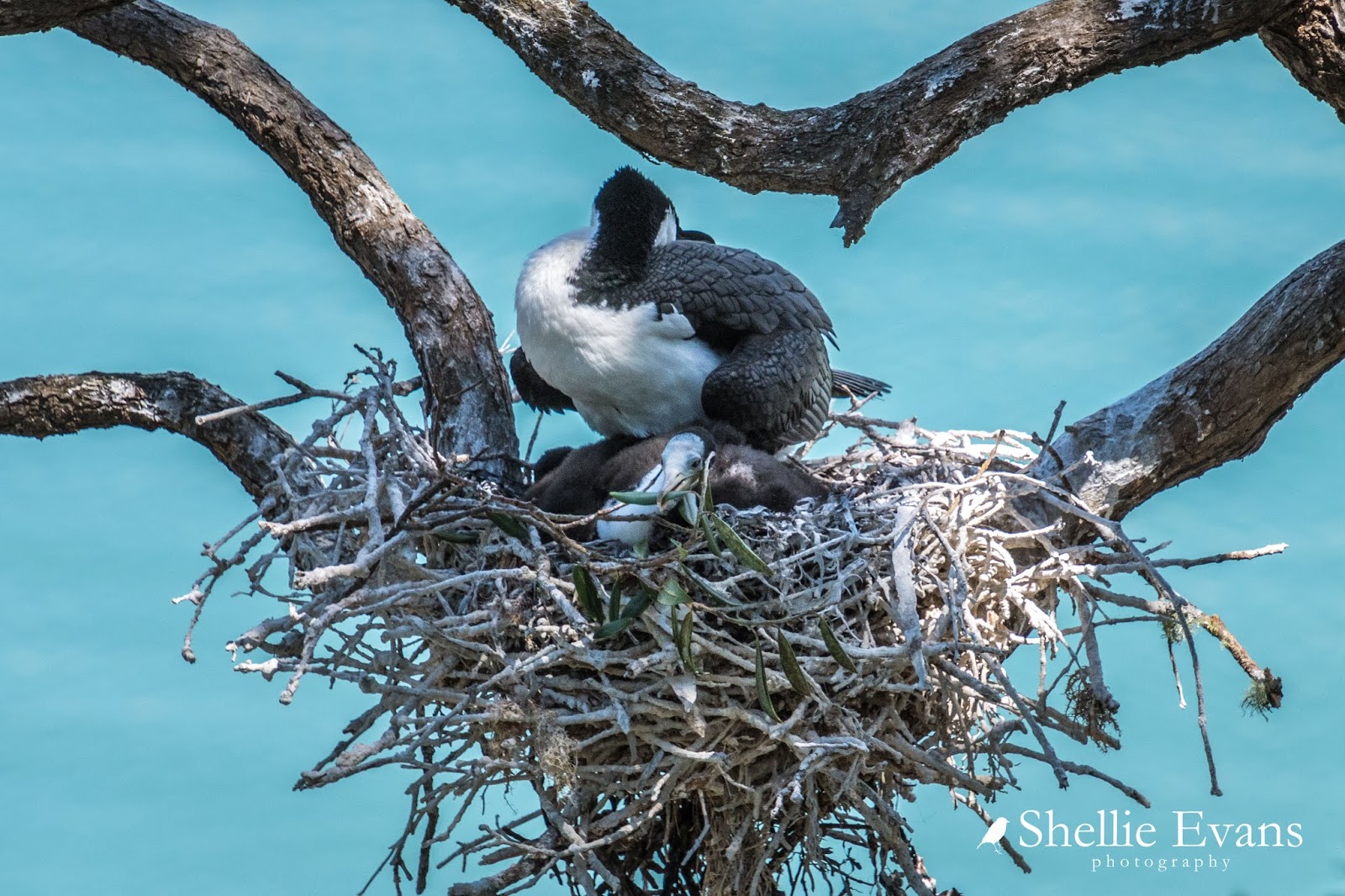
We parked on a slight rise atop the stream bank, with our slide-out overlooking the water where we could watch the bird life from behind our tinted windows. There was a small colony of Pied Shags/Kawau nesting in the overhanging pohutukawa trees alongside us, some of the chicks had already fledged, the ones still there spent the day exploring the branches around their nests.
An adult (top right) took some time out resting on a branch right in front of our window. A pheasant pair (top left) cautiously came out of the flax bushes each morning to feed on the grass. A male Yellowhammer watched proceedings from a nearby fence post.

Rarawa is a beautiful camp and is now firmly one of my favourite DOC camps in the North Island. The sunsets were stunning and even better I didn't have to move far from the van to catch them...


But wait there's more! It wasn't just the camp that received my favourite award, Rarawa Beach has to be right up there alongside Puheke (or just ahead by a whisker) as the most spectacular beach we've seen up north.

From the camp located behind the pine trees (below), it's just a short walk along a soft, sandy track beside the stream...

...to the beach. The colour of the sand on the track and the stream bed prepares you for what's in store once you are over the sand dunes and onto the beach.

A stunningly beautiful, glaringly white, silica sand beach (and don't forget your sunglasses).

The beautiful white sand beach (that squeaks as you walk) stretches for miles in a northerly direction...

...and down to a small sandspit at the south end where the stream exits into the sea.

As is the case with many of the sandspits along our coastline, it's been roped off and signposted to warn of nesting shorebirds, in particular our endangered endemic New Zealand Dotterel/tuturiwhatu.

Of course the birds can't read and don't know when humans are trying to do them a good turn. We're alerted to several nests outside the large roped off area when we spot a Variable Oystercatcher/Torea Pango doing the broken wing act to draw us away from it's nest.

And then a dotterel darts past us doing a mad dash for who knows where, but keen for us to follow.

That's when we stand very still, and then gradually step our way after it, as it leads us towards the water. We look ahead carefully before each footfall, making sure there isn't an egg waiting to be crushed by a careless step. David is our egg spotter extraordinaire and as he scans the surrounding sand he spots a lone egg in a shallow depression in the middle of a small piece of dune grass (centre left).

At least the grass offers a tiny bit of protection, many nests are just open scrapes of sand with perhaps a bit of seaweed or small piece of driftwood nearby. Looking just like any other bit of sandy beach. Which works well for camouflage against natural predators but it's no protection at all from humans, dogs & vehicles that pass.

We didn't try to locate the oystercatchers nest, it ran down to the high tide mark and settled in some seaweed. It's trying to trick us into thinking it's nest is down there.

Rather than disturb any other birds nesting outside the ropes we move to the high tide line and follow it down to the stream outlet where once again there are huge pohutukawa trees overhanging the water. One is smothered in red and the others just about to burst into flower.

December is a great time to visit the beaches of the top half of the North Island, nothing speaks of summer more than a stunning display of our iconic pohutukawa trees.

We walk back along the waterline and see that a group of young guys have come down to the beach from the camp.

Some are swimming while others are sunbathing on the side of the sand dunes. Most of them are lily-white and I wonder if they know anything about how harsh our sun is and how much more they can burn when the sun is reflected off such white sand. I think there will be several sore bodies about tomorrow.

As we near the track entrance another dotterel darts away from us just ahead and David quickly locates another nest, this one beside a strand of seaweed and very vulnerable as it's right in the middle of the beach with wheel-tracks very near and footprints all around. Dotterels usually have 2 or 3 eggs so the ones we've seen are still works in progress.


We decide to drag two pieces of driftwood (they are quite small, there's nothing much available) and place them a couple of metres away from the nest on either side. This will at least stop a quad bike from tearing through the middle of the nest (which is on the far side of the wood in the photo below).


Well, you've seen the white beach but where is the pink one?
Just 12kms south by road but only just around the headland at the southern end of Rarawa Beach is another stunning beach; Henderson Bay.

It's hard to believe that these two beaches are side by side and yet are so different. Henderson Bay has a beautiful pink hue to it, the colour showing more on the wetter sand below the high tide line. I've caught it mid-tide here.

It's not until you get down close to the sand that you can see the pink is made up by heavier grains of sand that are sitting on top of the white silica sand beneath. The pink sand is crushed coral, although I have no idea where it's come from as I'm sure we don't have any coral nearby (and googling it doesn't provide any answers either). It's certainly a freak of nature that there are two beaches right next door to each other with different coloured sand.

While I was taking photos down on the beach, I spotted a person off in the distance through my viewfinder. He was laying face down in the sand, I wondered if he was getting up close & personal with a pink grain of sand (click on the photo to enlarge). And then I saw him raise himself up, he was doing press-ups. Sometimes I see the strangest things while out exploring. With no other car in the carpark I have no idea where he came from either.

Henderson Bay is a true hidden gem, not too many people visit it. In fact both beaches wouldn't have too many visitors as most people are on day tours with trips to the Te Paki Giant Dunes & Cape Reinga. Both beaches are just a few kilometres off the main highway and are well worth a visit if you have your own transport.

Obviously the beach does get some unwanted attention though, this signpost alongside the track down to the beach.

The sun sets on Rarawa Beach. Next stop Houhora Heads.