Showing posts with label sound. Show all posts

Sunday, October 26

The End of the Road- Titirangi

Similar to the Pelorus arm of the Sounds there aren’t too many roads along the Kenepuru arm to explore either, although there are quite a few tiny settlements with a handful of houses and holiday homes. Just up the road from the campground is the one & only ‘major’ road junction, it’s 45kms from the beginning of the road and 25kms to the end at Titirangi Bay. Once again 25kms doesn’t sound like far but on these winding metal roads they seem to take forever and especially when you’re stopping regularly to explore and take photos.


The road at first runs through farmland up the Kenepuru Valley behind the head of  the bay before climbing sharply up to the top of Kenepuru Saddle. Our first stop is at the Punga Cove turn off which is also where the Queen Charlotte Track crosses & also meets the Kenepuru Road. The QC Track is a 71km 3-5 day walk that tracks along the ridge between Queen Charlotte Sound & Kenepuru Sound. Most of the accommodation and views of the bays & coves are out over Queen Charlotte Sound and this junction is one of only 2 or 3 that gives access to the Kenepuru side.

Twenty percent of the QC Track passes through privately owned land, especially at the beginning, and a Track Pass must be purchased before walking the track. The section from Punga Cove around Camp Bay & Endeavour Inlet and on to Ship Cove is Crown land and provides day walk options without having to buy a pass. Two vehicles arrived while we were stopped, their occupants heading off towards Camp Bay.

We drive the short distance down into Punga Cove and get our first view of Queen Charlotte Sound. The road leads directly into the Punga Cove Resort (very steep) and we can also see Mahana Lodge just across the point, both provide a range of accommodation options for track walkers. I always wonder what overseas visitors think when they arrive at a NZ ‘resort’. Images of golden sand beaches, beautiful swimming pools, swaying palms, luxury rooms, sun loungers & bronzed bodies come to mind when I think of resort. NZ resorts are quite a bit different.


We carry on along the road which continues to climb higher & higher. Through the trees and bush we catch tantalizing peeps of Queen Charlotte Sound but no wide open gaps where we can see the water far below. We both think that the ‘powers that be’ should at least include a couple of look outs along this section of the road (and in fact on the road in too). First it would stop people from parking their cars on the road in dangerous positions and secondly if you’ve driven all this way in from the main road it would be great to see something for your money!


Below was the one & only reasonably clear view of Endeavour Inlet we had and I had to stand on the back tray to get a little more height. Across the water to the right is the historic Furneaux Lodge, a popular place for boating holidaymakers to visit over summer. Exploring, as we are on our travels, has been great, I’m able to put names to places. I didn’t realise that the lodge and Endeavour Inlet were so far out in the Sound. Sadly this part of the Sounds will always be associated with disappearance (& murder) of a young couple on New Years Eve 1998.

The road ahead of us winds around the edge of Mt Stokes (1203m), there’s a 5 hour hike to the summit which seems rather excessive, this must be a minor peak. We won’t be doing that walk any time soon.


We stop a few more times when I catch sight of gaps caused by windfall ahead of us, some I can see over the top but most don’t have clear views. Even though the road has a lot of twists and turns we’re both surprised at how wide it is in places, especially this far down the arm. It feels like a four lane highway compared to some of the gravel back roads we’ve been on recently.

Through one gap we can see the road winding up the hill ahead of us and we think we might have to take the road to the right but in fact our road drops over the ridge at the junction with a farm track that cuts across to the right. And down below us we can see Melville Cove which is at the top end of Port Gore. We’re now in the outer sounds.


Further on and finally we break out of the bush and have a clear view across Port Gore to the long thin finger of land that is Cape Jackson, which points out to Cook Strait. The outer Queen Charlotte Track also finishes at the Cape.

Port Gore is the final resting place of the Mikhail Lermontov, a Soviet cruise ship that sunk in 1986. The ship in the care of the Marlborough Harbourmaster, & carrying 750 passengers & crew, hit rocks as it passed through a narrow passage between Cape Jackson & the old lighthouse. One person, an engineer, died as the hull was ripped open and there were also 11 injured people but passengers & crew were rescued before the ship sunk. The ship, badly listing, limped into Port Gore where it lost all power & got stuck on a sandbank. The incoming tide lifted it off the sandbank and the ship then sank, 5 hours after the initial impact.


Below is Melville Cove (Port Gore) with those ever present mussel farms blotting the seascape. This is taken from the the road junction with the farm track. We’re quite a height above the Cove, you can see the slope on the left is covered in ‘tiny’ punga ferns (tree ferns) which will give you a bit of perspective.


We’ve finally reached Titirangi, we’re heading down to the Farm Park for a picnic and to check out the camping site. At least this time we don’t have to stop and ask permission as we did in Bulwer. Titirangi Farm Park is crown land that is leased out. Again it looks like our road cuts around the edge of the hill when in fact it doesn’t, it drops down to the left just around the corner ahead of us and winds for 3 km all the way down into the bay.


The view down into Titirangi Bay is spectacular, some might recognise this photo as the one that appeared on TV One’s weather a few nights ago. This is looking north-west towards Pelorus Sound with some of the outer sound islands dotted across the horizon.


We stop near the bottom as the left hand side of the bay comes into view, I can see a little kiosk in the middle of a paddock and assume that’s where we’re headed.


There’s also lovely smooth expanse of inviting white sand on the beach, one of the very few sandy beaches in the Sounds.


On the other side of the small ridge, the road passes along the front of a large sheltered homestead and farm buildings, this is Waitui.


We head left to Titirangi opening the gate and driving down to the picnic table disturbing the resting & grazing sheep along the way. What a great place this would be to camp (except for the rather large sheep poo!), a fair way out and a tough road down to the bay but once you were here, paradise!


The ‘kiosk’ turns out to be the toilet/shower/kitchen/laundry block complete with a stock gate to keep the sheep out! Of course it’s basic (what do you expect for $5) but perfectly adequate. There are 4 narrow flushing loos on the other side, a shower to the left and tubs for everything else on this side.


And what would a picnic be in the Sounds without a weka making itself at home! Once again there were about half a dozen birds who quickly came over to see what we might have for them- in between chasing each other around the paddock. We’re now familiar with the habits of these birds and it didn’t take long for us to pick that one bird had chicks hidden in the undergrowth over the fence. She gathered up the pieces of bread I threw her, stuffing her bill full before running as fast as she could back along the fence line disappearing under the bottom wire and through a gap in the bushes. She must have had very young chicks as they didn’t make an appearance while we were there.


Another bird did the same but ran back across the paddock to some reeds, we could see two large chicks wandering about beside the stream and when I went over to see them one was more than happy to check me out. It’s sibling ran off and hid but this one kept coming closer until it’s parent squawked and must have told it to come away. It sauntered off down the sheep track in the general direction of the parent pecking at this and that, looking around and taking its time. Just your typical teenager.


After finishing our lunch & a walk along the beach we packed up and headed back to the turnoff for the long climb back out of the bay.


The road is steep and narrow and while it wouldn’t be so bad towing the 5th-wheeler in or driving a bigger rig, it would be a tough haul out of the bay when it came time to leave. Although we decided, if we did want to come here camping another time, it probably wouldn’t be wise towing anything down the road because of the narrow hairpin corners, many of which are hidden behind that first bend.


Once again we had a lovely afternoon exploring and while we’re enjoying the Kenepuru arm of the Sounds we both think the Pelorus side has superior views; perhaps that’s just because we couldn’t see them on this side.

Thursday, October 23

Kenepuru Head, Marlborough Sounds

We’re now parked up at the DOC Kenepuru Head camping ground and have been here for the last few days. The weather has once again been spectacular, deep blue skies and hot sunny days and just one with a little rain. The forecast is good & we’ve decided to stay put over the coming holiday weekend when other camping spots around the Sounds & closer to Queen Charlotte Drive will be busy with holidaying families marking the beginning of summer.


The turn off to Kenepuru Sound is at Linkwater and has the now familiar sign board with all the relevant information needed before heading deep into the Sounds. It seemed rather odd that there isn’t a more inviting entrance to Kenepuru (and in fact the same for Pelorus). Personally I think the District Council could have made an extra effort here as a lot of tourists visit these areas. Still, there’s nothing quite like a smelly dairy farm to tell you you’re in NZ, & in the countryside, and life still does go on around these beautiful areas. The dairy shed was across the road from the sign board and a mucky race ran alongside both sides of the road.


I can’t post any photos of Kenepuru Sound as we travelled along the eastern side to the Head. That’s because there was absolutely no views of the water except a few peeks and glimpses here and there. The bush grew high on both sides of the road and other than letterboxes marking hidden driveways, houses with their magnificent water views, were hidden too.

Aside from the bush hiding the views, the road, all 45kms of it, was very, very winding and extremely narrow in places and took all David’s concentration. He couldn’t have stopped even if I had wanted him too. Back & forward we wound, out of one corner & into the next without a break. I told David I need a counter so I can keep a tally. I’m sure there must have been at least 100 bends for every 1km. I won’t tell you what he said but suffice to say he didn’t want two lots of clicking distracting him!


Our first chance to pull over was at Portage, 30 kms from the turnoff where we took the opportunity of having lunch sitting on the water’s edge overlooking a small bay and a big marina (although we did stop with our hazard lights on at Cowshed Bay to check out the DOC camp there- it was quite small & surrounded by bush).

Portage was little more than the Portage Resort and a few houses, nothing like I was expecting. I assume it’s a busy place in the summer when there are many people holidaying in the area & walking the Queen Charlotte Track which runs right along the ridge line which separates Kenepuru & Queen Charlotte Sounds. It’s also a low point in the range at Portage and you can drive over the top to Torea Bay which is on Queen Charlotte Sound. Water Taxis transporting walkers & visitors come and go from Torea Bay too.


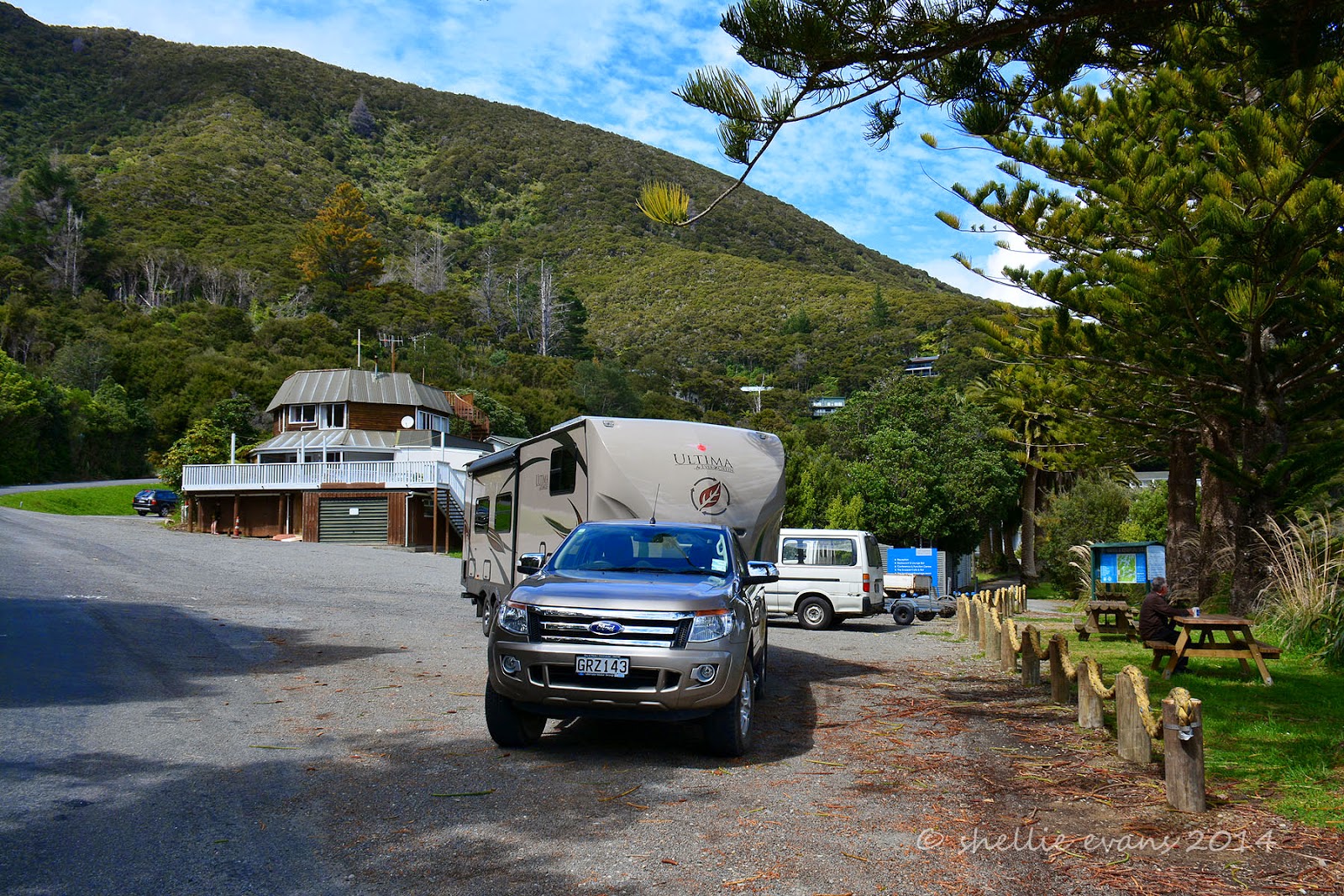
Another 15kms further on and we finally reached Kenepuru Head and the DOC campground which has recently been upgraded. It now has flushing loos & cold showers. The grounds have been landscaped a little and separation ‘fingers’ planted so it’s a little more organised. It’s a large site and there’s another open space through the bush if the main side ever got overloaded. Although I can’t see that ever happening, it’s not like this is a good fishing spot or there’s lot’s to do locally. It’s just a lovely peaceful area to park up for awhile and enjoy the wildlife.


There were two other motorhomes here the first night we arrived, they left the next day and we’ve had the place to ourselves for the last four nights. Today two more motorhomes have arrived. How dare they! And I’m sure there will be more over the weekend.


The reason why it’s not good fishing is because we’re right at the head of the Sound and when the tide is out there’s a huge expanse of mud which runs from one side to the other and down the bay for a few hundred metres or so. No good for the dinghy even when the tide is in, David would manage to wheel it down to the water, climb in and before he knew it the water would be gone. The tide moves very fast around here. I think he needs a spear, I’m sure there would be flounder out there, but then I guess he’d get bogged down in the mud. This is the view (at high tide) out our kitchen window from the back of the van.


The birdlife around us is incredible, with the mudflats on one side & bush surrounding us there’s plenty to watch & listen to, especially the Bellbirds (Korimako). There are dozens of them. At high tide this Kingfisher (Kotare) & her fledgling chick sit in the tree outside our back window diving down into the water below. They are very wary and fly as soon as we open the door. I managed to take these through the tinted back window.


Kingfisher Fledgling 
I was up at 6am a few mornings ago, the dawn chorus was deafening and I thought I must record it on my phone. I recorded about a minute of it out the front on the grass before I moved towards the back of the van to check out the mudflats. I don’t know who was more startled but just as I got to the rear a flash of red caught my attention and a huge wild red deer took off past me galloping along the edge of the mud (do deer gallop?) heading back towards the head of the bay. It disappeared behind a few bushes further along the bank and around a slight corner. By the time I scrambled down the bank (in my fluffy dressing gown & crocs) and out far enough to see around the corner it had gone.

I picked up it’s tracks in the mud and thought I’d come back with my camera later to take a photo of the size of the print. It was HUGE and also the speed of the run as the back hoof print was right up there behind the front one. Unfortunately the tide had come in by the time I returned and the prints not as clean but you can still see the size, my fingertips are touching the mud.


I then followed the hoof prints along the edge and found out that where I thought it had run off into the bush it hadn’t, it had continued on along the edge for quite a distance. It was funny to see nice clean prints where it had walked in and the hurried and scuffed marks as it made it’s escape. It had exited the bay near a stream right up the top where there were also quite a number of other hoof marks, so I wonder if there was more than just the large deer I saw.

I wish I had of gone back inside and seen it from the back window, it would have carried on up the bay and I could have taken a photo. For the last few mornings I have been leaving the blind up at the back at night and checking at 6am. Just in case. But it hasn’t returned & is not likely to either. Oh well at least I saw it flash by. Another exciting sighting.

A resident flock of about 14 Royal Spoonbills (Kotuku ngutupapa) feeds on the mudflats at low tide, I can’t manage to get too close to them without getting bogged down in the mud, they do roost in a large macrocapa tree near the road but I have yet to get them there in the right light.


I tracked a wood pigeon (Kereru) through the bush along the water edge the other day and found this cute little bach tucked up in a clearing. A mown track wide enough for a small boat trailer led down to the water but I think they also wouldn’t be able to go fishing too much. I like the wide opening doors onto the tiny deck.


And of course camping in the Sounds wouldn't be complete without the comical & scavenging weka. We are parked in another weka family’s patch, this time just one adult and one large fledgling chick.


There are quite a number of weka in the camp ground but they each have their own patch and woe betold any that encroach into another’s territory. We’ve witnessed a few big scraps, they are very fast runners but it doesn’t help when it’s another weka chasing you! I just love the feather pattern, I can see why Maori used the gorgeous copper coloured feathers in their cloaks.


Sunset over Kenepuru Sound, Marlborough Sounds.


Saturday, April 5

Doubtful Sound & Manapouri Power Station- Part2

Continuing on from Part 1

After poking our nose out into the ocean our boat then followed the south side of the fiord back towards the wharf turning down the long and narrow Crooked Arm quietly inching it’s way across the still water and tucking up in a small narrow cove near the end where the boat turned off its motors & we were all asked to hold still & quiet for a minute or two to listen to the sounds of nature. No camera clicks, no walking, no talking, no movement……wait, who is that stomping up the deck!


No it wasn’t David but he did have something to do with it. David was having a very expensive conversation. Instead of looking at the beautiful scenery of Doubtful Sound he was inside, engrossed in a discussion with an American couple, John & Diane,who we had sat near when we first boarded the boat. John was an ex-fighter pilot and David was in his element talking planes. David & John had been so focused on talking that they had failed to hear the announcement to be quiet & still. And then when they had noticed the quite they wondered what was going on…wondered in loud voices. They were suitably told to shsssh by the captain. Then John, not realising that he was meant to be still too, stomped off up the deck to find Diane & was frowned at by staff all the way. John & David had a little giggle about that, John said he felt like a naughty schoolboy!

The reflections on this part of the fiord were wonderful.


Leaving our “quiet" spot I overheard a few people saying how amazing they found that experience and it was, the bird noise from the bush surrounding us was of constant singing & chattering, something like I imagine the bush used to be before introduced predators decimated our native birds. Nearby a small waterfall gurgled as it entered the fiord and that was it, the rest was the sound of silence. 


This is known as a tree avalanche. The rainforest mostly cannot get a good root hold in the thin layer of soil & leaf mould & hangs precariously to the steep granite rock of the mountains. Tree avalanches are usually triggered by high rainfall or snow.


The Fiordland fiords are famous for their waterfalls but with no substantial rain for weeks a lot of them had dried up. Manapouri village receives 1 metre of rain a year but over at West Arm the rainfall rises to 4 metres and at Deep Cove it reaches 9 metres. As this rain makes its way into the fiord via streams, rivers & waterfalls it becomes the colour of weak tea, stained by the tanin and other matter from the forest floor. The tanin stained water is less dense than sea water & forms a layer on the surface that floats and only partially mixes with the salt. This gives the fiord its dark inky appearance and it’s where one of the largest colonies of black coral in the world live. The coral, which is usually found at depths of 60 metres or more grows at just 8-10 metres, it is tricked into thinking it’s deep water by the thick layer of freshwater which filters out the light.


Passing a small bush clad island on our way back to the wharf.


There were a few private launches visiting the fiord and  a number of fishing boats that are based in Doubtful tied up at the wharf.


The buses await our return.
 

We were taken on a small detour to check where the two 10km long tail-race tunnels from the power station that exit from under the mountain and into Doubtful Sound.


As promised, with the cloud now lifted, the bus stopped at the top of the pass so we could see the Sound in all it’s glory.


Back down at West Arm we took a side road up to the entrance of the power station tunnel, a 9 metre wide tunnel that spirals its way 2 kilometres underground to the Machine Hall.


The seven huge blue machines on the hall floor are exciters. The exciter stimulates the rotor of the main generator below it to produce electricity. It’s hard to get a sense of the size of these, it would have been great to have someone in the picture but have a look at trolley forklift to the left. The room is 18 metres wide & 39 metres high. The exciters are huge but below them on the stator floor are even larger generators & transformers. And below that floor is the turbine floor, the turbine shaft spins at 250 revolutions per minute. This is where the water comes in from the penstocks(the blue tubes in the station mock up) to drive the turbines. Above the turbine shaft is the generator. Water travels through the penstocks at a combined rate of approx, 500 cubic metres per second (500 tonnes per second)


Up on the surface the bus took us back to the terminal & our waiting boat, David & John still chatting away!


So what else could we do but invite them back for drinks which then turned into dinner. We had a lovely evening and quite a few laughs. It was great meeting you Diane & John, until next time, cheers!

Friday, April 4

Doubtful Sound- Part 1

One of our “must-dos’'’ before leaving Manapouri was to take a cruise on Doubtful Sound, David also wanted to visit the Manapouri underground Hydro Power Station. Doubtful Sound is reached by taking a boat across Lake Manapouri to West Arm where the power station is located and then being transported by bus over the Wilmot Pass and down into the Doubtful Sound deep in heart of the Fiordland National Park.

After a relaxing week at the Manapouri Motorhome Park with brilliant hot & sunny weather, we finally decided we’d better do the Doubtful Sound trip before it was time to leave for Milford. And wouldn’t you know it, the weather turned & it became overcast and cool with low cloud & passing showers. The beauty of not having a fixed itinerary is that we were able to hold off booking the cruise over the next three days while we waited for the weather to clear. Finally it looked like we had a small window of opportunity where the forecast was for fine weather followed by rain again the next day.

It rained heavy overnight but the day broke crisp & clear. We only had to drive a couple of kilometres down the road to the Real Journeys Visitor Centre located at Pearl Harbour on the lower Waiau River just below it’s outlet from Lake Manapouri. We were booked on the 8am sailing and were first in the queue (surprise, surprise) as we waited for the bus to arrive from Te Anau with the remainder of the passengers. The mid morning & early afternoon sailings are always busier as buses arrive in from Queenstown loaded with day-trippers. Our sailing was about half full so we had plenty of space to move about.


The lake was flat and calm, the water like thick oil smoothly parting as the boat glided through. Low cloud clung onto the Hunter Mountain Range with the unusual Monument spike clearly visible. A full moon was on its way west & soon dropped behind the range.


Just as the sun rose above the eastern horizon and fog settled over the village of Manapouri.


Before long we were cruising down West Arm to the wharf beside the hydro power station. Cables carrying 220,000 volts taking the power away from the switchyard were clearly visible as we approached.


We disembark and make our way into the information area and then onto the waiting buses that will transport us over the pass and into Doubtful Sound. The Wilmot Pass is New Zealand’s most expensive road at $80 per square metre & is also one of the remotest roads in NZ. The Pass is 22km long and was built in the 1960s to provide heavy equipment access for the construction of the power station. It passes through rainforest, waterfalls & towering cliffs and deep canyons. We get our first glimpse of the Sound just over the top as we start to wind our way down a very steep section of the road. The cloud hangs low but our bus driver tells us they’ll stop for a clearer view on the way back later in the morning.


We arrive on the tiny cantilevered wharf at Deep Cove (too deep for anything else) where our next boat is waiting and file on board. For such an isolated and not so easily accessible area there are a surprising amount of people about, including 40 or so children that are on a school camp at an education centre located near the wharf.


Across from the wharf at anchor is another Real Journeys boat, this is the yacht on which guests stay overnight in the Sound.


One of the staff members on board our boat was a nature guide who obviously had the experience and knowledge to locate any wildlife ahead of us as we quietly cruised down the sound. And as luck would have it one of the first birds he located was the rare & endangered Fiordland Crested Penguin. He was a very long way in front of the boat, just a ripple on the water and disappeared below soon after being spotted but I managed to zoom in & grab a shot that at least shows he was what he was meant to be. Another bird to add to my list. Only a small percentage of the cruises get to see a Crested Penguin.


Doubtful Sound is the second largest fiord of the 14 fiords located in the Fiordland National Park and is in the heart of a designated World Heritage Area. Deep Cove at the head of the fiord is 40kms from the sea. Doubtful is three times longer than Milford Sound and has a surface area 10 times larger. The fiord is 430m deep at it’s maximum, it is remote, wild & imposing and the scenery is stunning with the sheer sides of the mountains draped in cloud and climbing dramatically straight out of the water.


Before long we could see the entrance at the far end of the Sound.


And then to everyone’s excitement the call went out “dolphins ahead!” I had positioned myself at the bow of the boat with a couple of other hardy souls for most of the journey so far (it was very brisk) when suddenly we were swamped with people jockeying for a good position to see them. I held fast and got a good view of the mothers & calves playing and riding our bow waves & racing up and down the tunnel between the catamaran hulls; “Bugger if I am going to move” I thought. “I have earnt my spot!”. This pod of dolphins are resident in Doubtful Sound but hadn't been seen for a couple of weeks so again we were on the “lucky” cruise.


Ahead of us just outside the entrance was a rock looking like a large cupcake sprinkled with currants. As we got closer the currants started moving & revealed themselves to be dozens of seals, mostly pups that had been left on their own for the day while their mothers were away feeding.


The skipper eased the boat out into the rolling ocean swell so we could our first look at the West Coast before carefully turning and returning to the the sheltered waters of the fiord. Away in the distance we spotted a cruise ship making it’s way up from the bottom of the South Island, we later saw it inside the fiord.


To give you a sense of scale; a large launch (white dot) can be seen to the left of the entrance

To be continued.......Part 2