Showing posts with label town. Show all posts

Thursday, August 3

Millhaven- Home to Pete's Dragon

Catch-up (Feb 2017)

This one's an old catch-up. I've been also catching up on uploading photos to Flickr and when I came across this folder, I thought I couldn't let it pass without doing a quick blog on it.

Tapanui, in West Otago (pop. 800), is just another sleepy non-descript New Zealand country town that has seen better days. It was once a forestry town and is now a rural service town surrounded by rolling farmland in shadow of  the Blue Mountains and close to the Southland border. 


To many New Zealanders the name Tapanui is synonymous with a mystery debilitating illness that befell many people in the town during the early 1980s. The illness was nicknamed the 'Tapanui Flu', until it became an accepted illness known as 'chronic fatigue syndrome'. Dr Peter Snow, who served his community as a GP for 37 years, was the doctor who first documented the rise of the condition.

A Moonstone placed near the main street, is in memory of Dr Snow's achievements. He was also a fossil enthusiast and the moon rock was chosen because of his belief that a meteor had collided with the moon in 1766 and scattered debris across West Otago.


Click on the photo to read the details-


Tapanui now has another claim to fame. In 2015 the town was transformed into Millhaven, a small logging town in America's Pacific Northwest, for the Disney film 'Pete's Dragon'.


Around 250 crew and cast (including Robert Redford), stayed in and around the township during the month long filming, leasing many of the resident's homes for accommodation and visiting the various cafes and pubs in the area.


The old Blue Mountain Lumber Sawmill, 14kms out of town, along with many of the town's businesses were given make-overs and transformed into small town America. 


Locals were also cast as extras and once the film was finished two special screenings were shown in the town before the film was released in 2016.


Tapanui has long since returned to a sleepy one-horse town and unless you stopped for a refreshment break or know of the film, you'd hardly know of the town's recent history. 


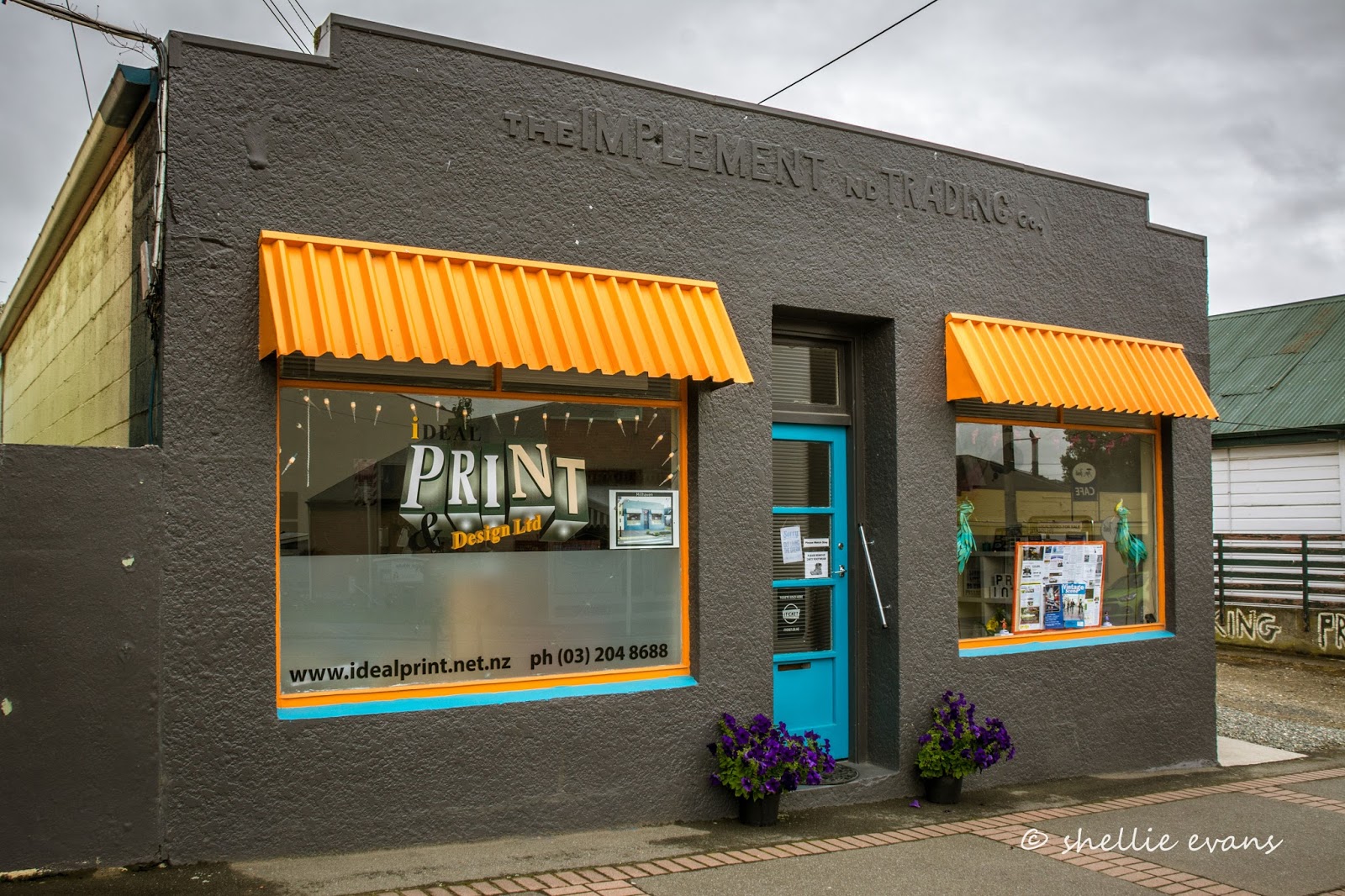
If you have a wander you'll find a framed photo in each of the business's windows, of how they looked in the Millhaven set. 


Some shops had only minor make-overs, others had entirely new identities or functions.


I'm not so sure the on-going economic benefits to the town have been as great as originally expected and I'd say nothing like the continuing Lord of the Rings tourist visitor windfall, but I'm sure there are still quite a few people who stop and visit, just to say they have been to Millhaven.


The old Bank of New Zealand building (always a monstrosity in small town New Zealand) became the Douglas County Sheriff's office.


The cast and crew gifted a plaque to Tapanui and it's since been mounted on an old saw blade and wood plinth and now takes pride of place in the centre of the town.


Tuesday, November 29

Two West Coast Mining Towns

Catch-up

After our sobering and thoughtful visit to the Pike29 Memorial we carried on towards Greymouth, taking a side road to the old mining settlement of Blackball.


And although the streets around village's few shops and one of the pubs, were lined with vehicles, the streets were deserted of people. The only sign of occupancy were these two characters resting in the shade of an old cottage in the midst of a makeover. 


David dropped me off so I could take the necessary church photos and then drove around the block (the block nearly being the whole village) and pulled up outside the other pub in town and the one I wanted to check out- the 'famous in New Zealand', Blackball Hilton.....now known as the former Blackball Hilton because of a certain international hotel chain's pressure to change the name.


Next door I finally found a single person checking out the Blackball Museum of Working Class History including an exhibition of the 1908 miners strike, which at 10 weeks, is the longest strike in New Zealand. Blackball is also the birthplace of the New Zealand Labour Party.


The Blackball Hilton publican & his wife came out to front table to have a smoko break and we got talking. The town was empty of people but full of vehicles because of a very large funeral for a local identity which was happening at the other hotel in town. When he heard we'd just visited the memorial he said we'd have to come in and see the hotel's memorial to the Pike 29. The first thing he pointed out was the clock, it was fixed on the time of the blast.


He took great pains in pointing out that his wall was the first memorial to the Pike 29 and that the hotel was in fact where many of the families and rescuers stayed and met each day during the early attempts at rescue. There were also memorials and information on the other walls right through the hotel of other mine disasters and important events in the area's history. After thanking them for their hospitality, we continued our journey.


Our destination for the night, as previously mentioned was Jellyman Park near Greymouth. We'd set up camp and were relaxing in the warm late afternoon sun when I had a brainwave (David would say a brainfade)...it was a lovely evening and when I checked my tide app, I saw that sunset was at 8:09 and low tide was at 8:15pm. 

Perfect timing for another visit to the fabulous hidden coastline at Motukiekie, 15kms up the coast- low tide, rock formations, a West Coast sunset & hopefully the special orange starfish, that inhabit the rock pools at very low tide and which I'd failed to find on our previous visit (although we did manage to find a caveman). All that combined (not the caveman though) could make for an epic photo shoot.


I told David I'd be happy to go by myself, but I'd love him to come; as back up and to help me down the steep bank and ladder to the beach. Otherwise I'd have to walk in from a couple of kilometres away and I really didn't fancy finding my way back to the ute after dark. Of course how could he refuse!

We left a couple of hours before sunset, which was a little too early but we were ready to go, so we took a detour via Runanga, another old coal mining town on the West Coast. I wanted to take a photo of the historic 'Miners Hall' which is adorned with famous socialist slogans. British miners brought a strong tradition of industrial unionism to New Zealand, where it quickly established itself, especially on the West Coast.


This Historic Places Category 1 building will hopefully be restored eventually (click to enlarge)


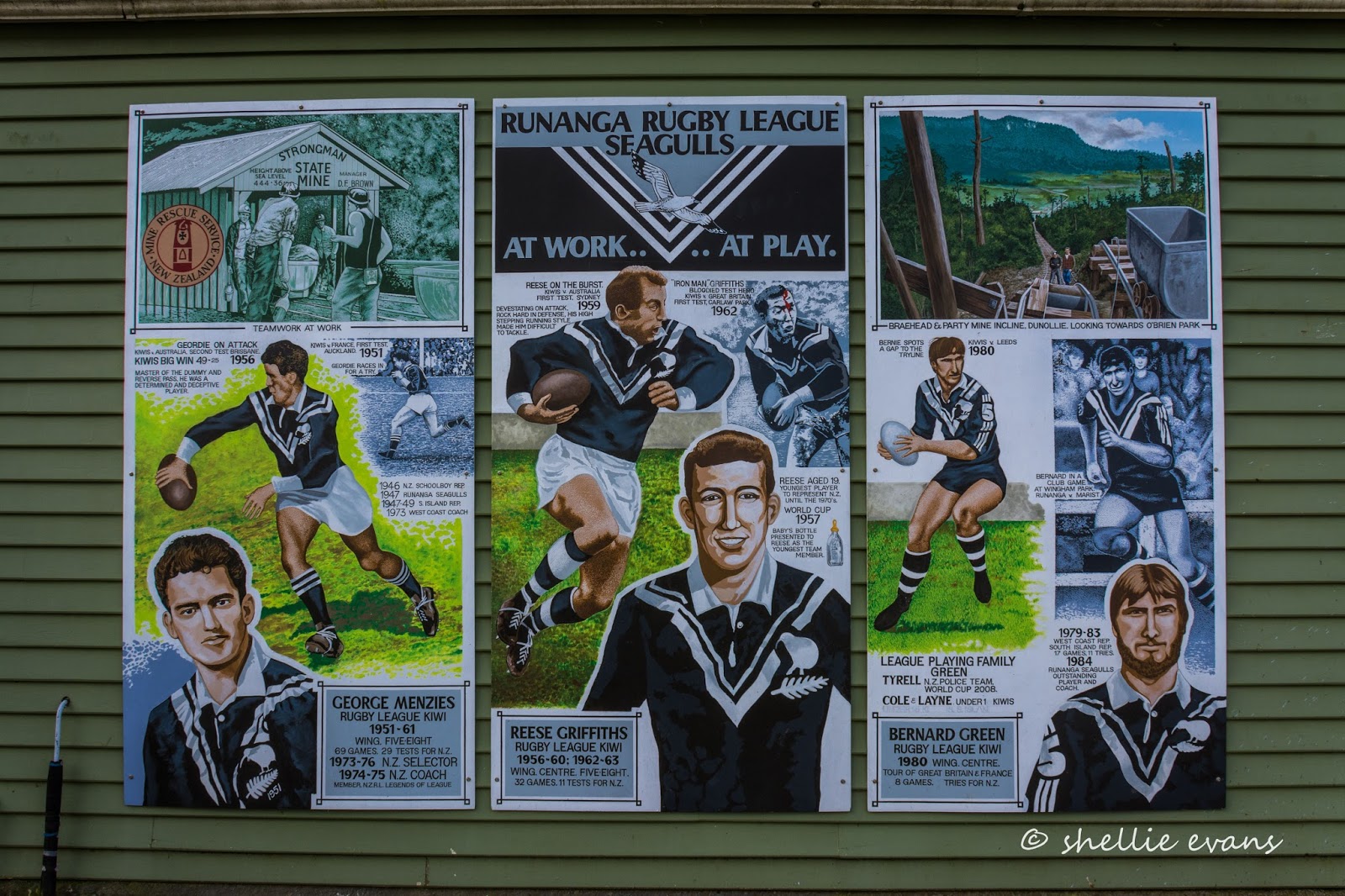
Runanga is also very proud of their mining heritage, rugby league roots and their international players; this large display was on the side of one of the shops.


Unfortunately the Buffalo Butchery didn't stand the test of time. I remember when we were on the Coast many years ago and had a buffalo burger at a cafe out in the middle of nowhere somewhere near Punakaiki. The cafe was actually at a buffalo farm (these are water buffalo), poor things, watching their mates being turned into burgers. It too had disappeared when we travelled that area last year.


While I was taking photos David decided that we'd have 'Chicken 'n Chips' for dinner from the local (the one and only) shop. It was rather surreal eating dinner at a picnic table on a footpath in a deserted and slightly rundown town.


But the 'Chicken 'n Chips'  were very tasty (hey, anything's tasty when you don't have to cook dinner) and we did see a few locals, mainly young people coming in for their daily fix; a packet of fags.


We carried on up the coast and checked out Motukiekie from the beach where I was going to walk in from. Hmmm....the tide looked like it still had a way to go and the sun had disappeared behind a thick band of grey cloud. 


We drove back to our secret track and headed down to the beach, finding the ladder just as it was the last time. 


The rocks came into view at the last turn in the track....that tide still looks a little high and the waves are still rolling in. And the sun has definitely disappeared.  


We swung down the rope (middle right) onto the rocks at the base of the cliffs...


...and walked up the beach to the rock stacks where unfortunately the tide was just not going to go out far enough tonight. It still blocked the way around the last section and the starfish pools were still covered in water. Oh well, it was worth a shot but we decided it just wasn't going to happen tonight so headed off back to the rope.


I caught a movement out of the corner of my eye and found this juvenile spotted shag trying desperately to blend into the rock-face behind him. He was actually warming himself in the sun that had finally appeared for a few brief moments...


...but he quickly decided he needed to find an escape route...


"If I tip-toe quietly this way, she won't notice me"


Meanwhile David had disappeared down the beach...


And while I was taking that shot, Master Shag made a quick escape.


As did we; back up the rocks, up the rope, the ladder and through the bush, back to the ute and home again...


...just in time to catch the sun setting!!


Friday, July 31

Ophir - Old Time Town of Blacks

More history! This area swims in it.

The Daniel O’Connell Bridge (1880) crosses the Manuherikia River just down the road from where we are in Omakau. The single lane wooden bridge is one of the last surviving suspension bridges in Central Otago.


The bridge is part of a loop road off the main highway which passes through the tiny historic settlement of Ophir. The town sprang into life overnight when gold was discovered on the property of a local runholder, Charles Black in 1863. In less than 3 months thousands  of miners occupied what became known as Blacks Diggings. It was shortened to Blacks – a name that remained with the school and the hotel in spite of an official name change to Ophir in 1875.


In its heyday, Ophir was the commercial & social centre for the district but when the gold ran out so did the population. The final blow came in 1904 when the railway line by-passed the town in favour of the farming community at Omakau just across the river. Ophir sank into obscurity which probably helped save many of its historic buildings. Nowadays the village has become popular again, with tourists, many from the Rail Trail, keen to sample the towns history and stay at the accommodation houses dotted along the main street. A main street that hides its charms well.


Ophir Peace Memorial Hall (1926) - has an excellent dance floor and is still used for many functions and events.


Ophir Post Office (1886) - it still operates as a post office agency for between 9am and noon each day.


Ophir Jail (1900) - This small wooden 2 cell jail was located beside the policeman’s house. After a new police station was built in Omakau in the late 1940s the jail was no longer used. It was shifted off site and became a sleep-out in Omakau before being returned and restored.


The Courthouse (1884) – the building reflects the optimism that Ophir would remain a town long after the gold ran out. The design is the same  as the Alexandra and Clyde courthouses.


The Old Drapery was both shop and living quarters.


The Cottage Hospital was most likely both the hospital and doctor’s residence.


This large stone building was originally a grocery store at one end and a butchers shop at the other with the owner living in the residential part at the back.


The buildings roof and front were altered in the 1960s when it became a service station. In 2011 it underwent a complete restoration and is now a restaurant and offers accommodation.


The Bank (1886) - at one stage Ophir had two banks but only one has survived. The former Bank of New South Wales building has been substantially modified since its conversion to a private home.


Roadside characters -  A boy and his dog


A few of the private residences along the street, including Kintail House (1917) and the entrance to the Bakery (1880s) where the buildings have been restored and are now used as a homestay -


Stone Barn with a iron lean-to and a two-stall stable behind. In early times, various horse drawn vehicles were built in the barn by the McKnight brothers and it was also used as a smithy.


Union Church (aka St Andrews Predbyterian Church), a simple gothic church opened for worship in 1897 and closed in 2008. It is now in private ownership.


More buildings from Ophir’s main street- top left, the Policeman’s House & Station (1870s), which is next door to the Courthouse. Larson House (middle left) which is actually two, two roomed cottages, one placed in front of the other and bottom left is McKnights Cottage (c1904), John Mcknight was a local builder, a blacksmith, funeral director & county councillor. He built many of the Ophir’s buildings and also built the Bank of New Zealand building in Omakau. A jack of all trades!


Blacks Hotel (1937) - located at the end of the town, or the beginning depending which way you come, is the art deco style Blacks Hotel. It was established when a new bridge crossing the river to Omakau was built and what was known as the Ophir lane became a highway. That ‘highway’ carries on over the Raggedy Range and into the Ida Valley. Behind the hotel are lovely accommodation units (looking like a shearing gang shed) for rail trail cyclists.


MacTavish’s Hut- a short distance up the ‘highway’ is a restored miner’s hut. The two-roomed hut was built on an acre of mining land owned by Lockhart McTavish.


At one stage the hut was occupied by Clem Daniels, a goldminer who ended his days there at an advanced age. Clem was well known in Ophir, he dressed in a blue suit whenever he walked to town, he also umpired many cricket games, marking the number of balls bowled with his walking stick. It was always obvious when he found gold- he would hold a roaring celebration at the old pub.


I hope you enjoyed your ‘wander’ around Ophir. Many thanks to “Promote Dunstan” for their informative brochure.

So laugh with me now or cry with me now
As you tramp those memoried tracks
For they all lead down to Ophir Town
And the old time town of Blacks
(Todd Symonds)