I wrote an article for the NZMCA magazine which was recently published so now I can share this incredible once in a lifetime experience with you (if you haven't already read it of course!). I haven't forgotten the next part of the Northland blog either, that's up next.
Oh. My. Goodness.
I have just had one of the most incredible (&
highly anticipated) experiences of my life. Early last year I was invited by
Viva Expeditions to join them on a ‘Southern Lights by Flight’ journey to view
the Aurora Australis from within the auroral oval, flying thousands of
kilometres south of New Zealand towards Antarctica.
After a couple of Covid
related postponements my dream finally came true and on April 1st (I
was hoping the date wasn’t ominous) I joined over 250 other enthusiastic passengers
on an Air NZ 787 Dreamliner for a 10 hour return flight over the Southern
Ocean.

Led by Otago Museum director and astronomer Dr Ian Griffin- who
organised the first-ever commercial flight to see the Southern Lights in 2017-
the flight also included astronomers, astro-photographers and Antarctic Academy
Director Miranda Satterthwaite.
A ‘Pre Flight Mission’ was held
during the afternoon before our flight where we toured the International
Antarctic Centre and listened to & watched presentations from Ian
& Miranda who explained in detail, information about our flight and
what we could expect to see once we reached the auroral zone including
information on the Aurora Australis itself.
Photography workshops where also
held with the astro-photographers assisting guests with handy hints and
tips on how to best photograph the aurora and also to help with camera settings
for the flight.

Aurora flights are timed around the spring & autumn equinoxes when the aurora display is at its brightest. Thanks to a phenomenon called the Russell McPherron effect, auroras are known to be more frequent and brighter than usual in spring and autumn.
Close to the equinoxes the alignment of the interplanetary magnetic field and Earth’s magnetic field is such that the two opposing fields can cancel each other out. This creates holes in Earth’s magnetosphere through which particles from the solar wind can flow, giving rise to auroras when they interact with the atmosphere.
The flights are also planned around the moon phase, a bright moon restricts aurora visibility, so flights are timed close to a new moon when the sky is dark.
Once checked in & through security we had a pre-flight meet &
greet near our boarding gate and as 7pm approached we made our way to the
aircraft, excitement building in anticipation of the flight of our lives. The
Dreamliner is the plane of choice because of the large portholes which makes
for better aurora viewing.
Casting an eye over the Departure Board I see that
our flight, NZ1914, is flying to Christchurch. An unusual sight as all the
listed departures are to other New Zealand cities. Not us; Christchurch to
Christchurch with 10hrs lost in the middle somewhere. And I can’t wait!
There are various seating options available but essentially if you
travel in economy, you & your neighbours in the row, swap seats every 20-40
minutes during the aurora viewing period.
But don’t worry, we flew for 6 hours
with the aurora on show so there was plenty of time to view the Southern Lights
& in fact towards the end only the most obsessive aurora watchers were left
‘standing’, many others had retired to the middle rows or were just happy to
listen to what others were seeing.

We departed Christchurch just after 7pm, flying up through the cloud
cover and catching the last glow of sunset on the horizon as we headed
south-east towards the Antarctic Circle, aiming for Latitude 64 & what is
known as ‘magnetic midnight’.
Though our ultimate flight path would depend on
where the aurora was found. Magnetic midnight is the time of day when the
magnetic poles align between the Sun and the Earth; it's said to be the optimum
time for viewing auroras.
Full in-flight service is available on the flight (dinner, snacks &
breakfast) and we’d only just finished dinner- about 2hrs into the flight- when
an excited call came through from the flight deck to inform us that the aurora
had been spotted on the horizon.
I leaned into the window trying to
shield the camera from the cabin lights & clicked a couple of photos off
just to be sure they weren’t fibbing & sure enough two bright green
auroral bands appeared on my camera’s back screen. There was a hurried rush
around the cabin to clear the trays and turn the entertainment screens &
interior lights off.
The most important thing to do to view an aurora is to allow our eyes to
adjust to the darkness. It can take up to 20 minutes for our pupils to fully
dilate and even a glimpse of bright light for just a few seconds will set your
dark adaptation back several minutes. This is why there is complete darkness in
the cabin of the aircraft and also why people with cameras need to have them
ready to go before the flight.
To enhance the aurora viewing experience even
further the plane has permission to fly in 'stealth mode', with all outside
navigation lights turned off. Of course there are no other planes within
thousands of kilometres; we’re the only ones flying around a dark empty sky on
some crazy mission looking for an incredible light show.
In the cabin around me the excitement was palpable as we approached the
aurora and then, with everyone seated, cameras ready & eyes adjusted to the
darkness, we entered one of nature’s most stunning, magnificent &
unforgettable displays of power.
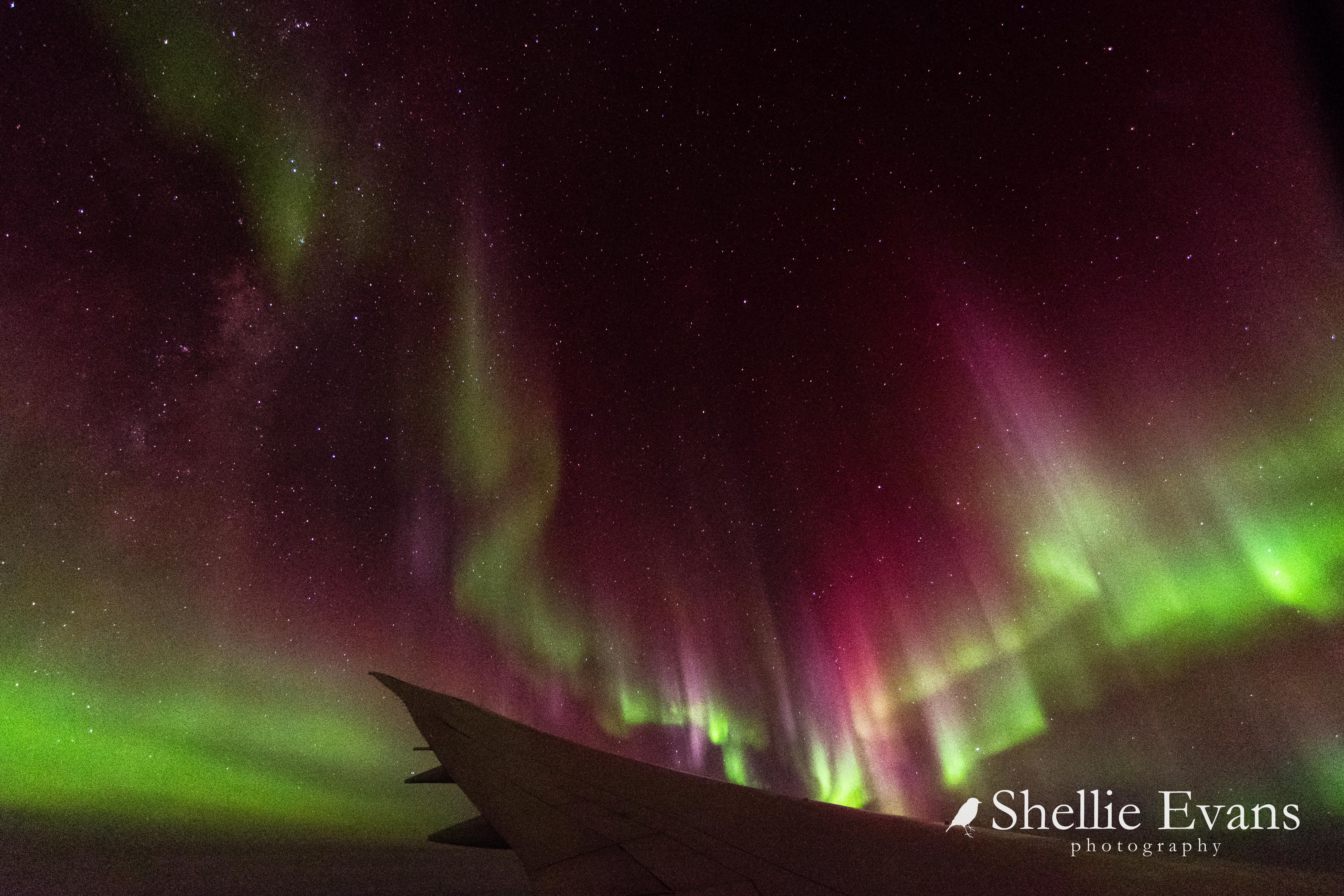
For 6 hours we flew under, over & through
the aurora, weaving our way back & forward over the Southern Ocean,
crossing the International Dateline numerous times, the pilots often banking
the plane, left & right so both sides were able to view the depth &
height of the display.
The star trails you can see in some of my photos weren’t
caused by a slow shutter speed as is usually the case, the trails are caused by
the banking plane, lovely graceful movements.
We flew directly beneath a corona
several times- the crown or centre of an aurora burst- the ultimate position to
be to watch a burst of activity. I was lucky enough to capture the side of an
exploding display a couple of times.
And I know what many of you will be thinking as you read this, ‘
Yes that’s all very well, but can you see the aurora with the naked eye?’
And the answer? Hell yes, you sure can!
Though our eyes aren't sensitive enough to see the bright colours that
show on the camera screen & in photos, you can sometimes see a hint
of green & pink, with younger eyes seeing more colour.
I could certainly
see the huge shimmering curtains and pulsing waves as the aurora moved about,
along with shooting beams reaching from far below us to high into the heavens
above. An aurora becomes visible when high-energy particles from the sun rain down
on Earth.
As these particles get closer to us, they interact with the Earth’s
magnetic field and this channels them in the direction of both magnetic poles
(hence only seeing the aurora close to the South or North Poles). As the
particles are accelerated downwards, they hit atoms in our upper atmosphere
(ranging from 90km to 700km high) and this process results in a glowing field
of excited gas.
This is what gives us an incredible natural light show and the
range of colours; oxygen causes the fluorescent green and yellow colour
of the aurora (the most common), nitrogen the blue and red colours and
sometimes pink, while neon turns the aurora orange.
After what felt like a very short time but turned out to be six hours
later, the pilots did a final bank, the aircraft turned & we headed
for home leaving dancing beams & a bright green band far behind us. I was
still clicking photos as the cabin lights came back on and the plane filled
with chatter & the lovely aroma of coffee & breakfast which was soon to
be served.
What more can I say? If you hadn’t already gathered as much, I had the
most amazing, incredible experience ever, and I would highly recommend the trip
to anyone who would like to take a unique, once in a lifetime trip to witness
one of the world’s most magical phenomena.
No worries if you’re not a
photographer either, Viva, with the courtesy of the astro-photogs on board,
supplies copies of the best photos for all the passengers to download. So you
can sit back, relax & enjoy the show of your life.
For an aurora chaser like myself this was the ultimate nirvana &
guess what? I get to do it all again. I’ve been invited back for a September
flight to help out with the photography (update- the fully booked September 2022 flights have been cancelled as Air NZ need their planes for international flights after Covid 19, here's hoping the flights in March 2023 go ahead.
ETA- In fact the March 2023 flights didn't go ahead either & since then, there's been no mention of any further flights).
Shellie was a guest of Viva Expeditions


.jpg)


.jpg)