Showing posts with label karearea. Show all posts

Wednesday, February 3

'Murder' At Monowai

Real-time

We’re now back in range and parked up at a POP (NZMCA Park over property) behind the Waiau Town & Country Club in Tuatapere…


…after an interesting time at Lake Monowai, which is south of Te Anau on the edge of the Fiordland National Park. We stayed at the DOC camp at the lake for a few days where we were parked in the carpark- there are two other areas but both were in the bush and not ideal because we couldn’t get TV reception. Mind you, if we had parked in them, not many others would have been able to join us, they were quite small.


The carpark was fine but we shared it with quite a number of vehicles and boat trailers as boaties, fishermen & hunters came and went.


The mist and cloud hung low over the lake most days which was a shame, especially when we could see a clear blue line away from the mountains and back towards the main road. We shifted just 10kms away to Borland Lodge after three days so we could explore Borland Road and do a few walks in the area. Borland Lodge is an outdoor education centre (it used to be the power project workers camp) where movanners can park in the grounds for a small charge and connect to power if they wish. The site is only available when there are no groups at the centre so it pays to call ahead if you're thinking of staying there.


Borland Road is a 30km narrow, winding, gravel service road for the power pylons that carry electricity from the power station at West Arm, Lake Manapouri to the Tiwai Aluminium Smelter near Bluff. Borland Road finishes at South Arm on the lake, a place where there are squadrons of sandflies the size of helicopters! The views and scenery are fabulous to the top of the Borland Saddle and down through the Grebe Valley (nice name there)…but I’ll do a blog on that in due course.


This blog is about a ‘murder’ committed right beside the carpark at Lake Monowai.

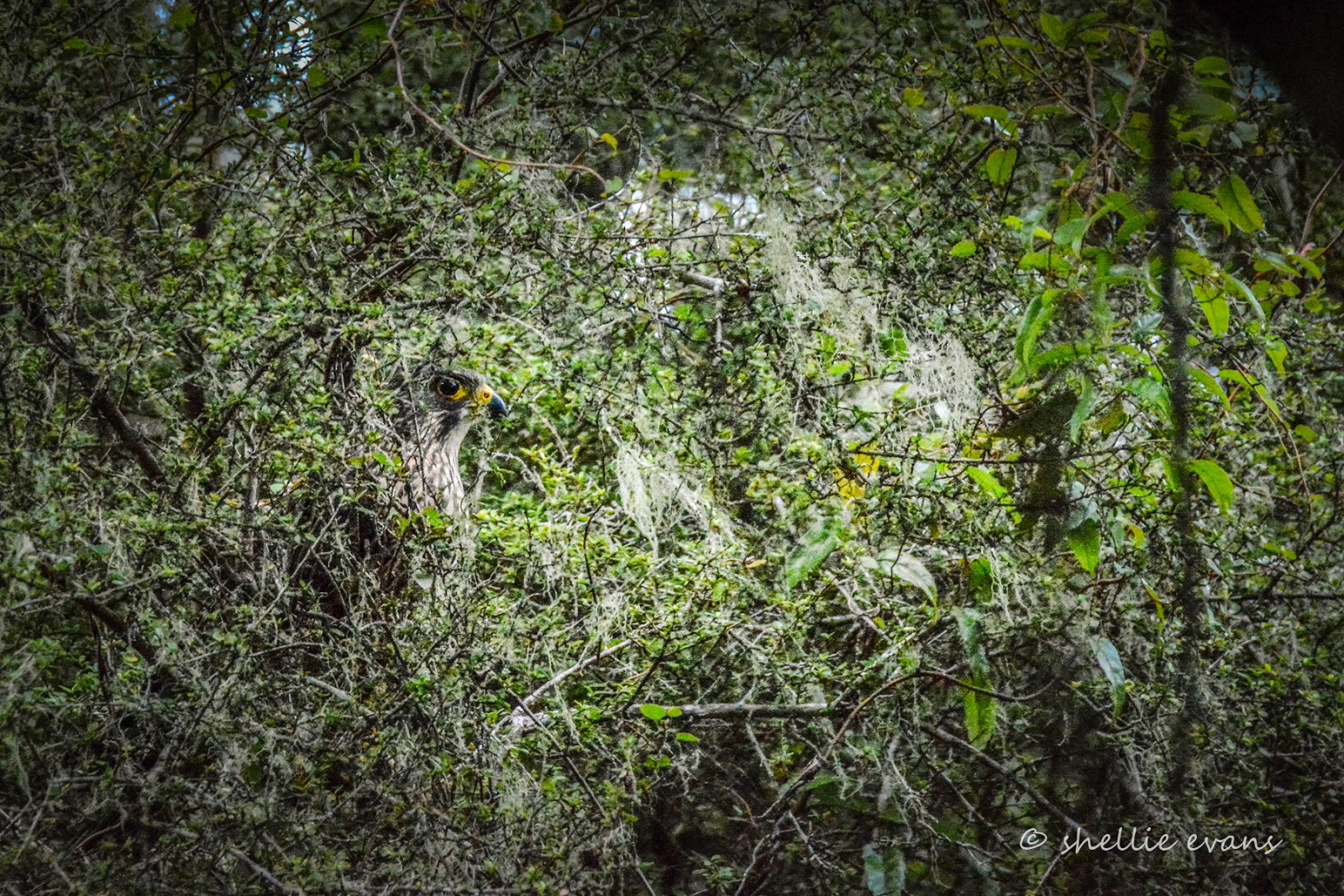
I was walking back across the dam wall to the van when I heard this horrendous commotion coming from the bush beside the carpark (in front of the blue car on the right in the photo, two above). I walked up to the edge and peered into the dark gloom (it was about 8:45pm); the bank ran down to an overgrown swampy area. I couldn’t believe my eyes when I saw a rare NZ Falcon/Kārearea flapping about in the undergrowth.


At first I thought it had a nest and the noise was coming from it’s chicks, and the surrounding birds were complaining about it being too near. But then falcons usually nest close to the ground or in fact on the ground and this seemed too high plus the other birds were calling and flying about too much. While I was trying to decide what was happening the falcon flew out and up into a nearby tree. I hurried back to the van, grabbed my camera and called for David.

As I got back to the bank edge again, the falcon flew back down to the tangle of vines and branches where I’d seen it the first time. I could hardly see what was going on because it was so dark and getting darker by the second. My camera recorded it in much more detail that my brain! For those that know the workings of a camera, I shot these with the ISO set on auto so I could get as much detail as possible out of the dark ‘hole’. I usually shoot at ISO100-200, these are all at ISO25,600! The reason why there is so much noise (grain), but worth it for the shots.

The falcon was peering into the bush (above) and then looking over it’s shoulder at me, I presume, although I couldn’t quite see that as I was clicking away.


She(or he, I have yet to find out) looked back down into the vines, all the while the birds in the trees around me were alarm calling and flying about; tui, bellbird, brown creeper, grey warbler amongst others.


She disappeared through a gap in the vines…


…to reappear seconds later in a different area of the vines, checking to see if I was still watching…


…and to decide what to do…

…it looks like she has a vine tangled around a leg as she pulls at it with her bill…


…she then stretches forward and peers about before jumping…


… back near the hole she disappeared into the first time, checks on me again…


…before flying off…


…to the top of the trees once again, the other birds still protesting loudly and flying after her.


Just moments afterwards she’s back down on the vines; the hungry call of her chicks no doubt ringing in her ears;


…as she decides I’m no threat and jumps across to be the hole in the vines again…


…where she takes one last look around…


…and dives down through the gap...(the other birds are now really going berserk and the volume of noise increases tenfold)…


…to reappear just a second later with….…a squawking tui chick in her mouth!


Remember I can’t actually see all this, I’m just clicking 20 to the dozen but I can see the outline of the falcon and hear the screaming chick though and I can guess what is happening.


She flies off, up towards the tree tops and then across the road where we can see three adult tuis in hot and noisy pursuit. The falcon circles around and flies off across the lake heading for the top of a ridge a few kilometres away. The bush falls into a deathly silence.


There are no chicks left in the nest and we’re left wondering whether she maybe took a chick on the first visit when I heard all the commotion and ate that for herself before returning to steal the second one for her chicks. Or perhaps she’d already snatched a chick earlier in the day or the day before and knew there was one more there for the taking. Then again perhaps there was only one chick in the clutch. Whatever it was, she had flown a long way and found the nest in a obscure and nearly inaccessible patch of vines. I assume she was initially attracted by the hungry squawking of the tui chick(s)

It was a huge surprise when I uploaded the photos to see that I managed to capture the falcon leaving with the chick in it’s mouth, although I kind of wish I hadn’t. Everytime I woke that night, I had visions of that poor baby squawking for it’s mum! Nature in the raw, such is life.


Monday, August 31

Finches & A Falcon

I mentioned in the last post that we saw a second New Zealand Falcon on our road trip over Danseys Pass, the first was chasing a smaller bird down a narrow gully, they disappeared over a rise at great speed and we didn’t see the outcome of that battle. The second happened when we stopped at Kyeburn Diggings to watch three Australian Harrier Hawks/Kahu swooping and diving through thousands of finches which were feeding on the seeded grasses that were growing in a paddock of winter stock feed.


These photos were taken a few days later, after the snow fall, when we went back to see if we could spot the falcon again and even though they’re not the best photos, they’ll give you an indication of the sheer numbers of finches that were feeding over the paddock- the next two photos are full of finches, right to the bottom of the photo (click to enlarge)


These are mostly Redpoll Finches with a few Goldfinches scattered in amongst them with slightly larger (and possibly slower flying) Chaffinches around the periphery of the flocks. Redpolls are the smallest of New Zealand’s introduced finches and are widespread throughout the South Island but not so abundant up north.


There were thousands of birds lifting and swooping, swirling and landing for a moment before lifting again. The chatter and wing noise was amazing and no matter how often I tried to catch them up close they spooked, with the hawks hunting through the masses, they were on full alert.


I managed to catch a few birds as they stopped briefly on some bushes nearby- a lone male goldfinch at the top left and the rest are redpolls. When mature, both sexes have the red patch on their heads (poll) with just the males having the colour on their lower throat and chest after their second year moult. Juveniles have no colouration. Without these photos it was extremely hard to identify the birds, they were so fast and quite a distance away. We couldn’t keep up with them even with the binoculars.


While we were watching the hawks swooping over and scattering the flock a slightly smaller, faster bird came flying through, swooped up and landed awkwardly at the top of a tall poplar tree just behind us.


At first we thought it was one of the hawks and as we trained the camera & binoculars on it, it still took us a few seconds to realise with stunned disbelief and great delight that is was a NZ Falcon/Karearea.

Falcons are one of only two New Zealand endemic birds of prey- the other being the native owl, the Morepork/Ruru. Falcons are found throughout New Zealand but are quite rare. The NZ Falcon is one of the fastest falcons in the world capable of flying at up to 200 km/h, they hunt live prey mainly by watching from a vantage point and making a fast direct flying attack striking or grasping the prey with their sharp talons and killing with a powerful bite to the neck. They’re capable of catching prey larger than themselves but their diet mainly consists of small birds.

She (or he- the males are quite a bit smaller but without a comparison we couldn’t tell) couldn’t get a good perch where it had landed and lifted off (slightly out of focus, these photos are at the end of my zoom lens and have been cropped)


To land in the top of the poplar next door….


….where it still had trouble holding on….


…it hopped about from one foot to the other…


…bounced up in the air….


…tried once again…


…before deciding this wasn’t the best vantage point to wait before the next dinner dash…


…so lifted off heading to the right….


…before changing direction and sweeping around and dropping into a spectacular stooping dive back over the paddock scattering thousands of finches along the way.


She disappeared along the river at the end of the paddock and we didn’t see her again, even though we returned a few days later where we found the hawks still working the field.

It was another thrilling encounter with a rare and endangered bird and extra special that we were able to watch it for a good minute or so before it moved on. Most of our sightings recently have been very brief and usually on the wing except for our first encounter on the Catlins River back at the beginning of our travels.


Sunday, March 16

Mavora Flora & Fauna

I found the plant life around Mavora especially fascinating, in particular the low profile alpine plants that grew on the tussock grassland plateau. I would suspect that most people would just see a scrubby dry expanse of green & bronze with tuffs of tussock here & there. But stop & explore down low and there's a myriad of tiny little ground cover plants with equally tiny flowers & berries. There is also plenty of dried rabbit poo and half dug holes everywhere but there must have been a major pest eradication programme happening because in all our time there I only saw two rabbits; one we startled when we stepped off the swingbridge & the other I saw way up the back of the campsite running about like a mad thing on the thick covered moss in the forest.
 
Unlike the drive through Nokomai Station & along the Nevis there were only a handful of Spear Grass at Mavora, this one in flower with some nasty looking spines protecting it.
 
 
This is our native bidi bidi, there were a number of small patches at the edge of the gravel tracks. The red was very bright in amongst the greens & browns of the grass. The little hooks on the end of the red spikes latched onto your socks without warning and then when you went to remove the flower ball it fell apart in your hand dispersing individual seeds with their own hooks on to everything within reach. A typical bidi bidi.


A montage of tiny alpine ground cover, the ones above look like mini pine trees. The tiny yellow spikes were a few millimetres high, they were obviously flower spikes of some sort. The more mature ones let loose a cloud of brown dust when you touched them. The single tiny red spikes in the fourth photo were flower spikes of some sort too.


More bidi bidi flowers followed by tiny berries on a bush, fungi & a ground cover orange berry in the fourth photo; no wonder our birds are so small, these berries are pill sized. The fungi wasn't as colourful as what we saw in the Catlins but there was still many varieties along with many different shades of green moss & lichen.


I happened to be walking along the access road one afternoon when I got the fright of my life as a bird lifted off the fence right beside me and took off up the valley. As it flew I quickly registered that it was, of all things another NZ falcon -Karearea.  How exciting. I didn't have my camera ready but managed to grab a couple of shots as it disappeared. We saw or heard the falcon just about every day while we were at Mavora. At 7am most mornings it would circle high above us calling with it's distinctive call as it went. We saw it land high on the slope at the north end of the lake when we were out in the boat one day, we thought it may have a nest close by but we lost sight of it by the time we got close.

Another day we watched as it chased & had a aerial battle with a harrier hawk that had intruded into it's territory. David also saw it flying with & swooping around a black backed gull along the lake edge. It didn't seem to be battling with it, just cruising & checking the gull out. These photos aren't in focus but if you look closely at the one on the right that I've blown up, you'll see that he's turned his head & is looking at me.

 
Just on dusk one day David also spotted it land on a ridge not far from our campsite. He came racing back to get me & it was still there when we returned in the ute but it lifted before we could get close. Unfortunately I didn't manage to get any close up shots of him but it was a thrill just to know that he was out there (no pun intended) around us everyday.


If you have been following my blog you'll remember that while in the Catlins, try as I might, I just could not get a good photo of our fast moving smallest native bird, the Rifleman- Titipounamu. At Mavora there were lots of Rifleman, well lots compared with elsewhere where we've seen them. But they were still proving to be elusive, I could hear their tiny high pitched peep as we moved through the bush but unless you caught sight of a movement you had no idea from where the noise was coming.

We were out on the boat one day, another calm day with the lake a millpond when we both spotted some movement in the water quite a way off to the side as we passed. At first it looked like a thistle "fairy" seed head and then like a fish was nipping it from down below making it move. Just a slight movement but enough for us to turn the boat around and take a closer look. As we approached we both realised at the same time that it was a tiny waterlogged bird floating on the surface; a Rifleman no less!  I quickly scooped it up in the net, it was just alive but died in my hand moments later. I massaged it's tiny breast and cupped it in my warm hands then wrapped it in the towel for awhile, willing it to take a breath, but sadly it was gone. So finally I had my close up photo of a Rifleman but definitely not the one I wanted. When we stopped later, I buried it on a stony beach, wrapped in some soft leaves with a tiny stone cross & some wild flowers on top.


Around camp & at regular intervals on any bush walk we did we'd hear the loud & familiar call of the Bush Robin- Toutouwai, and on many occasions they'd step out onto the path looking for stray insects that we disturbed along the way. These are the South Island Bush Robin (of course), they are virtually the same as the North Island Robin except that they have yellow tinged breast feathers. Robins are quite large & very cute, I'm going to sign off my Mavora posts with one on a very special little bird I made friends with but you'll have to wait a couple of days for that.

 
Once again David found the fishing hard going, this was the only one he managed to land & of course it went straight back in. Just before this though he had a monster on line....true, I saw it jump. Jump right off the hook & swim away!

 
And finally just before we left Mavora, I managed to get some reasonable Rifleman shots although I'm still not 100% happy with them. Rifleman are busy little blighters, they were moving in and out of the bush and sunny spots and I couldn't keep up with my camera setting changes. This was a family of rifleman (or should that be riflemen); male, female & two fledglings. I had gone out into the bush specifically targeting rifleman & trying hard not to get distracted by the nosey robins but although I heard and saw quite a few they were all too far away or in too dark a bush to get clear shots.
Female Rifleman
I was heading home through some trees where there is a camp area when I heard their familiar high pitched contact peep and there they all were racing up & down the trunks, along the grass, under the branches & of all things, climbing over & under a vehicle parked beside the wood BBQ. One disappeared up the exhaust pipe, another hung off a bit of string that was tied to the bumper. They ran up and down the grille and in and out of the headlights & mag wheels & all over the number plate picking off all the dead insects. 
 
Male Rifleman

Juvenile Rifleman


And after the vehicle they moved onto the BBQ, picking their way through the embers and running up the metal grille behind. Some seriously adapted habits there! But at least I got some shots to replace the ones of my dead little buddy.