After our night tour to Zealandia to see the famous Kakapo, Sirocco, we returned to the Sanctuary the next day to do a self-guided tour and hopefully see some of the many other endangered birds that live in the park.
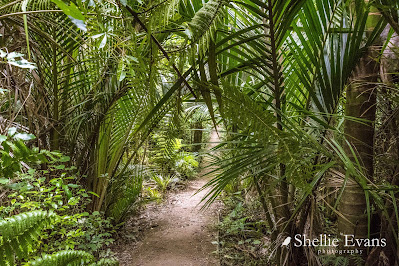
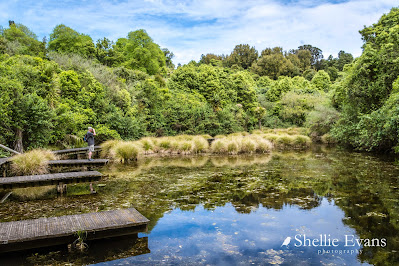
Zealandia, formerly known as the Karori Wildlife Sanctuary is a 225ha natural area of regenerating bush and forest just 10 minutes from downtown Wellington. The valley where the sanctuary is located was previously part of the catchment area for Wellington's water supply, the two large lakes were the former dams.
At 135 years old, the historic and distinctive Gothic-style valve tower has pride of place on the lower lake. Beneath the 21 metre-deep water level the cylindrical tower is stock-standard concrete. The tower, and the dam, are classified as having significant engineering heritage by Engineering Heritage New Zealand.
The most important part of Zealandia is the 8.6km pest-exclusion fence that surrounds the sanctuary. Designed to exclude fourteen species of non-native land mammals ranging from deer to mice it has allowed re-located populations of endangered native species to re-establish themselves on a mainland ‘island’. And not only in the Sanctuary, the numbers of sightings of some bird species have greatly increased in the nearby city suburbs too.
Part of the fence can be seen snaking up the hill behind another historic building near the lower lake. The boat shed was used by the governor-general of the time (1872) who had fishing rights on the lower dam.
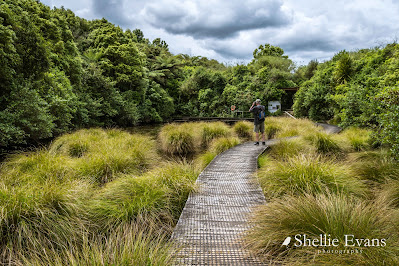
There are 32km of tracks to choose from within the park, ranging from wheel-chair friendly paths to some serious ‘tramping tracks’ on the extremities of the valley. The main track alongside the lake is the one we followed the previous night when we visited Sirocco. A string of fairy-lights sparkled on the bank above us while a volunteer guide led the way and another was tail-end Charlie so none of us would get left behind. It certainly looked a lot different in the day time, we were unaware the lake was right there below us.
These are Wellington Green Geckos/Moko kākāriki, they were sunning themselves in a rearing enclosure near the entrance. There are many in the wider sanctuary as well but only the keen-eyed would spot them. It’s the same with the Tuatara, there are breeding enclosures and wild populations which are regularly seen on the night tours.
Near the top of the lake on overhanging and fallen trees there are two shag rookeries with three different species of shags nesting. These are Pied Shags/Kawau and they have babies only a mother could love.
At the top of the lake where the Kaiwharawhara Stream forms a wetland as it flows into the dam there are a number of rare Brown Teal ducks and another endangered bird, the Takahe. A cousin of the much lighter and much more common Pukeko/Swamp Hen, Takahe were once officially declared extinct until a very small number were re-discovered in 1948, in a remote Fiordland valley. There is now a current population of 221 birds- due to the incompetence of a few this figure should be 225. Four critically endangered Takahe were shot dead during a pukeko cull on an island sanctuary in the Hauraki Gulf last August.
The Takahe pair here at Zealandia are a retired couple who no longer produce chicks, they were moved from their last sanctuary to make way for younger birds.
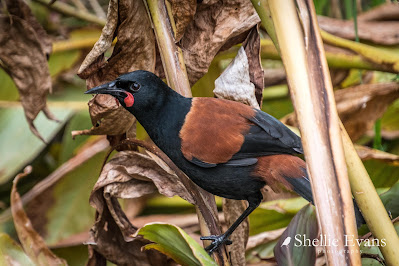
The path follows the stream up the valley through thick bush and along the way we hear a very familiar bird call. Rummaging through the leaf litter and bounding up the exposed roots and lower branches are three or four North Island Saddlebacks/Tīeke.
We are very familiar with Saddlebacks, having seen them many times on Mokoia Island in the middle of Lake Rotorua, Moutohora Island off the coast from Whakatane and Tiritiri Matangi Island in the Hauraki Gulf near Auckland (all island sanctuaries), but these ones are a lot more confiding than others we have seen. Which is most probably because of the number of visitors passing by, they aren't as fearful. Saddlebacks have been extinct from the mainland since 1910, they are poor flyers and mostly forage close to the ground which makes them easy prey to introduced pests. They have a loud distinctive contact call which once you’ve heard you’ll never forget.
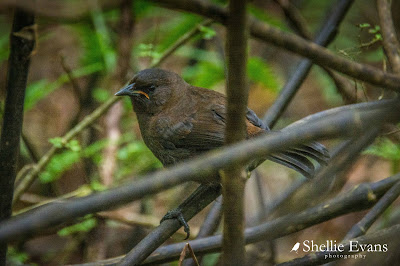
Unfortunately as confiding as the Saddlebacks were I was unable to get a good photo, dark bush and overhanging banks did not help with exposure- for those that understand settings, this was shot at 270mm, ISO 2500, f/5.6 and the killer 1/30sec!
A Kākā feeding station is located halfway up the valley and while the birds of Zealandia can feed and fend for themselves some of them receive supplementary food.
Kākā are a large, noisy, olive-brown forest parrot (with bright orange under their wings), similar looking to their ‘cousin’ the Kea, New Zealand and the world’s only alpine parrot. Kākā have a very loud ‘scraak’ call which can be heard far and wide, the word kākā can mean ‘screech’ in Māori.
Kākā had been extinct in Wellington since the early 20th century until they were transferred back into the wild at Zealandia in 2002. Now they can often be found outside the sanctuary in suburban gardens where they’re not always welcome due to their screeching, and the damage they do, tearing bark and small branches from trees. Just like the Kea they are also very engaging birds, I could easily spend hours watching their antics.
Zealandia has a volunteer workforce of over 450 people helping rangers with everyday tasks such as track maintenance, fence monitoring, conservation work, gardening, bird feeders and guides. Here the Kākā feeders are being replenished and the Kākā know it’s about to happen, they are quietly waiting (which is unusual) in the wings, for the trays and bottles to be refilled.
The bottles contain a high protein liquid and as soon as a they are refilled the Kākā flock to them. They know exactly how to extract the liquid, some have mastered the task extremely well, using their tongue to push the valve up the tube, while the liquid pours down their throat in big slurps.
Others mouth and play with the valve until a little liquid is released.
Other nectar feeding birds such as this Bellbird/Korimako wait patiently in the nearby bushes, flying in, in the hope of collecting a stray drop while the nozzle is vacated for a few short seconds between Kākā . They don’t have the strength to push the valve up themselves.
The tray lids open when the Kākā moves onto the perch in front of the tray, the bird’s weight pops the lid and they can help themselves to the snacks inside. This opportunist Blackbird(male) waits for a Kākā to come along so it can dive in and help himself too when the lid opens. He’s too light to lift the lid. Sitting beneath the feeding station, ducks also wait for an free meal.
Across the way from the Kaka feeding station is another feeding area, this one is for our smallest parrot, the Red-Crowned Parakeet/Kākāriki.
Kākāriki were once common on mainland New Zealand but are now mainly confined to predator-free islands although we have seen them in the bush on the Central Plateau. Like all of New Zealand’s parrots and parakeets, Kākāriki are endemic (found nowhere else in the world).
Once past the parrot feeding stations, there’s a short steep climb to the top dam. Construction of this dam began in 1906. Completed in 1908, it is one of only three gravity arch dams in the country, and an early example of the use of concrete in New Zealand. An engineer’s report done in the late ‘70s found the dam to be an earthquake risk as it was positioned right over the Wellington Fault. The lake behind the dam was lowered and in 1991 the upper dam was decommissioned.
The top lake now looks very natural and being quite isolated, it’s hard to imagine that this is located in central Wellington. What a fabulous asset Zealandia is to have, right in the heart of the city.
We had one last bird to find (well in fact there are a few more we could have found if we’d had more time) but there was one last bird I wanted to see before we headed back down the valley.
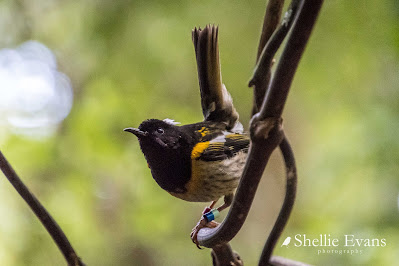
This is another one of New Zealand’s rarest birds, the Stichbird/Hihi. Hihi are like many native NZ birds, they didn’t cope well with the arrival of humans and the habitat changes and animal pests they brought with them. Like many natives, Hihi nest in tree cavities close to the ground which makes them especially vulnerable to rats, stoats and cats. It’s also thought that bird diseases carried by introduced exotic species may have also contributed to their rapid decline. By 1885 they were extinct on the mainland, surviving only on Little Barrier Island in the Hauraki Gulf.

It was thought that the Hihi was part of the tui & bellbird family but in fact it belongs to another bird family, it’s closest relatives are the iconic wattlebirds that include the Kokako, Saddleback & the extinct Huia. Hihi are a North Island species only and this is a male, the female, as often is the case in the bird world, is a little more muted in colour and without the bright yellow and solid black. Being the beginning of the breeding season when we visited, there were mostly males chasing each other near the Hihi feeding station. Any females that made an appearance were soon harassed out of there with two or three males giving chase.
Another dark bush, out of focus shot but in this one you can see the how the ear tuffs are used when the bird challenges other males.
Happy with our exploring and the birds we had managed to see, we walked back over the dam where there’s a good view down the valley towards suburbia, crossed a swingbridge and wound our way back towards the entrance along another track...
…tip-toeing past Sirocco’s enclosure on the way. If you missed my blog post on Sirocco, you’ll find it here-
How the Dud Became a Stud
We made our way back to Evans Bay ahead of the afternoon rush hour, arriving back to find ‘Out There’ parked up all on her lonesome, the evening influx of motorhomes, sleeper vans & buses yet to arrive. Wellington’s famous wind was just picking up so I took the opportunity of taking a few more photos of the 26 metre high Wind Wand (Zephyrometer) which we’re parked near.
It’s quite mesmerising standing underneath it watching it dip and bow with each gust, not quite silent and with the grace of a conductor it seemed to be guiding the evening rush hour past.
We left Wellington the next morning,
stopping at Marton for a night, before one final long haul onto our old home town and eagerly awaited catch-up with family & friends.
We’ve been parked in the campground at Mt Maunganui for the last 4 weeks and have thoroughly enjoyed ourselves although the first week was a major culture shock after spending the last few months in the deep South where people (and motorhomes) are few on the ground.
And with that, I've nearly caught up to date again. Just a couple more posts from the Mount and I should be ready to report live again. Just in time because we're on the move again later this week. Hawkes Bay here we come, with a few more weeks of family & friends 'meet & greet' to do. Can't wait.