Real-time
We're back on the Mainland, back to our home on wheels and still parked on the family's front lawn in Winton. We had a fabulous time on Stewart Island/Rakiura and enjoyed every minute even though the weather was a little fickle. After the initial 2 days of solid rain, the sun came and went as regularly as the rain showers. One day it was hot and sunny, the next cold and blowing a gale. Thankfully we went prepared with our wet-weather gear and as long as we had that on board we were good to go.
If you are into birds and tramping, then Stewart Island is the place to go. We were in seventh heaven with the amount of bird life we saw and how close we were able to get to a lot of it. And with so many walking tracks both around town and further afield there's plenty to keep you occupied. I'll do some more posts on Stewart Island later but in the meantime here's one for the birds....I mean on the birds!
Of course the kaka and their antics kept me occupied whenever we were in our unit at Kaka Retreat, they are such characters.
I can see how people fall in love and want a parrot for a pet, I wanted to bundle one up(a gentle one) and take it home! I was taking a photo of a kereru when this photobombing kaka's face appeared in my viewfinder.
They are quite endearing although you do need a healthy dose of caution around those beaks. After a few quick nips I became very wary, I don't think they meant to hurt it was more frustration. I think if they had meant to be nasty they'd have had my finger off, the pressure behind a small nip was amazing- my finger knuckle ached for an hour or so afterwards. I managed to find some distinguishing feathers on a few of the gentler birds and allowed them to get close each time they visited.
I hadn't realised that not only are the Kaka Beak plants named after them because of the shape of the flower but the bird also eats the flowers. I'm not sure if they're getting the nectar or just playing with the flower. They didn't take them off just shredded the petals a bit.
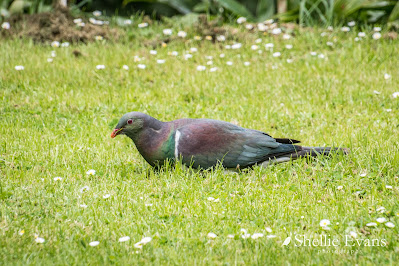
We have never seen as many Kereru/NZ Wood Pigeon in such numbers as we did on Stewart Island and especially around Oban village.
Dozens and dozens of pigeons flying here, there and everywhere, the sky overhead was a constant sound of swoosh, swoosh, swoosh as they flew from tree to tree and garden to garden feeding on a variety of ripe berries in the bush. Often they'd crash land in the undergrowth or drop through from the trees above, bumbling about looking for food or chasing rivals away. More than a few times we were startled by a fat pigeon flapping out of a thick bush at head height. If they'd stayed still we'd be none the wiser that they were there. When it rained they were perched in large numbers on the power lines looking very much like over-sized starlings.
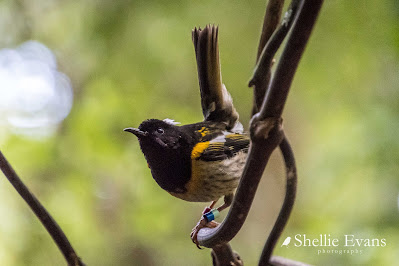
Also enjoying the fruiting bush were Bellbirds/Korimako- here's a male on a Fushia tree...
And a female with a berry from a Māpou bush...
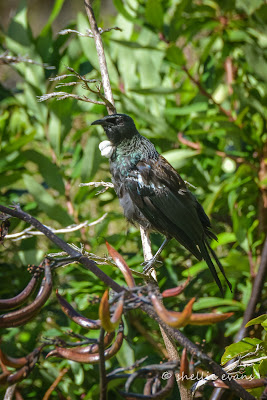
Quite often we'd stand beside a thicket of bush listening to all the different noises coming from the depths and wait to see what emerged. Often there'd be all of the above birds along with tui, warblers, fantails, tomtits, parakeets and brown creepers amongst others. All feeding, chattering and stumbling about in the bush. Many of the birds had fledgling chicks with them which of course added to the noise. It was certainly a good time to visit because the chicks calling for food often lead us to them and the parents.
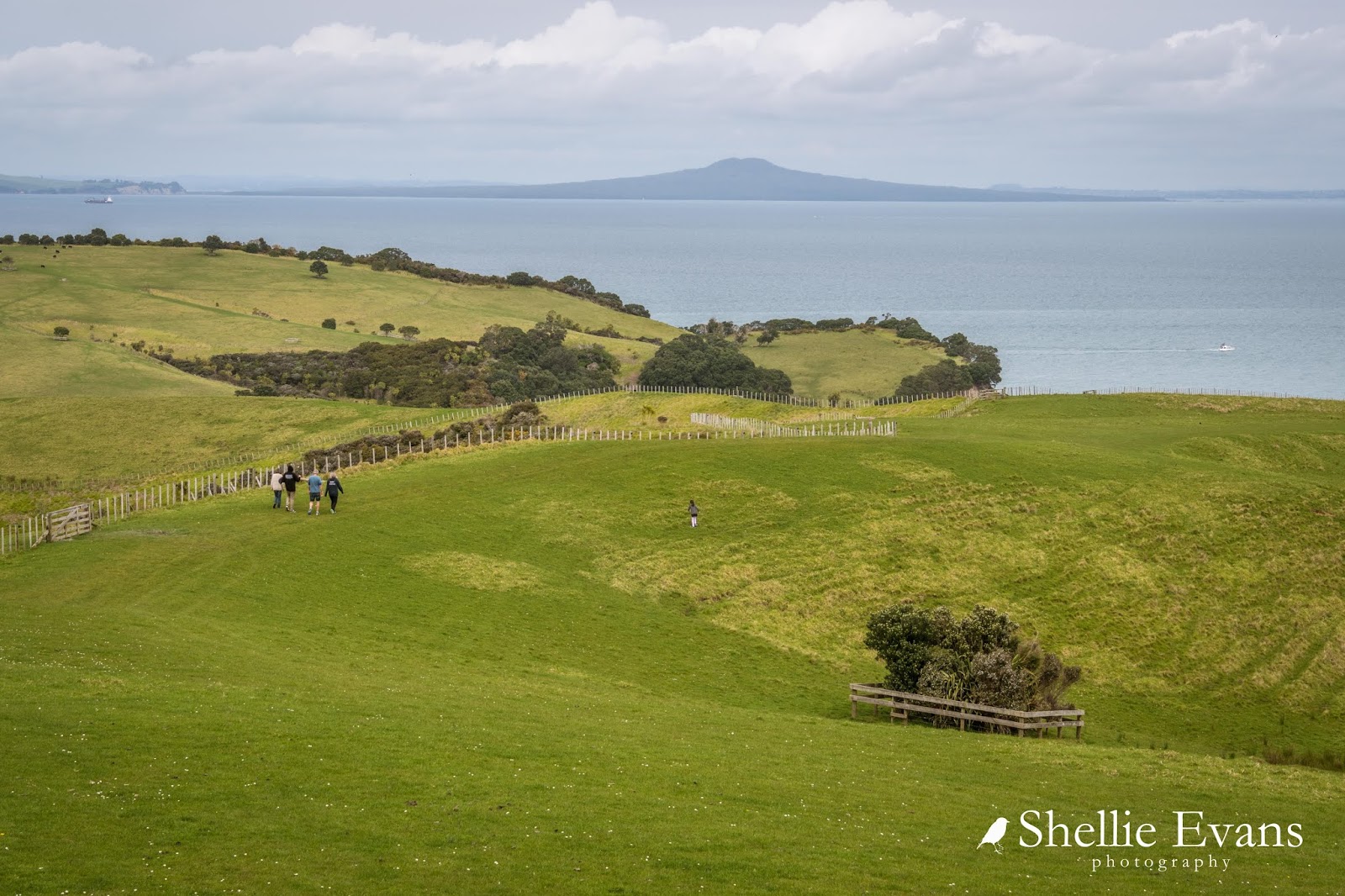
One of the first excursions we wanted to do was to Ulva Island/Te Wharawhara, an open bird sanctuary just offshore in Paterson Inlet. After two days of rain and then one of gale force winds we finally decided to try for Ulva the following day. The ferry leaves for the island at 9am and we were up bright and early hoping to catch the first crossing. We had to walk down the hill into the village and then haul ourselves up the short steep climb and over into Golden Bay where the jetty was located.

We were first in line, paid our $20 each, received our boarding pass; a leaf from the aptly named Muttonbird Scrub and boarded the small ferry. Although it was relatively calm over on the village side of the island, the wind hadn't dropped at all in the inlet. It was wild and rough with squall after squall passing through.
The skipper zipped up the boat's back curtain and told us to hang onto our hats we were in for a rough ride and that usually it was a 10 minute ride to Ulva, today it was going to be 20 minutes! A couple of passengers looked a little nervous. Waves were crashing over the top of the boat as we bounced across the gap between the islands. Unfortunately when we got to the jetty, the swell and waves were just too big for this little boat. The skipper tried to edge into the jetty and then back up to it but the waves kept crashing over the top of us and there'd be no way we could have jumped off the boat with the swell heaving the boat up and down. The skipper made the decision to return to base.

Back on dry land we made decision not to board the slightly bigger water taxi which was able to land that day; the wind was picking up and rain clouds were forming on the horizon. We wanted a more settled day to explore Ulva, so we said goodbye and decided to head home via a nearby walk around the bays. From a vantage point on the walk we could see the water taxi (top right & bottom above) heading back from Ulva. We heard later that that our skipper was very experienced and had been doing this run for many years and that this was possibly the first time he'd called off a landing.
Later we also got caught in the the most violent rain and wind storm we've ever had while walking, we were about 5kms from home, the rain was horizontal and stung like a thousand needles on our faces. We arrived home totally drenched and cold through to the bone. It would have been no fun on Ulva.
 |
| Post Office Bay, Ulva Island |
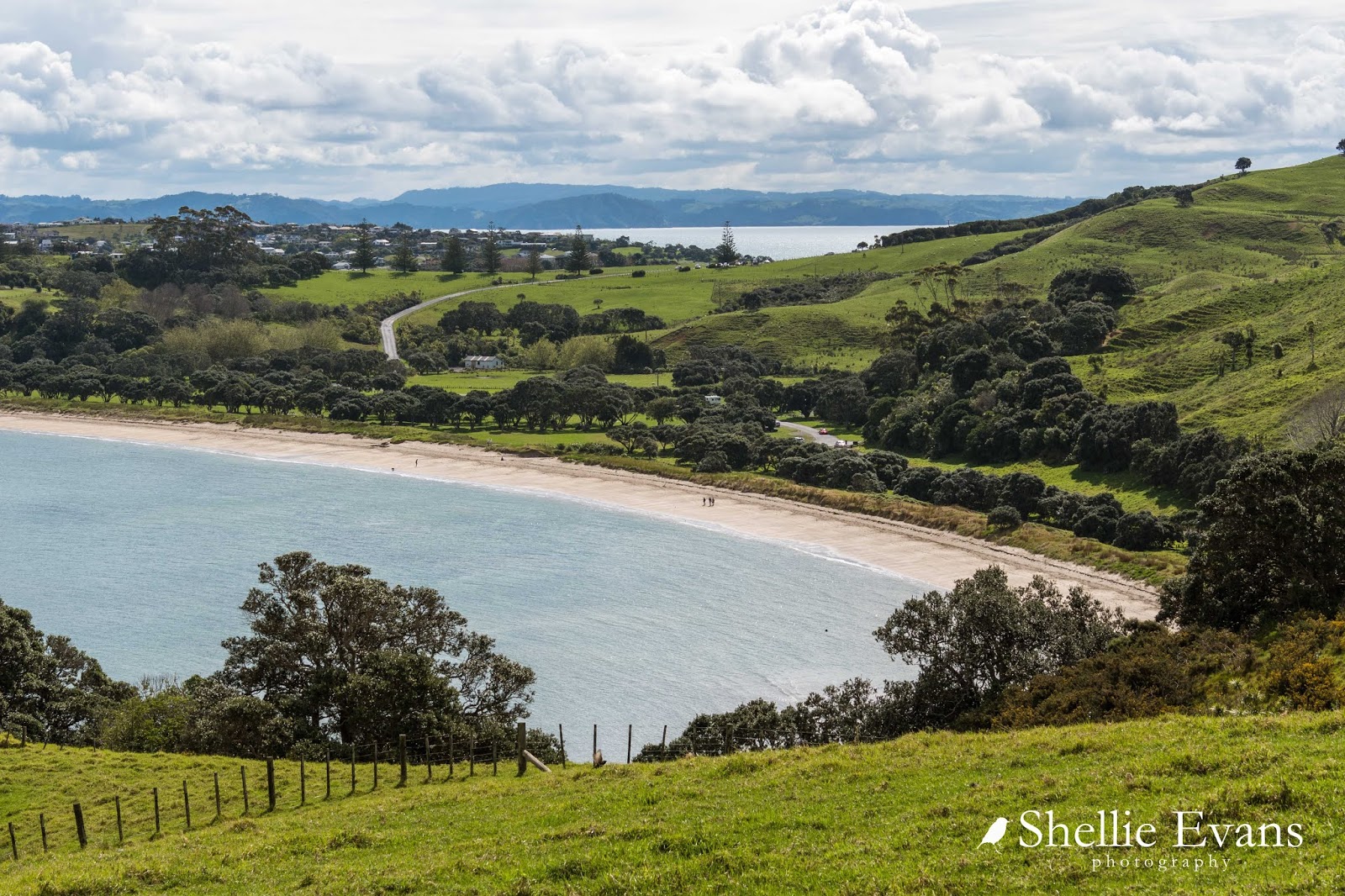
A couple of days later we made the journey again, this time arriving at Post Office Bay, Ulva Island on a sunny and relatively calm day, although the wind did pick up again later on. Just under 8ha of the 260ha island is privately owned, part of it being here in this bay.
The post office was built in 1872 and used until 1923. There was only one family living here on the island but the irregular mail boat stopped at Ulva to offload the mail for the many families that lived in the sawmilling, boat building and fishing settlements around the inlet and on other islands. A flag would be raised at the nearby Flagstaff Point to indicate the mail had arrived and workers and families would row or sail to Ulva to collect their post. This also became a social occasion as people caught up with friends.

The tracks on Ulva Island are well maintained and signposted. There's a choice of four walks of varying lengths to do depending on mobility and time and they are all linked so you can cover the whole area in a quick three and half hours. We were there for the 6 hours, wanting to take our time exploring and tracking birds. Public access is only to a small peninsula section of the island which includes three beaches where sealions can sometimes be found sunbathing.
Our first sighting was of a juvenile Brown Creeper/Pīpipi who was calling for his mum (or helper) who came flying in with some food. I did learn something new about the Brown Creeper; only the dominant male & female in the flock will breed and a number of helpers assist with feeding the chicks.
We saw the usual suspects many times over; bush robins, warblers, kaka, wood pigeons, rifleman, silvereyes, fantails, tomtits, weka, tui, bellbirds, oyster catchers, terns and gulls. But there were a couple of birds we were keen to sight. The first was the endangered Mohua/Yellowhead which is found only in the South Island and then only in small pockets of forest in the Catlins, Fiordland and on Stewart Island.
Mohua are closely related to Whiteheads (which are only found in the North Island) and Brown Creepers, all three species are the preferred hosts of the long-tailed cuckoo. The male Yellowhammer(introduced) is often mistaken for a Yellowhead but the Yellowhammer never enters the forest and a Yellowhead never leaves it. Plus I think the Mohua is a much more handsome bird.
It was a thrill to find our first small noisy flock not long after arriving on Ulva. This was our very first sighting of the yellowhead although we have heard them in the Catlins before. They usually spend most their time in the forest canopy but here on Ulva (where there are no predators) they also forage in the lower canopy and on the forest floor. The flock called to each other incessantly, the females have a distinctive "buzz" and they all move at a fast pace through the bush, often with a posse of other bird species following along scavenging disturbed insects and bugs.
This family group had approx. 6-7 birds and included at least two and probably three (they were hard to count moving so quickly) hungry and demanding fledglings- that's a baby on the right below. These two birds were right on the edge of the track at head height and although I tried my best, the bush was once again very dark, so many of the photos are a bit noisy (grainy) because of the high ISO.
Mohua, like the Brown Creeper, also have helpers.
The fledglings were keen to learn where their food was coming from, staying on the tree trunks long after the adults has left. Mohua have spikey tails which they use as a prop while hanging on to the side of a trunk while digging around for food. It was a thrill to finally see Mohua and to be able to spend quite a bit of time observing and following them through the bush.
I was also pleased to add another native orchid to my 'have seen' list; the delicately draped and tiny "Lady's Slipper Orchid".
We've seen Red-crowned Parakeets/Kākāriki on many occasions but never this close in the wild and in so many numbers. There were plenty of red-crowned parakeets on Stewart Island too, every morning & evening we would hear their high-pitched chatter as small flocks passed overhead.
Here on Ulva we often found pairs resting on low branches just off the track, foraging on the path or poking about in hollow tree trunks at ground level.
Another bird we wanted to tick off our virtual list was the much rarer Yellow-crowned Parakeet/Kākāriki, I'd heard they sometimes hang out with their red-crowned cousins and we soon found one of each perched in a tree together.
How exciting is that! And not only did we see one yellow-crowned, we saw several during our visit.
Not long after we arrived on Ulva we heard a familiar call and we were both quick to identify it, the distinctive call of the Saddleback/Tīeke. We've seen Saddlebacks on a few predator free islands in the North Island, most notably on Mokoia Island in the middle of Lake Rotorua and also in Zealandia in Wellington. But this is the South Island Saddleback and they are distinct from their North Island counterparts in that it takes up to 18 months for their feathers to develop the black colouring and red 'saddle' of the adult birds. Later, on another track, we located a family of two adults and two juveniles (aka 'jackbirds') feeding on the forest floor. They are fast movers, digging under the moss and rotten trees and while not afraid of people, they tend to head off in the opposite direction when they spot you.

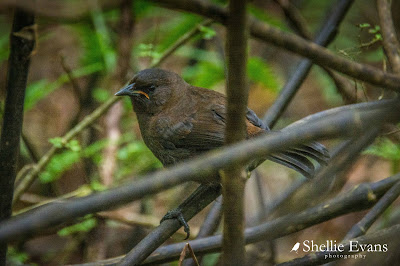
While I was waiting on a seat for David to return to the jetty, this inquisitive and very friendly Stewart Island Robin/Toutouwai came to say good-bye. It reminded me of my
little buddy at Mavora Lakes. There were dozens of friendly robins along the tracks, we helped them find grubs and insects by scraping aside the leaf litter whenever we stopped to say hello. They all seemed plumper and darker than their South Island cousins, although this guy wasn't so dark.
We thoroughly enjoyed Ulva Island and actually visited it twice during our stay, the second time the day was overcast and cool and the birds weren't nearly as active as on our first visit. But we were able to spend a bit more time sitting and listening and following a few of our favourite species a little more closely.
And we had the added bonus of seeing a preening Yellow-eyed Penguin/Hoiho on the ride back to the wharf. Yellow-eyed penguins are resident around Stewart Island and our skipper said he only saw them in the water once or twice every couple of months or so. The penguin quickly disappeared below the surface when he spotted us watching him.
To be continued....Part 2