Showing posts with label sanctuary. Show all posts

Monday, October 15

Auckland Regional Parks & More- Part 2

Continuing on from Part 1

After lunch at Opahi Bay on the Mahurangi West side of the harbour, we drove back to Warkworth, back down Sandspit Road, past our turnoff, past Snells Beach and on along Mahurangi East Road. Then it was along Ridge Road twisting and turning through some magnificent homes with magnificent views  until we finally arrived at Scotts Landing on the tip of a narrow finger of land, one of two fingers that make up the Mahurangi East Regional Park.

We were just in time to see one of  Bio Marine's barges arrive at the slip to offload. 


They have several oyster farms in the Mahurangi Harbour; you can see one (centre) in this photo I took from the other side of the harbour (click to enlarge). You can also see Scotts Landing at water level, on the right, on the other side of the water, 35kms by road away.


These are Pacific Oysters and they are farmed in the inter-tidal zone of sheltered harbours and estuaries. Two tides a day wash over the racks that hold the caged oysters. When they are ready to be harvested, the baskets are removed and taken back to the factory to be emptied, then they're cleaned and returned with hatchery spat inside them. Wild spat are collected on timber sticks in the summer months and the sticks are then attached to racks in the inter-tidal zone too.


While David watched the unloading, I walked around the corner and along a short boardwalk to have a look at another magnificent historic homestead in a regional park.


This is Scott Homestead (hence Scott Point) which was once the hub of the area. Mahurangi Harbour had a busy past with timber milling, ship building and firewood cutting trades. 


How's this for a view from your front garden? 


Thomas Scott Jr built the Georgian style house in 1877 on the site where his father, a shipbuilder, ran an inn until it was destroyed by fire. 


I just loved the colour of the clivias under the pohutukawas in the front garden. Being protected from the sun, they were a deep orange.


From Scotts Landing we headed back towards home but not before I twisted David's arm to drive down to Martins Bay to check out the beach and the holiday park.


Martins Bay was another lovely east facing beach with a backdrop of huge pohutukawas; come summer and New Zealand's very own Christmas trees would be in full bloom, what a beautiful sight that would be.


The large camping ground just about filled the bay with hundreds of sites, it's great to see that the casual camping sites are located on the water front (bottom right).  


There are rows and rows of  permanent caravans, all tucked up for winter. This is obviously a very popular place in the summer. No doubt a few of them will be getting a good airing this coming long weekend.


And then there was some more arm twisting to convince David to drive along the waterfront at Snells Beach to check out the two freedom camping sites; he was getting weary and thinking of home.

This is  Snells Beach East where there's a 2 night maximum stay, it looks great but we'd only fit in at the far end otherwise we'd stick out too much for people to pass.


The Snells Beach West site looks to be the better one if we ever come back this way, it also looks like it may be a little quieter (allocated sites at the back of the carpark) with the added bonus of a boat ramp. This also has a two night maximum stay. 


We had the next day off and then the following day (and our final at Sandspit) we headed north to check out the last of the regional parks in the area; Tawharanui which is located at the end of the Takatu Peninsula just south of Omaha Beach.

We were travelling along a winding country road not too far from the end of the road when David suddenly exclaimed 'That's it!" as he pulled to a sudden stop. He had spotted his brother's old business 'Sandpiper Lodge', we hadn't seen it in over 25 years and we weren't exactly sure we'd recognise it or in fact if we were on the right road. We just knew it was in the general area. 

It's still a lodge but with a different name. I remember the estuary that the grounds border, we did some bird watching along the edge and we spotted out first and only Kookaburra, a fairly rare Aussie import that hasn't spread much further than the North Auckland area.


Finally after another short length of narrow and winding road we came over the top of a brow and there below us was Tawharanui Regional Park, another park, like Shakespear, that is protected by a predator proof fence.


There's not many (if any) places in New Zealand that you'd see this sign cautioning drivers to the existence of three rare birds; Pateke (Brown Teal ducks), Takahe (a little like an oversized pukeko and very rare, they were thought to be extinct not too many years ago) and Kiwi. Unfortunately we didn't see any of them; not that we went looking any further than out the car window! According to the DOC Ranger we spoke to, the Takahe are frequent visitors to the surrounding paddocks.


The park has several beaches and a lagoon along with a fairly large campground tucked in behind sand dunes; this camp is another one that has a 8 metre size restriction- I'm guessing because of the narrow road in and sharp drop down to the park. A marine reserve also borders the northern boundary of the park.


There are several walks over the headlands, around the lagoon and along the beaches. We walked along the boardwalk around the end of the lagoon until we reached this noisy fellow, a male Paradise Duck/Putangitangi (can he read?). Paradise Shelducks like to rest on high spots, some even high up in trees. It's likely he was warning his mate that we were approaching, she would have a nest somewhere near by in the reeds of the lagoon.


And that was that, a little bit of the North Auckland area explored. Though not nearly in enough detail but at least we managed to tiki-tour a few places. Onwards and upwards....


Thursday, September 27

An Open Sanctuary- Part 1; Shakespear Park

Real Time

To try and keep up to date, I'm going to do a few more short posts rather than wait until I have a stack of photos to process and then have to spend a couple of days writing up a long post. We'll see, but you know how it is, it's very hard to change a habit of a lifetime (well 6 years of blog writing anyway).

From Ardmore we carried on heading north towards our next destination...


...timing the drive through Auckland just right as there wasn't too much traffic on the motorways. It's been five years since we last saw the Sky Tower loom up ahead of us. 


Once across the Harbour Bridge and through the northern suburbs we headed out along the Whangaparaoa Peninsula where the locals have this flash (fairly new) control system to ease congestion during rush hour traffic. The middle lane changes direction depending on the traffic flow. Outside rush hour it becomes, as the sign says, a flush median. 

You might wonder why this was of interest to me; we used to have this over the causeway on Chapel Street in Tauranga for a number of years (before the expressway was built). We didn't have flash lights and signs though; ours were just road cones that were moved from one lane to the other during rush hour- it fixed the problem though! 


Twenty kilometres later we arrived at the tip of the peninsula; our next camp is through that pest proof fence. The automatic gates open as we approach; of course we have checked we have no stowaways onboard- you know us and our mouse traps; they are permanently set in the rig.


This is the stunning Shakespear Open Sanctuary, a 500ha Auckland Regional Park that was once a large farm at the end of the peninsula.


This is a ideal site for a sanctuary, a relatively short 1.7km predator proof fence runs across the narrow isthmus between Army Bay on the north side and Okoromai Bay on the south side while water borders the remaining three sides of the sanctuary. You can see the fence snaking down through the gully here on it's way to Okoromai Bay. Gulf Harbour houses overlook the bay.


Mr WH Shakespear purchased the farm in 1883 and built the family homestead overlooking Te Haruhi Bay in 1910, it's now a YMCA Lodge. The farm was purchased from the Shakespear family by the Auckland Regional Authority in 1967. The end of the peninsula was also an important defense site during WWII and the army acquired (and still has) 130ha at the northeastern tip which is fenced off.


The farm woolshed used to sit right in the middle and to the front of Te Haruhi Bay; obviously for ease of shipping sheep and wool from the farm.


The historic woolshed has now been shifted back from the water and sited below the homestead, you can see it mid right in this photo (click to enlarge), the homestead is higher up to the left. Our camping area is on the right side of the road above the cars you can see, You can just see the end of a caravan below one of the trees.


The Auckland Council run a website booking system for all of their 26 regional parks; bookings for camp sites and camping grounds, for accommodation in houses & baches within the parks, for functions inside buildings (such as the woolshed) and outside for picnics & parties at the numerous BBQs that are dotted around the park.

It's quite a long-winded and often confusing website to use but once you get the hang of it, it does work. It just takes a bit of time to organise things, and to get your bearings if you're unfamiliar with the parks and their layout.


We initially wanted to book at the campground (basic) in the park where you can stay for 7 nights, but it was closed because of the ground conditions. This only left us with the CSC (certified self-contained) camping area, which was fine except that there was a maximum of 3 nights only.


Once the booking is confirmed ($15pp per night here) the combination number to the gate into the camping area is sent via email- so you do need to be organised before hand if you're wanting to stay (or risk sitting outside a gate for a couple of hours waiting for confirmations and emails).

There are 4 hard stand areas to park on the side of the drive in the CSC area or you can park on the grass if the ground allows it. We had the place to ourselves the first night and then 2-3 vans for the next two nights. In the end I decided that I liked this area probably better than the other camp which was at the end of the bay.


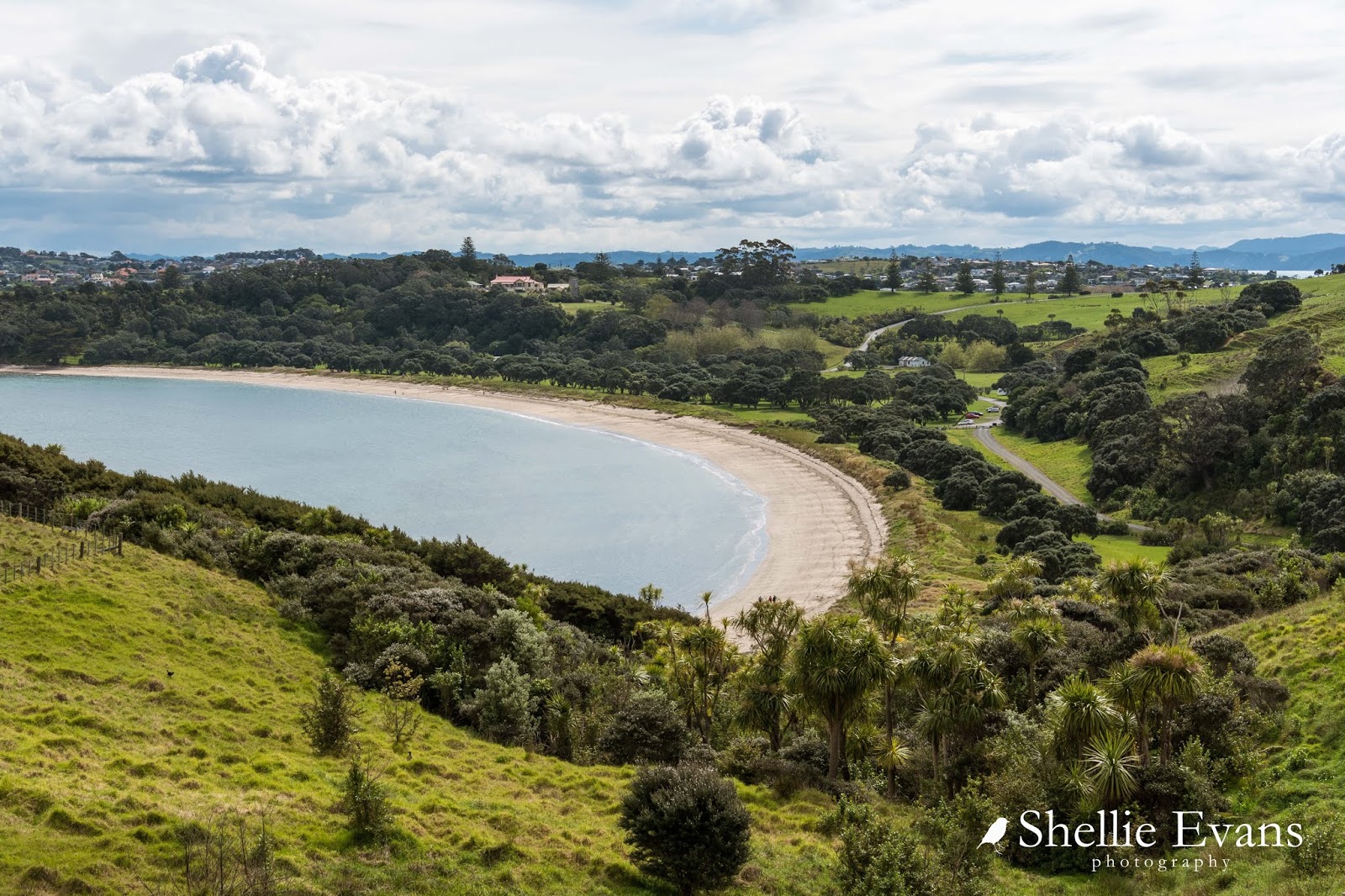
It wasn't too far to walk across the grass, pass under the large pohutukawa trees lining the sand dunes, to reach the beach.


Where another world can be seen far across the water...

Sky Tower & Auckland CBD
... and Rangitoto Island in another direction. 


The bird life throughout the park is amazing....but more on that in the next blog.

To be continued....


Sunday, November 20

West Coast Progress Report

Real-time

Here's another quick blog to let you know of our progress down the West Coast. I'm starting to get that anxious feeling when I know I'm getting behind in my latest blogs and I still have a few too many past ones to catch up on. The problem at the moment is we're on the move every second or third day and 'Out There' doing things in between. But bear with me, I have some really great blogs waiting in the wings and I will get to them, it might just take a little time.

Whataroa Main Street
After sitting out the rain and stormy weather in Hokitika for several days, a window of opportunity opened in the weather forecast for a couple of fine days, so we quickly packed up and headed south to Whataroa where we parked behind the local pub in their well equipped camping ground. Not. At least there was power ($35 a night, $25 without) but I wondered at any maintenance; we wanted to plug in for a day or two to boost the van and give the solar and everything else a rest, it's been a few weeks since our last charge.

We were the only ones there the first night- the other 5th-wheeler belonged to 'the boss'. With the pub the only available site for camping in the area there were assortment of people staying the next night in sleeper vans, tents and motorhomes. I felt sorry for those that weren't self-contained as the sub-standard 'facilities' were at the back of the pub, a good walk away and locked up after dark.


Talk about the wild west, this was as rough as they come. The owner has a finger in many pies. But, what is that saying? Jack of all trades, master of none...


The only redeeming feature was the awesome sighting of a NZ Falcon/Kārearea...


...who sat atop the hiab on this truck looking a little perplexed as he tried to work out how to extract the starling chicks from the nests inside the arm.


As bad-luck would have it, the next day 'the boss' decided to have the arm repaired and the two starling nests and chicks that were inside the arm went for half a dozen 'octopus' side-show rides of their short life. 

Unbelievably, the nests survived although one chick did fall out (too young to survive) and the parents had to find a new backdoor as the nests slipped down the hollow inside the arm. I couldn't bear to look the next day, when 'the boss' arrived to show someone how the repairs went, swinging the arm up and around a few times. And yet they were still chirping away the next time I walked past. Thank God I'm not there if & when they come to drive the truck away...


The resident Paradise Duck pair had an unusual vantage point to survey their patch...


And the reason we were in Whataroa was, of course, to visit the White Heron/Kotuku sanctuary in Waitangiroto Nature Reserve, the only place in New Zealand where they breed. We'd been waiting for the weather to clear and we picked the right day.


The reserve is a 14km van ride and a 20 minute jet boat sprint away from Whataroa township. We had a fantastic visit, one of the best activities and most enjoyable we've done on our journey- there will be a blog coming soon.


With the Kotuku Sanctuary finally done and dusted (we've had it on our 'must do, can't wait' list since we hit the road) we carried on south to Okarito, a place we thoroughly enjoyed on a day visit back in winter when we passed through. This time we bought our home with us and stayed at the campground for a couple of nights...


 ...so we could do some bird-watching. Can you see the tiny fluffy bumble-bee sized banded-dotterel chick?


And walk the Okarito Three Mile Pack Track & Coastal Walk, along the rocky beach (it can only be walked one hour either side of low tide)...


...to the bridge to nowhere at 3 Mile Lagoon...


...and then return via the Pack Track over the Kohuamarua Bluff, a walk that in the end turned into an epic 12km hike because we couldn't not walk (well one of us couldn't, the other could have passed on it) up the 1.8km side track to the trig lookout, on our way home.

Okarito Lagoon & township
And now we are back at the lovely Franz Josef NZMCA Park where we sat out the rain during our winter visit. And guess what? It's just started raining again.


Sunday, October 11

Take a Tour Through Zealandia

After our night tour to Zealandia to see the famous Kakapo, Sirocco, we returned to the Sanctuary the next day to do a self-guided tour and hopefully see some of the many other endangered birds that live in the park.


Zealandia, formerly known as the Karori Wildlife Sanctuary is a 225ha natural area of regenerating bush and forest just 10 minutes from downtown Wellington. The valley where the sanctuary is located was previously part of the catchment area for Wellington's water supply, the two large lakes were the former dams.


At 135 years old, the historic and distinctive Gothic-style valve tower has pride of place on the lower lake. Beneath the 21 metre-deep water level the cylindrical tower is stock-standard concrete. The tower, and the dam, are classified as having significant engineering heritage by Engineering Heritage New Zealand.


The most important part of Zealandia is the 8.6km pest-exclusion fence that surrounds the sanctuary. Designed to exclude fourteen species of non-native land mammals ranging from deer to mice it has allowed re-located populations of endangered native species to re-establish themselves on a mainland ‘island’. And not only in the Sanctuary, the numbers of sightings of some bird species have greatly increased in the nearby city suburbs too.

Part of the fence can be seen snaking up the hill behind another historic building near the lower lake. The boat shed was used by the governor-general of the time (1872) who had fishing rights on the lower dam.


There are 32km of tracks to choose from within the park, ranging from wheel-chair friendly paths to some serious ‘tramping tracks’ on the extremities of the valley. The main track alongside the lake is the one we followed the previous night when we visited Sirocco. A string of fairy-lights sparkled on the bank above us while a volunteer guide led the way and another was tail-end Charlie so none of us would get left behind. It certainly looked a lot different in the day time, we were unaware the lake was right there below us.


These are Wellington Green Geckos/Moko kākāriki, they were sunning themselves in a rearing enclosure near the entrance. There are many in the wider sanctuary as well but only the keen-eyed would spot them. It’s the same with the Tuatara, there are breeding enclosures and wild populations which are regularly seen on the night tours.


Near the top of the lake on overhanging and fallen trees there are two shag rookeries with three different species of shags nesting. These are Pied Shags/Kawau and they have babies only a mother could love.


At the top of the lake where the Kaiwharawhara Stream forms a wetland as it flows into the dam there are a number of rare Brown Teal ducks and another endangered bird, the Takahe. A cousin of the much lighter and much more common Pukeko/Swamp Hen, Takahe were once officially declared extinct until a very small number were re-discovered in 1948, in a remote Fiordland valley. There is now a current population of 221 birds- due to the incompetence of a few this figure should be 225. Four critically endangered Takahe were shot dead during a pukeko cull on an island sanctuary in the Hauraki Gulf last August.

The Takahe pair here at Zealandia are a retired couple who no longer produce chicks, they were moved from their last sanctuary to make way for younger birds.


The path follows the stream up the valley through thick bush and along the way we hear a very familiar bird call.  Rummaging through the leaf litter and bounding up the exposed roots and lower branches are three or four North Island Saddlebacks/Tīeke.

We are very familiar with Saddlebacks, having seen them many times on Mokoia Island in the middle of Lake Rotorua, Moutohora Island off the coast from Whakatane and Tiritiri Matangi Island in the Hauraki Gulf  near Auckland (all island sanctuaries), but these ones are a lot more confiding than others we have seen. Which is most probably because of the number of visitors passing by, they aren't as fearful. Saddlebacks have been extinct from the mainland since 1910, they are poor flyers and mostly forage close to the ground which makes them easy prey to introduced pests. They have a loud distinctive contact call which once you’ve heard you’ll never forget.

Unfortunately as confiding as the Saddlebacks were I was unable to get a good photo, dark bush and overhanging banks did not help with exposure- for those that understand settings, this was shot at 270mm, ISO 2500, f/5.6 and the killer 1/30sec!


A Kākā feeding station is located halfway up the valley and while the birds of Zealandia can feed and fend for themselves some of them receive supplementary food.


Kākā are a large, noisy, olive-brown forest parrot (with bright orange under their wings), similar looking to their ‘cousin’ the Kea, New Zealand and the world’s only alpine parrot. Kākā have a very loud ‘scraak’ call which can be heard far and wide, the word kākā can mean ‘screech’ in Māori.

Kākā had been extinct in Wellington since the early 20th century until they were transferred back into the wild at Zealandia in 2002. Now they can often be found outside the sanctuary in suburban gardens where they’re not always welcome due to their screeching, and the damage they do, tearing bark and small branches from trees. Just like the Kea they are also very engaging birds, I could easily spend hours watching their antics.


Zealandia has a volunteer workforce of over 450 people helping rangers with everyday tasks such as track maintenance, fence monitoring, conservation work, gardening, bird feeders and guides. Here the Kākā feeders are being replenished and the Kākā know it’s about to happen, they are quietly waiting (which is unusual) in the wings, for the trays and bottles to be refilled.


The bottles contain a high protein liquid and as soon as a they are refilled the Kākā flock to them. They know exactly how to extract the liquid, some have mastered the task extremely well, using their tongue to push the valve up the tube, while the liquid pours down their throat in big slurps.


Others mouth and play with the valve until a little liquid is released.


Other nectar feeding birds such as this Bellbird/Korimako wait patiently in the nearby bushes, flying in, in the hope of collecting a stray drop while the nozzle is vacated for a few short seconds between Kākā . They don’t have the strength to push the valve up themselves.


The tray lids open when the Kākā moves onto the perch in front of the tray, the bird’s weight pops the lid and they can help themselves to the snacks inside. This opportunist Blackbird(male) waits for a Kākā to come along so it can dive in and help himself too when the lid opens. He’s too light to lift the lid. Sitting beneath the feeding station, ducks also wait for an free meal.


Across the way from the Kaka feeding station is another feeding area, this one is for our smallest parrot, the Red-Crowned Parakeet/Kākāriki.


Kākāriki were once common on mainland New Zealand but are now mainly confined to predator-free islands although we have seen them in the bush on the Central Plateau. Like all of New Zealand’s parrots and parakeets, Kākāriki are endemic (found nowhere else in the world).


Once past the parrot feeding stations, there’s a short steep climb to the top dam. Construction of this dam began in 1906. Completed in 1908, it is one of only three gravity arch dams in the country, and an early example of the use of concrete in New Zealand. An engineer’s report done in the late ‘70s found the dam to be an earthquake risk as it was positioned right over the Wellington Fault. The lake behind the dam was lowered and in 1991 the upper dam was decommissioned.


The top lake now looks very natural and being quite isolated, it’s hard to imagine that this is located in central Wellington. What a fabulous asset Zealandia is to have, right in the heart of the city.


We had one last bird to find (well in fact there are a few more we could have found if we’d had more time) but there was one last bird I wanted to see before we headed back down the valley.

This is another one of New Zealand’s rarest birds, the Stichbird/Hihi. Hihi are like many native NZ birds, they didn’t cope well with the arrival of humans and the habitat changes and animal pests they brought with them. Like many natives, Hihi nest in tree cavities close to the ground which makes them especially vulnerable to rats, stoats and cats. It’s also thought that bird diseases carried by introduced exotic species may have also contributed to their rapid decline. By 1885 they were extinct on the mainland, surviving only on Little Barrier Island in the Hauraki Gulf.


It was thought that the Hihi was part of the tui & bellbird family but in fact it belongs to another bird family, it’s closest relatives are the iconic wattlebirds that include the Kokako, Saddleback & the extinct Huia. Hihi are a North Island species only and this is a male, the female, as often is the case in the bird world, is a little more muted in colour and without the bright yellow and solid black. Being the beginning of the breeding season when we visited, there were mostly males chasing each other near the Hihi feeding station. Any females that made an appearance were soon harassed out of there with two or three males giving chase.


Another dark bush, out of focus shot but in this one you can see the how the ear tuffs are used when the bird challenges other males.


Happy with our exploring and the birds we had managed to see, we walked back over the dam where there’s a good view down the valley towards suburbia, crossed a swingbridge and wound our way back towards the entrance along another track...


…tip-toeing past Sirocco’s enclosure on the way. If you missed my blog post on Sirocco, you’ll find it here- How the Dud Became a Stud


We made our way back to Evans Bay ahead of the afternoon rush hour, arriving back to find ‘Out There’ parked up all on her lonesome, the evening influx of motorhomes, sleeper vans & buses yet to arrive. Wellington’s famous wind was just picking up so I took the opportunity of taking a few more photos of the 26 metre high Wind Wand (Zephyrometer) which we’re parked near.


It’s quite mesmerising standing underneath it watching it dip and bow with each gust, not quite silent and with the grace of a conductor it seemed to be guiding the evening rush hour past.


We left Wellington the next morning, stopping at Marton for a night, before one final long haul onto our old home town and eagerly awaited catch-up with family & friends.

We’ve been parked in the campground at Mt Maunganui for the last 4 weeks and have thoroughly enjoyed ourselves although the first week was a major culture shock after spending the last few months in the deep South where people (and motorhomes) are few on the ground.


And with that, I've nearly caught up to date again. Just a couple more posts from the Mount and I should be ready to report live again. Just in time because we're on the move again later this week. Hawkes Bay here we come, with a few more weeks of family & friends 'meet & greet' to do. Can't wait.