Showing posts with label winery. Show all posts

Thursday, March 12

Warding off Jack Frost- Cromwell

Catch-up (early October, 2019)

After I'd completed my mega road trip from Winton to Cromwell & Lawrence return, to photograph the fruit blossoms, a photography acquaintance mentioned that I should do the trip again, at least to Cromwell, to take photos of the blossoms after the frost protection sprinklers were switched on in the orchards. 

Sunrise over Cromwell
How do frost protection sprinklers work? Coating a tree or vine with ice to protect new buds & blossom from frost may seem counter-intuitive but there is a science behind it.


Overhead low pressure sprinkler systems provide a high level of protection, the key is to form clear ice on the plant. Sprinklers deliver just enough water to glaze the plants in layers of ice, rather than soaking them and forming one massive layer of ice that may cause more cooling before it freezes.


Clear ice means that an endothermic reaction is taking place and the warmth of the plant is being trapped inside it. If the ice starts to become cloudy, the plant is losing heat and that’s when damage can occur. Water spraying starts well before the frost forms and continues until after the ice has completely melted from the trees. If water stops spraying on the clear ice, it goes from being endothermic to exothermic, and the heat loss and ice can then damage the fruit.


Drive back to Cromwell? 'What a good idea', I thought, the seed was planted. It would mean a 4am start to cover the 200+km from Winton to Cromwell but I was up for the challenge. Like a hoar frost, iced blossoms had been on my 'must capture' list for awhile, I'd just never been in the right place at the right time. Now was my chance. 


My friend had access to a Cromwell orchard's temperature gauge and he informed me by text late one evening that there was a predicted frost the following morning and I should be ready to go.


It turned out to be a very light frost and the sprinklers weren't needed but thankfully he was able to text me before I had left Winton. The next time I heard from him was a week or so later but unfortunately we had left Winton and were exploring the Milford Road by then, so I missed out again.


But as luck would have it, and after our short visit to Mavora Lakes, we were unexpectedly back in Cromwell parked in the NZMCA Park at Lowburn when very early one morning, around 3am, I woke with start to a very loud noise filling the air.


Once I figured out where I was- you get that when you're constantly on the move, it's sometimes takes a few moments to visualise where you're parked and in what direction you're facing- I realised that I could hear wind turbines and helicopters roaring into action, preparing to fight off a frost. 


How about that! I had no need to drive 400km this time, I was a mere 4kms down the road from the orchards! I was ready to go and out the gate well before the sun came up. The first orchards were still in darkness but I could hear the soft click, clack of the sprinkler heads turning and the gentle patter of water falling through the trees to the ground.


I carried on to the far end of Cromwell and then around onto a back road; sprinklers swishing back & forward everywhere I looked, a helicopter down very low in one orchard, weaving back and forward along the ends of the rows and the roar of wind fans and turbines in others.


All three methods obviously work but I'm not too sure how the orchardists decide which is the best way to go; sprinkler systems seemed to be most numerous.


Perhaps it's money, helicopters would cost a fortune, maybe there isn't access to water or perhaps the wind turbines can be shifted around the orchard more easily.


I had overlooked one major difficulty which now seems rather obvious. I was soaking wet within minutes of getting out of the ute- even with a rain jacket & gumboots on.


It didn't matter that I was ducking in and out of the passing overhead sprinkler trying to shoot a blossom before the sprinkler passed over again because if the sprinkler next door didn't get me the neighbour on the other side would. They were all out of sequence. 


Luckily I had an extra jacket in the ute and there were a couple of large towels packed into the back seat. I used one to cover the seat as I was climbing in and out in my wet gear all the time and the other one to wipe down my camera and dry my hair! I looked like a drowned rat. 


I was a little worried about my camera though, it's weather proof but not water proof and also, as I was zooming my lens in and out, water was tracking inside the lens.


Later when I arrived home and had dried my camera and lens out as much as I could, I left them on the bed in the warm sun to dry them out. I opened the window a little so any water would evaporate rather than condensate in the warmth. It worked although it did take a few hours each day to get rid of the moisture. Next time I need a waterproof cover for my camera.


After flitting back and forward through town and up and down down many of the back roads chasing sprinklers and easy to access orchards, I stopped at the Wooing Tree Vineyard, right in the middle of town. The sprinklers were also working overtime here and...


...at River Rock Estate, a little boutique winery across the road...


...where I managed to do a few close up shots...


...without getting drenched as I could keep outside the sprinkler's reach. 


Then with the sun climbing higher, the ice melting and enough blossoms photos to sink a ship, I thought I might just add a few more before I headed home. 


I'd passed this row of beautiful old crab-apple trees numerous times during the last couple of hours, now I stopped to take some photos of the gorgeous blossom.


Never satisfied and always striving for better photos, I can't wait until the next frost event. If you're passing through Cromwell next spring and you spot someone with a camera, ducking & diving around the fruit trees on the edge of an orchard covered from head to toe in ocean going wet weather gear, you'll know who it is! 


Saturday, September 26

Baby Dolls & Wine

We left the beautiful Maniototo heading north to the top of the South Island. Here are the blogs I posted along the way, in case you missed them or want to refresh your memory, just click on the links.

First stop was Kakanui village where we parked on the edge of a cliff overlooking All Day Bay.

Next was the intriguing sounding Waihao Box.

Then onwards and upwards along the rugged Pacific Coast with a stop at Kaikoura and a catch up with those endearing inhabitants, the NZ fur seal, followed by a stop at one of our favourites camp sites, Ward Beach. And then it was just a short haul to another favourite; the DOC Camp at Marfells Beach.

Where the weather was sublime and we awoke to this gorgeous golden orb rising in the east each morning. 


Well, I awoke, his Highness slept on. David is not a morning person. Mornings are the best for me, I could take all my photos for the day in the first hour and be done and happy. It’s not known as the golden hour for nothing. Soft warm light and limited shadows enhance even the most mundane subjects. I’ve been a little slack over winter, staying up late to type my blogs (you guys are to blame) and not getting up in time to catch the golden hour which actually, down south during winter, doesn’t happen until what seems like mid morning anyway! Although I think I have an even more reasonable excuse; the minus 5 to minus 12c degree temperatures we were waking up to. I can tell you it positively felt like summer in Marlborough!


While at Marfells Beach we visited a nearby winery & vineyard. This isn’t just any winery and believe me there are dozens of fabulous wineries in the world-famous Marlborough region. Yealands’ Seaview Vineyard is located in the Awatere Valley just a short distance from the small settlement of Seddon, it stretches from the foothills of the Kaikoura Ranges to the cliff tops overlooking Clifford Bay & Cook Strait.


Peter Yealands is a man on a mission and a man with great vision, he’s also a pioneering entrepreneur. The Awatere Valley was originally thought unsuitable for grape growing. Peter Yealands thought differently; working the land, often by himself, he re-contoured it, filled ravines, smoothed gullies, terraced hills and planted a wide range of grapes.

At 1500ha (3,705 acres), Peter Yealands turned the rugged pastoral land into the single largest privately owned vineyard in New Zealand and the first winery in the world to be certified as carboNZero. His vision is to have Seaview Vineyard become the world’s most sustainable wine producer.


Much earlier and well before grapes, Peter saw the potential to farm Greenshell mussels and in 1971 was issued with New Zealand’s first marine farm license. Thanks to his innovative design technologies and helping establish aquaculture in the region, marine farming now contributes $160 million to NZ’s export earnings. In the 1980s Peter also established one of NZ’s most successful deer farms, a 2,000 hectare property in Kaiuma Bay in the Marlborough Sounds.

Peter now concentrates on the vineyard and with each year, Yealands grows closer to its goal of becoming self-sufficient and carbon negative.

Our first sign that this vineyard is different to others are the large vine pruning bales that are dotted throughout the rows of bare vines near the entrance to the vineyard. Ten percent of the vineyard is baled up and left to dry for 6 months. Purpose built burners (designed by Peter of course) turns vine prunings into a heat source for the winery’s water & glycol. One bale weights around 200kgs and when burned, provides the equivalent heat of approximately 60kg of LPG.  At full capacity the burners can produce 500kW of energy, enough to keep the average Kiwi household going for three weeks!  This process eliminates over 180 tonnes of greenhouse gas emissions (CO2) per year.


After a video presentation, wine tasting and some carefully selected purchases we headed out on the White Road Tour, a 3km self-drive tour around the vineyard and one of the main reasons I was keen to visit this winery. It’s not often you get to see behind the scenes and also see some of the sustainability projects in situ.


Our information brochure & tour map told us to make allowances for wild birds, peacocks, chickens & ducks- they have right of way at all times and to be careful not to run them over as they settle beneath parked cars. There was just the one over friendly rooster who came running from his chook-house, he’d lost his harem somewhere or a rival had whisked them off to one of the other houses (probably ones with a better views). The chickens free range and help keep grass grubs and weta at bay, their coops are moved around the vineyard depending on where they are needed.


In all directions and as far as the eye can see- Yealands Estate Vineyard.


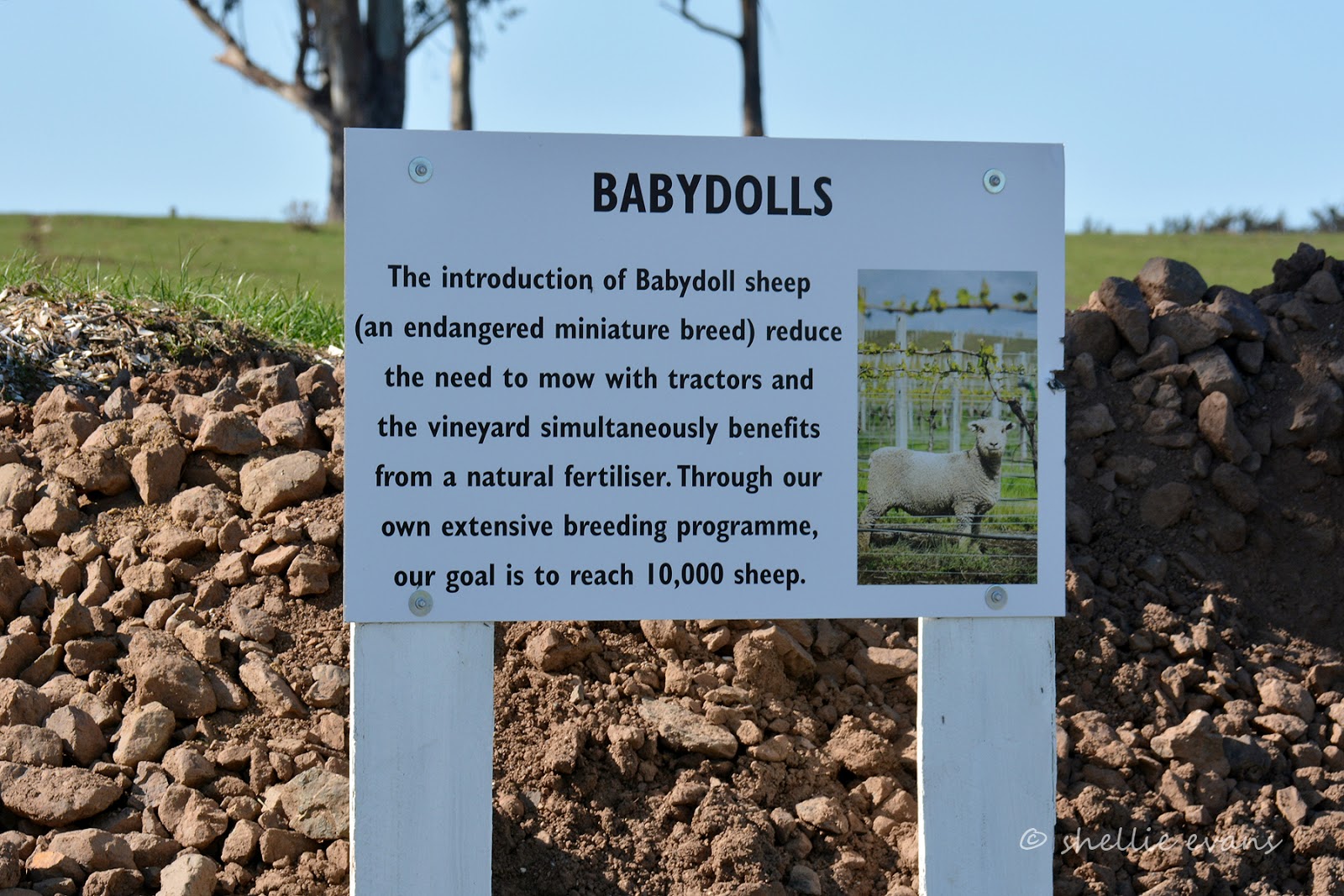
Along with the chickens there’s a natural grass mowing community too; Kune-Kune pigs (hiding during our visit) &  Babydoll Sheep, a minature breed with a cute teddy-bear face, both are too short to reach the grapes, although the sheep didn’t look too short to me. Babydoll? A cute name but I can’t quite marry the two together- baby doll & sheep just don’t seem right together.


And it was nice to see sheep that weren’t interested in what we were doing, no chasing us along the track or racing across a paddock to see if we had any food for them; just well fed contented Babydoll Sheep sleeping amongst the vines.


Mt Tapuae-O-Uenuku is the highest peak in the northeast of the South Island and is New Zealand’s highest mountain outside the main ranges of the Southern Alps. At 2,885 metres (9,465ft) it is over 80 metres taller than the higest peak in the North Island.


Along the way we pass the Marc Pad, an area where all the grape skins (marc) are collected during harvest. This area is where the organic compost is produced; over 10,000 tons annually.


We stop at Lookout Point, where you are free to rest awhile, take in the views or have a picnic lunch….if you have brought it with you. I’m not sure why, but we didn’t have our usual thermos, soup and sandwich with us this day. I think I was hoping for some sort of lunch platter from the Cellar Door but it has no restaurant/cafe unlike many wineries.


We walk out to the edge overlooking Clifford Bay and the views are spectacular. Far across the bay we can see the Cape Campbell lighthouse  and back towards the curve in the first clump of trees on the shoreline we see Marfells Beach where we’re camped. Lake Grassmere (the salt lakes) is further right, hidden in the gap between the cliff faces (remember to click on the photos to enlarge).


And in that clump of trees, and through the camera lens, I can see ‘Out There” parked up along with a couple of motorhomes and a caravan- we’re the first in the trees on the right.


In the other direction Clifford Bay runs into Cloudy Bay (a very famous name in wines) and on towards Port Underwood and Cook Strait with the North Island on the far right horizon.


A spidery web of wires weaves its way across the soft contours to the heart of the vineyard, Yealands Winery & Cellar Door.


There was no music playing while we were there, I think the vines are in hibernation mode. Perhaps with spring the hills will come alive to the sound of music. The suggested website is very interesting; if you want to while away a few hours click on the link and see!


We followed the White Road away from Lookout Point, these vines have recently been pruned, the prunings yet to be collected.


More Babydolls and more wires. Most of the sheep seemed to be resting towards the ends of rows but I did watch a few sheep barge their way through the wires to reach their mates in the middle of the next row, I guess it’s a long walk to the end. They wouldn’t want to be doing that when the vines are in bud or with grapes on board. Perhaps it’s more of a barrier when they’re coated in green.


Twin Lakes, the largest wetland on the vineyard, holds 150,000 cubic metres of water and is another area where the public are welcome to stop for a picnic or rest. There are over 25 strategically placed wetland areas around the vineyard which capture water run-off, slowly releasing it back into the soil over the long hot dry months.

Around the lakes are solar lights which attract nuisance insects that eat the leaves of the vines. the bugs are attracted by the lights and some end up in the water much to the enjoyment of the trout.


Further on up the road we’re accosted by those over-friendly chickens we were warned about, and this time they chase along after us for quite a distance- chickens in sheep’s clothing perhaps?


As we approach the rear of the winery we can see dozens of plastic tanks, 70 plus mist green 25,000 litre tanks to be exact. Just like the ones we used to sell many moons ago.


These aren’t Devan Tanks though, they belong to an opposition manufacturer. My eyes light up, what an order that would have been. Mind you, I bet they had to well and truly sharpen their pencil to secure the deal. The silver wrap is obviously some sort of insulation to keep the contents cool.


How’s this for a bank of solar panels? The northern side of the winery roof has one of NZ’s largest solar panel installations. The panels produce 133,000 kW per year – enough to power 17 average New Zealand households for a year, and Shellie’s laptop for a decade plus!


The coastal wind is put to good use too. Two traditional wind turbines and a horizontal axis wind turbine generate extra power for use in the winery. These turbines produce approximately 75,000 kWh of energy. Eventually Yealands hopes to supply surplus power back to the national grid.


The stunning & impressive Yealands Estate Winery building was designed to blend into the landscape with no disruptive contours- although I’m not sure that blend is the right word, it’s a pretty big building. I doubt anything that size could ‘blend’. Rainfall is either recycled or piped to the wetlands and inside the building, motion sensors control lighting and air conditioning (ensuring neither is left on needlessly) and extensive insulation and heat recovery technologies reduce heat loss and recycle energy for re-use.


We thoroughly enjoyed our visit to Yealands and learning much about the company’s self-sufficiency and sustainability. I think the ‘behind-the-scene’ White Road Tour experience is a touch of genius, include and inspire your audience (and they might just continue to buy your product long after their visit).