Showing posts with label insect. Show all posts

Monday, December 16

Spoonbills & other birds

After exploring closer to home we drove right around to the other side of the harbour, directly across from our campsite but about 15kms by road. David had seen a vehicle parked up on the beach a few times and wanted to check out what was there (we think they must have been gathering paua (NZ abalone) as there was a large area of flat rocky outcrops & pools jutting out into the sea). It was with great surprise that in amongst the usual shore waders feeding in the low tide rock pools we found a flock of eleven Royal Spoonbills very resplendent in their breeding plumage of yellow breast patch, bright yellow spots above the eyes & head plumes.


Spoonbills are quite rare in New Zealand although there are quite a few pockets of birds around the country including a large flock of about 30 birds that spend a lot of time in & near the Ahuriri Estuary in Napier. Having only seen these ones before and out of the breeding season it was great to see the changes in their plumage.


That's the sealion beach off in the distance.
The eye spots are a little bit creepy, they are iridescent yellow & give the impression that they're looking at you all the time. Which I guess they are if you could see their black eyes underneath.


The bird below on the left had a lot of bling on her legs; banded, & female because she was noticeably smaller.


We later saw another half a dozen or so spoonbill feeding on the mudflats further up the harbour & over the other side on our way home so is probably a good sized flock in the area. When we come back we'll have to explore more.

And back we'll definitely be coming. This time we concentrated mainly on seeking out the sealions but the area also had many birds that I would loved to have got some great shots of. As it was these were "just in passing". 

A Bellbird (Korimako)- feeding on flax flowers

That big fat Wood Pigeon (Kereru) again

We passed this family of variable oystercatchers ( Torea-pango) on the way to the sealions

This Welcome Swallow had a nest under the foot bridge below our camp site, it & it's mate flew out distressed every time somebody walked over or near the bridge. On one occasion we watched as a stoat ran across the bridge then down onto the rocks and along the edge of the stream. The swallows flew along dive bombing it all the way. We knew there were stoats in the area as the day we arrived a stoat was caught in a cage trap at the end of the garden just above the bridge. The campground has an active pest control programme & it seems to be working. I know they are terrible predators on our birdlife but I couldn't help thinking about the kits the caught stoat would have had back in the nest wondering when Mum was going to get home. I figured it was Dad out looking for her the next day!


And this is a dunnock (with a moth in its bill) also known as a hedge sparrow. They are not so frequent up north although we have seen a few around the Central Plateau area, they have a wonderful song & like to sit right on the tip of a tree & sing their heart out. They are an introduced species and seemed to be quite plentiful the further south we move. They are quite shy & like to keep to the undergrowth although this one was searching around the rocks for dinner. A number of them were feeding on the grass seed.

And finally, not a bird but a bug. A huhu beetle that took up residence for a short while in our outside shoe box.


Wednesday, April 17

"Closed for the Season"

It rained on & off all night but by daybreak the worst appeared to be over & the sun was trying to make an appearance. The birds seemed to be very pleased as well, there was an amazing dawn chorus with lots of not so common bush birds we recognised.

We would love to stay on here at Broken Hill, but after looking at the forecast for the next few days and seeing that heavy rain & gale force winds are due back later today & for the next couple of days we decided we really didn’t want to get stuck out here in the wops by a slip or the river bursting it’s banks. Even with the rain, this has been a great campground, we’ve both loved the isolation & the peace & quite although I’m sure, going by the large number of sites dotted around the reserve, it must get very busy during the high season.
The sun came out for a brief couple of hours so before we headed off we decided to do two of the short walks that start near the campsite; the Broken Hills Battery Walk & the Gem of the Boom Creek Loop Walk. This area was once a bustling gold mining settlement & rusting relics from two of the batteries litter the bush alongside the tracks although we only managed to find some old wire rope, a  large scoop of some sort & a round metal sheet that may have been a tank.
Broken Hill Battery
Of more interest to us were the two mining shafts we came across. It's hard to believe that over 200 people lived in this area early last century, along the side of the river & this stream were a hall, post office, shops & houses. By 1914 the two large batteries had ceased production & people had moved on.
 
If you’ve been following my blog you’ll know what I’m going to tell you we found in the mining sharfs aren’t you? Cave wetas! And dozens of them again.  Here’s the link to the other post on the wetas where you'll find some detailed facts - Gold Mine, Wetas & Glowworms


In fact one of these shafts wasn’t a shaft afterall, it’s thought that this was some kind of jail. There was the remains of a steel bar protruding from the roof & the end opened up into a wider space. Someone with a sense of humour has added extras for special effect!

 
The mining shaft was much longer than the other one we visited at White Star Station & of course pitch black, it also turned a couple of times which always un-nerves me as you can’t see the light from the entrance. Did we have our head torches? No, again we forgot them. Thank God for mobile phone apps. I held on tight to the pack on David’s back as we walked through & tried hard not to think of the wetas swaying about just above my head. It didn’t help that I hadn’t realised that they can jump long distances! Duh, of course they can, that’s why they have such bloody long legs!
Back at the campsite we packed up and pulled out, still nobody about & just a small tree down across the road which David was able to skirt around. We did try manhandling it out of the way but it wouldn’t budge. Must remember the chainsaw next time! ;)

The river was still high but was dropping fast
 
Our next stop was not far down the line to another campground near the beach, small, private & with a great recommendation from some people we met at Colville;  Opoutere Coastal Camping. I’d already earmarked the area as there were a few walks & bird watching opportunities on the beach & in the estuary nearby. 
Opoutere Estuary
Down the road we went, all the way to the end only to find a sign up ‘CLOSED FOR THE SEASON’ And there were the owners with their car & trailer packed to the gunwales with kayaks & bikes strapped to the top parked outside their house; obviously off on their own holiday (the guy was quick to disappear inside when he spotted us). So there was nothing for it but to turn around, luckily in a paddock that had the gate conveniently open, & head back to the main road.

But not before rescuing a friendly old, fat, black & white corgi cross dog. We came around a corner & there he was stumbling down the middle of the road looking very tired & hot & bothered. David thought it was a small pig at first. He came straight up to me when we stopped & as there weren’t any houses nearby I decided he needed to be rescued. He had a collar on, no name tag but about 15 years worth of colourful registration tags. He lapped up a little water I offered him & followed me around to the door like he wanted to hop in. David wanted to drive on. I told him there was no way I was leaving him.
There should be a photo right about here of the dog but I figured if I got my camera out at that stage David would have throttled me!

The dog continued to plod along the edge of the road. I ran ahead around the corner until I found a house; an old run down house that I had to fight my way through junk to get to the door. An old guy answered it & told me that he thought the dog might belong to someone quite a way back up the road. He told me this after he told me he wanted to shoot all dogs. They were nothing but trouble.
When I got back out on the road David must have decided if he wanted to continue this journey he had to find a solution. We (as in the royal we) have saved a number of animals over the years, once David was in his suit & tie on his way to a conference when I made him climb a barbed wire fence to haul a sheep out of a very muddy bog(he's done this a couple of times since), in Ireland we had to turn around & travel quite a distance back to a spot where  I was sure I’d seen a sheep with huge horns caught in a fence. I had & it took all his effort to free him plus a seriously squashed finger that got caught in the wire.  Another time he had to run in amongst  morning rush hour traffic along the Tauranga expressway with the cat cage after I saw an injured plover up against the centre concrete barrier (I've been told to insert here the fact that I continued onto golf while he carried out the rescue). So he knew we wouldn’t be going anywhere until I had helped this old dog. My hero.
He had stopped a guy in his ute and after I came out & told them where the dog may have come from David convinced the guy to take him up the road & drop him off. So we bundled him onto the tray of the ute where he promptly collapsed on all fours, tied him with a bit of rope to the deck so he wouldn’t jump (not that he could possibly manage that) and sent him on his way. Job done. I’m sure the guy in the ute thought we were barking mad.
By now we’d decided to head all the way through to Waihi Beach. We had tentatively suggested that Maddie, our grand-daughter, come & stay with us for the last few nights of our Coromandel Odyssey & especially now that her mum & baby brother had chicken pox which she had kindly passed onto them.

And with the weather about to turn to custard & school holidays due to start on Friday we decided we were about done with the Coromandel. So now we are parked up in a tight little spot at the Waihi Beach Top 10 Holiday Park, under a huge pohutukawa tree where we have no TV reception (we keep forgetting to check that option; make sure the satellite reception has a clear view) with the wind gusting & a few showers passing through & one happy excited little girl trying to fall asleep in her very own bed on the sofa.

 
The Waihi Top 10 is an excellent holiday park  for children, there’s a great playground, heated swimming pool & spa, a huge bouncy cushion & you can even feed the eels in the stream that runs through the park behind our van. The beach is just across the road too, along with a couple of great looking cafes.

Saturday, April 6

Stony Bay & Finishing the Coastal Walk

We had one more bit of exploring before we leave the tip of the peninsula; Port Charles & Stony Bay. Both of these along with Sandy Bay are located on the eastern side of the tip and to get to them we crossed over the range just north of Colville and then turned left at the only intersection for miles, turning right would have taken us back past Waikawau Bay and on to Kennedy Bay which then loops back to Coromandel township. We were going to do this road if we had of stayed at Waikawau  before heading south but we’ve heard it’s very corrugated & extremely winding towards the end & as we're not stopping at Waikawau, it now makes sense to head back to Coromandel township the way we came up, on the western side. 


Part of a "Shoe Fence" at the beginning of the climb over to Port Charles
It was only about 14kms from the intersection to Stony Bay but it might as well have been 44kms, Port Jackson’s road had nothing on this one for winding. After 5 kms & 150 corners I lost count & at least every 3rd or 4th one of those was a sharp blind one. The road winds itself through beautiful native bush that covers most of this side of the peninsula. This is the Moehau Range, it forms the backbone of the upper Coromandel Peninsula but runs steeply down to the coastline on this side. Mt Moehau at 892metres, is the highest peak on the peninsula & is of special significance to Maori.

 
Port Charles is the first of only two settlement we come across, population 150,  it’s located on the edge of a large enclosed deep harbour & it would seem fishing is the main activity here. There is also a large mussel farm at the entrance.

The road, which is not council maintained- got narrower & no less winding from Port Charles. A along the way there were tantalising glimpses of the rugged coastline. Finally we dropped down into Stony Bay & the end of the road.


A gate opened into the DOC campground and the other end of the Coromandel Walkway which we had half completed the other day from the other end- (read about it here)

Stony Bay, as the name implies is a beach of pebbles & boulders, very beautiful & surrounded with magnificent pohutukawas festooned with huge astelia epiphytes.
 
We had brought our tramping gear but hadn’t quite decided whether we’d do the walk or not but once we got there and saw that the track disappeared up the side of the hill & into the bush, a totally different scene than the other end, we decided we’d do it now that we were here. We’d walk to the lookout which was one steep climb away from Poley Bay, where we’d ended up coming in from the other side. We could now say we had walked the 7km track apart from that small section. In fact we’ve walked nearly double the distance considering we had to retrace our steps twice.
One of the large pohutukawa that line Stony Bay
It was overcast & rather grey but there were signs that the sun was going to break through, either way; rain or hot,  it didn’t matter as we were under the bush canopy most of the way. It certainly was beautiful, the path was lined with brilliant green ferns, pongas, mamakus and dozens of nikau palm. Some areas were certainly very tropical looking especially when the track crossed one of the numerous waterfalls. The path ran around the steep slopes that fell from the range above down to the rocky coast below, it weaved in and out of the valleys between each vertical ridge and & each turn back out to the ridge edge there was a waterfall. Although with no significant rain for months the falls were more of a trickle. It would be very magical after heavy rain & a little more difficult to cross I would think.
 
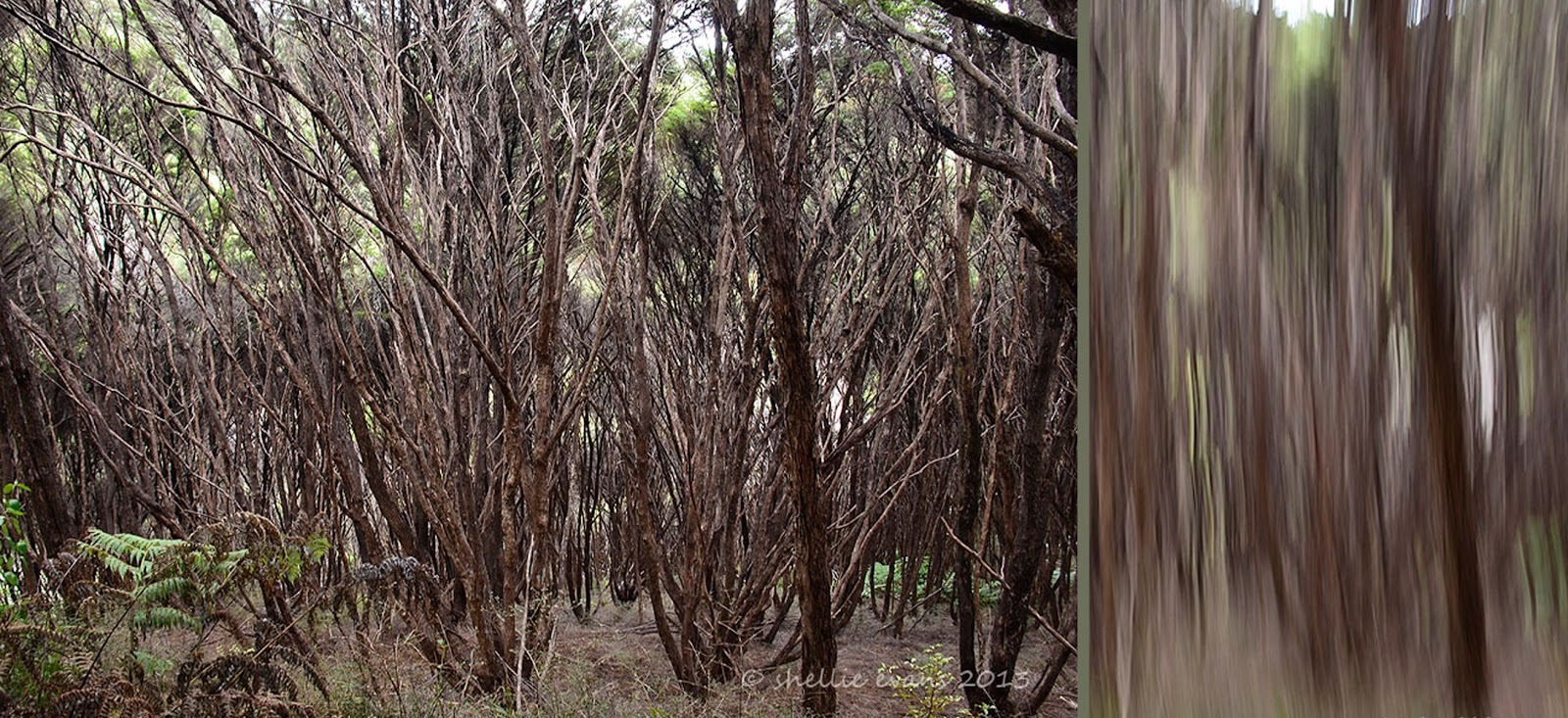
For quite a distance the track also passed through a manuka (tea tree) forest which was the highlight for me. It’s the first time I’ve seen such tall manuka, it’s usually shorter scrub but these were very tall and under the canopy were masses of relatively straight narrow trunks & branches.  On the ground grew bright green ferns which contrasted against the brown of the trunks. Looking down the steep slopes at the mass of branches gave me a touch of vertigo. I did some of my camera tricks too J
 
 
Throughout the bush and in fact all along the roadside are bright marker pointers written in various codes. These mark areas where there are pest traps or bait stations set. As most of this area is conservation land & many kiwi reside & have been released here, DOC obviously have an intensive pest eradication programme running.
That's NZ Mistletoe on the trunk
Two hours, 4.8kms and many tantalising views of the coastline & secluded bays later we finally reached the fork that led to the look out.
Centre photo- Mt Moehau
After a steep scramble up a slippery clay track we were greeted with fabulous views up & down the coast and out to Great Barrier Island. And there not very far away were the Pinnacles which were the prominent point of interest when we came in from the other end.
 
Port Charles harbour entrance is back centre

The track winds it's way back & forward over these ridges. Stony Bay is around the last point over by the green patches
We ate our lunch perched precariously on the side of the cliff. David also rescued a small stick insect that was being harassed by a wasp and then we were off again back to Stony Bay.  

It was a quicker trip back, our legs were starting to tire & by the time we reached the ute we were totally exhausted, we’d done nearly 10kms & shaved an hour of the return leg. I know this because David has an app on his phone called “My Track”, which keeps all the data. I have a few photos of him standing on various tracks looking at his cellphone. I kept thinking what’s he doing checking his phone so often. I’m thinking he’s looking for that elusive cell phone reception but he’s not, he’s checking the data. That is so typically my husband, I said he was a train-spotter ;)

We stopped in Sandy Bay just before the hill over to Port Charles for a well deserved coffee before heading home back over that winding road again. And with that we have done the northern tip of the Coromandel. We’ve got quite attached to this area & will be sad to leave.
Sandy Bay Baches


Sunday, March 31

Coromandel Coastal Walkway


It was overcast today, ideal to walk part of the seven kilometre Coromandel Coastal Walkway which runs from Fletcher Bay, at the end of the road coming up the western side of the peninsula & Stony Bay, the end of the road on the eastern side. There is no road access right around the tip of the peninsula so this a great way to see this rugged & remote area. It’s a 56 kilometre drive over narrow & winding roads from one bay to the other so it is wise to either walk part of the way then return or if in a group, have a vehicle left at either end & swap keys when you meet on the track. Some even carry their tents & packs & stay overnight at either end, returning the next day.


The views are fabulous, the coastline steep & rugged with jagged rocks, offshore reefs, island & small wild rocky bays as far as you can see. This area is known as the Pinnacle Coast.


Click on the photo to see the rock fisherman in the first photo

The first section crosses the hilly farmland of the Colville Farm Park which was purchased by the Crown in the 1970s, with the intention of preserving the coastline & forested inland slopes for the benefit of all New Zealanders. It was a steady & steep climb through the first paddock where there was a large flock of sheep which had obviously decided they quite like to rest on the level track at night, most of our time was spent dodging large amounts of sheep poo.


The next open section we crossed is known as ‘The Six Foot Track’, an old bridle path constructed & used by pioneers with pick, shovel & wheelbarrow to join the two bays. Not far from here is a valley of flax that early settlers harvested for a mill that they had in Port Jackson where the fibres were dried, baled & shipped to Auckland. The tin shack set high up the slope is used by itinerant scrubcutters.


About an hour and a half after setting off the track passed through a large area of manuka scrub, then we started a steep descent down into Poley Bay which is a small compact cove with a shingle beach. This was going to be our turnaround point. Large pohutukawa, ferns & nikau palms dominated this section & it was a shame to see so many mamaku ferns (Black Tree Ferns) in various stages of dying. Apparently the endless summer as taken its toll on our native forests & especially with the ferns which need a lot of moisture & frequent rain.

 
We had a break & ate our lunch in Poley Bay and while we were sitting there a family came climbing over the rocks, they’d been exploring as the tide went out. It was a surprise to see them as it was a long way in and quite a strenuous hike to where we were. The two little boys were two & five & had walked the whole way. They were now headed back & Dad said as long as they didn’t push them they'd make it all by themselves. Although the wee one must have finally decided enough was enough as we caught a glimpse of them on the last section before home with the boy riding on his dad’s shoulders.

The climb out of Poley Bay was very steep and slow, we were both relieved to get back to the carpark at Fletchers Bay, especially as it had just started raining although that didn't seem to stop the campers from enjoying themselves.
 

Tuesday, March 26

Gold Mine, Glowworms & Wetas!

This will be my last post for 10 days or so as we'll be moving up to Port Jackson later today where there is will be no internet connection. After Port Jackson we are coming back down to Colville & then crossing over to the east side of the peninsula to the DOC camp at Waikawau Bay, another area where there will be no internet.

We stayed an extra day here at White Star Station so we could go exploring out the back of the farm. The station is named after the White Star Goldmine that's located high up in the hills and having a 4WD ute was of great benefit to us. The mine has glowworms inside it & we hoped they'd still be there, they need dampness as it's been so dry they may have moved on. There are maps for visitors to follow & they said the walk to the mine would take about an hour. More like three hours I would think, it was a very steep & steady climb up a bulldozer track cut into the side of the hills.


We climbed & climbed in the ute and very nearly thought we were on the wrong track, I'm sure the sheep thought we were mad, it certainly looked like they hadn't seen anyone in a long while. This was the first real 4WD outing the ute has had & David was very impressed with the performance especially on the downhill leg when HDC (hill descent control) is selected & the ute takes over the whole descent. You only have to steer it.


We finally saw the mine sign & then couldn't decide if we wanted to do climb down a very steep & slippery hill & fight our way through scrub up the otherside to it. In the end we figured we'd come this far we might as well complete the task. The mine is located on the rock face in the centre of the first photo, you can see the track up to it on the otherside of a stream we had to cross first. And if you click on the photo & look closely you'll see our vehicle parked on the track just about where the row of pines finishes, the second photo is taken from the mine entrance.


Half way up the vehicle track we suddenly remembered we needed a torch! Duh! Visiting a pitch black old disused mine without a torch would be just silly. Luckily David remembered he had a small magnetic LCD torch that he uses to check that the hitch has grabbed stuck in the tray under the hitch in the tray of the ute. That would have to do. I even have a head torch I use when doing night photography that would have been ideal for the cave. Next time we must be more organised!

The mine had three tunnels, two didn't go very far and after stumbling through the pitch blackness, me holding David's shirt tail so I didn't get left behind we found another entrance. We didn't spot any glowworms on the way through but found them on the way back, dozens of them sparkling away on the ceiling and sides of the walls looking like a lost milky way. Of course we had to turn the torch off to see them and any photos just don't show the tiny grubs although we you can see their hanging threads that they use to catch food.


Before we saw the glowworms, in a little short side tunnel when David shone the torch up on the ceiling just a foot or so away from our heads we found dozens of cave wetas! My mother's favourite insects. Not. Yikes! I know they can't harm you but they were quite scary all the same. They have such long legs & feelers & moved quite fast when disturbed.
I made the pictures large just for you Mum :)


Weta Facts

• The weta is only found in New Zealand and is so old it has outlived the dinosaurs.
• Weta are large by insect standards. Some of the giant weta are enormous and are amongst the heaviest insects in the world
• The weta is sometimes called the dinosaur of the insect world
• The weta is more primitive than the tuatara. The weta has changed very little in the past 100 million years.
• Weta have their ears on their front knees and can feel the vibrations of noises around them.
• You can tell a male and female weta apart because females have a long ovipositor, which looks a bit like a stinger, which they use to lay eggs.

Types of Weta

There are five different types of weta – tree weta, cave weta, giant weta, tusked weta and ground weta. All together there are over 100 different species of weta.
 
There are 60 species of Cave Weta. 
 • They are mostly found in caves, which is a good place to hide from predators like rats, but they can also be found in other dark places such as under houses and logs.
• Cave weta have big back legs and can jump up to two metres!  (luckily I didn't read this before we went!!)
• The cave weta has very long antennae and legs. It uses it’s antennae to feel around in the dark.
• The cave weta can live up to seven years
 
 
 We also found this large spider & web(last photo) on one of the walls.

And that was that, we had a great afternoon & slept well last night after clambering up & down hills. We're packing the van up now, tie-ing everything down ready for the gravel road, will be heading out of here early afternoon to park up by the water until about 4pm when we'll set off on our next "little" adventure.

Happy Easter everyone.

More photos here from White Star Station, Colville