Showing posts with label gravel. Show all posts

Wednesday, August 20

What Does The Sign Say?

We went tiki-touring today, to the DOC campground at Totaranui on the coast. Twenty kilometres on a narrow winding gravel road up and over a range through the Abel Tasman National Park. On our way back from Totaranui (I’ll post on that soon) we took a side road to visit Awaroa.

Awaroa is across a large estuary at the end of a extremely narrow road. There’s not much to see there, just a grass parking area, a few DOC signs directing people walking the Abel Tasman Great Walk and a huge mudflat. There’s a lodge & a few baches but they’re far across the estuary and only accessible by dinghy at high tide or walking at low tide.

The warning sign at the beginning of Awaroa Road says it all. We would never attempt to take our fifth-wheeler down this road but these roads are great to explore when we’re out in the Ranger.


Other than one vehicle that arrived at Totaranui while we were having lunch we hadn’t seen another car on the roads all day.


That was until we rounded a bend about a kilometre down Awaroa Road to come across this…


What you can’t see are the eight, yes that’s right, eight people standing on the road further on. A family from overseas; elderly Mum & Dad, a son who has just graduated from Dunedin University & was driving, plus sons & daughters & two partners, all in their teens & twenties who were visiting NZ. The son from Dunedin was taking the family on a South Island tour, they’d left Christchurch two days ago.


We have no idea why the guy decided to ignore the sign but once he had committed himself to the road there was no turning around. We also don’t know why he cut the corner, it was actually one of the wider corners on the road. And eight people? We’re sure this would be a six berth van and only have seatbelts for six people.


They were extremely lucky the van didn’t tip over, the ground was very soft & the boulders loose & there was a very steep gully below the culvert. Knowing that there was no way we could haul it out with the ute, we took the son back up the road to see first, if we could get phone reception & if not, take him down to Totaranui where there was a phone box located.


As luck would have it, a DOC Ranger was waiting at the road junction for a mate to arrive. He resides at the Awaroa Hut but had been at Totaranui to do a check as that ranger was away. He was able to call Head Office on his CB and they called Apollo who then arranged a tow truck. And although the family had insurance we have the feeling that it may not help in this situation as they were on a gravel road that had a clear warning sign about not driving it in a motorhome.


The tow truck was going to take about two hours to arrive. By now it was about 3pm and getting quite cold. The family had managed to get their jackets and a rug out of the van and were sitting on it further down the road. We left them with the DOC guy while we drove past and down to the estuary to check it out before returning up the road.

We had to be quite forceful when the son told us the family thought they’d walk down to the “beach”. We told them it was 3kms downhill with two “rivers” (fords) to cross and there was no way he’d be able to drive the van down there to collect them once it was free (if in fact the tow truck managed to pull it free). The DOC ranger thought he might need to bring the tractor back to use as an anchor as winching from behind would have dragged the front over.

There was no more we could do for them so we left the son at the top of the road waiting for the tow truck and we headed back over the range for home. An extra careful drive, inching our way around every blind corner expecting to come across the tow truck at any moment. We finally saw it ahead of us, just starting to climb, at the beginning of the road. We gave him a quick update and wished him luck. I have a feeling it was going to be a long evening.

Monday, December 2

Mt Peel & the Himalayan Lilies

Yesterday we travelled inland for about 30kms towards Mt Peel and the Rangitata River Gorge. Along the way we passed numerous deer farms, David spotted some ears sticking out of the grass as we flew by a large paddock. He backed up so I could get some shots & the fawn stayed very still just like his Mamma taught him to. And soon after this shot he ducked even further down until just the tips of his ears were showing.


A little further on we passed a herd of deer in velvet (well I'm assuming that is what is happening, all with soft downy antlers) what a sight they were, they looked fantastic all moving in unison back & forward along the fence line. Deer are so highly strung, any movement spooked them this way & that. They weren't at all sure what to do; whether to run or come closer.


We stopped & had a look at the DOC camp at Peel Forest. What a great camp site this will be to come back to, the river & good fishing on one side, Mt Peel & many walks on the other. AND powered sites too! Now that is a change for a DOC site. We didn't have time for any walks today though, we were happy exploring by vehicle.

On further up the valley we travelled until we reached the high country station Mt Peel, where I'd learnt that there was a beautiful stone church very near the homestead that I could photograph.  It was gifted to the community by the Station owners back in 1869. We spotted it from the road up on a knoll overlooking the river flats and drove on up to it.

The Church of the Holy Innocents, Mt Peel Station

Sadly it had been very badly damaged in the Christchurch earthquake three years ago and the front stone wall had collapsed. Not only had the stone collapsed but the beautiful stained glass front window had been smashed too. It would have been heart breaking to see the damage after the church had stood for so long. Apparently with a lot of fund raising & generous donations the window is being restored at a cost of well over $60,000. Much of the broken glass, some of it just splinters & shards, was saved by the family and used in the restoration.  More fundraising is needed to repair the church though.

There is a very famous New Zealander buried in the graveyard; Dame Ngaio Marsh well known for her crime writing novels. She was a governess here on the station for many years and kept her ties up with the family until her death.


Mt Peel Station is also very well known for it's lilies. In the forest that surrounds the homestead there are thousands & thousands of Himalayan lilies & they are due to bloom over the next two weeks. In fact there is a fund raising open day in two weeks time where visitors can see the lilies and take a tour through the homestead as well. Something that is very rarely done but obviously when there's a need there's a way.

From what I saw of the flower gardens surrounding the beautiful homestead, we caught a glimpse of it on the drive up to the church, they are very well looked after and manicured. There was also a huge vegetable garden at the rear with built up beds, raised boxes & beautiful bean teepees dotted in amongst it, all very English. And around the outside were the lilies en mass through the trees. The homestead was built in 1865 and it & the station have stayed in the same family for all these years.


The lilies are magnificent, apparently they escaped after a conservatory got blown down and have self seeded right through the forest & bush around the home grounds. What a shame we were too early, I would have loved to take the tour & see the flowers in full bloom.


We drove further on until the road turned away from the river, another 40kms on gravel road and we would have reached the well known high country sheep station Mesopotamia (from a Greek word meaning between two rivers). Now that is one place I would really love to visit, I've added it to my list for next time. Across the river and about the same distance into the mountains is another very well know sheep station, Erewhon (the title is an anagram of 'nowhere').


This is as close as we got to the Rangitata Gorge which was a bit disappointing, we did follow a dirt track past the rafting company across private land but that too got a bit rough so we called it a day and turned for home.


We stopped at one of the river tributaries and had some lunch below the bridge, there was an hour long walk along the stream bed up to some falls but we decided it was too hard going climbing over the rocks & river boulders. The water was low, crystal clear & ice cold.


This big fellow was waiting by the ute when we got back to it. The paddock had about 30 bulls in it, half white Charolais & half black Angus, it looked kind of cool, the two colours together. I wasn't game to test out his temperament by patting him; apparently they are very quiet (yeah right!). And I definitely would not have gone near the Angus, they looked mean.

Historic Peel Forest Hall
River bed flower
 We are now in Waimate...

Monday, April 15

We Nearly Came Unstuck

With the first heavy rain forecast in the whole four & a bit weeks that we’ve been away, we couldn’t quite decide if we'd stay put at the Top 10 campground at Hot Water Beach or headed out into the wilderness again. Broken Hill, a DOC (Dept. of Conservation) campground was the next place I had tentatively marked on our route, 47kms further south & getting that little bit closer to home.

Did we need power to keep us topped up? Who knew when the sun would shine again to top us  up via the solar panels. Did we want the internet to keep us occupied (yes; that would be me!) Would we be better staying here in the Top10 high & dry & safe from any weather related problems even though the wind gusts were starting to move the van about a bit. We weighed up the pros & cons of moving on and decided we might as well be tucked up in the wilderness facing the rain than here in the camp, either way we’d be stuck inside.
In between passing showers we packed up the van, hitched up, emptied our tanks once again, set TomTom for Broken Hill & hit the road. The turn off was off the Hikawai-Kopu road and by the time we got there it was raining quite heavy on & off.

There was a large ford to cross at the beginning, the stream still just a trickle & then the road turned to a track, it was 8kms to the end and the track slowly got narrower and we crossed another couple of fords.
 
We were both starting to get a little worried, we’d always said we’d unhitch & check out any unknown roads if we felt uncomfortable about the chance we might get stuck with no turn  around areas at the end of dead end roads. But we kept seeing signs that we were heading in the right direction. Mostly signs saying “Private Property” “Keep Out” “No Hunting”, these would indicate the landowners in this area were fed up with the public accessing their properties from this road which would mean a lot of people heading up this road to the DOC land.
Along the way farm animals looked up & stared at us rumbling by, some were even startled; like they hadn’t seen anything like this down here before. And then we saw a farmer on a tractor coming down the side of a hill, I said to David  'He must be thinking “Those guys are keen” as the rain squalls continued to pass through.

And then we were at the end of the road but no sign of a DOC camp. I could see a sign board a bit further on so got out with the umbrella & had a look. Yes it said “Broken Hill”, yes it indicated many of the walks to be had in and amongst this old gold mining area, but no, it didn’t say anything about a DOC campground. “Oh wait, look there it was” At the other end of the park, 17kms away and accessed from a totally different road! Physically different but not that different; one was called Puketui Road & the other was Puketui Valley Road! Never trust your TomTom……well in fact that’s not quite right, always check your husband had entered the right information. But to give him his dues, it did say Broken Hill, it did say Puketui and it did say(somewhere) that it was hard to find.


Thankfully at the end of the road were some stock yards & a barn so there was a reasonable area to turn around in and thank God for the manoeuvrability of the fifth-wheeler. We felt a bit of a fool driving back down the road, the animals still standing there staring at us, at least the farmer had disappeared. I’m thinking he just said to himself “bloody JAFAS”.

So back we went retracing our steps until we found the right road to turn into, it followed alongside the Tairua River & wasn’t too bad width wise until towards the end when it narrowed down, especially where there had been some major slip areas which had obviously wiped out the road into the river below & been repaired.


At the end of the road was the DOC camp, & what a beauty it was too. 
I'm not too sure who was going to enforce the liquor ban...
A large tiered site set amongst mature native bush on the banks of the river. There are dozens of sites to choose from, lovely grassed areas in amongst the bush or under trees.
 
There was no warden on this site, it’s self check-in , you drop your fee in the “iron maiden” and find yourself a spot. We have a DOC pass so no need for us to pay, just fill in our details.
 
There was one other motorhome parked near the entrance , two cars arrived later in the day (& stayed overnight) & the motorhome left before dark & that was it. Just us & the wilderness. Oh & the rain. It rained solidly all night, It didn’t let up one iota & in fact got heavier & heavier. There was quite a bit of wind too but we were quite sheltered below the tree line. I love the sound of rain on the roof & on the van it was very loud. But I can seriously say that by daybreak it had certainly lost it's appeal.
This is the first lot of heavy rain we’d had since we’ve been on the road. We’ve had a couple of overnight rainfalls & one day of drizzle & that’s been it. The Coromandel is calling out for rain, as is the rest of NZ, the drought has taken a heavy toll so we can’t really begrudge the fact that it is now pelting down with rain. I was hoping to do some of the walks in the area & David had his eye on doing some trout fishing in one of the few trout rivers in the Coromandel. No such luck.

We’d already discussed the process of collecting water especially when we’re freedom camping, so much clean water falls from the sky in a downpour like this that it makes sense to try & collect some of it. It pours off the corners of the van & the awning & we're going to sort out some sort of collection system for it before our next trip away. In the meantime McGivor set about adapting a few bits & pieces & managed to fill the containers dozens of times over. He couldn’t keep up with them, he’d turn his back & the other one would be fill. We didn’t have a funnel but a Sprite bottle came in handy. The benefit of this was one long hot shower this morning! No rationing today!
 
Last night before darkness overtook us, David found a Morepork (NZ owl) roosting in a tree nearby, we were able to get right up close to him but unfortunately it took me awhile to sort out my camera settings and by then he’d moved on. It was a thrill to see him though & hopefully David might find him again tonight.

Friday, April 12

309


That’s the 309 Road, a road that strikes fear in the most ardent Coromandel traveller. The 309 is the “shortcut” route between Whitianga & Coromandel township, all gravel & all winding, straight up & over the range.


The signs say it all. But in fact again, after the roads we’ve been on lately this one was a doodle. We’d even take the fifth-wheeler over it if we had to. Not that we have any intention of doing that but still if we ever had to, we’d be up for it.

I wanted to visit the Waiau Kauri Grove & Falls which looked like it wasn’t that far down the road but in fact as it turned out was only 8kms from the other end, just down the road from the Mussel Kitchen, where we had lunch a couple of weeks ago!

It was lovely to see so much Rata flowering right through all the native bush and especially on the trees near the roadside.  Rata, along with the pohutukawa,  belong to the myrtle tree family. It is under considerable threat caused by browsing possums; an imported pest destroying a native parasite. Rata are epiphytes, they start life in the canopy of the trees and send their roots down to the ground where the roots slowly thicken & enclose the host tree, killing it and taking over the dead structure. A rata tree can be huge, growing up to 25 metres high, with a 2.5 metre wide trunk.

It was only a short walk through lovely native bush to the kauri, a magnificent grove of about 12 huge trees that have been there for well over 600 years, young by kauri standards. A kauri somewhere else in NZ was aged at over 4000 years old when it died. It is unclear how these kauri survived the intensive logging (plundering) that happened over the Coromandel from 1880 to 1930 but these were located on mining land & it’s thought the company may have restricted the loggers. 

The trees remained undisturbed until WWII when the government  wanted the timber to aid the war effort. The locals were unimpressed and formed what is thought to be the first Coromandel conservation action group. Much to their amazement their plea was heard by Wellington & a reserve  was  established  around the kauri trees. The biggest kauri in the grove measures  1.9 metres through & 6 metres around it’s trunk & it’s 16 metres to the first branch. The biggest Kauri ever measured, Kairaru, had a 20 metre girth and was twice as high as the tallest kauri in this grove. That is humungous!


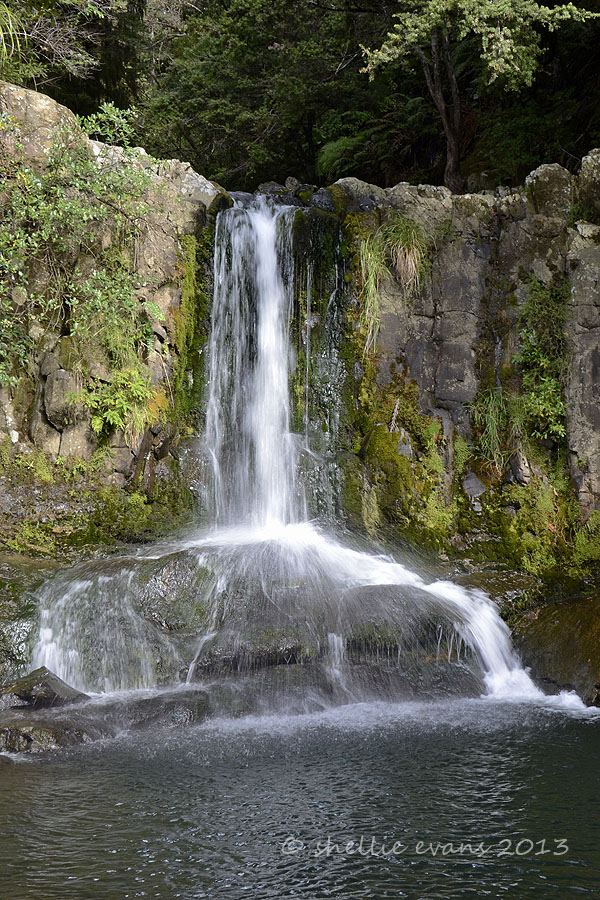
Next stop were the Waiau Falls which were just down the road, a lovely place for these tourists to have their lunch. Unusual falls too in the way the water fell & hit a centre rock then spilled either side. I bet when the river is in full flow the effect wouldn’t have been quite the same.


After the falls it was time to head back over to the other side and it was then that we met these trucks on the road, four of them in total. Not so bad as we had warning that they were coming, they were dumping more gravel on the road. Back & forward all day long, a huge quarry was at the beginning of the road. Very handy for the 309.

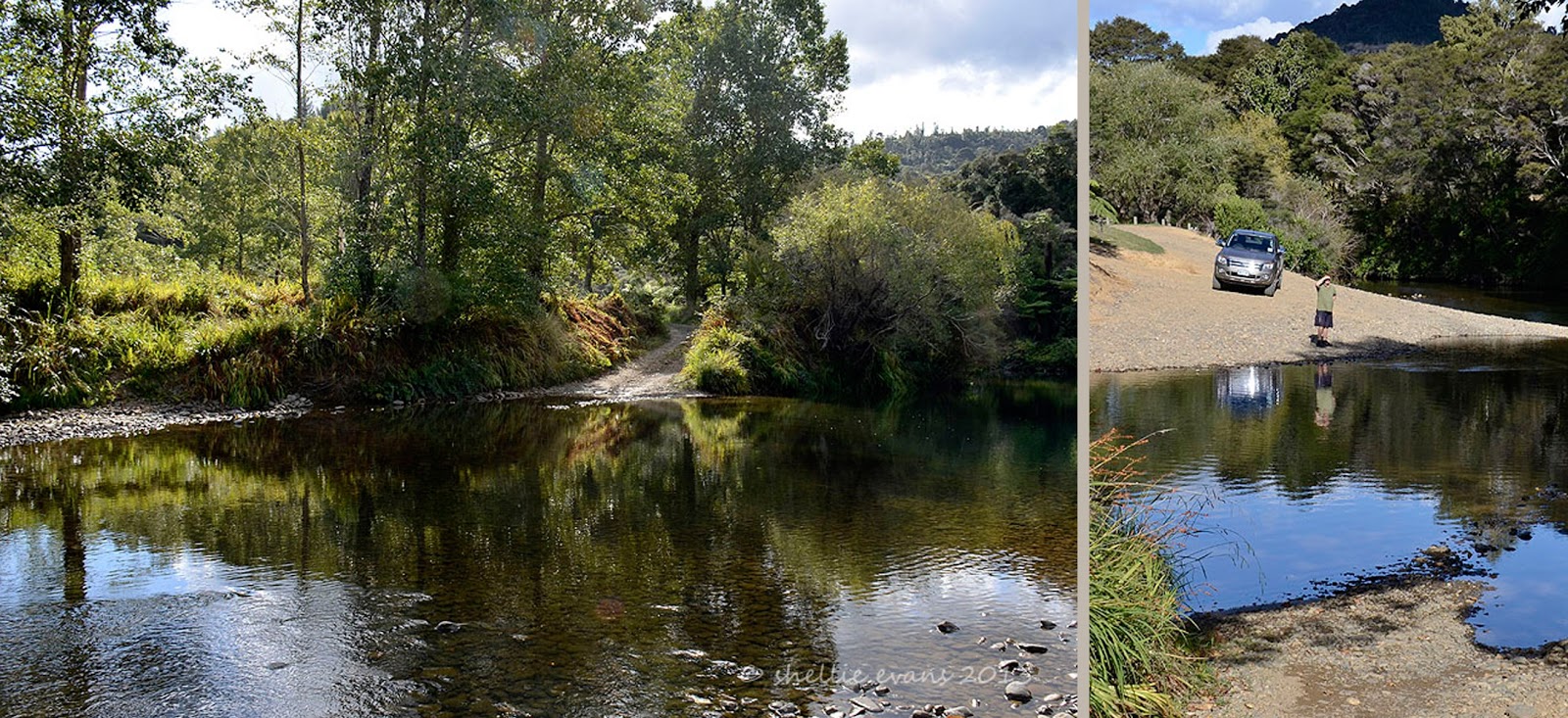
We stopped at a couple of lovely reserves beside the river on the way home, this one was called the 309 Waterhole. How would you like to cross this every time you needed to drive to town. There were a couple of houses up the drive, David was trying to decide if he would cross it or not, in the end he decided he wasn’t going to be a hero even though he got me to cross it to check out the depth! J


Thursday, April 11

A Helicopter & the Red Checkers

This morning we were woken by a helicopter that seemed to be buzzing our campsite. In fact it was topdressing or spraying the farm & in particular the hills behind the beach. It’s turn around point was right over the campsite, back & forward it weaved its way up & down the hill paddocks. After about six runs it would disappear over the hills only to return 10 minutes later to pick up where it had left off. This farm must be doing very well; helped along by many $5 notes! J


Yesterday we were also buzzed by the Red Checkers. The Checkers are the aerobatic  flying Team of the Royal New Zealand Air Force. They fly Pacific Aerospace CT-4E Airtrainers & were doing some practice work over Whitianga for the Super V8 opening in Pukekohe. We were having our lunch on the beach & a young foreign tourist came to ask us what it was all about. He thought they were doing a show just for him; there was no one else about! J

I cheated, these are my Napier Art Deco Checker shots... :)
 As you can see from my last post we did a bit of tiki-touring around the beaches on the north-eastern side of the peninsula that forms the top of Mercury Bay. These are all beautiful  ocean beaches & it would be hard to pick a favourite, I think I liked Otama for its isolation but Opito would be my choice to holiday at & if I wanted to get totally away from the world for a bit I’d have a bach in Matapaua Bay. We’ve anchored in most of the bays of these beaches at various times over the years but this was the first time I had visited them by road. Black Jack Road is world famous in New Zealand, well, world famous if you visit the Coromandel regularly. It’s another winding narrow gravel road up & over a ridge, for us, after all the winding narrow gravel roads we’ve been over lately it wasn’t actually that bad. And the views were spectacular.
 
I wanted to take the very narrow winding road to Matapaua Bay, a bay that’s always fascinated me because it’s actually on the inside of the peninsula & part of Mercury Bay & facing Whitianga & Cooks Beach but to get to it you have to take the long drive over and around the top, right to Opito and then over the top again and down into the bay. As already mentioned, we have anchored & overnighted in this bay ready for our run home to Tauranga in the morning, it has deep water & is a beautiful sea green colour.


We had lunch (when a cock pheasant strutted past us) at Otama Beach which looks out over another one of our happy boating areas, Great Mercury Island.
I think we need a new sun umbrella, this one is a little short!
 
We then headed back past Kuaotunu to look at Gray & Rings Beaches which we hadn’t been aware of before. They were both smaller lovely white sand beaches which looked to have been the old traditional holiday spots of this part of the Coromandel going by the iconic kiwi baches lining the roadside.  The rocks & boulders piled in the corner at the end of Rings Beach made an interesting pattern, it looked like they’d been blown there in a big storm. No doubt they’ve been there for thousands of years.
 
The road continued around the point to Matarangi Beach, a very popular holiday “resort”. I never like calling them resorts in New Zealand because they are nothing like the beach resorts that we’ve visited overseas. These just happen to be more popular holiday spots & sometimes they come with a flash golf course. And no, we didn’t play Matarangi Dad.

Bluff Road probably shaved about 10 minutes off the trip had we taken the normal route to Matarangi, back along the main road. This wasn’t called Bluff Road for nothing, now this was a winding, narrow road. Used more by locals than anybody I would think. It had some great fishing spots in amongst the rocks.

On the way home we stopped to see if David could pick out his sister’s old house in amongst the bush on the main road at Kuaotunu, his memory wasn’t  that great so while he was thinking about it I did as all good photographers do, never miss an opportunity of taking a shot! J