Showing posts with label black swan. Show all posts

August 20, 2016

Love is in the Air- Napier

A stay in Napier is not complete until I've paid a visit to my favourite suburban park to check out my favourite exotic ducks. Though sadly, another duck is missing, leaving just one lonely Plumed Whistling Duck from the original three who have made Anderson Park pond their home for the last 4 to 5 years.


It is not known where the ducks came from but it is thought that they were either storm blown vagrants or perhaps illegally imported eggs that hatched and then been dumped at the pond. Their natural habitat is in tropical northern Australia & Indonesia so they were a very long way from home. Here are the two ducks, taken last October.


The remaining duck has latched onto a pair of black swans, following them around on the grass and in and out of the water. It passed close to me while walking with the swans but as soon as they moved off a way, the duck gave me a wide berth.


The male black swan was very protective too, hissing and chasing me if I got too close. Although I suspect he was probably protecting his lady, it had the desired effect of protecting the duck too.


Amongst the mixed menagerie of domestic and wild ducks that call the pond home, are a number of ducks suffering from 'Angel Wing'; an incurable disease caused by a high-calorie, low vitamin diet of bread. Anderson Park is a favourite place for parents to bring their children to feed the ducks and while there are notices asking that they don't feed the birds, it would seem that nobody takes any notice. This poor fellow will in the end, pay the price.


There was a lot of noise and activity coming from the weeping willow on the island across the pond...
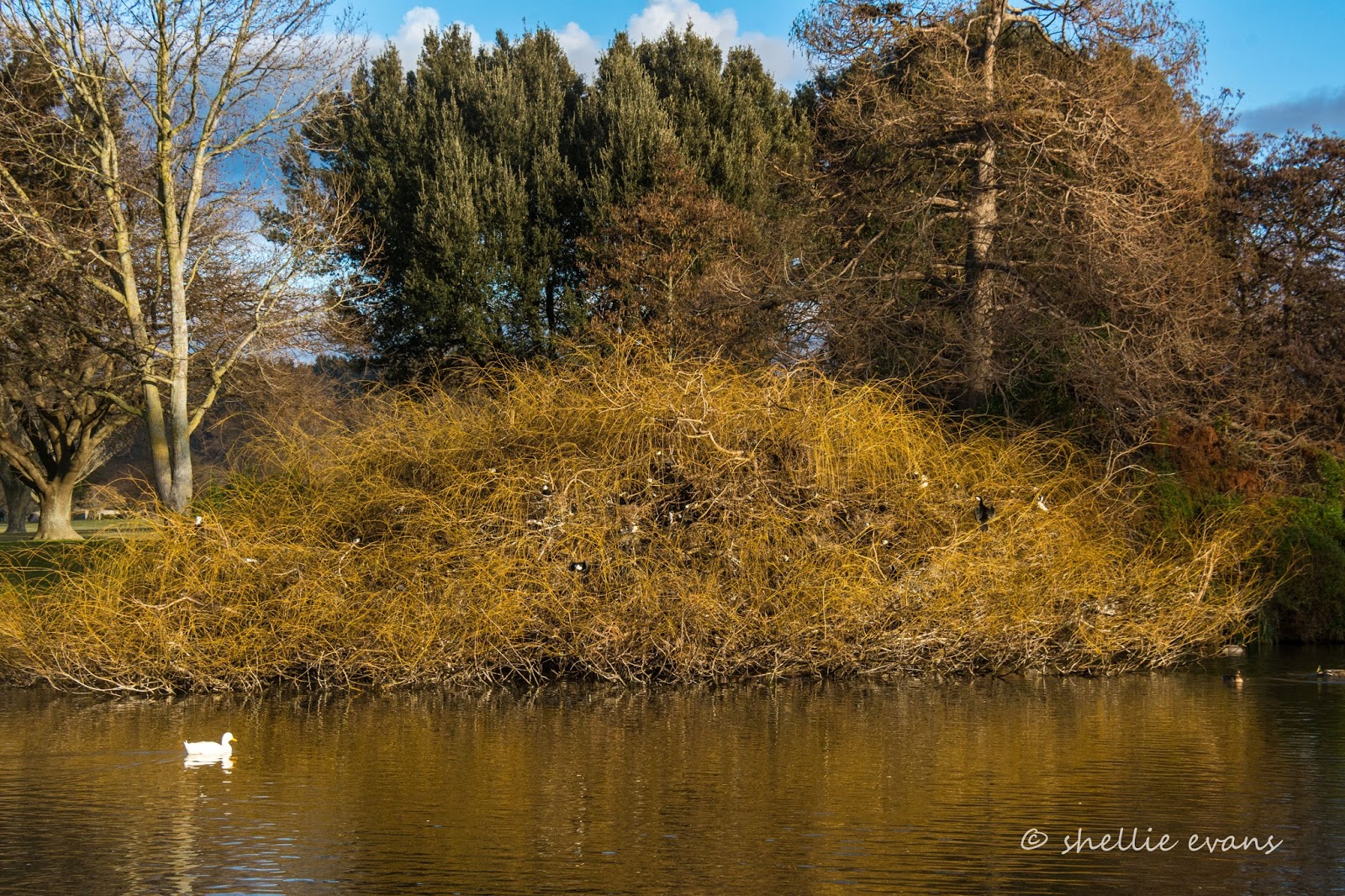

Love is in the air....as dozens of Little Shags/Kawau Paka squabble over nest building duties, feeding duties (for the few that have chicks already) and love making duties! 


Meanwhile, back on the mainland a Barbary Dove is making cooing sounds to his mate in a tree...


...and showing off his exceptional skills at collecting nest material. 


This is the first time I've seen Barbary Doves at Anderson Park; Barbarys are an introduced species with small wild populations in Northland, Auckland, Waikato and the Hasting areas. I've also seen them near Tauranga in the Bay of Plenty. Since my visit to the park, one has visited Mum & Dads' bird feed table for the first time and I've seen a few sitting on power lines out near Meeanee, so I'm assuming they are fairly well established in the Napier area too.

I walked around to the far side of the pond and who should be making their way at speed across the pond towards me? A loved up pair of swans with a duck in tow...someone needs to tell that duck "...threes a crowd!"


The swans put on an elaborate courtship display of synchronised swimming just for me... 


and him...who was waiting patiently in the background while they circled each other, swam back and forward...


...bowed and twisted their necks together, and then tapped bills..


...forming a perfect heart. All the time their little friend just floated about in the background. Eventually the show was over and the swans headed back towards the island with the plumed whistling duck following at a respectable distance. I wonder what will happen to him when the signets arrive.


I carried on around the edge of the pond and managed to get a quick shot of the notoriously flighty NZ Shoveler Ducks/Kuruwhengi before they took to the pond.


I had one more bird to check out, and he is usually found on a third pond at the far end of the park. I walked along the edge of the stream which joins the ponds, spotting bellbirds, tui, warblers, swallows and kingfisher along the way.


And two or three White Faced Herons/Matuku Moana fishing for their breakfast in the shallow waters. This one is wiggling his foot in the mud, see the bubbles? He's hoping to dislodge a small fish or eel that he can quickly snatch.


It was a thrill to get to the end of the path and find an old favourite still lording it over the back pond. For as long as I can remember there has been a White Heron/Kotuku at Anderson Park. Not all the time and not always by himself (once there were 3 white herons) and probably not the same heron either, but I've very rarely missed seeing a white heron on this pond. 


It's quite ironic that we spent 4-5 weeks on the West Coast- the home of the White Heron- a couple of months ago and failed to see one. Well, that's not quite true. I did manage a fleeting glimpse of one near the Haast River bridge as we sped by. A small white dot on a gravel island as the far end of my view. And then to later hear that one hunts in the NZMCA Park at Hokitika on a regular basis really upset me. He's never called in when we've been there.


You can see that the long feathery breeding plumes are forming on the wings. The only Kotuku heronry is near Whataroa on the West Coast, they don't breed anywhere else in New Zealand (you'll remember we need to revisit Okarito Lagoon to do a tour during the breeding season). It's likely that this heron won't be breeding this year; they are already gathering on the Coast.


'Mirror, mirror on the wall....' He (or it could be a she) stood like this, staring into the water, for over 10 minutes. Stock still staring, not flinching a feather, waiting for a fish to swim by. That is some patience. 


I left the heron to his fishing and walked back up the other side of the stream spotting a small flock of gulls resting on the grass near the middle pond. These aren't just any gulls, these are endemic Black-billed Gulls/Tarapuka and they have the undesirable status of being the most threatened gull in the world. Black-billed gulls mostly breed on the gravel of South Island's braided river systems and are often found around inland lakes and waterways.


I wonder how many people, both residents &/or visitors to Napier know the history behind Anderson Park. The city's largest passive recreation park was once a racecourse and the home of the Napier Park Racing Club which was formed in 1886. Racing ceased in 1960 and moved to Hastings.

Anderson Park has been a constant in my life since childhood; as children we rode our horses to Greenmeadows and the river, skirting the edge of the park on the way. We once walked our show pigs (on harness and leads) through the park to the shops (that's a whole 'nother story) and rode our bikes along the paths. (I also occasionally took shortcuts through the park on my motorbike- naughty girl) We flew kites, attended Christmas concerts, had school sports days, went to the circus, took nieces, nephews & cousins to the playground, watched a brother skateboard and learn to drive in the carpark. 

Later, when Mum & Dad left the farm they purchased a house right across the road from the park, and then shifted again to just around the corner from it. I also had a house not too far from the great green expanse and walked my dog regularly through the park. Over the years I've also walked and run (or staggered) along the paths on a multitude of exercise regimes. I've visited it at sunrise and sunset and at all times in between; it's a park of many moods but it can look quite stark during winter when the trees have shed their leaves or at the height of a typical Hawkes Bay summer when the grass is burnt to a dry cinder. But it's still a lovely park with beautiful mature trees and interesting waterways and birdlife. And it's still a favourite to me.


October 27, 2015

Visiting My Favourite Ducks

While I was out walking yesterday I took the opportunity of visiting my favourite pair of ducks which live on a pond not too far from where we're parked at my parent's house.


This pair of Plumed Whistling Ducks are very rare visitors to New Zealand (only 2 or 3 sightings have ever been recorded) and they have made a suburban pond their home for the last four years.


I've visited them each time we've been in Napier; there were three ducks until a year or so ago when, sadly, one disappeared. These two seem to be doing very well and are a lot more confiding then they have been in the past. They live on a very busy pond with a lot of people passing by so they're obviously getting used to all the activity. Although they are still fairly shy and unless you know where to look or stop for awhile, most people passing wouldn't know of their existence. 


It is not known where they have come from but it is thought they are either storm blown vagrants or perhaps illegally imported eggs that have hatched and then been dumped at the pond. Their natural habitat is in tropical northern Australia & Indonesia so they are a very long way from home. 


Of course I couldn't miss the chance of shooting(with my camera) some of the other waterfowl at the pond, especially with all the spring babies about.

A family of Black Swan signets resting beside the path....


With Mum and Dad quick to move close to them when I stopped for a chat.


Another family of teenagers resting under the trees....


While Mum keeps a watchful eye on them from her sunny spot nearby.


Another juvenile Black Swan sits down on the job, grazing as far as its neck can stretch in a wide arc around it's front.


On the other side of the pond a newly hatched Mallard family are out for a quick and wary walk. 


They head for the safety of the water as soon as I approach. Many dangers lurk at the ponds; dogs on the loose, wandering cats from the nearby houses, aggressive geese & swans, shags, eels, rats, pukeko, other male ducks, even other larger ducklings. It's a wonder any babies survive.


Another mother shepherds her ducklings quickly across the grass between ponds.  With their longer bills, these look like they're a NZ Shoveler hybrid.


As I'm about to cross the road and head home, I spot a wayward family of swans dwadling across the usually busy main road. Thankfully it's a public holiday so the traffic isn't too heavy this morning.


And lucky the ambulance wasn't on a call out. Talk about take their time, they even stopped for a break on the median strip. In the end I crossed behind them and shooed them up onto the grass. I hate to think how they made it back later in the day when there would have been many more cars. Someone needs to tell them the grass isn't always greener on the other side!


May 19, 2015

Beautiful & Bountiful Lake Brunner

Lake Brunner at 40km2   is the largest lake in north Westland and apparently the warmest (although I didn't take a dip to confirm this fact), so with the weather seemingly settled and the lake calm we embarked on a tiki-tour of the rather large (for our little dinghy) lake.

We headed out of our bay, towards the Hohonu Range on the south side of the lake….


We followed the lower slopes of Mt Kinga around the corner passing a large rock slide that starts right up at the top of the mountain, sliding through a narrow gully before fanning out into the lake. (Remember to click on the photos to see a larger size)


We motor towards the head of the lake where there’s a kahikatea forest, the trees at the front have their feet in the lake and are surrounded by reeds, rushes and raupo (bulrush).


This looks like fertile bird habitat and sure enough before we have time to move in close, a small flock of Canada Geese take off.


Scaup, ducks, shags and white faced heron move quickly and quietly out of sight. These birds don't like being disturbed.


Instead of birds to photograph, I ‘make do’ with the wonderful reflections. This looks like an abandoned maimai (duck shooting hide) or perhaps it was a bird watching hut.


It was interesting to see the tide lines on the rushes, I’m surprised after all the rain we’ve had that the lake is not higher.


The buttressed bases of the Kahikatea.


We move very carefully along the edge of the drowned forest, some areas are shallow and in others, submerged trunks and branches reach up ready to snag and puncture our little boat.


Kahikatea love to have their feet in water, they once dominated New Zealand’s lowland swamp forests. They are also New Zealand’s tallest tree and can grow to a height of 90 metres. Because they have very straight trunks they were ideal for milling to be used in boat building and export packaging.


We move on past Swan Bay, where there are a small number of Black Swans that also take off as soon as we round the end of the trees.


We speed up a little and head on further round the lake, dodging a floating tree trunk along the way. Now that would make a mess if you hit it in the middle of the night.  We’re now over the far side of the lake near Mitchells which is little more than a name on a map. Mitchells is on the Kumara-Inchbonnie Rd and is reached via the Otira Highway (Arthurs Pass). Nearby is an isolated bach and boat shed on the lake edge. We’re getting a little worried that if we carry on exploring along the lake edge, the weather might change and we’ll be caught out a long way from home, and with the most direct route being across the middle, we’d be in for a rough ride.

Instead we head across the bay towards the settlement of Moana, David is wanting to check out the river outlet for fishing. Just as we approach I hear the Trans-Alpine railcar toot it’s horn as it pulls away from the station.


The Arnold River is a tributary of the Grey River, it has a very wide and deep outlet from Lake Brunner.


We head down river passing under the Kotuku Awa swingbridge which is part of the Rakaitane Track, a short 45min loop walking track that starts in Moana. We’ll go as far as we can and then David’ll fish his way back to lake.


We travel quite a distance down the river, enjoying the beautiful scenery and peaceful surroundings when suddenly David discovers his phone is missing. He’s been using one of his apps to track our route and is suddenly in a panic. Where has it gone. We turn the boat upside down- not hard to do- and he then remembers he’s left it on the log we sat on to have our lunch. Lunch back along the lake edge before we reached Moana.


So we turn around and head back out, and even though I tell David it won’t disappear, his mind is no longer on fishing. He’s just keen to get back to retrieve it.


Once the phone is back on board we head across Moana’s lake front towards our side of the lake, giving the river a miss this time. There’s a large drowned wetland on the north side of the lake with hundreds of dead trees that looked to have been willows. Right along the edge are hundreds of Black Swans, some swim off and disappear back into the mass of dead limbs….


And even though we keep well away a few take flight, scaring many more into the sky. Behind the row of dead trees there’s a lagoon called Swans Retreat. I can now see why.


David had been trolling as we made our way over to the swans and it was with much excitement to suddenly find he’d hooked a fish. It put up a huge fight so we were expecting something a little bigger than what finally appeared beside the boat. This lovely little brown trout had been foul-hooked through his dorsal fin hence the fight he put up. Our first trout from the lake was of course released.


We pulled into a bay near the Crooked River inlet and were surprised to see another boat pulled up onto the shore further down the bay. After checking out part of the wetland…


….we were even more surprised to see, as we went tootling past, two stealthy fishermen looking for their quarry in amongst the reeds. Lake Brunner offers some of the finest brown trout fishing in the South Island but with their deep bronze colour, caused in part by the tannin stained, tea coloured water, they are hard to spot. David thinks there's a trophy trout nearby and the guy in camo is a guide.


We round Howitt Point and are nearing the entrance to our bay when finally David hooks a decent size fish. Even though it does put up a reasonable struggle, he is surprised at the lack of fight in the fish. This is probably because it’s a lazy lake fish, they don’t need to struggle against the flow like their river cousins.

Unfortunately for this fish, we haven’t had smoked trout for a long while so I look the other way as David dispatches him, it’s trout for dinner tonight.


Just as we get ship-shape- can you imagine how awkward it is to get out of the way of the fisherman in a tiny inflatable? I’m sure I’m going to go over the edge one day- the sky is filled with the sounds of hundreds of honking geese and from all directions Canada Geese fly over our heads, probably headed for the back of the lake where we’d seen a few earlier in the day.

They reminded me of our visit to Horicon Marsh deep in the backblocks of Wisconsin, USA. Canada Geese winter over on the marsh and at the height of the season over 350,000 birds leave to feed on the surrounding farmland in the morning. The sky darkens with hundreds of V formations at they fly back in at sunset.


We head for home as the sun disappears behind the clouds and the chilly air arrives. There are drowned forests all around the lake, this one is just across the bay from where we are parked. There are a number of stream outlets in amongst the trees so I can see why this area is flooded.


The ripples created by our dinghy makes the water look like corrugated iron.


We round the point and can see ‘Out There’ off in the distance, we’ve had a great day exploring and it’s not long before we’ll be eating trout for dinner….