Catch-up
From Cromwell we headed to one of our favourite holiday parks, Glendhu Bay Motor Camp on the shores of Lake Wanaka, for a couple of weeks of relaxation.
Glendhu Bay is 8kms from Wanaka town on the road to Mt Aspiring National Park. This is overlooking Parkins Bay, across to Glendhu Bay which is behind the point of land, with Roys Peak up behind.

And speaking of Roys Peak, I took the photo below on our way to Glendhu Bay. This is the carpark for the 16km return 'walk' (steep climb) to Roys Peak, a very popular day walk thanks to Instagram posts of travellers standing on the narrow peak with the lake and mountains behind. And no, I can't post a photo because I haven't done the walk yet. I was building up to do it this time but chickened out when I nearly died walking 12kms of the Millennium Walk around the lake. My winter fitness hasn't quite been up to scratch.
This new carpark is nearly full and it's only the middle of winter albeit a beautiful midwinter's day. Cars used to spill out of the old carpark and along both sides of the narrow road for a few hundred metres in the summer. Somehow I don't think they've solved the problem.

We were able to park very near our regular site right on the lake front. It was great to be plugged into power and have a break from running the generator every day. Solar intake is just about non-existent in the bottom half of the South Island during winter when the sun sits low on the horizon and the days are short.

Regular chores of filling with fresh water and dumping grey water in the chilly daytime temperatures are much easier to do in a campground too. Although, for the first time in 7 years we had a very rude neighbour who wanted to hog the water supply tap all to himself.

David put the dinghy up and while he went fishing...
 |
| Mt Alta after a good coating of snow overnight |
...I caught up on photos and computer work, although it was a hard not to be distracted by this beautiful view from my seat.

We certainly had some beautiful winter sunshine and blue sky days during our stay; the lake was often a millpond and especially as the sun dropped towards the mountains.
 |
| Glendhu Bay, Lake Wanaka |

Glendhu Bay and Mt Alta-

With no clouds in the sky the setting sun turned the sky a stunning pink.

But my favourite sunsets were when the fiery colours were reflected off the cloud in the sky.

Some nights were extra chilly and in the morning we knew that when the low cloud lifted a dusting of snow would be revealed on the surrounding mountains, including Roys Peak above us.

On August 14th (yes, I'm that far behind in my blogs), between midnight & 5am the Perseid meteor shower was due to pass over New Zealand. It was described by Nasa as 'One of the best meteor showers of the year', 'The nightsky would be lit up by a fireball meteor shower' others said.
So with a stunningly clear night sky (and temperatures hovering around zero) I headed down to the lake edge to see if I could shoot the meteor just after midnight. The one negative was that there was a full moon which doesn't help with astrophotography as it lights up the sky too much. I had my wide angle lens on, camera on the tripod, found the direction the meteor shower was meant to be following and started shooting some long exposure shots.
When I looked on the back of the camera I could see a bright flash at the top of the photo. 'Woohoo' I thought, 'How's that?', I managed to shoot the meteor first shot. I clicked off a few more shots and a bright flash appeared in every one. In exactly the same spot. So I looked closer at my camera back and zoomed in on the streak. That's when I realised it wasn't a meteor at all, it was a flamin' lens flare off the moon! It's going to be a long night I thought.

I went and got a deck chair and sat out on the beach for over an hour but I still didn't see a thing! I did have fun though, shooting left, right and centre as I moved about trying to keep warm- this photo was taken at 1:10am, look at all those stars in the sky (and the neighbours outside light, it was brighter than the moon!)

By 1:30am and with no sign of a meteor shower, I decided it was time to head back inside before I froze to death. Other than the cold though, it was extremely peaceful sitting on the edge of the lake in the dark looking at masses of twinkling stars above and hearing the gentle sounds of nature sleeping around me. And I say it was peaceful and it was, until I walked along the water's edge and disturbed a pair of Paradise Ducks snoozing in the shallows. And you know how loud they are, the male kept up his honking long after I retreated.

On one particularly calm day we headed out in the dinghy for a tiki-tour across to Paddock Bay, a tiny sheltered bay tucked into the corner of Lake Wanaka.

As we move into the bay, the peak of Mt Aspiring came into view (the peak on the right). It looks small here but that's because it's at the far end of Matukituki Valley, about 40kms away.

There were several pairs of Australasian Crested Grebes on the lake and one lone male who David had seen several times in the bay while fishing. And just as I was asking where he'd seen him, as if on cue, he popped up right beside us.

He'd been feeding along the edge of a massive underwater forest of the invasive lake weed lagarosiphon. Nearly half the bay is covered in the weed. Further on we could see where divers had laid in previous years, and were laying again this year, hessian mats on the lake bed to starve the plant of sunlight. It takes about 5 months for the weed to die off and while it looks to have worked in areas, we could see the matting has either rotted or broken apart in places and it was growing back through the holes.

After we'd done a circuit of Paddock and Parkins Bays, we pulled the boat up onto the shingle beach across the bay from the campground to have some lunch.

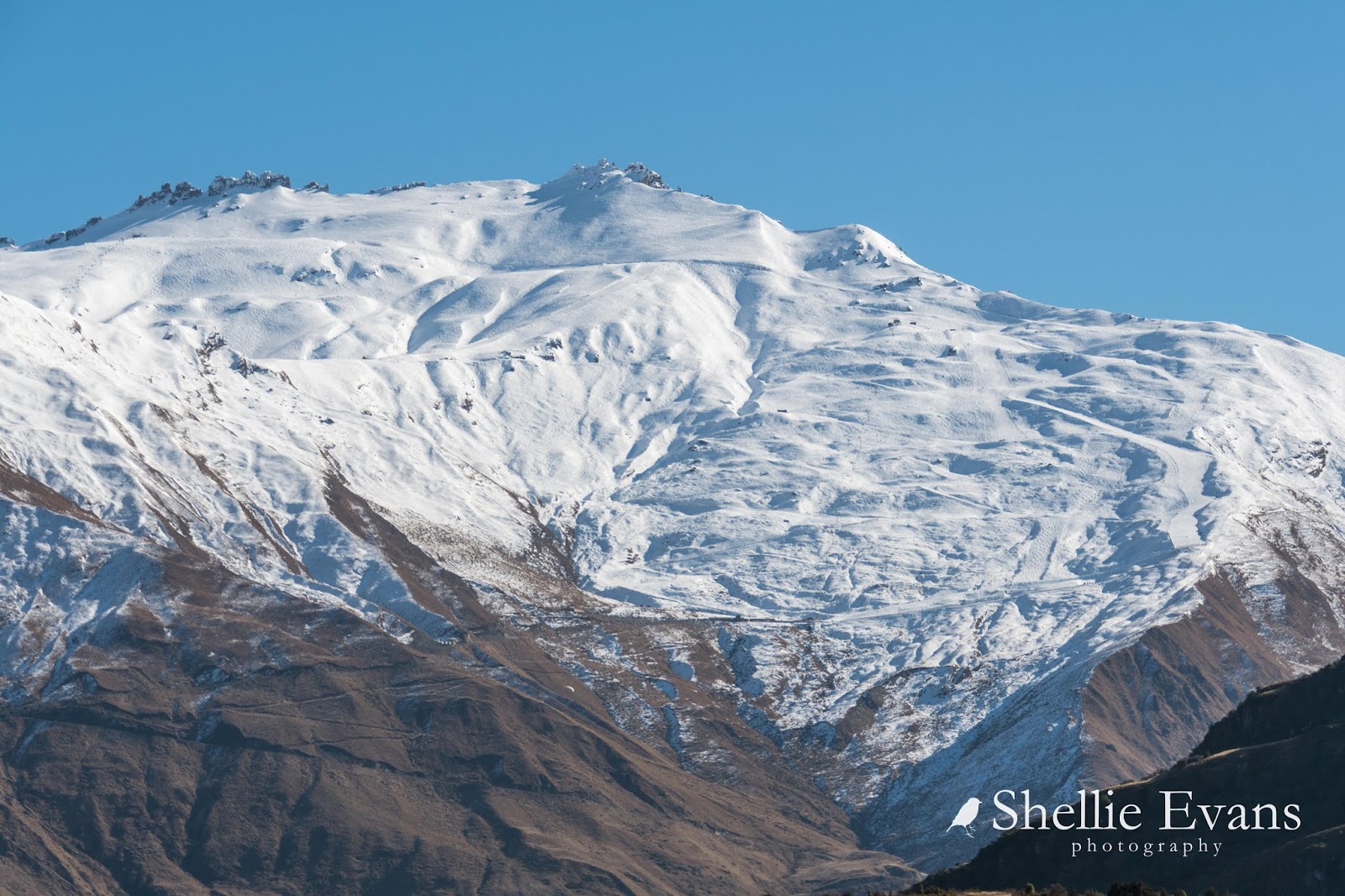
From there I zoomed in on the Harris Mountains (behind the boat in the photo above) and found Treble Cone Skifield, which we can see from our campsite too (click the photo to enlarge). You can see the access road zig-zagging up the mountain bottom left, base buildings and carpark just as the road reches the snow and the trails zigzagging up the slopes above. At night we could see the lights of snow groomers moving around the trails, I thought what a lonely, cold job that would be.
After lunch we headed back to camp, David dropped me off and then motored off to do some fishing. He doesn't have much luck on Lake Wanaka and once again he failed to hook up even after several 'hot tips' from a few locals. We saw plenty of large trout while we were exploring, many of them sunbathing in the shallows so we know they're there.

Two small kowhai trees beside our van were in full flower and each day there was a tussle between the local Bellbird/Korimako population to be the only one to feed in the trees. If they spent as much time feeding as chasing each other there'd be enough for everyone to share and they'd all be finished feeding by lunch time.
I staked out the tree several times and after many bum shots (the bane of a bird photographers' life, they turn so quick) and a photo when he looked like he was checking to see if I was still there, I finally managed to photograph him side on.

But the best encounter I had was with a male New Zealand Falcon/Karearea. We were standing outside the rig late one afternoon when David spotted a smallish bird zipping through the sky heading to the top of one of the lakeside trees near us. Against the bright backdrop it actually looked like a large blackbird but after landing we could see that it was in fact a falcon.
Falcons are our number one favourite bird and we report any sightings to the New Zealand Falcon organisation. Over the 7+ years we've been on the road we've seen at least 60 birds and while they are 'Nationally Endangered', they're more common than you'd think and in more urban areas than you'd imagine too. I love their call and am fine tuned to it, while David knows their flight pattern and these often alert us to a nearby bird.
This one sat in the top of the tree for about 10 minutes preening & cleaning, watching smaller birds fly past and surveying the surrounding area. I like how his tail is spread to hold him steady while he's resting on one foot, you can see his other foot tucked up to his chest. After a few photos I thought this was as good as I was going to get.

How wrong could I be. He suddenly swooped down out of the tree and into a nearby old kowhai tree, I followed him over to it and found him walking along a branch just above my head. He seemed to be looking for something as he moved along the branch...

...then he jumped up to a higher branch and disappeared into a tangle of leaves and seed pods. Next second he flew out with something in his talons. He'd stashed dinner in there!

He flew over to a large willow...

...and proceeded to pull apart one very dead starling. Falcons very rarely eat carrion but will cache their catch for later. Perhaps they've already eaten, or are being harassed by other birds so they wait until it's a little quieter and then return for their catch later. I couldn't believe my luck to see this happen and I was even more thrilled that he was quite happy to have me standing nearby.


Once I had enough photos, I left him to it and walked back to the rig. On Cloud 9!
Isn't he just a lovely looking boy?


