Tuesday, July 5

Hanmer Springs to Kaikoura

Real-time

We pulled over at the Hanmer Springs NZMCA Park on the way out of town, we've stayed here a few times but because it is about 8kms from the village, it's sometimes easier to stay in town at a campground or a POP (park over property). Back in March there was a major scrub fire on the hill behind the site. It was quite frightening to see how close it got to the houses. Luckily there's a road and a river between the hill and the Park, I know the motorhomers that were on site were woken and warned to be prepared to evacuate. Talk about front row seats!


The fire did jump the road further around the hill and closed the only road in and out of Hanmer Springs. It also threatened the historic Waiau River Bridge which crosses the gorge. If that had been destroyed Hanmer would have been isolated for months.


We took the Inland Route heading for Kaikoura on the coast, stopping at Rotherham so I could take photos of the church and the historic cob Watters Cottage.


Click photo to read.
We've driven the Inland Route in the past, so this time we decided to turn off at Waiau and take the more direct Leader Road to the coast.  The road passes through a number of large sheep stations, following the Waiau River for a time and then climbing a little into the hills. There was very little traffic other than a few farm tractors moving between paddocks.

We were climbing steadily up one of the hills when I let out a yell (to my ever patient husband) to stop, after I spotted a church down in a dip and surrounded by farm buildings. My first thoughts were that it was an odd place to have a church and then, perhaps it was a family church on a farm station. But I think it's a decommissioned church from somewhere near and it's been shifted there. Now I need to do some research to check it's history.


Leader Road exits onto SH1 just north of Parnassus, we thought about stopping at the NZMCA Park there, but decided to press on to Kaikoura even though the weather was deteriorating somewhat. I always unconsciously hold my breath as we pass through the Parititahi Tunnels- they never look large enough, no matter how many times you pass through them. Some idiot drove the wrong way through the right hand tunnel heading north just the other day and was chased (at low speed) by a police car for something like 80kms before being pulled over.


Usually we stay at the Kaikoura NZMCA Park in South Bay but this time we decided to check out a POP we'd heard a bit about- Donegal House. Mr TomTom lead us out the back of the Kaikoura township through dairy country, along a straight, narrow and very undulating road; a few items in the van moved shelves in protest. 


I've dubbed Donegal House the 'pub in a paddock'. It's a few kilometres north of Kaikoura and a couple of kilometres off the main highway, if you choose to ignore Mr TomTom like we should have. It is a most unusual place to have a Irish hotel, restaurant, function centre and accommodation lodge along with a large campervan park. But it works.


And much of it has been here for over 20 years. The campervan park was new last year, each parking position is marked out like horse stalls (the farm has a horse stud) with an Irish name on each section. Powered sites are likely to be available later this year. For now you must be self-contained, it's $10 per night although free if you're a NZMCA member. Of course they're looking for your likely custom in the hotel and I can report the Lamb Shanks were an excellent choice!


There's a large garden, pathways and footbridges over a pond and waterway along the front of the hotel but unfortunately with the drought that North Canterbury has been suffering for the last few years, and no recent rainfall, the pond level has dropped considerably. 


There's also a large farm pond alongside the park which attracts an amazing amount and variety of birds. Not only were there the usual mix of ducks; mallards and paradise, there were pukekos, swallows, plovers, stilts, herons and a couple of hawks. 

A large flock of swallows hovered over the pond for hours, catching insects on the wing. They'd slowly make their way up the pond, the front ones peeling off as they reached the edge, then flying to the back of the flock to start again. What incredibly hardworking little birds they are and I'm amazed they eat enough to balance the energy they use. Although they do take time out, I found this little guy resting on our shower dome one morning.


Each evening a large flock of White-faced Herons/Matuku flew in, circling for a short time before landing on the opposite pond bank. Then after a little bit of squabbling and shuffling back and forward they evenly spaced themselves out for the night. I counted 28 birds one evening including one uncommon white Cattle Egret. Unfortunately they arrived on dusk (this photo has been lightened a lot) and they left before sunrise so I couldn't shoot the egret. 


But the biggest spectacle of all were the mass arrival of starlings who roosted in the gum trees that lined the drive on the way in. Half a dozen flocks would fly around and around, ducking and diving, rising and falling, as they circled the trees, faster and faster as they swooped down and around; the flocks growing as they passed through each other. 


What an incredible sight and sound as they swept past time and time again in a loud swoosh, before eventually disappearing at a fast pace directly into the trees, sounding like they crash landed in the leaves as they landed. Silent other than the wing sound while they were flying they now set up a short burst of chatter announcing their arrival and saying hello to their neighbours before settling down for the night. Until someone who shall remain nameless started up the generator. The closest birds shot out of the trees like bullets squawking in surprise as they did a couple of circuits before resettling again. 


In a smaller pond near the driveway I found another rare bird, and a first for me, the introduced Mute Swan. Wild Mute Swan populations are only found in Canterbury (approx 80 birds) and Hawkes Bay (20 birds). There are also odd semi-feral birds elsewhere around the country on ornamental ponds and reserves. This poor fellow is all on his lonesome and has apparently been here for many years.


He was very pleased to see me and propelled himself across the pond at a fast rate of knots everytime I passed. I climbed over the fence to get some close up photos and he obliged by swimming back and forward and around displaying his magnificent and beautiful wings and cocking his head as he went. Living on a muddy farm pond may provide you with tasty dinners but it does nothing for your neck feathers!


No matter the length of stay in Kaikoura, a visit to Kean Point and the seal colony is always on my must do list. I never tire of watching seals go about their 'busy' daily schedule of lazing about, looking like giant fat slugs amongst the seaweed and sunning themselves on the rocks.


But the real reason to visit at this time of the year is too see the seal pups that have been left to their own devices while mum is out feeding, for sometimes up to 3 days at a time. There weren't so many pups about (compared with a previous July visit) and the fresh water pool that they were frolicking in back then, was a swampy puddle with very little water- another sign of the drought. The water level came to the top of all the dark brown grass(which has since grown) before.


There were still half a dozen pups lounging on the low branches and hiding underneath a large tree but none swimming in the pool. You can see the same tree and pups swimming in the pool on this blog, from 2 years ago.


I did find this gorgeous wee guy drying himself off on a grassy patch beside the Kaikoura Peninsula Walkway.


I wanted to reach out and rub that cute little flipper as he was scratching himself. Of course I didn't. 
I know that look of pure bliss when your scratch reaches the spot very well, little fellow.


He barked a warning each time David walked past, we think he thought David was a large seal because he was wearing black jacket and pants. Whatever it was, little seal pup didn't like him approaching at all.


We found this 'luxury resort' on a back road, on the way home.


Complete with information centre nearby! Don't you love some people's sense of humour. Although I'm not so sure the neighbours would agree.


Friday, July 1

Curly Tree & Ship Creek Treats

Catch-up

We left Haast Beach Holiday Park after the long weekend and on another stunning day, with thoughts that we'll definitely be back to explore further over the summer months.

We cautiously approached the one way Haast River Bridge, which at 737 metres, is the longest single lane bridge in the Southern Hemisphere. There are two passing bays in the middle of the bridge should we meet anyone coming from the other direction, although with the 5th-wheeler on the back it would have been awkward slotting into them. Luckily we had the bridge to ourselves.


Our first port of call on our road trip north today is the Curly Tree Whitebait Company beside the Waita River. A sign points the way in and we hope we'll be able to turn around once we drive down the gravel track. The track actually leads into Waita's fishing settlement and a farm house and yard beside the river.


 In a shed, alongside the farmhouse, whitebait fritters (they call them patties here) are made and sold, along with whitebait itself, when it's in season or the freezer full. Curly Tree is a popular place and is well known amongst visitors who've read about it on travel websites. 


We've had whitebait from Curly Tree before, when we attended the Bluff Oyster Festival a couple of years ago. When we were all evacuated as a violent storm blew through, and after Curly Tree had driven over a thousand kilometres to get to Bluff- via the Lewis Pass, as Haast and Arthurs were closed due to the weather. This lady remembered it well, it was a disaster for them.

There was a collection of whitebait nets beside the shed, including a large box net which is the one that's fixed beside the  lifting whitebait stands I mentioned in earlier blogs. The fritter was fine (with a little mint sauce drizzled around the edges, another thing I learnt from Curly Tree at Bluff) although I never know what the fuss is about, give me Blue Cod any day.


I walked back along the track and met David at the entrance so I could take photos of the fishing huts. There's no need for burglar alarms or guard dogs here, I walked around a corner to come face to face with a monster bull and 5 of his mates, equally as big. 


I'm sure they are docile enough but I wasn't taking any chances and gave them a wide berth as I made my way to the rig. I figured the closest bull would be held fast for as long as it took me to reach the ute if he did decide to check me out; he was knee deep in a bog.


It's not often that we explore along the road we are travelling with the 5th-wheeler on the back. We usually park up and then radiate out exploring over the next few days, it's easier to get to some places and we don't have to worry about parking. But with alot less traffic on the road over winter most of the car parks and pull-ins can accommodate our size fine. 


Our next stop is at Ship Creek. This has got to be one of the best short walk activities we've seen and is very well set out by DOC. I know I was impressed with the Hapuka Walk across the road from the Haast Beach campground but this was even better. Two totally different but stunning walks that showcase the many beautiful features of the West Coast's landscape.  A boardwalk leads us to a large shelter with a tower where...


...after climbing up a well fixed, standard aluminium ladder you get a panoramic view along the coast line south-west right around to Jackson Head in the distance, out over the carpark and to the swamp forest behind. 


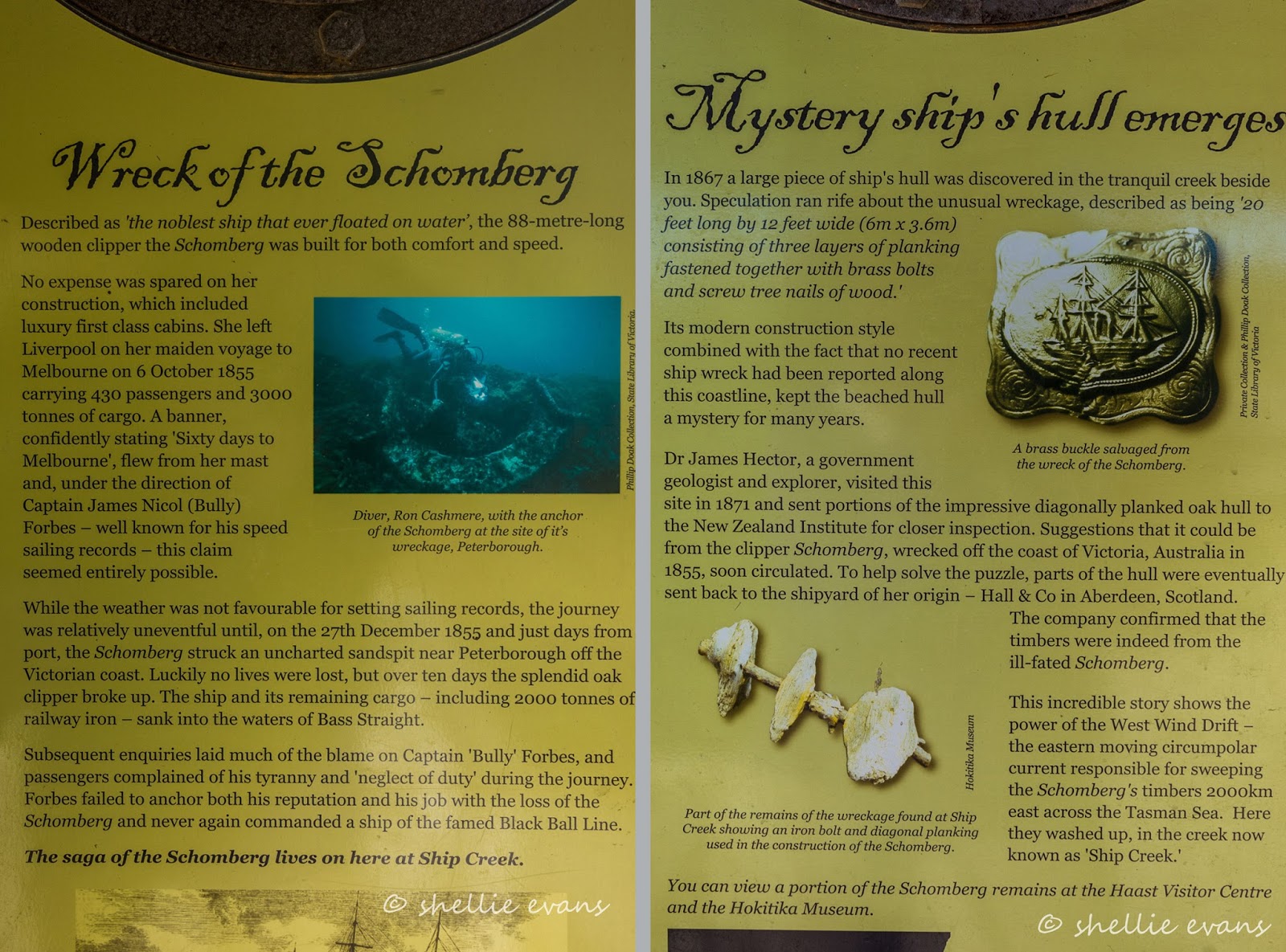
On the pillar supports of the shelter there are a number of information panels explaining the reason for the Ship Creek name (click on the photo to enlarge). 


We decide to do the 1km, 30 minute Dune Lake Walk first. The boardwalk passes along the back of the dunes and we stop to check out the first of a number of interpretation panels along both walks. One of the reasons we'll be back in the summer is to see the Fiordland Crested Penguins/Tawaki that live on the Coast, they start arriving back in the spring to breed. Did you see the No' Dog' sign back at the carpark? No? Neither did that couple out on the beach! Grrrrr......


We leave the beach behind and follow the track into the bush where it winds its way through dense coastal forest stunted by the prevailing westerly wind, before climbing steps up onto a platform with more magnificent views and explanation panels.


We can now see the dune lake that gives the walk its name. 


I've included the panels again just because I know there are people out there (hi Dad) who like to have all the information. It would take me far too long to research and write my blurb on the subject and I'm in catch-up mode so I must move along! Also, you may not have noticed but the cream fishing crib back at Waita was named "'Drovers Rest' On the cattle track". Now you'll see why.


We leave the platform behind and follow the path on through the bush until we reach another boardwalk and the dune lake. There's one lonely Black Swan who makes a hasty retreat towards the reeds when he spots us. We don't see any other waterfowl.


The boardwalk skirts around the edge of the lake and winds up into the bush and up to another platform and more information. It was interesting reading about the water reeds/Kuta I must say, we usually only hear about flax being woven.


From the platform we can look down on the lake and see that there are still no birds in sight and that the black swan is still hiding. Personally I think this lake is a little slice of hidden paradise.


The track heads back towards the carpark and we're now passing through a magnificent emerald green forest, the understory draped in ferns, mosses and epiphytes. This is what a rain forest is all about. Small birds flit about, dart across the path or call from the canopy.


We pass back through the shelter and out to the other side heading for the second shorter Kahikatea Swamp Forest Walk, a 20 minute 800 metre walk.


The gravel track is wide and passes under the road bridge tracking up the side of Ship Creek whose dark tannin stained waters lay still and reflective. The path turns inland and becomes a winding boardwalk over the top of a dark soup-like swamp. Once again the forest trees are smothered in epiphytes and mosses. These are a few of the remaining Kahikatea (White Pine) left behind by pioneers of past.


We come to another platform deep within the swamp, with, what looks like a couple of large round crates as tables and one that someone has put on it's side. It's a wonder they haven't been thrown into the swamp, we think. Except that they are all fixed to the decking and don't move.


These are cheese crates made from the Kahikatea trees that were milled from the forests along the Coast. Back in 1769 Captain Cook thought the tall straight trunks of the Kahikatea would make ideal spars on sailing ships but the wood proved too soft. Settlers soon felled many trees as they drained the swamps, the land was flat and fertile and good for agriculture. Once dairy became established and product exported to England, the great Kahikatea forests came tumbling down, the pale and odorless timber was used for butter boxes and cheese crates to protect the exports.


We made our way around the swamp boardwalk loop and back onto the creek path, passing another deck with an impressive view of a lone Kahikatea standing very tall and alone. And not too far from the base of the mighty tree I spied another familiar sight, two tiny and slightly faded Blue Pinkgill mushrooms, not so rare on the West Coast but rare in the world; New Zealand and India are the only two countries where the blue fungi is found. 


I'd highly recommended both walks if you are travelling along the Coast road, and especially if you are visiting the West Coast for the first time or you have overseas guests with you. 

Our next stop is at Knights Point lookout. Knights Point (named after a road workers dog by the road gang) marks the meeting of the highway- road gangs worked from the south and north on the Coast road and Knights Point is roughly where they made a connection. A stone monument and plaque commemorate the achievement.  

There are more than enough 'love birds' holidaying in New Zealand at this time of the year; couples hand in hand on walks, couples smooching at picnic tables, couples cuddled up for selfies, couples sitting arm in arm on lone rocks looking wistfully out to sea, couples in motorhomes.....wait that's us.   


The lookout was boarded up and access closed and it looked to have been for awhile too. Obviously something's not safe on the overhanging deck. A pity because the views would have been stunning. I managed to take a photo between the greenery. 


We arrived at our overnight stop in the late afternoon. The DOC camp at Lake Paringa is just a short 60kms from our starting point. All those stops and walks have taken us most of the day to cover. That's the beauty of having no plans or itinerary, it's what we love about our life-style. Start and stop whenever and wherever you like.


Unfortunately as lovely as the camp is, the sites are all individually spaced out and set back into the reserve surrounded by bollards and far too small for our rig. There's no one else in the camp tonight so we decide that the best place to park is in the boat ramp carpark. I doubt there'll be an influx of boating traffic this evening.


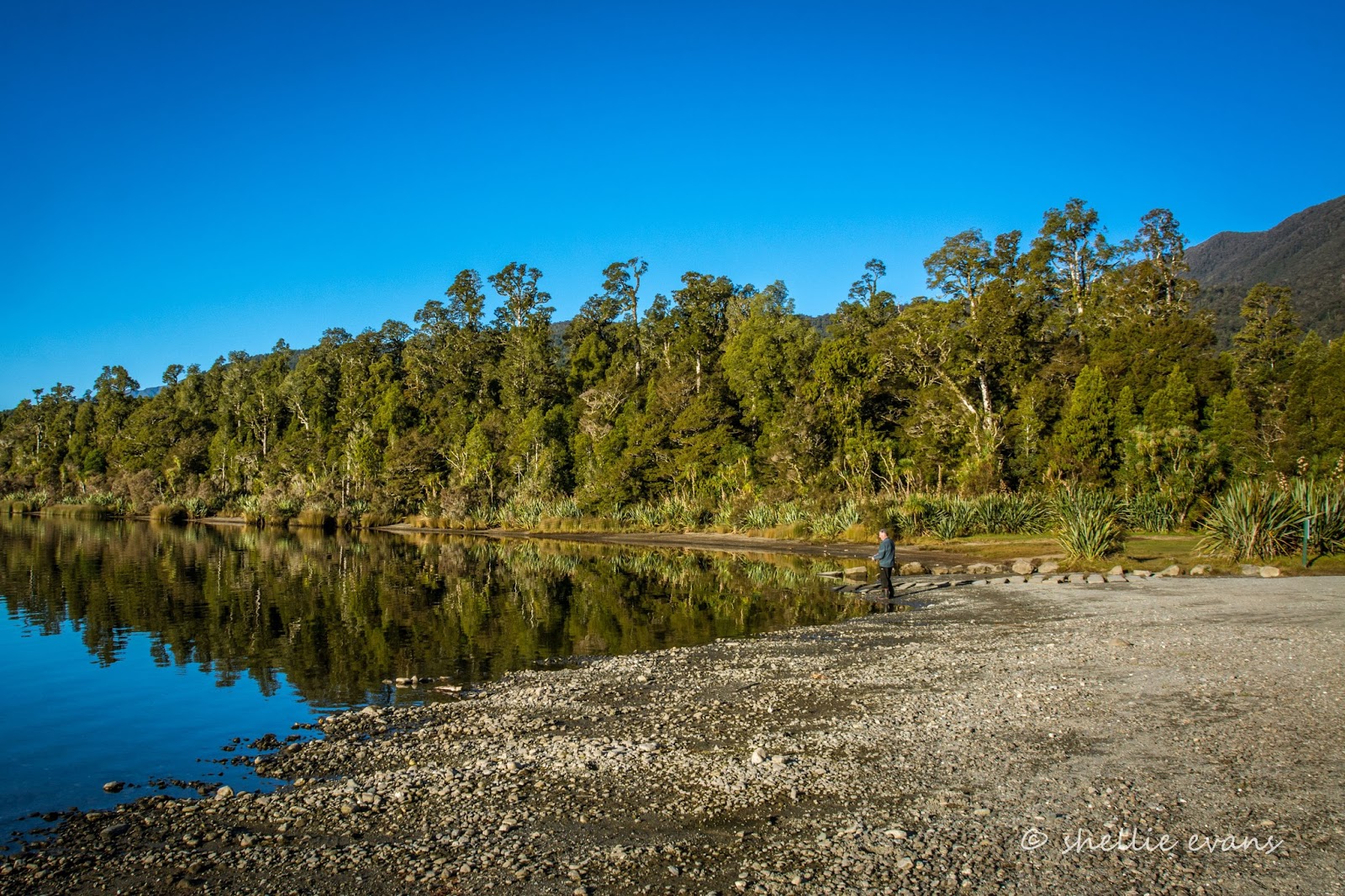
The afternoon draws to a close and the reflections on the lake are beautiful.


Lake Paringa is a small horseshoe shaped lake with a large hill (or small mountain) at the centre point (out of picture, to the right). It was a shame, the sun sets earlier enough as it is at this time of the year, but it dropped behind the hill even earlier, and not long after we arrived.


Not before David got his spinning rod out and went fishing; having fun with a half a dozen or so small to pan sized trout and salmon. All caught and released of course. 


We woke to thick fog the next morning and a bone chilling cold- another reason we love this laid-back lifestyle, there's no reason to be up and off at the crack of dawn. It took a long while for the sun to even attempt to push through the pea soup...


...and then slowly but surely the mist lifted...


...with just enough blue sky & promise of some warmth for David to try out his luck again. 


More fun with some very sprightly fish and then it was time to hit the road again.