Showing posts with label blowhole. Show all posts

January 24, 2017

'Monsters' From the Sea- Catlins; Part 2

Catch-up, I was thinking to myself - 'is this a catch-up post or a real time post?'  Because I am usually behind with the posts anyway so how far behind, is behind? So I made an executive decision and 'catch-up' is anything over two weeks old. And then I looked at the photos for this blog and they miss real-time by one day! You can't win.

As I mentioned in the previous post, David, and Peter, one of the other RVers staying at the Hinahina Reserve, were trying their luck fishing from the rock pile when they got the fright of their life when this little rat-bag came racing out of the depths of the channel at them.


And then wouldn't let them get anywhere near the water again as she skillfully ducked and dived along the edge of the murky water, popping up to surprise them as they moved along the rocks...


...growling and mock charging them everytime she emerged from the water.  


You'll remember me telling you about an aggressive leopard seal in the Pounawea Fishing blog. Well, I'm 99% sure this little girl is the aggressive seal the guys saw further down the estuary. 


I had contact with DOC at Owaka and was able to supply them with her tag number and it turns out that she is this female's last year's pup. This sealion is the one I wrote about which was resting on the bush track at Pounawea. She is indeed (as I thought) waiting to give birth and has weaned her last year's pup (our little monster) and set her loose all by herself.


Poor wee thing, no wonder she's mad with the world. She decided she not only owned the rock pile but the boat ramp too. 


It was great to hear from DOC that there were 4 pups born in the Catlins last year and they were all females. Which means they'll all be coming back to the mainland to breed. Great news for the endangered sealion, not so good for holidaymakers at Pounawea. Apparently the female due to pup had already been shooed away from under someone's deck where she'd settled in to give birth.

How cute is that look? 


As cute as she was, she was a feisty little madam; 


I couldn't work out whether she was being aggressive or just wanting some company, especially when she flopped down on the concrete and went to sleep. We all retired to our vans to give her some space and after a time she headed back down the ramp and off down the estuary.


I wanted to re-visit nearby Jacks Bay (after visiting there 3 years ago) to walk to the blowhole again and check for sealions on the beach. We couldn't wait any longer for the weather to fine up so headed there once the rain stopped.


There are expansive and impressive views out over the bay on the walk to the blowhole...


 ...including a view down into a secluded and rugged little cove where we saw Yellow-eyed penguins resting on a rocky ledge the last time we were here. We scanned and checked with our binos but saw none this time.


There were a steady stream of people walking to the blowhole...


...but unfortunately the sea (for once in a blue moon) was calm and the blowhole wasn't playing! We should have come when it was wild just a couple of days before. Can't win.


It's still impressive watching the swell rise and fall as the water's pushed 200 metres inland.


Jack's Bay is a well known place to visit if you're wanting to view sealions, especially if you're on a tight time-frame and only have a day or two to check out the Catlins.


What never fails to amaze me in places like Jacks Bay, is how many visitors, both domestic and foreign tourists, pull up in the carpark, go for a walk, maybe to the blowhole, scan the sign above, look up and down the beach, perhaps walk to the water's edge or a few meters along the sand hoping to see a sealion and then climb back in their vehicles and drive off. Can you see any sealions here?


No, and nor could I but I know they're mostly likely there and a quick scan with my camera on full zoom (my pseudo binos) and I spot a suspicious looking lump of driftwood about a third of the way along and up near the dunes. And way down the end of the beach a further two possible 'logs'. We drive back down the road and stop at the next track, near the first sighting; I can smell sealion before I see it and it looks like he has done the same (although I suspect the smell is coming from the resting areas other sealions have made in the flattened grasses above the beach). 


After taking a few photos I carry on to the end of the bay and sure enough there are more sealions; not two as I saw but 3, all fast asleep in the warm sand. Such cute faces, don't you think?


This is what you miss if you don't know what to look for or don't look hard enough.


After Jack's Bay we drove around to the entrance of the huge Catlins River Estuary, to the Owaka Heads part of what we could see across the water from the Pounawea Holiday Park.


It was very windy and there were dozens of waders sitting out the weather, roosting above the high tide line on the point; Bar-tailed Godwits, South Island Oystercatchers, Royal Spoonbills (bad-hair day), a few noisy Spur-winged Plovers and running around in amongst them all, dozens of tiny Banded Dotterels(no photos they move too fast).


And we spot another two 'monsters from the sea', a very big maned male who didn't look too friendly. He could smell another male but couldn't see him and sure enough as we scanned around the dunes we saw the second one resting further inland. It's quite scary walking through the dunes (as I was doing sneaking up on the birds), they're quite undulating and the grasses are very tall. You don't want to stumble on a sleeping sealion that's for sure. Luckily the 'nest' in the 3rd photo was empty.


The icing on the cake for our awesome nature experiences, and at the top of the 'monster from the sea' candidates, was this huge elephant seal. 


I received a 'hot tip' from the DOC office that an elephant seal had swum into the estuary the night before and hauled itself out of the tide beside the Newhaven boat ramp. We were due to leave Hinahina that morning but not before we raced around to the other side of the estuary to check out the sighting and hope that the seal was still there.


It was still there alright and if you didn't know about it beforehand, you certainly did when you stepped out of the car. Seals and sealions have nothing on the smell that was emanating from this big boy with the kind eyes.


One great big lump of lard with a number of battle scars and a little on the skinny side (according to DOC, he is probably quite old), you have to wonder who designed these guys and what's their purpose, they certainly can't move very well on land. Adult male elephant seals can measure 4-5 metres and weight 3600kg, females weigh a third of this and are 2-3 metres in length.

Here he's stretching out, or maybe relieving pressure?


The Southern Elephant Seal is a rare visitor to mainland New Zealand, their usual range is in the Southern Ocean around the Antarctic and sub-Antrarctic islands.

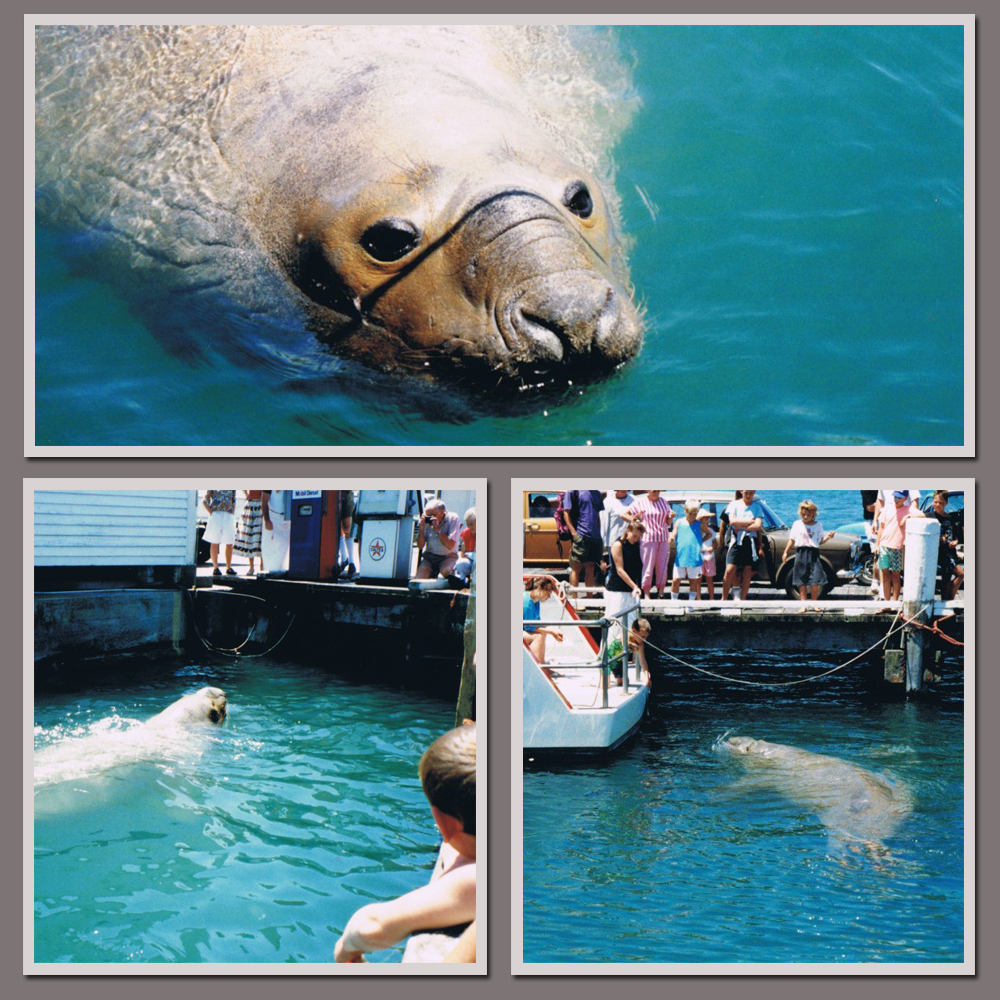
This is the second elephant seal I've been lucky enough to see; the first one was in Tauranga, 27 years ago, when Humphrey a young male came on a visit and decided to stay for a few months when he fell in love and tried to set home with a herd of dairy cows in Katikati, and where a sculpture of Humphrey now sits beside the stream he used as his private waterway from the ocean to his harem.


Humphrey also spent a few weeks (Christmas shopping?) lolling about at the The Strand carpark and wharf area in downtown Tauranga. My photography has come a wee way since these photos were taken.

Of course the most outstanding feature of the Elephant Seal is the inflatable proboscis, and inflate it certainly does. It's thought to increase the effectiveness of the bull's roar. I don't know about the roar but it certainly increased the snoring. I took a video of him, click to listen! That very loud bird you can hear is a Bellbird/Korimako. If it hadn't of been for the seal I'd have been hunting down the bird to photograph. And I'll not make a videographer anytime soon, excuse the clumsy filming.


Sweet dreams...is that a smile on his face?


April 16, 2015

Punakaiki- Pancakes & Blowholes

Continuing on with our journey down the Coast-

We left Westport just as the rain started to fall and it really hasn’t stopped much since. As the locals say- ‘you can’t have a rainforest without the rain’. But then I’ve also heard them complaining too!

I spotted this poem on a cafe wall which just about sums it up-
Rain
It rained and rained and rained
The average fall was well maintained
And when the tracks were simple bogs
It started raining cats and dogs
After a drought of half an hour
We had a most refreshing shower
And the most curious thing of all
A gentle rain began to fall
Next day but one was fairly dry
Save for one deluge from the sky
Which wetted the party to the skin
And then at last the rain set in
                                                       Anonymous
We’ve cursed it the odd day, but mostly we’ve just got on with it. Because we have no time frame it’s just a matter of sitting out the rainy days (great for catching up on blogs) and venturing out in between showers. One bonus is that we’ve had plenty of rain water to top up our drinking water containers and our house water tanks have been full to overflowing many times.

We made our way down the coast passing through some amazing coastal scenery- the bits we could see between downpours.


I kept reminding myself that we’ll be back this way someday before we bring this journey to an end. But there will be one beach that I’ll return to very soon- a very special beach that not too many people know about. I’m hoping I’ll visit it when we return to Greymouth after we’re finished with Hokitika (which, for those that are directionally challenged is south of Greymouth so we’ll be doubling back to Greymouth for a few days and then crossing over the Divide via Arthurs Pass).

Hokitika will be as far south as we’ll travel the West Coast this time- we'll come up from the bottom of the island to complete it later in the year. We need to get to Christchurch to have some servicing done before the onset of winter…..although I think we missed the memo that says it’s already started! There’s snow on them thar hills.

I’ve passed through Punakaiki twice in my lifetime stopping for a short visit both times, one I can’t remember and the second time was when David and I caught the TransAlpine train across to Greymouth from Christchurch about 17 years ago and then we headed north and over Lewis Pass to Hanmer Springs for a short break. I can hardly remember that visit to Punakaiki either- just a few snippets here and there but one of them was the amount of Nikau Palms that lined the road- Punakaiki didn’t disappoint this time either.


There wasn't too much traffic on the road and when we did pass a vehicle it was mainly hire campervans, so it was a surprise to suddenly round a corner and find a lot of activity in the carparks and on the roadside as we passed the entrance to Punakaiki Rocks.  We’re definitely in tourist country now. We also had our first foreign tourist driver episode (which for my overseas readers has been a major issue in NZ over the summer) where a driver had stopped in the his tracks on a narrow winding section of the road and was backing up. Not pulling over to the left and waiting to do a U turn, just backing up, up a winding hill. Luckily we saw his reverse lights and were able to pull up well in advance. I gave him a polite smile as we passed.....yeah right!

We planned to stop at a CAP (costs apply parking), a NZMCA park over property in Punakaiki for a few nights and we found it just south of the Rocks and right beside the Punakaiki Resort. We were familiar with the resort, we stayed there not long after it opened and when it was known as the Punakaiki Eco Resort, now we were sharing the same beach. The CAP was a great place to stay, a large raised gravel area that had obviously been prepared for subdivision, very close to the blowhole & local walks, and with a wild west coast beach just through the flax bushes. It was just a pity it rained solid for 2 out of the 3 days we stayed, and rained on and off on the 3rd day. But we did get to witness a very impressive thunder storm and light show out over the ocean one night.


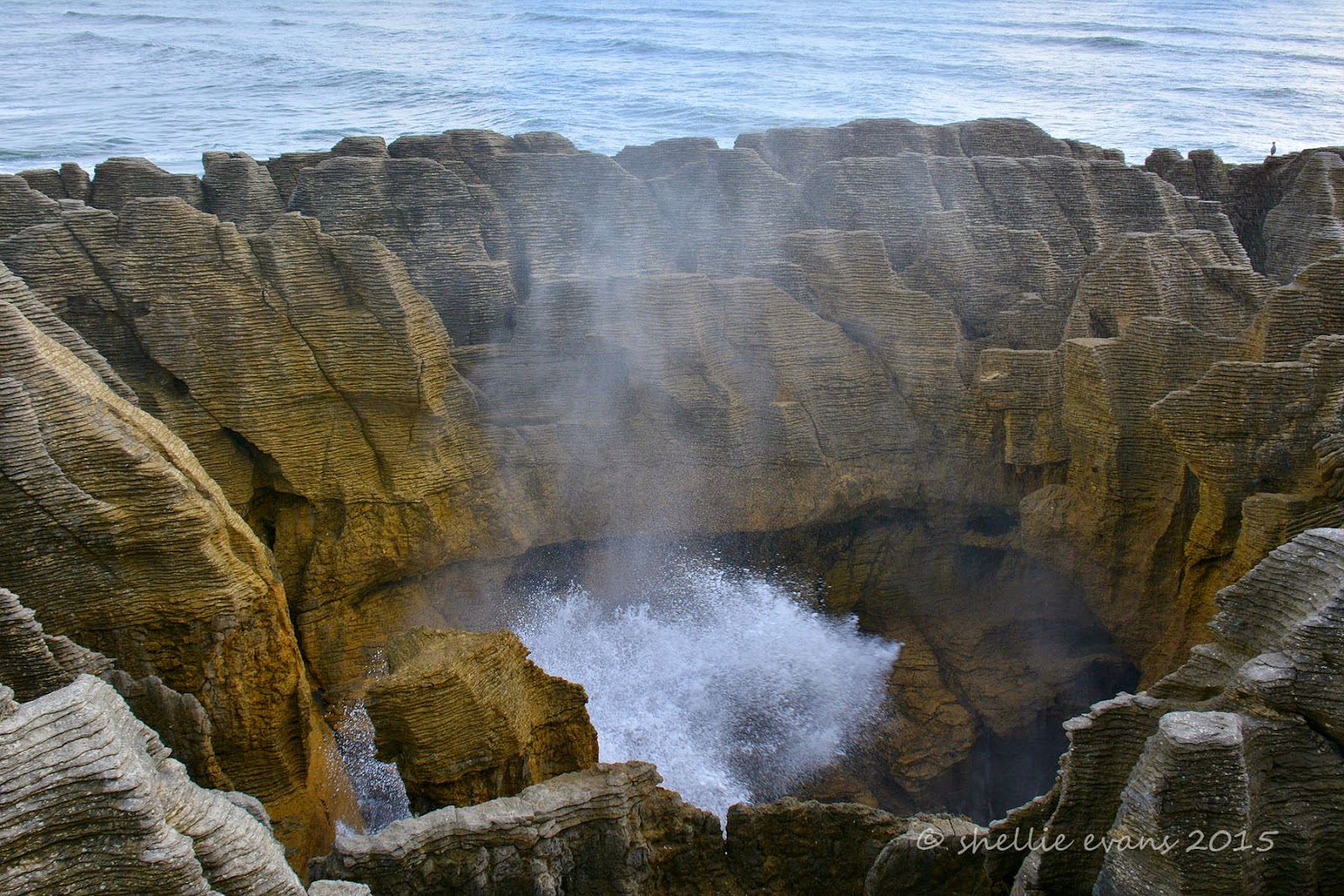
Of course our first visit had to be to the famous Pancake Rocks and Blowhole at Dolomite Point, which are located just off the main highway at Punakaiki. The 20 minute loop walk starts out in native rainforest with many Nikau Palms before passing through dense flax and coastal vegetation as it nears the rugged coastline.


There are numerous formations and smaller blowholes in amongst the rocks before you get to the main iconic blowhole, Putai. This surge pool is called the Devil’s Cauldron and at high tide it lives up to its name as the waves gush in from the sea channel and break against the rock sides getting bigger and higher as the tide rises.


 From the information panel-
Looking like giant pancakes the unusual limestone formations were formed 30 million years ago from minute fragments of dead marine creatures and plants that landed on the seabed about 2 km below the surface. Immense water pressure caused the fragments to solidify in hard and soft layers. Gradually seismic action lifted the limestone above the seabed. Mildly acidic rain, wind and seawater sculpted the bizarre shapes.

The main attraction, is of course, Putai – the largest blowhole – where on stormy days the seawater swells upwards from the rocks in a giant wall of spray. Coinciding high tide with a westerly wind is the best time to visit the blowholes as then the water is forced through underneath the rocks and up into the blowholes producing huge plumes of sea water.

Today, it wasn’t quite high tide and there was no wind but the sea was still a little rough (from the storm overnight), so we managed to see a few reasonable blows.


The Chimney Pot Blowhole-


The walkways, railings, platforms and information panels have been very well done and I’m sure the many hundreds of visitors that walk the track every day, leave feeling they’ve seen an impressive and unique landscape and also learnt a little about how it was formed. Of course a good show by Putai would be the icing on the cake but I don’t think it’s totally necessary to be impressed by this spectacular coastline.

If you look closely, you can see our van parked up near the beach in the background of the photo on the top right. That’s how close we were to the Pancake Rocks.


After the blowholes the track carries on around the edge of the rocks and at one point disappears down through a narrow rocky gap before climbing up the other side….


…to a lookout point, looking north up the coast. It’s late afternoon and the sun makes a brief appearance….along with a rainbow over the top of the rainforest.


There is another well known walking track just up the road from the Pancake Rocks that is also well worth a visit. The Truman Track begins again in a beautiful sub-tropical rainforest of ferns, nikau palms & rimu trees with this coastal tarn (is there such a thing?) right beside the carpark.


As the track nears the coast it passes through dense coastal flax again before emerging onto a headland with stunning views up and down the coast. At this point my memory is jogged; I knew David & I had visited an area before, where we’d climbed down onto a beach underneath a cliff overhang- I thought it was back at the Rocks but that was clearly impossible when I saw how rugged that area was. This was the spot!


A stairway leads down the north side of the headland to a gravel beach with cliffs, caves, a waterfall, more amazing rock formations and what looks like an extinct blowhole. The beach is accessible only at low tide and even then it’s quite scary with the rough seas and crashing waves. I leave David in the cold wind, scanning the ocean for seabirds while I climb down over the boulders and under the tiny waterfalls that are dripping off the rocks above.


I want to take a photo of the waterfall that looks like it’s flowing out of the rock wall at the far end of the beach.


I take a few slow shutter shots to get a silky ribbon of water, but the wind is blowing hard and most of the shots have the water flow at a weird angle.


February 07, 2014

Jack's Bay & the Blowhole

After exploring the inland river area we left "Out There" in the DOC camp for the day & headed back towards the coast to check out a few more areas. First port of call was the Purukaunui Falls, one of Otago's most iconic & photographed sights. The falls often appear on calendars & post cards & featured on a postage stamp back in 1976. Just a short 10 minute walk through bush leads you to  the falls which are known as "wedding cake" falls because of the three tiers. The falls are pretty impressive & I would imagine they'd be even more so when in full flow; we gave them a 9/10 on our waterfall scale, well worth the short walk.


Next destination was Jacks Bay, on the way I took a photo of this abandoned classic early 1900s farmhouse built from native timber & corrugated iron. The farmhouse, or homestead on bigger farms, usually had a veranda on the front (this one looks like it has been enclosed at some stage) & and a woodshed &/or washhouse (laundry) at the back. This house had a large specimen tree in what would have once been it's front yard, with old fruit trees behind. I wonder of the stories these houses could tell.


Most of the old derelict houses I've seen have overgrown macropapa hedges wrapped around two or three sides. These would have originally been planted to give the house shelter& protect it from the prevailing winds. Now the hedges have grown into huge trees that have nearly swallowed up what remains of the house. The old house below was located just down the road from our camp. It's unusual in that it's rather small with just one front room with the front door to the side. The kitchen & bathroom facilities would have been located in the 'lean-to" attached to the back. Maybe it was the farm worker's house or perhaps shearers quarters.


Talking about old buildings, we called into the Catlins Boating Club which is on the edge of the Catlins Lake, the huge estuary that we were already familiar with, Surat Bay & Newhaven where we stayed on the way to Invercargill, are located on the other side and we visited this side to check out the Royal Spoonbills while we were there too.

The boat club is also a POP, a motorhome association park over property, where members are allowed to park overnight free of charge. They still obviously use the clubhouse as the trophy boards had the year 2013 written on them. The floor is gravel, the odd assortment of chairs rickety & broken and we decided the Americas Cup could be run very well from the rust covered starter's box. At high tide only of course. We said hello to a motorhome that had pulled in ahead of us, a couple from of all places, Tauranga.


Further on towards the Heads the gravel road took a sharp right turn & after another 5-6kms of gravel we arrived at Jack's Bay, another sleepy holiday settlement in another beautiful sheltered bay.


And wouldn't you know it, the first thing we spotted was another Ultima fifth-wheeler exactly the same as ours, parked up alongside the beachfront. This area is a free camping area for self-contained vans as long as you don't block the view from the cribs, although most of the beach length is lined with cribs so I'm not too sure how that would work.

We made ourselves know to the owners of the Ultima when we later met them down on the beach checking out the sealions. They hailed from Hawkes Bay, Havelock North to be exact and this was their first major trip away. They were keen to talk to us about all the different idiosyncrasies of the Ultima and it was over an hour later that we emerged from their van. 


Just as we arrived at the beach we spotted a sealion surfing in on the waves. He gave a guy on a wet bike a bit of a fright as he surfaced right beside him at one stage, enough for the guy to speed off down the beach & haul his bike out. The sealion seemed to be sniffing the air and then not finding what he was looking for, he'd walk back out into the waves and swim further along, come in again & check the air & then move along once more until he finally spotted & obviously smelt what he was looking for, another sealion soundly sleeping in the sand right up by the dunes. It is incredible to think they can smell & spot another sealion from so far away & know exactly where to come out of the sea.

This one had a mission in mind and he quickly walked up the beach making a bee-line for the sleeping sealion. He walked very close & straight past a tourist with his camera and then broke into a run when the other sealion spotted him. They eye-balled each other for a moment before the new arrival growled & charged. The other guy was quickly out of there, heading for the sea although he did stop at a decent distance and have a good scratch. The new arrival had a good roll around in the others sand pit covering himself from head to toe, or should that be flipper, with sand. He then flopped down, stretched out and fell asleep. Meanwhile not too far away from all the going on was another smaller rust coloured sealion who slept on blissfully unaware of how close he was to trouble.


One of the reasons for visiting Jack's Bay was so we could walk to Jack's Blowhole, a sea cave with a cool 55-metre deep blowhole that is 200m from the sea. The blowhole is a popular tourist attraction in the Catlins, it was quite a strenuous 20 minute walk to the it and once again we passed people walking in inappropriate footwear & wearing little but skimpy shorts & singlets on a exposed cliff top with a cool breeze blowing.

This panoramic view is looking north east over Jack's Bay, the Catlin Heads are in the centre and Surat Bay just behind. This is the large bay that we walked around on our quest to see our very first sealions back in early December.


Along the way we spotted a yellow-eyed penguin resting on a rocky ledge way down below in a small bay; probably another fledgling chick waiting for dinner. David had his binoculars and of course every group of people that passed by wanted to know what he was looking at. And then of course they wanted to have a look too. Needless to say the walk took longer than the indicated 20 minutes, both ways!


Jack's Blowhole was formed when the roof of a large subterranean cave (similar to the Cathedral Caves) was eroded by the sea and collapsed. Waves are forced through the tunnel and expel air through the blowhole. It was named after the famed Ngai Tahu chief, Tuhawaiki, known to early European settlers as Bloody Jack - apparently he liked to use expletives. Jack's Bay & a nearby island offshore are also named after the same popular guy!


The tide was on its way in but the sea calm, so the blowhole wasn't "playing" very much at all although white water appeared on each swell, all quite amazing considering the water travels 200 metres inland before bursting out into the open. It would be spectacular in a heavy sea & quite scary, it's a long way down there & the noise quite deafening even in this benign state. The cavern was filled with bird noise too, lots of small birds were flitting about around the cliff faces.


On the way back down the track, while waiting for David to finish passing around his binoculars, I managed to capture a Redpoll Finch.  Redpolls are an introduced bird and are not that uncommon in NZ although they are more common in the South Island. A lot of people may have seen them but not realised as they do look like sparrows and you can hardly see the red when they are flocking together & flying from one grass seed patch to the next. I've found it hard to take a photo as they are very well camouflaged in the dry grass & very flighty. They spot you approaching long before you can get within range. This one stayed still long enough but I was shooting directly into bright light hence the white background. Still pretty impressive red isn't it?