Showing posts with label curling. Show all posts

March 23, 2017

Return to Ranfurly

Real-time

I have several posts from Lake Onslow & now Poolburn Dam that I want to do but they'll have to wait until I have a bit more time up my sleeve- once again I took far too many photos. It's hard not to when you're surrounded by such beautiful scenery. So here's a few more photos from Poolburn-

Sunrise-


Early morning mist-


I think I extolled the virtues of  Poolburn on a couple of travel forums and Facebook pages a little too much, suddenly we had motorhomes galore....well 'galore' for a remote place like Poolburn.


Sunset-


I was thrilled once again to have the NZ Falcon/Karearea fly in and land on a nearby rock just as we were hitching up to pull out. It was like he'd come to say good-bye.


Goodbye Poolburn Paradise, thanks for the memories....just a pity the fish weren't biting.


The road wasn't so bad on the way down, recent rain had settled the dust and it was mostly downhill and without the corrugations. This is towards the bottom of the road, overlooking the Ida Valley.


We headed up the Ida valley, stopping at the 'famous in NZ' Idaburn Dam for another photo, this time with the dam full of water. We've passed the dam 3 times in the last couple of years. The dam appears in a number of TV ads and is often shown when there’s a hoar frost in the Maniototo. 

This is where the 'Brass Monkey' Motorcycle Rally is held in the middle of winter and it’s also the home of the Roaring Game, that ancient Scottish sport of curling and is famous for the Bonspiel, the grand tournament which occurs when (and only when) the ice reaches 14cm thickness. That’s when the Ice Masters put out the call to curlers nationwide to come and play within 48hrs (click on the photo to enlarge)


 Here it is empty last April- 


And frozen the previous August!


Our next stop was at the relatively new, very popular Ranfurly NZMCA Park, right in the middle of the small township and nice and handy to the Otago Rail Trail. The last time we stayed in Ranfurly, the park wasn't open and it was the middle of winter. We stayed next door at the holiday park and had a great time especially when it snowed and the temperature dropped to -12c. We also had just about the whole of the Maniototo to ourselves.

The cloud formations and sunsets each night at Ranfurly were magnificent, these were the sunsets I was looking for at Poolburn; instead of rocky tors I had to make do with motorhomes as subjects.


Because we've seen most of the Maniototo there was no urgency to get out and explore. After a couple of days and with the weather looking great, we decided to re-visit Naseby. Once again the last time we were there, snow had fallen and the township was picture perfect.

There were a couple of dams in the Naseby Recreation Forest that we couldn't visit last time because the road in was knee deep in snow and closed. Today Coalpit Dam was as calm as a millpond with some beautiful reflections. In the winter the lake is used for ice skating.


The nearby playground has seen better days, the forest is a working forest and pine trees have taken over the area. But the toilets must have been the cleanest we've found in a long while. Somebody obviously takes pride in their work (most probably voluntary as well) 


Hoffmans Dam is just above Coalpit and both are fed from the Mt Ida water race, a 108km long water race constructed in 1876 and used for sluicing during the gold mining days. Now walking and mountain bike and motorcycle tracks weave through the forest and around the dams.


There was another place I wanted to revisit, a very small curling dam we found in the forest, up behind the town. Overgrown and in need of some tender loving care it certainly looked different...


....to our last visit!


At a bit of a loose end after a quick visit to Naseby we thought we'd drive the 20kms to Danseys Pass Coach Inn and have lunch at the old hotel at the bottom of the Pass. It doesn't look like it here, but it was actually quite busy due to it being Otago Anniversary weekend.


While we ate lunch we also had a discussion about whether to complete the Pass crossing, we came up during winter and could only reach the summit before the ice and snow got the better of us. We were thinking maybe we could do a quick trip across and back that afternoon but once we'd had lunch and relaxed in the warm sunshine, we didn't quite feel like bouncing about over a rocky pass- there & back- for the next couple of hours. So we headed for home.

Kyeburn Diggings
We see dozens of Australian Harrier Hawks/Kahu on our travels, soaring above us, swooping across paddocks, attached to road kill or sitting on fence posts. Sadly we've even come across a few sick or hurt ones, sitting stunned on the side of the road.

But for all the hawks we've seen I've yet to get some decent flight shots of them; hawks are notoriously shy and will fly as soon as they see anything out of the ordinary. We often drive past them and if they stay on the post, we'll turn around and David will crawl back past with me all set to click off a few shots out the window before they fly. I nearly got this guy but he turned left and swooped down out of sight.


We stopped at Keyburn Diggings where we'd seen a  NZ Falcon on our previous visit, just in case we spotted it again. There was no falcon this time but I took a photo looking across to the Kakanui Mountains...


...it's a repeat of one I took last time, one that is one of my favourite photos. We've both decided we prefer the Maniototo in the winter.


September 09, 2016

Moa Creek Cemetery- Ida Valley

Catch-up, late March 2016

A few days after our Upper Manorburn road trip we did another long day travelling a circuit that took in the Ida and Manuherikia Valleys in Central Otago. We'd travelled both valleys on previous visits but there were a few places we hadn't stopped at before, and one place that had been closed which we'd put on our 'must visit on a return trip' list (I have a few of those!). It was a lovely warm late summer's day which also made it much more pleasant exploring. 

Here's the first of a few 'shorter' blogs on the trip (yeah right), we stopped at a number of places and they all deserve their own spot in the limelight.

Moa Creek Hotel (former)
Our first stop was at Moa Creek, we've stopped here and passed by on a number of occasions on our way to Poolburn Dam. The old Moa Creek Hotel stands on the corner of  Poolburn Road. I'd looked for the Moa Creek Cemetery previously but couldn't locate it. This time I wasn't leaving until I found it. 

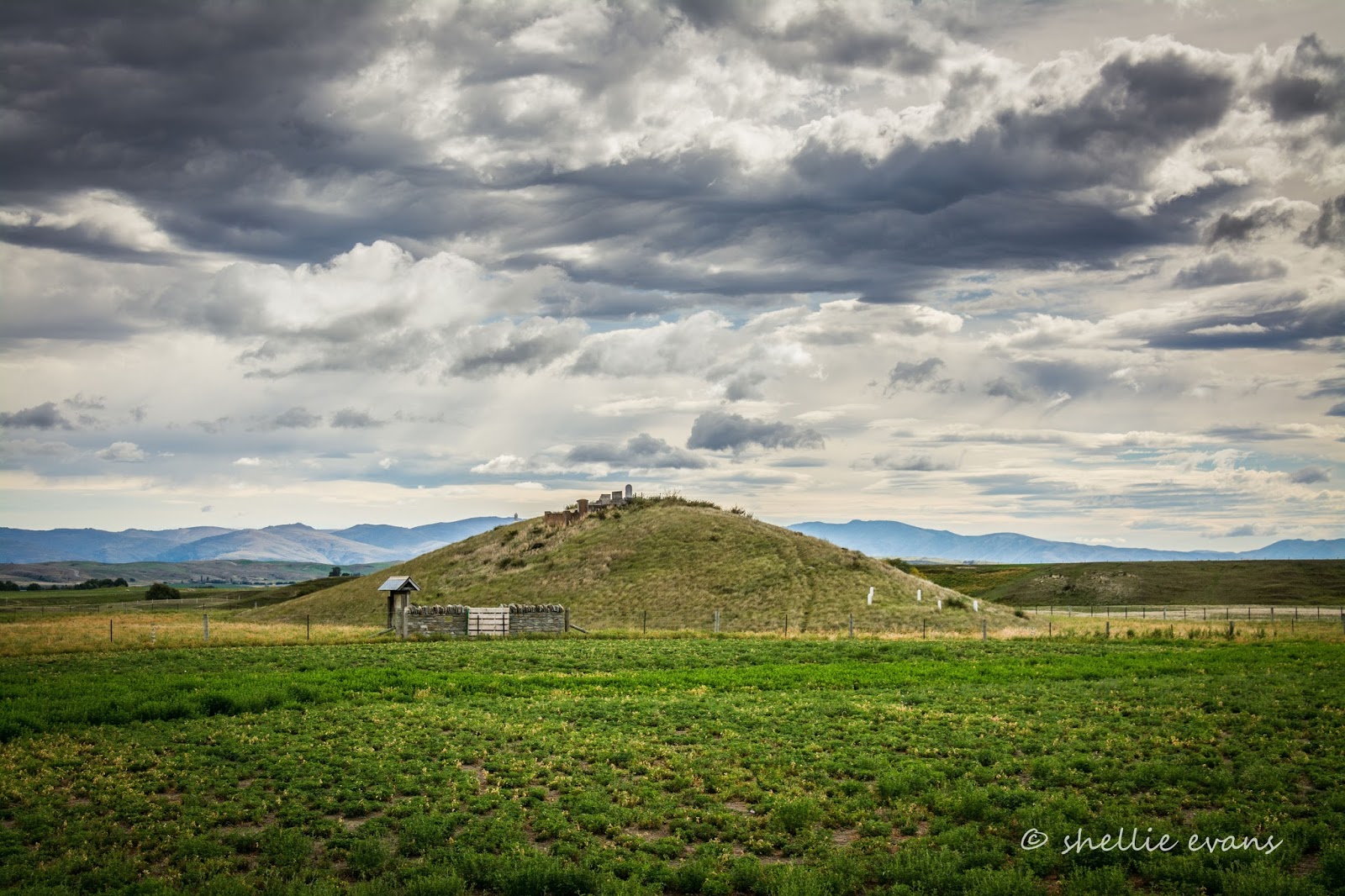
There are no sign-posts but by scanning the nearby paddocks with my binos, I located a tiny hill with, what looked like headstones on top, with an information shelter roof at the base. Problem though, it was across a large paddock of knee-high (and higher in some places) lucerne with no visible track. 


There was nothing for it but to 'bushwhack' a route through on a more or less direct line, which was fine until I came to a large boggy patch and then a pond, both surrounded by lucerne double the height. I heard a few scurrying noises as I moved through the crop, a duck flew out once, but I tried not to think about what the others might be. Heavy dew made it hard going and soon my legs and boots were soaked. Eventually the soil soured, the crop thinned and was patchy near the cemetery, making it much easier to walk.


After 30 years of neglect and with the threat of the historic cemetery being reclaimed by the land, a restoration project was instigated in 2010 by the descendants of those buried in the cemetery.


Although it would seem that the lovely wrought-iron gate is not stock proof- a pallet protecting the entry into the cemetery!


I hope you can read the information panels- they're not the best quality but I know there's a few people out there who like to know all the background history- hi Dad!  (Click on the photo to enlarge).


As is also the case with many of the early cemeteries, the Chinese had their own section, here it's at the foot of the hill.


Some of the Chinese headstones were located at the Alexandra Museum and were returned to their original positions.


At the top of the hill the graves don't look towards Moa Creek...


... they face north, taking in the magnificent view right up the Ida Valley to the Hawkdun Range.


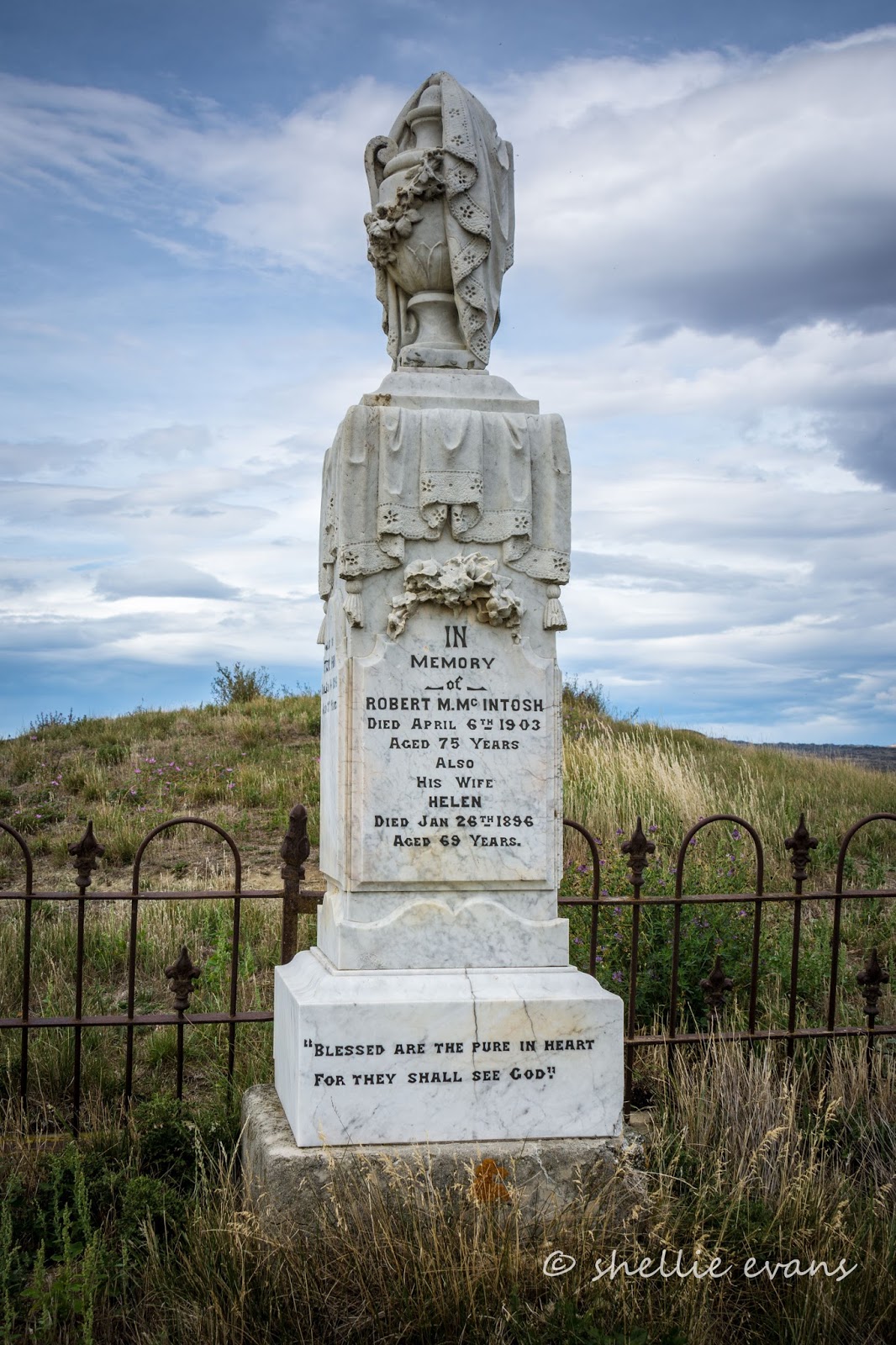
A wrought-iron fence surrounds the MacIntosh family plot which takes a commanding position on top and at the front of the hill.


Stabilization of MacIntosh Memorial Column was done as part of the restoration work.


Some of the grave sites still need a bit of work and it's a shame the weeds and rabbits have made themselves at home around and under the plots. It'll not be long before the cemetery succumbs to the ravages of time once again.


New Zealand's pioneer families certainly had a lot of heartache.


It's just as well some of the headstones have holes drilled in the stone to form the letters, it looks like a dark filling was then inserted in the letters (which has now fallen out of most of them). It's a pity this wasn't done on a lot of the headstones I've seen at old cemeteries where the words (and history) have long faded away.


I took a few last photos and fought my way back through the lucerne to the road where David was patiently waiting for me.


We headed off, north up the east side of Ida Valley coming across a flock of sheep being moved, along the way.


The dogs were whistled in to push the sheep over to the left and the shepherd called out that we'd be right to head along the verge to get past them. 


Trouble is, once the dogs set about barking, the sheep took off at a gallop and stretched so far out that we had to take evasive action to miss a deep overgrown drain that suddenly sprung up in front of us towards the end. A sharp yank of the steering wheel to the left by 'Possum Bourne' and we just cleared the culvert, very nearly bowling a couple of sheep in the process. 


Leaving the flock behind we carried on up the road passing the historic Ida Valley Station woolshed on the way.


Our next stop was at the famous Idaburn Dam which looked totally different to our last visit when it was full of water and nearly frozen solid.


It was a shock to actually see how shallow the pond was and to even see half a dozen sheep grazing on the surface towards the back.


The ice had started to melt around the edges on our last visit and we were concerned about people walking on it or attempting to skate (we could see recent blade marks). But having now seen the depth, it wouldn't have been so bad after-all if they had fallen through the ice while skating (just cold legs & a bruised ego).

A Frozen Idaburn Dam- August 2015
The Idaburn Dam appears in a number of TV ads and is often shown when there’s a hoar frost in the Maniototo. It’s also the home of the Roaring Game, that ancient Scottish sport of curling and is famous for the Bonspiel, the grand tournament which occurs when (and only when) the ice reaches 14cm thickness. That’s when the Ice Masters put out the call to curlers nationwide to come and play within 48hrs- an event I'd love to capture. Perhaps next winter we'll be somewhere close and I'll hear the call too.


September 02, 2015

2000ft Above Worry Level

So says the welcome sign for the tiny little historic village of Naseby- not only has the town been left behind but they’ve not moved their slogan into metric measurements either! Then again I suppose ‘610 metres above worry level’ doesn’t quite have the same ring about it. Naseby is nestled in a forested valley in the foothills of the Mt Ida Range and is just 14kms from Ranfurly.


Naseby is another town that came into existence with the beginning of the gold rush in 1863, the rush was short lived but gold mining on a more commercial scale continued for over 50 years and the town grew to become a thriving rural town. Unfortunately after the railway came to Ranfurly it gradually took over as the centre of the Maniototo and Naseby became a quiet backwater and holiday destination with many of the old mining cottages and houses sold, restored and used as cribs (holiday homes). The surrounding forest has many walking and mountainbike tracks and there are plenty of dams for swimming in during the summer and ice skating on over winter.


Naseby is also the curling capital of New Zealand, and while the Bonspiels have been held on the Idaburn Dam since 1932, the latest tournament was held in Naseby just two weeks before we arrived in the Maniototo- I was very tempted to drive up from Winton to catch the spectacle. The curling rink shown in the middle left photo below was the one used for the tournament, but it was well on the way to melting when we stopped to check it out. The indoor Maniototo International Curling Rink was across the road, along with the indoor curling rink there’s also an outdoor skating rink and a luge.


The village was virtually deserted which isn’t surprising given that there are only a hundred or so permanent residents and it’s the middle of the winter. The Royal Hotel was open, the publican was out sweeping the snow away from the path and front doors. The Royal opened in 1863 and was one of 22 hotels in the town at the height of the gold rush. There are just two left now. It became a Cobb & Co stop in 1869 and an accommodation wing was added on the right, giving ‘ladies’ an entrance to the hotel.


Across the road from the Royal is the old Mt Ida Chronicle newspaper office. Snow had fallen the night before although we hadn’t had any down in Ranfurly, that was yet to come. We had been warned by one of the locals back at Omakau, not to camp up at Naseby in case we got snowed in but as it turned out, the camping ground at Naseby was closed anyway.


Next door to The Royal Hotel is the old Council Office which is now a museum. Unfortunately it was closed for winter too so I was unable to have a look at the local history.


With no traffic on the road and nobody about I was able to wander through the village taking photos of all the historic buildings. I wasn’t quite by myself, this lovely dog was sunning herself against the wall and watching me carefully through half closed eyes as I moved up and down the street. She came out to greet me on my way back and then went back to her wall. I think she belonged to the nearby dairy.


The two most iconic Naseby buildings are the Watchmaker’s Shop & Boot Manufacturer. The watchmakers shop opened in 1868 and the owner Robert Strong turned his hand to repairs of any precision tools of the day. His son ran the shop until 1959 when he was 80 years old.  The Boot Manufacturer shop is a recreation of the 1863 original building on the site.


A German Field Gun, a war trophy, sits near the War Memorial. It is one of very few that remain in rural NZ towns.


David was delighted to spot a Trekka sitting outside the local garage. It’s been a long time between sightings and we hadn’t found any more on our travels since finding two on the Coromandel a couple of years ago. David was once the sales manager for Five Star Motors in Auckland, a retail outlet of Motor Industries, and sold many of the 2500 Trekkas that made it onto our roads.


Not only did he find one Trekka, but he found another one out the back. He also found the guy who owns them and so they spent the next half hour or so reminiscing…


…which was great because I could carry on clicking! This was the Union Church where Protestants worshipped, built in 1865. It was also used as a temporary school and a teaching centre for mining classes before becoming the Athenaeum and library in 1873.


The Naseby Post Office is another huge building for a small town, it was built in 1900 and is typical of government architecture of the day. The building now houses the Information Centre which I found closed too.


Alongside the post office are the Masonic Hall & the Court House (bottom). The Masonic Hall was built in 1869 of  mud and tussock for the Mt Ida Masonic Lodge. It was later used by the Oddfellows Lodge. The Court House was built in 1875 with its last hearing held in 1961.


This rather pink building, the All Nations Store was built in the 1870s from mudbrick and timber and like many buildings of the day had a fancy wooden facade to make an impressive frontage. It has been added to and altered over the years.


There are numerous tiny miners cottages and grander settlers houses around the village-


..including the Monkey Puzzle House (bottom right) obviously named for the very large & very old Monkey Puzzle tree in the front garden. This was the Borough Clerk’s house, the current owners have restored it to its former glory and it is now a B&B.


Once David had run out of Trekka facts and figures to discuss and I had returned from down the street we popped over the road to have lunch at Black Forest Cafe. The snow was melting fast and a curtain of water was dripping off the old roofs of the cafe building which has housed, at various times, banks, bakers, drapers and others long forgotten.


One excellent piece of inside information I did get from the Trekka man before I left them talking was the location of a tiny curling dam used by the locals.


Known as the mini Mt Ida dam it’s just a handkerchief sized shallow boxed square located in the forest behind the village.


A place where the sun don’t shine and the ice don’t melt.


Although David was less than keen to be the guinea pig and walk out on it for me after I pointed out a few slushy edges. Later I saw a photo of the dam in the summer- a large grassy square which looked to be all of a foot deep.


I wondered who would keep a dog in such a cold kennel, then I realised it was the wood box! Duh!! And I had the feeling that this little scene was going to be the full extent of the ‘hoar frost’ I've been looking for in the Maniototo.


It was about now that I wished the museum or i-Site had been open. Beside the dam sat this very old hut(complete with dog kennel too) with a sign attached which you couldn’t read other than it was built in 1905.


I wanted to know it’s history. It looks like a sentry box, although I think that thought was helped along by the words- ‘1883 Colour Royal B—‘ . I might just have to call the museum.


On our way home we stopped at the Naseby Golf Course- no chance of playing golf here for awhile.


We drove back through Naseby a few days later and stopped for lunch at the Royal Hotel. We met a very interesting fellow at the bar….but, you’ll have to wait to hear about that…