Showing posts with label deer. Show all posts

October 10, 2017

Totaranui- Bird Paradise

Real-time

This must surely be the grandest entrance to a DOC Camp in all of New Zealand. This is Totaranui at the northern end of the Abel Tasman National Park and the Abel Tasman Great Walk. The trees, alternate London Plane & Macrocarpa, were planted in 1856 by the first European settler & landowner, Williams Gibbs. He wanted an imposing entrance for visitors arriving by sea (the only means of access back then), and he sure got it, albeit many years after his passing. 


Gibbs established a farm of over 7000 acres here at Totaranui and supplied Nelson with milk & dairy products. He also built two holiday cottages which he rented out to holidaymakers. Even back then this little pocket of coastline was a popular holiday destination. Sadly the Macrocarpa looked to have succumbed to disease or old age as there were only large stumps in their spots! Ngatara, the farm homestead (see the link in the next paragraph for photos) is now owned by the Crown and used for school camps.


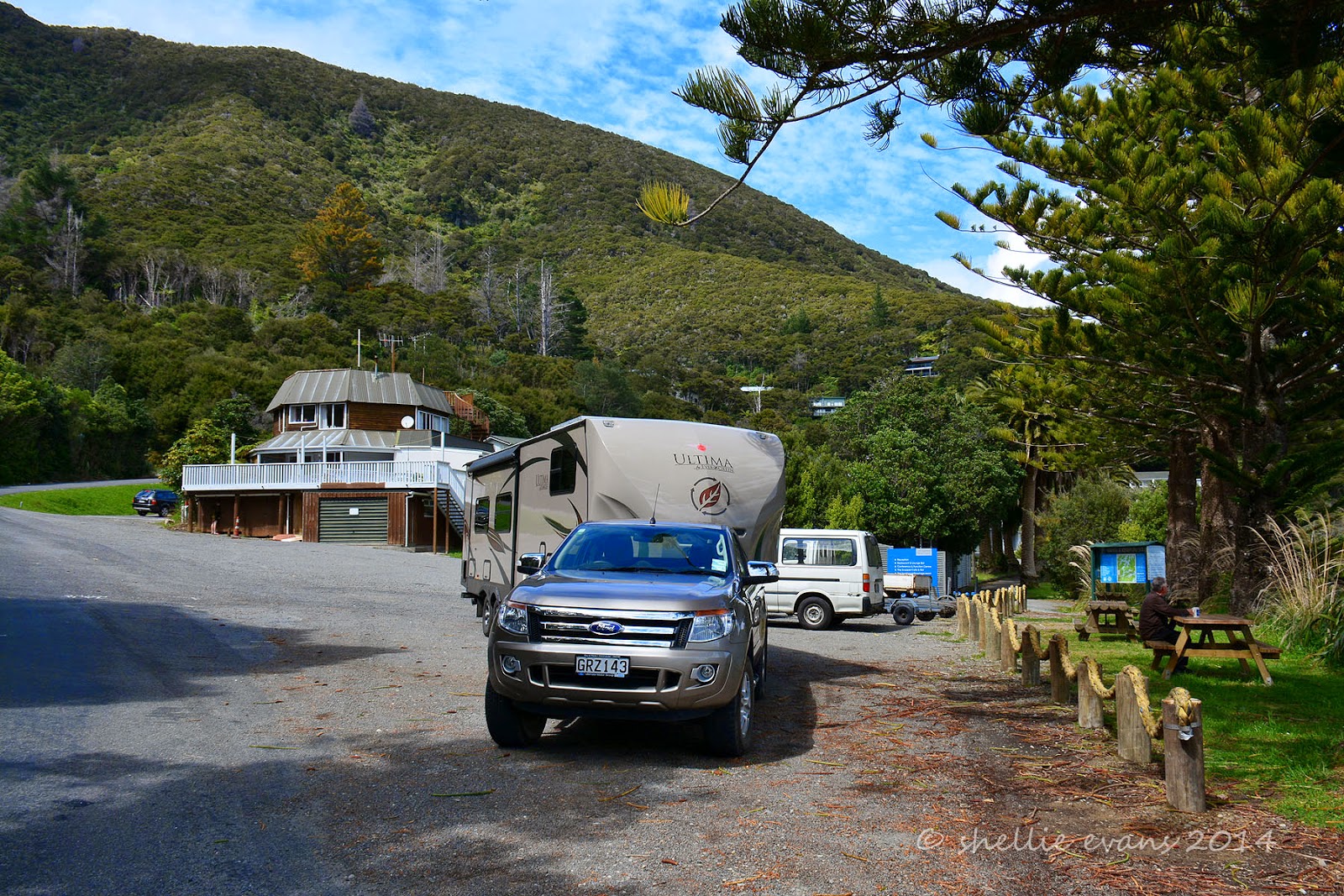
If you don't arrive by boat or on foot, Totaranui is accessed via a 12km narrow winding gravel road from Pohara in Golden Bay. And it's where we have been parked up for the last week. We've driven the road before but just as a day trip in the ute, this time we brought the 5th-wheeler along for the ride.

The road was fine, it's up and over a small range and not as bad as some we've been on. Just a couple of sharp switchbacks and a little narrow in places but with lots of areas to pull over if you meet other vehicles or need to let others pass. We timed it to cross over late morning when most of the traffic would have been ahead of us and any day-trippers would still be enjoying their visit.


The DOC campground is a very popular destination for holidaymakers and at the height of the summer season there can be over 1000 people in camp. It's a huge place with over 23 large bays for camping, each bay can hold anything from 10-20 campsites; fire pits (bring your own firewood) and picnic tables are a central point where campers can gather. There also fresh water available in every bay, a refuse collection area nearby and a dump station for campers (not day trippers as it's very expensive to empty septic tanks this far out).


Each bay is bordered by bush and some have the estuary as a backdrop, they stretch right along the beach although there is no camping on the ocean side of the road. There are numerous ablution blocks dotted about with flushing toilets, cold showers and more impressively, laundry tubs with hand mangles!


We have our bay to ourselves and at the most there have only been 8-12 vans in each night. If I didn't know any better I'd think we were here by ourselves. Most have headed to the end of the camp beside the estuary where they can access the boat ramp and do some easy whitebaiting in the numerous streams that flow from the estuary.


We arrived in the sunshine and had a couple of lovely days before the heavens once again opened up and it rained solid for nearly three days. Luckily we have been able to access the internet through the big wet.  Netspeed has been a Godsend, although even with the big booster Yagi aerial pointing all the way across the bay to Nelson, it's been mostly borderline and often we have only been able to connect to read but not contribute.


Just like Kaiteriteri, Totaranui also has the same beautiful golden sand; this is looking south into the Park and towards Awaroa...


...and north to the end of the bay... 


 ...where the huge estuary empties into the ocean twice a day. 


This is just a tiny section of the estuary and at high tide it's at least thigh deep.


The bird life is prolific with, unusually, the most common sighting being of the Kereru/NZ Wood Pigeon.


I'm sure there's at least a few hundred birds around the camp; any casual glance into the surrounding bush, under the tree canopy or up to any bare trees produces three or four birds glancing down as they rest during the day. 


This one was perched precariously in a small bush; wings spread, sunning itself in the warm afternoon sun. 


I counted at least 20 birds feeding in a patch of tree lucerne which they have nearly stripped bare. 


They squabble, flap, bash and bumble about through the soft vegetation with most staying put as I pass by. It's such a treat to see them at such close quarters.


Sadly this bird with the odd coloured feathers is not well, it has a wound on it's neck which may have been punctured by a branch as it landed to feed.


While Kereru and Tui swoosh and soar about above us, down on the ground Weka and Pukeko roam throughout the camp. Here a Western Weka stretches and spreads it's wings as it soaks up the warm sunshine (I know how you feel mate!). I had to laugh the other night, I forgot to turn the water pump off and when I visited the little room at some unGodly hour the pump swung into action along with what seemed like the whole population of weka screeching out their alarm calls at the noise.


I have been surprised by the lack of chicks on the ground for both the weka and pukeko although I did manage to spy these two chicks with their parent hidden in some tussock. It's either a little too early or they are being kept out of harm's way- I've seen weka stalk and attach pukeko chicks and I know pukeko kill ducklings so they'd likely kill weka chicks too. 


And looked who else popped up- a regular visitor at Kaiteriteri- a male California Quail with his partner. I've only spotted the two birds although I've heard a few calling but there are nowhere near the numbers we saw at Kaiteri.


It's not only the humans who are whitebaiting in the estuary...


...this Kotuku/White Heron is a regular visitor snatching at the small fry swimming up the channels...


...that weave their way through the Jointed Wire Rush.


Along with a pukeko who was also grabbing at the whitebait swimming past in the clear water.


While walking around the edge of the estuary I disturbed a weka digging for and munching on tiny crabs. 


I'd noticed a track through the estuary when I was looking at the google map of the area so yesterday afternoon I went exploring. The 'track' was on an embankment with a fast flowing stream on one side and a swamp on the other and I had to fight my way through so much gorse it wasn't funny. It left the road back near the entrance to the park and reached right out into the estuary coming to an end not too far from the north end of the campground and just across the reeds from where we are parked. The deep stream and high tide stopped me from heading home this way. 


I was very excited to find some deer prints in the sand about three quarters of the way along and could see where they'd walked down to a bush and munched the ends off it. There was also a wide swathe of bent reeds through the swamp where I think they may have made a quick exit. 


But best of all I saw five highly secretive Fernbirds/Matata, one carrying nesting material. More like a mouse than a bird, Matata creep silently through the undergrowth very rarely making an appearance above. I heard them 'clicking' long before I spotted the first one, but then one made a dash across the sand from a bush on the embankment down into the reeds, looking very much like a mouse with a feathered tail. I sat quietly for about 20 minutes before this one made an appearance from out of a gorse bush. It soon flitted across and down into the reeds too.


 Totaranui, what a great place to bird watch!


October 23, 2014

Kenepuru Head, Marlborough Sounds

We’re now parked up at the DOC Kenepuru Head camping ground and have been here for the last few days. The weather has once again been spectacular, deep blue skies and hot sunny days and just one with a little rain. The forecast is good & we’ve decided to stay put over the coming holiday weekend when other camping spots around the Sounds & closer to Queen Charlotte Drive will be busy with holidaying families marking the beginning of summer.


The turn off to Kenepuru Sound is at Linkwater and has the now familiar sign board with all the relevant information needed before heading deep into the Sounds. It seemed rather odd that there isn’t a more inviting entrance to Kenepuru (and in fact the same for Pelorus). Personally I think the District Council could have made an extra effort here as a lot of tourists visit these areas. Still, there’s nothing quite like a smelly dairy farm to tell you you’re in NZ, & in the countryside, and life still does go on around these beautiful areas. The dairy shed was across the road from the sign board and a mucky race ran alongside both sides of the road.


I can’t post any photos of Kenepuru Sound as we travelled along the eastern side to the Head. That’s because there was absolutely no views of the water except a few peeks and glimpses here and there. The bush grew high on both sides of the road and other than letterboxes marking hidden driveways, houses with their magnificent water views, were hidden too.

Aside from the bush hiding the views, the road, all 45kms of it, was very, very winding and extremely narrow in places and took all David’s concentration. He couldn’t have stopped even if I had wanted him too. Back & forward we wound, out of one corner & into the next without a break. I told David I need a counter so I can keep a tally. I’m sure there must have been at least 100 bends for every 1km. I won’t tell you what he said but suffice to say he didn’t want two lots of clicking distracting him!


Our first chance to pull over was at Portage, 30 kms from the turnoff where we took the opportunity of having lunch sitting on the water’s edge overlooking a small bay and a big marina (although we did stop with our hazard lights on at Cowshed Bay to check out the DOC camp there- it was quite small & surrounded by bush).

Portage was little more than the Portage Resort and a few houses, nothing like I was expecting. I assume it’s a busy place in the summer when there are many people holidaying in the area & walking the Queen Charlotte Track which runs right along the ridge line which separates Kenepuru & Queen Charlotte Sounds. It’s also a low point in the range at Portage and you can drive over the top to Torea Bay which is on Queen Charlotte Sound. Water Taxis transporting walkers & visitors come and go from Torea Bay too.


Another 15kms further on and we finally reached Kenepuru Head and the DOC campground which has recently been upgraded. It now has flushing loos & cold showers. The grounds have been landscaped a little and separation ‘fingers’ planted so it’s a little more organised. It’s a large site and there’s another open space through the bush if the main side ever got overloaded. Although I can’t see that ever happening, it’s not like this is a good fishing spot or there’s lot’s to do locally. It’s just a lovely peaceful area to park up for awhile and enjoy the wildlife.


There were two other motorhomes here the first night we arrived, they left the next day and we’ve had the place to ourselves for the last four nights. Today two more motorhomes have arrived. How dare they! And I’m sure there will be more over the weekend.


The reason why it’s not good fishing is because we’re right at the head of the Sound and when the tide is out there’s a huge expanse of mud which runs from one side to the other and down the bay for a few hundred metres or so. No good for the dinghy even when the tide is in, David would manage to wheel it down to the water, climb in and before he knew it the water would be gone. The tide moves very fast around here. I think he needs a spear, I’m sure there would be flounder out there, but then I guess he’d get bogged down in the mud. This is the view (at high tide) out our kitchen window from the back of the van.


The birdlife around us is incredible, with the mudflats on one side & bush surrounding us there’s plenty to watch & listen to, especially the Bellbirds (Korimako). There are dozens of them. At high tide this Kingfisher (Kotare) & her fledgling chick sit in the tree outside our back window diving down into the water below. They are very wary and fly as soon as we open the door. I managed to take these through the tinted back window.


Kingfisher Fledgling 
I was up at 6am a few mornings ago, the dawn chorus was deafening and I thought I must record it on my phone. I recorded about a minute of it out the front on the grass before I moved towards the back of the van to check out the mudflats. I don’t know who was more startled but just as I got to the rear a flash of red caught my attention and a huge wild red deer took off past me galloping along the edge of the mud (do deer gallop?) heading back towards the head of the bay. It disappeared behind a few bushes further along the bank and around a slight corner. By the time I scrambled down the bank (in my fluffy dressing gown & crocs) and out far enough to see around the corner it had gone.

I picked up it’s tracks in the mud and thought I’d come back with my camera later to take a photo of the size of the print. It was HUGE and also the speed of the run as the back hoof print was right up there behind the front one. Unfortunately the tide had come in by the time I returned and the prints not as clean but you can still see the size, my fingertips are touching the mud.


I then followed the hoof prints along the edge and found out that where I thought it had run off into the bush it hadn’t, it had continued on along the edge for quite a distance. It was funny to see nice clean prints where it had walked in and the hurried and scuffed marks as it made it’s escape. It had exited the bay near a stream right up the top where there were also quite a number of other hoof marks, so I wonder if there was more than just the large deer I saw.

I wish I had of gone back inside and seen it from the back window, it would have carried on up the bay and I could have taken a photo. For the last few mornings I have been leaving the blind up at the back at night and checking at 6am. Just in case. But it hasn’t returned & is not likely to either. Oh well at least I saw it flash by. Another exciting sighting.

A resident flock of about 14 Royal Spoonbills (Kotuku ngutupapa) feeds on the mudflats at low tide, I can’t manage to get too close to them without getting bogged down in the mud, they do roost in a large macrocapa tree near the road but I have yet to get them there in the right light.


I tracked a wood pigeon (Kereru) through the bush along the water edge the other day and found this cute little bach tucked up in a clearing. A mown track wide enough for a small boat trailer led down to the water but I think they also wouldn’t be able to go fishing too much. I like the wide opening doors onto the tiny deck.


And of course camping in the Sounds wouldn't be complete without the comical & scavenging weka. We are parked in another weka family’s patch, this time just one adult and one large fledgling chick.


There are quite a number of weka in the camp ground but they each have their own patch and woe betold any that encroach into another’s territory. We’ve witnessed a few big scraps, they are very fast runners but it doesn’t help when it’s another weka chasing you! I just love the feather pattern, I can see why Maori used the gorgeous copper coloured feathers in their cloaks.


Sunset over Kenepuru Sound, Marlborough Sounds.


May 21, 2014

The Dismal Swamp- Lake Onslow

We had about a week to fill in once we left Pinders Pond & before we were due back in Invercargill for the Bluff Oyster Festival and to say goodbye to the family for winter. We’re heading to the top of the South Island to escape the bitter cold of a Southern winter. While looking for the next camping site I saw that there was a freedom camping site at Lake Onslow which was about 22kms inland from Roxburgh. It looked pretty isolated, & with good fishing available, David was keen to take the fifth-wheeler there for a few days to check it out.

I did some research & asked a few questions on one of my forums, David also asked the guy at the local garage when he was filling up (he said it’d be fine as long as the weather was too) but after a bit of a discussion we decided that we’d stay on at Pinders Pond & do Lake Onslow as a day trip. The road starts out as gravel turning into a clay dry weather track about 10kms from the lake. It hadn’t rained for a week or so and the weather forecast was for fine but even though we thought we’d probably get in ok, if the weather turned, we’d then get stuck in there for a week or more. The weather at this time of the year can be very unpredictable.

There were two recommended access roads to the lake, one at Roxburgh East & the other at Millers Flat. The guy from the garage recommended the Roxburgh route & we thought we’d come back via Millers Flat to check that road out too. We wanted to be sure of the road because if we like the lake we’d probably  take the van there in the summer. The road climbed steeply out of Roxburgh and at the top we found ourselves nearly opposite our turn around point from the other day, when we travelled up the Old Man Range across the valley.


Once up on top, the road levelled out as we travelled through rolling green farmland for quite some distance. And the gravel slowly disappeared too, to be replaced by hard clay with very few corrugations or pot holes. It was actually a good road all things considered & would not have been a problem towing or driving a motorhome.


At the intersection with the Millers Flat route & Lake Onslow Road the road narrowed, the “Dry Weather Track” sign appeared and it now became a dirt track. Still not a problem to drive though, nice & smooth with the added benefit of no dust.


We had been slowly climbing and the surrounding 360 degree views were spectacular, as far as the eye could see there were smooth plateaus, narrow ridges & shadowed valleys.  The rolling green farmland gave way to the rugged desolate tussock grasslands that is typical Central Otago.


I could have stopped at every turn in the road (David thinks we did), fabulous landscapes & photographic opportunities in every direction, the scenery just amazing.


We hadn’t passed anybody on the road so far (and weren’t to see anybody else after this encounter either) but while we were stopped near the top of a ridge I heard a vehicle approaching from ahead of us. It was a ute which slowed when the driver saw me on the side of the road, they wound down the window to say there was another vehicle coming behind them. David asked if they had been duck shooting, “Yes we have but the guys coming have been hunting”. And then around the corner came a dust, mud & blood splattered ute with this poor stag tied to the deck. They weren’t  hanging around either and roared off down the road, no doubt keen to get home to tell all & sundry what heroes they were. Ok, I’m being facetious but I’d like the odds better if the deer had guns.


Further on near the summit of the road we came across more “Lonely Graves”, but these were memorial stones, a father lost in the 1960s & a son with quite a recent date. Perhaps farmers from the area who loved the land & the view.


We carry on along the track which seems to go on forever, it also looks like it may have rained recently up here as it was cut up a bit with a few more ruts and muddy potholes in the dips. Still taking our time we would have been fine with “Out There” on the back.


Finally we arrived at the top of a ridge to see Lake Onslow far below us in a shallow valley. The area where the lake now is was once known as the “Dismal Swamp”, the lake was created in 1888 by the damming of the Teviot River for a gold claim far below the range at Roxburgh.


Lake Onslow was not like any lake I’ve ever seen before. From this vantage point it reminded me of a large puddle, & with not a tree in site.


Down at lake level we found the worse patch of mud on the whole road & just through the gate and around the corner a narrow section with a reasonably sharp bend that we would have had to take our time getting “Out There” in there. But we would have made it. And what a perfect spot. If you like isolation, wide open space, big skies & vast views then Lake Onslow would be the ideal place. Add to that the large population of self-sustaining big brown trout that make the lake their home & you have the makings of a grand holiday.


Dotted around a point jutting out into the lake were an amazing assortment of huts and long-drops (NZ slang for outhouse). More fodder for the photographer!


We stopped on a clearing between the huts over looking the lake. Lake Onslow is known as an isolated, barren & windswept lake but today there wasn’t a breath of wind, the silence was deafening and to top it all off, it was a stunning warm autumn day with a huge blue ski and a beautiful deep blue lake. I can now see why blue & gold are Otago’s colours. What a breathtaking view.


And then from far across the lake we hear and could see hundreds of excited Canada geese making their way across the water to the island in the centre. I wonder if there are hunters over there and they’ve been spooked. And then we see two microlights flying across the lake. At first we think they are herding the geese but they fly right on by disappearing over the tussock covered rise behind us. The geese settle on the shore and the noise dies down. Peace & quite once again.

We wandered along the front of the huts admiring the whacky collection of ramshackle holiday homes……..wait, I can’t do the huts (& loos) justice by posting a photo or two of them here and then moving on so I’ve decided to do a whole separate blog post of them! Don’t worry though, I've posted it at the same time, you can find it here.

In the meantime here is a tempter-


After our walk through the huts we pulled out the chairs and sat on the edge of the lake to have our lunch enjoying the warm sun on our backs and still air.


I know that we were seeing the lake on a perfect day but I think I’d love it just as much during a storm or if it was raining & windy, even snow for a few days would be ok. I’d tuck myself up in the fifth-wheeler with a few good books, my laptop, plenty of food & some good wine in the fridge and the diesel heaters pumping out cosy warmth. Oh and of course the generator handy with plenty of spare fuel. Splendid isolation! David might even like to join me.

After lunch we drove back through the gate and headed up the road to check out the dam. In 1924, after originally being dammed to supply water for gold mining, Lake Onslow started operating as a irrigation & power scheme. In 1982 a new dam was built downstream and this increased the area of the lake from 367ha to around 830ha.

Below the dam there was a bridge & also a well maintained ford which I assume would be for any stock trucks taking sheep in and out of the surrounding high country stations. We took the bridge on the way over and the ford on the way back to clean the wheels, although it happened to be a bit deeper than it looked. No harm done though just a clean belly & a few raised eyebrows.


We drove on for a short distance, the road carries on into the interior for miles and actually joins up with the Old Dunstan Road, another 4WD road we want to travel when we “do’ the Maniatoto area. That in turn leads to the Serpentine 4WD road which I definitely want to travel, it would take us to the most isolated church in the country. In the meantime our road turns into a 4WD track  not far from where we turn around and is closed over winter because of snow. We might just come in from the other side one day.

While David turned around I got out to take a photo of the these sheep and the lake from another angle. Still not a tree in site.


And then we headed back up the road towards home stopping at the top of the ridge for one last look at the lake & the beautiful sky and to grab a photo of this abandoned tractor overgrown with tussock.


Back into rolling farmland with the road snaking across the ridge. We took the Millers Creek route at the junction and while it was a little quicker the road was a lot narrower & quite corrugated. We decided the Roxburgh East road was the one we’d travel with the fifth-wheeler on the back.


We had a fabulous day and I would recommend the trip to anybody that has the time, & especially to those who love wide open spaces and fishing.

And in case you missed the link, here it is for the Lake Huts & Longdrops