Showing posts with label wood pigeon. Show all posts

Thursday, October 23

Kenepuru Head, Marlborough Sounds

We’re now parked up at the DOC Kenepuru Head camping ground and have been here for the last few days. The weather has once again been spectacular, deep blue skies and hot sunny days and just one with a little rain. The forecast is good & we’ve decided to stay put over the coming holiday weekend when other camping spots around the Sounds & closer to Queen Charlotte Drive will be busy with holidaying families marking the beginning of summer.


The turn off to Kenepuru Sound is at Linkwater and has the now familiar sign board with all the relevant information needed before heading deep into the Sounds. It seemed rather odd that there isn’t a more inviting entrance to Kenepuru (and in fact the same for Pelorus). Personally I think the District Council could have made an extra effort here as a lot of tourists visit these areas. Still, there’s nothing quite like a smelly dairy farm to tell you you’re in NZ, & in the countryside, and life still does go on around these beautiful areas. The dairy shed was across the road from the sign board and a mucky race ran alongside both sides of the road.


I can’t post any photos of Kenepuru Sound as we travelled along the eastern side to the Head. That’s because there was absolutely no views of the water except a few peeks and glimpses here and there. The bush grew high on both sides of the road and other than letterboxes marking hidden driveways, houses with their magnificent water views, were hidden too.

Aside from the bush hiding the views, the road, all 45kms of it, was very, very winding and extremely narrow in places and took all David’s concentration. He couldn’t have stopped even if I had wanted him too. Back & forward we wound, out of one corner & into the next without a break. I told David I need a counter so I can keep a tally. I’m sure there must have been at least 100 bends for every 1km. I won’t tell you what he said but suffice to say he didn’t want two lots of clicking distracting him!
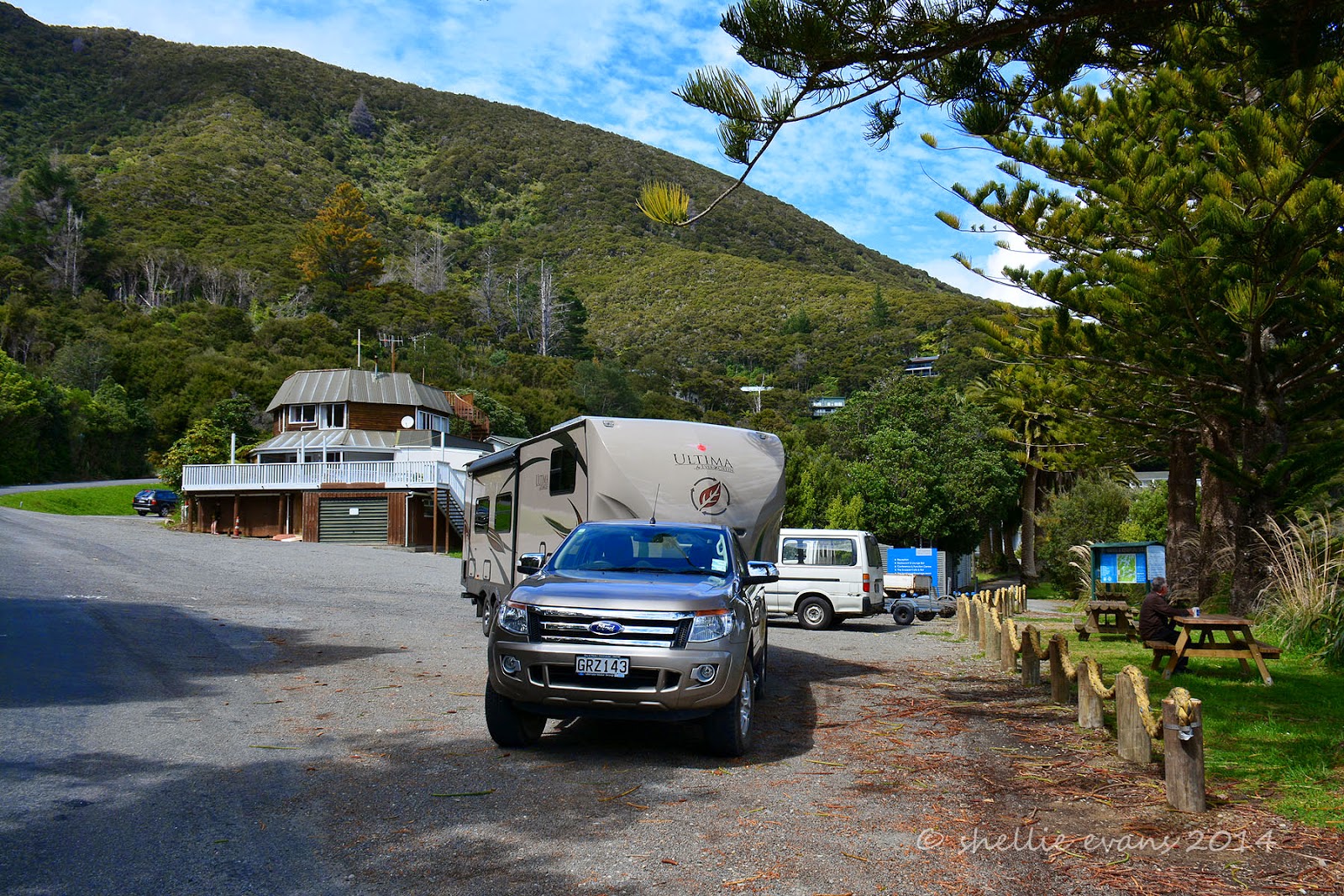

Our first chance to pull over was at Portage, 30 kms from the turnoff where we took the opportunity of having lunch sitting on the water’s edge overlooking a small bay and a big marina (although we did stop with our hazard lights on at Cowshed Bay to check out the DOC camp there- it was quite small & surrounded by bush).

Portage was little more than the Portage Resort and a few houses, nothing like I was expecting. I assume it’s a busy place in the summer when there are many people holidaying in the area & walking the Queen Charlotte Track which runs right along the ridge line which separates Kenepuru & Queen Charlotte Sounds. It’s also a low point in the range at Portage and you can drive over the top to Torea Bay which is on Queen Charlotte Sound. Water Taxis transporting walkers & visitors come and go from Torea Bay too.


Another 15kms further on and we finally reached Kenepuru Head and the DOC campground which has recently been upgraded. It now has flushing loos & cold showers. The grounds have been landscaped a little and separation ‘fingers’ planted so it’s a little more organised. It’s a large site and there’s another open space through the bush if the main side ever got overloaded. Although I can’t see that ever happening, it’s not like this is a good fishing spot or there’s lot’s to do locally. It’s just a lovely peaceful area to park up for awhile and enjoy the wildlife.


There were two other motorhomes here the first night we arrived, they left the next day and we’ve had the place to ourselves for the last four nights. Today two more motorhomes have arrived. How dare they! And I’m sure there will be more over the weekend.


The reason why it’s not good fishing is because we’re right at the head of the Sound and when the tide is out there’s a huge expanse of mud which runs from one side to the other and down the bay for a few hundred metres or so. No good for the dinghy even when the tide is in, David would manage to wheel it down to the water, climb in and before he knew it the water would be gone. The tide moves very fast around here. I think he needs a spear, I’m sure there would be flounder out there, but then I guess he’d get bogged down in the mud. This is the view (at high tide) out our kitchen window from the back of the van.


The birdlife around us is incredible, with the mudflats on one side & bush surrounding us there’s plenty to watch & listen to, especially the Bellbirds (Korimako). There are dozens of them. At high tide this Kingfisher (Kotare) & her fledgling chick sit in the tree outside our back window diving down into the water below. They are very wary and fly as soon as we open the door. I managed to take these through the tinted back window.


Kingfisher Fledgling 
I was up at 6am a few mornings ago, the dawn chorus was deafening and I thought I must record it on my phone. I recorded about a minute of it out the front on the grass before I moved towards the back of the van to check out the mudflats. I don’t know who was more startled but just as I got to the rear a flash of red caught my attention and a huge wild red deer took off past me galloping along the edge of the mud (do deer gallop?) heading back towards the head of the bay. It disappeared behind a few bushes further along the bank and around a slight corner. By the time I scrambled down the bank (in my fluffy dressing gown & crocs) and out far enough to see around the corner it had gone.

I picked up it’s tracks in the mud and thought I’d come back with my camera later to take a photo of the size of the print. It was HUGE and also the speed of the run as the back hoof print was right up there behind the front one. Unfortunately the tide had come in by the time I returned and the prints not as clean but you can still see the size, my fingertips are touching the mud.


I then followed the hoof prints along the edge and found out that where I thought it had run off into the bush it hadn’t, it had continued on along the edge for quite a distance. It was funny to see nice clean prints where it had walked in and the hurried and scuffed marks as it made it’s escape. It had exited the bay near a stream right up the top where there were also quite a number of other hoof marks, so I wonder if there was more than just the large deer I saw.

I wish I had of gone back inside and seen it from the back window, it would have carried on up the bay and I could have taken a photo. For the last few mornings I have been leaving the blind up at the back at night and checking at 6am. Just in case. But it hasn’t returned & is not likely to either. Oh well at least I saw it flash by. Another exciting sighting.

A resident flock of about 14 Royal Spoonbills (Kotuku ngutupapa) feeds on the mudflats at low tide, I can’t manage to get too close to them without getting bogged down in the mud, they do roost in a large macrocapa tree near the road but I have yet to get them there in the right light.


I tracked a wood pigeon (Kereru) through the bush along the water edge the other day and found this cute little bach tucked up in a clearing. A mown track wide enough for a small boat trailer led down to the water but I think they also wouldn’t be able to go fishing too much. I like the wide opening doors onto the tiny deck.


And of course camping in the Sounds wouldn't be complete without the comical & scavenging weka. We are parked in another weka family’s patch, this time just one adult and one large fledgling chick.


There are quite a number of weka in the camp ground but they each have their own patch and woe betold any that encroach into another’s territory. We’ve witnessed a few big scraps, they are very fast runners but it doesn’t help when it’s another weka chasing you! I just love the feather pattern, I can see why Maori used the gorgeous copper coloured feathers in their cloaks.


Sunset over Kenepuru Sound, Marlborough Sounds.


Monday, August 18

Kaiteri Snapshots

Kaiteri is what the locals call Kaiteriteri & I figured after 4 weeks we can just about be classed as locals. We talk over the fence to the regulars out walking for exercise, walking their dogs or just on their daily stroll along the waterfront to the shop. We know most of the camp ground regulars both employees & long term residents and can wave an acknowledgement to the water taxi & tour boat skippers as they pass by. Even the local birds know where they can get a daily hello (& a feed).

But the time has come for us to move on over the “hill” to Golden Bay for a few weeks so before we go I thought you might like to see some random snapshots from this wonderful little place called Kaiteri, a place that delivered exactly what we were looking for over winter; golden sand, calm waters, sunny days, rest & relaxation.

A bush walk behind the camp leads up to a lookout over Kaiteriteri estuary & bay. A massive amount of water funnels in and out under the bridge each tide movement, so much so that there are signs along the edge of the outlet stream warning of the sudden changes in depth & swift current.


And here’s a close-up of “Out There” parked on the front row at the Kaiteriteri Motor Camp.


This gentleman made regular visits to the beach, mostly after the weekend. The first time I saw him approaching from the far end of the bay I though there was a blind man coming as he swept his metal detector back & forward. And just to prove that we’re both silly as each other, David thought so too. And while he hasn’t found too much in his quest for fortune he told us he'd found a few rings & coins. I liked his nifty “flour sifter”.


Another day in paradise.


Birds around camp- In the afternoons, the big fat wood pigeons (kereru) flew out to sun themselves in the camp trees. Gulls & sparrows cruised up and down the beach looking for easy handouts. A Little Shag dries out on a post in the estuary.


And then there were the cheeky birds. This thrush is a camp favourite, like a little shadow it followed us about as we moved around the vehicles, darting out from underneath as soon as we stepped outdoors. No matter where you were it would suddenly appear right beside your feet. Many times it waited at the bottom of the stairs giving a short peep for a bit of food.  If it was off digging for worms and a motorhome arrived it rushed over to make friends.


Then along came the ducks, just two, this female & her mate who most of the time waited for her on the road. They wandered up from the beach late in the afternoon (or were waiting first thing in the morning), luckily she only realised there was food to be had in the last few days otherwise I’d have had to ignore her. Because as soon as I fed her the sparrows arrived and after the sparrows came the gulls, dozens of them!


I know, I know, feeding the birds is a bad habit because they reward your generosity with poop! All over the step & the mat much to David’s annoyance. I know this but I can’t help myself and other than the thrush I only started to feed the others in the last few days & we’ll be gone soon. Who could say no to this cute little fellow? “Please sir, I want some more?”

 
In a small grove of beech trees on the way to one of the lookouts there were many birds in a feeding frenzy, including this tui. They were flitting about all through the trees, running up & down the trunks and chasing others away. They were feeding on the tiny droplets of honeydew produced by the beech scale insect which have blackened the trunks of the trees, it's similar to sooty mould. Honeydew plays a vital role in the food supply for a range of native bird and insect species. The honeydew drops have a high sugar content and are an important energy source for birds over winter.
 
 
And if I could take one thing with me when we leave Kaiteriteri it would be the pink phone booth on the left! I’d stick it upright on the storage box at the back or squeeze it through the door and make it into the shower box. A two in one; a shower on the inside, communication on the outside. This my friends was our number one best gadget while parked up here at Kaiteri, a free wifi zone, delivering one whole gigabyte each per day for our phones & computers. Considering I use approximately 5GBs a month costing around $75, having a free zone so close was a very big deal.

But best of all it was delivered to the inside of our parked up van without us having to sit outside the booth as we would usually have to do. The only problem was that we were on the outer edge of it’s range and as motorhomes came & went and parked up on the front row between us & the phone booths the strength came & went. We had to move about the van holding the computer up in the air or work off the kitchen bench to pick it up sometimes.


Frosty feet- Winter lesson #1; make sure you put your crocs in the shoe box otherwise come morning, you’ll have a very cold (& slippery) walk to the showers. Lesson #2 stand your crocs up when you get back, to drain the water, otherwise you’ll have wet socks the next time you step back into them.


Our neighbours had a frosty start to their kayak tour, they were heading up to Abel Tasman Park for three days but had to wait for things to thaw before stowing away their food & sleeping bags.


And this would have to have been the heaviest frost we experienced while at Kaiteri, the same day as we headed to Flora Carpark & the snow.


And finally a photo for Dad. Hop frames near the turnoff to Kaiteri. When I was a child Mum & Dad did a tour of the South Island with some friends (and without us). Whenever we watched the home movie of their trip dad would say as they drove past the hops in Motueka “There’s my favourite plant”. It was much later on in life before I realised why!

Monday, July 7

Around the Bays- Pigeon Bay

Banks Peninsula comprises of two extinct volcanoes which were active less than half a million years ago. The two craters have since enlarged many times their original size due to erosion and water flow, then around 15,000 years ago when the sea level rose dramatically, the craters were flooded, these now form the two main harbours of Akaroa & Lyttelton. Many smaller bays & coves indent the remainder of the coastline.

The Summit Road, a very popular “Tourist Drive” runs around the Akaroa crater rim affording spectacular views of the harbour and surrounding valleys and ridges. There is also a Summit Road around the Lyttleton Harbour; we are leaving that side of the peninsula for another time.


Two days after the snow fall we thought it would be safe enough to travel the summit road and visit some of the bays on the northern side of the peninsula. We stopped at The Hilltop, a hotel & cafe at the top of the long climb (from both directions; Christchurch & Akaroa) A light covering of snow still lay on the ground and the surrounding peaks. We started along Summit Road and straight away became concerned at the possibility of black ice. In fact this wasn’t black it was just plain old ice (bottom left), sheltered from the elements it had started to melt and then refroze. We eased our way through it carefully and were then relived to see that most of the snow had melted further on.


There were many vantage points along the road to check out the spectacular views of the harbour and bays down below, including Duvauchelle Bay and our camp ground.


Our first port of call was Pigeon Bay, the road dropping sharply down to the bay from the Summit Road. The roads down to the bays may only be 6-8kms long but they take a while to navigate. Steep, narrow & with dozens of hairpin bends you have to take your time & hope that you don’t meet anybody coming up.

Pigeon Bay is a small settlement, just a few baches & farm buildings at the head of the bay. Oh and a church. We drove around to the end of the road where we could see a jetty & some boat sheds, coming across this deserted camping ground on the way. It was like stepping back into the 1970s with these closed up old retro caravans, an overgrown tennis court complete with rusty fence, an old wash tub set up with wringer in the centre, concrete table & chairs arranged to watch the sunset and a notice board informing us we could stay for $10 a night. I’m sure in the summer time this place would be pumping but today it was deserted, it was quite eerie wandering about. Like everybody had been nuked! 


At least the boat club had a decent building but still nobody about, the holiday home right on the side of the road looking straight down the bay was closed up, we were tempted to sit and have our lunch in their Cape Cod chairs but thought better of it.


Instead of heading back up the road out of Pigeon Bay, David drove around to the otherside of the bay, the camp caretaker, Glen, had told him about a road that would take us out to the head of the bay on the west side. The road we were on continued on all the way through to Port Levy, it was another narrow, steep & winding road and not recommended for motorhomes or towing.

After a few kilometres we turned off onto a gravel road, actually more of a gravel track. It climbed steeply up the side of ridge, with a sheer drop on the drivers side down into the valley below. This is at the top looking back towards Pigeon Bay settlement at the end of the bay, the jetty and boat sheds are across the water.  I spied this house out on the point, what a fabulous place to live, looking straight down the bay.


Once on the top we weaved our way back & forward across farm land crossing many cattle stops heading for the small point we could see ahead of us.


As we got nearer we realised that there was a tiny sheltered cove with farm buildings on the left of the point. This bay is called Little Pigeon Bay. We stopped at the top of the road just through the gates. Even though it was a public road we didn’t want to disturb the people we could see down at a house near the beach getting ready to go sailing.


The view over Pigeon Bay to Wakaroa Point was breathtaking. Right along the otherside we could see the tiny track of the Pigeon Bay Walkway which is a five hour return walk through farmland out to the point.


Looking back towards Pigeon Bay settlement, with mussel floats from a mussel farm in the waters below.


After a short while we headed back up the road passing the young farmer & his wife driving in. Luckily they were at the top of the steep road otherwise that would have been fun. No passing, a 100 metre drop & him with a trailer on the back. He told us the house at the beach was a bach & was rented out for holidays. We passed a large homestead along the way, all closed up and overgrown but not that old, well probably 1950ish but still in good condition. We’ve seen a few like this on our travels, obviously just too far away from civilization.


This sheep must have one of the best views in New Zealand. In the background you can see the walkway track cutting through the slope just up from the water.


After safely negotiating the steep road again, this time with me on the scary side, we stopped in the valley to watch dozens of wood pigeons (kereru) in a feeding frenzy amongst the flowering tree lucerne. Great big bumble footed clumsy birds jumping from bush to bush bending the tiny supple branches over under their weight. Pigeon Bay of course!

Bird on a Wire

Monday, December 16

Spoonbills & other birds

After exploring closer to home we drove right around to the other side of the harbour, directly across from our campsite but about 15kms by road. David had seen a vehicle parked up on the beach a few times and wanted to check out what was there (we think they must have been gathering paua (NZ abalone) as there was a large area of flat rocky outcrops & pools jutting out into the sea). It was with great surprise that in amongst the usual shore waders feeding in the low tide rock pools we found a flock of eleven Royal Spoonbills very resplendent in their breeding plumage of yellow breast patch, bright yellow spots above the eyes & head plumes.


Spoonbills are quite rare in New Zealand although there are quite a few pockets of birds around the country including a large flock of about 30 birds that spend a lot of time in & near the Ahuriri Estuary in Napier. Having only seen these ones before and out of the breeding season it was great to see the changes in their plumage.


That's the sealion beach off in the distance.
The eye spots are a little bit creepy, they are iridescent yellow & give the impression that they're looking at you all the time. Which I guess they are if you could see their black eyes underneath.


The bird below on the left had a lot of bling on her legs; banded, & female because she was noticeably smaller.


We later saw another half a dozen or so spoonbill feeding on the mudflats further up the harbour & over the other side on our way home so is probably a good sized flock in the area. When we come back we'll have to explore more.

And back we'll definitely be coming. This time we concentrated mainly on seeking out the sealions but the area also had many birds that I would loved to have got some great shots of. As it was these were "just in passing". 

A Bellbird (Korimako)- feeding on flax flowers

That big fat Wood Pigeon (Kereru) again

We passed this family of variable oystercatchers ( Torea-pango) on the way to the sealions

This Welcome Swallow had a nest under the foot bridge below our camp site, it & it's mate flew out distressed every time somebody walked over or near the bridge. On one occasion we watched as a stoat ran across the bridge then down onto the rocks and along the edge of the stream. The swallows flew along dive bombing it all the way. We knew there were stoats in the area as the day we arrived a stoat was caught in a cage trap at the end of the garden just above the bridge. The campground has an active pest control programme & it seems to be working. I know they are terrible predators on our birdlife but I couldn't help thinking about the kits the caught stoat would have had back in the nest wondering when Mum was going to get home. I figured it was Dad out looking for her the next day!


And this is a dunnock (with a moth in its bill) also known as a hedge sparrow. They are not so frequent up north although we have seen a few around the Central Plateau area, they have a wonderful song & like to sit right on the tip of a tree & sing their heart out. They are an introduced species and seemed to be quite plentiful the further south we move. They are quite shy & like to keep to the undergrowth although this one was searching around the rocks for dinner. A number of them were feeding on the grass seed.

And finally, not a bird but a bug. A huhu beetle that took up residence for a short while in our outside shoe box.