Showing posts with label kamana. Show all posts

Monday, January 18

Riding Shotgun

I couldn't help myself, I just had to post these photos. I have around 400 to scan and select my best but that'll take time so I've selected a quick few to make you smile.

We were due to head off out of range this morning but have delayed it 24hrs because my computer died on me again last night and as you know I'd be lost without my computer, even out of range (that's when I process photos and write catch-up blogs). David has worked his way through the known issues and talked to people in far away lands(call centre) and he's managed to nurse it back to a reasonable state of health but I'm not so sure it's going to last. At least I can still work on it...but perhaps not so intensely, fingers crossed until we get to a town a little bigger than Te Anau!


Anyway following on from my last post, here are some shots of the gorgeous grebe family a few days later- I was lucky enough to visit the nest just as the chicks were called onboard for the ride of their lives. The parent and chicks floated about a little way off from the nest, the adult constantly calling it's mate who was still sitting on the nest with 2 unhatched eggs.


About an hour later, the sitting grebe must have decided it was time to abandon the nest (this was 5 days after the two chicks hatched), she- I don't know, but I'm thinking it would have been the female who didn't want to leave- climbed off the nest, did one last swim and dive, bringing a big bit of weed back to the nest and pushing it onboard (that piece that is partly covering one egg). And then swam off to join her family.


She began feeding two or three feathers she'd scooped from the water to the chicks who greedily swallowed them. I have heard that this is a habit of the grebes, the feathers cushion and help with the passage of fish bones through the chick's digestive system. I've seen this happening on every visit to the grebe family.


Riding shotgun- this is how the chicks will travel much of the time for the next few weeks, on one or the other parent's back. The chicks are already proficient swimmers and divers but prefer, for now, to catch a ride. They'll use their parent's back to keep warm, to rest and to escape danger. 


Man overboard! If you insist on riding side-saddle while taking in the big wide world, it's not long before you fall off...


The chick struggles for the next 10 minutes trying to get back on...


I thought the parent would have some sort of rudder system (it's got big enough feet) to be able to brace itself in the water so the chick can climb back onboard. But no, the parent and the chick went around and around for ages, I even got the feeling the parent was doing it on purpose, making the chick swim for awhile.


Meanwhile, the other parent took the opportunity of doing some grooming while it waited for order to be restored. Finally the chick clambered up the 'ramp' at the back and disappeared below deck!


They're off again, heading for the big blue yonder, they won't return to the safety of the nest area again and must negotiate through and around many dangers over the next few weeks.


One day later I found them again, safely swimming and feeding a few kilometers away from the nest area.


With both chicks frequently hopping off and on, although still taking an age to get back onboard.


While I was watching the grebes, a NZ Scaup family swam past- Mum, Dad and 4 quite large ducklings, not that close but obviously close enough for all hell to break loose.  


Neither bird was giving an inch, both attacking each other. The scaup, it's the female, was sitting low in the water and launching herself at the grebe. The grebe was using it's sharp bill, stabbing and grabbing the duck. At one stage the grebe dived and and grabbed the scaup from underneath. All I could see was the scaup walking on water!


I don't think there was a winner in the end, just two very irate mamas but it was the scaup that swam off to rejoin her family who had carried on along the lake edge out of sight.


"Go Mum!!" - The grebes sat watching from the sidelines and the safety of Dad's back (I have no idea which parent was which, you can't tell the difference with grebes). 


Order is restored, wounds licked and the family move off.


I'm sure I'm going to find a lot more photos once I check the pile in more detail so don't be surprised to see another blog on the grebes in due course. What a privilege to not only find a nest but see newly hatched chicks being fed on the nest and then returning a few days later just in time to see them leave the nest, see the parent abandoned the remaining two eggs, and then find the family again a day later out in the big wide world.  I couldn't have planned it any better if I tried.


Sunday, July 12

Gorgeous Grebes - Lake Wanaka

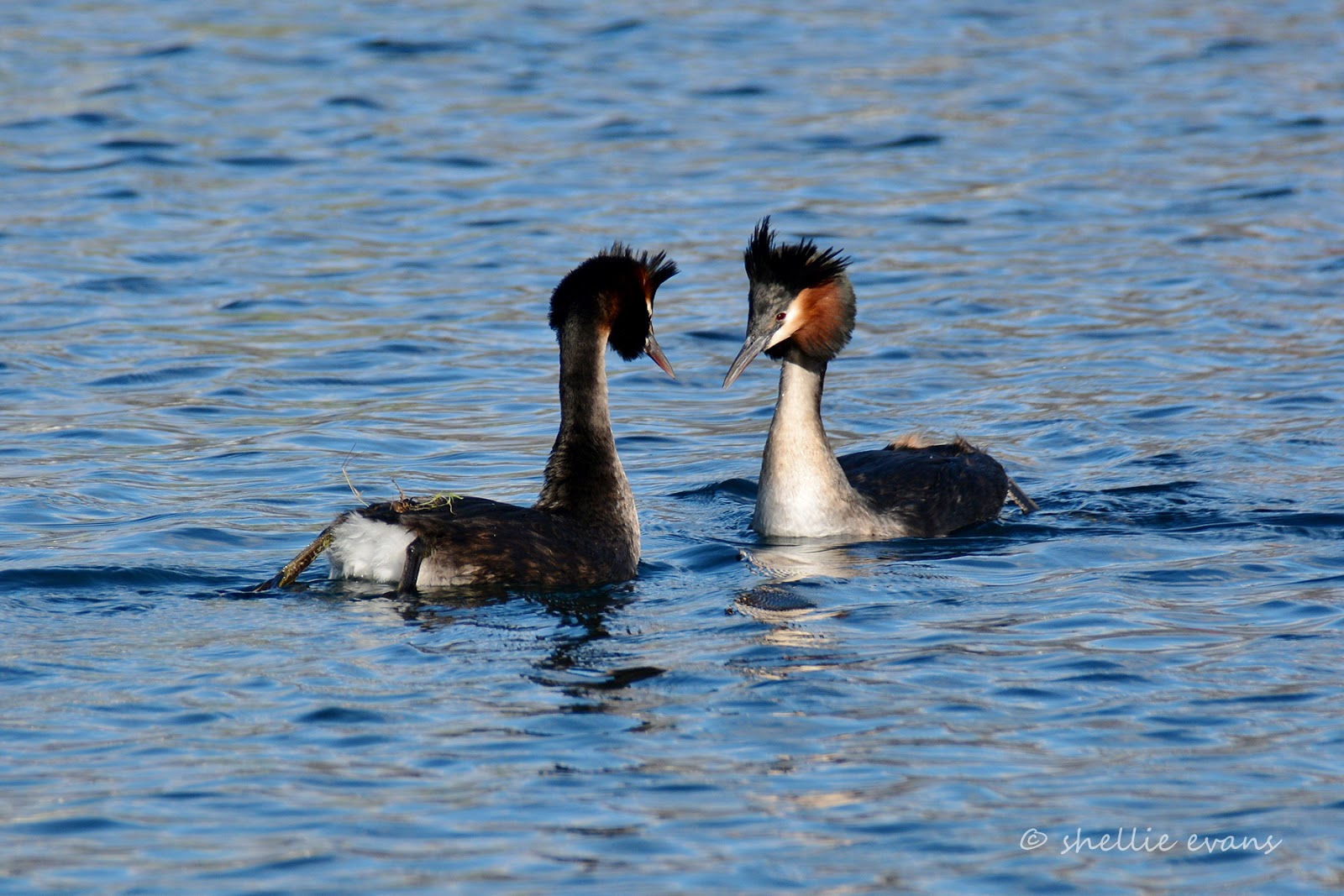
If you’ve been following my blog you’ll know that the Australasian Crested Grebe/Kamana has been a bird we’ve been seeking out on many of the high country lakes we’ve explored in the last few months. Initially we didn’t have much luck in getting close to the ones we did locate, that was until we stayed at the Ohau Canal near Twizel and I managed to get a lovely close up shot.

I knew that if I hadn’t have managed to get a good shot, there was one more lake that had grebes at close quarters; Lake Wanaka. The grebes at Lake Wanaka are well known locals, not only because they have made their home along the town waterfront but they’ve also increased their numbers tenfold because of the work of one dedicated man, John Darby. More on his work later.

Not long after arriving at the Outlet Campground, David went down to the river to check it out for fish. It was a big surprise when he came back to the van to tell me there was a juvenile grebe swimming along the river bank just below us. Being a juvenile he had probably been chased out of his parent’s territory further on around the lake.

At the first opportunity I drove around to the Wanaka town's waterfront to check for grebes and I was not to be disappointed. Within 20 minutes, along the lake front past the marina to the sailing club (around 400 metres), I saw seven grebes; 3 adult pairs & one juvenile. They were all still a little way out from the shore and wary but I managed to get a few shots before they headed out to the moored boats on the otherside of the marina. (Click on the photos to enlarge)


A couple of days later when I returned, I noticed that one pair of grebes had laid claim to the floating platform in front of the marina. I had seen it previous with just a few twigs on it but no birds nearby. Now they were steadily building up a mound of weed and twigs, and one was staying put on the pile- making sure another pair didn’t steal it. These are man-made floating platforms, there are four or five around the marina  and they have been made by John Darby.

One on the platform and one floating off to the side.
Two years ago only one pair of grebes lived in the Roys Bay area of the lake, now there are seven breeding pairs who have produced over 30 chicks. Just to show how significant this is, grebes once inhabited over 100 South Island lakes but numbers have been declining mainly due to introduced predators and habitat loss through wetlands drainage and the establishment of hydro schemes. Now the grebe is one of New Zealand’s rarest birds, only around 600 remain in the South Island.

Grebes nest on floating rafts of vegetation that they build themselves and Lake Wanaka’s fluctuating levels meant their nests either flooded or were left high and dry. Once their nests were no longer floating the eggs and chicks also become vulnerable to predators. The grebes even tried to build a nest on the transom board of a boat one year.


John designed a floating wooden nesting platform that has had a few modifications to cope with the lake’s strong north-westerly storms. The platform in my photos is anchored to the lake bed, others are tethered by chain and bolts to the marina piles. Apparently the grebes made instant use of the first platform which was installed around 9pm one night. By 7am the next morning it had been claimed by a pair of grebes.

While the birds keep a wary eye onshore, the comings and goings of boats around the marina does not seem to disturb them.


Over the next week I returned to the waterfront a number of times to see the progress the birds were making on the platform. It was fascinating watching them carry a wide range of vegetation back to the raft and then try to manoeuvre it on-board. Prodding and poking it until it fitted just right. One partner would sometimes disagree with the placement and pull it off, swim around to the other side and try and poke it in there.


Unfortunately a very large tree shaded the site in the late afternoon when most of the activity happened so my shots aren't so great. And oh how I wish I had that 600mm lens!


The handsome grebe belongs to an ancient order of diving water birds found on every continent in the world. It is renowned for its courtship displays and the way the young grebes ride among plumage on the back of their swimming parents- that’s my next mission but I guess I’ll have to wait until the spring and a return visit to Wanaka, to catch that.

I did capture some of the elaborate greeting displays and saw another pair mating (they were on one of the platforms attached to the marina- no photos though, although I can say it looked rather awkward- when you see the size of their feet you'll understand)

Grebes have a range of loud growling, grunting and barking calls that travel far across water but here my pair are calling to each other with soft grunts before greeting each other after one had left the platform.


And here’s a series of shots at the ‘changing of the guard’- after this, the one that had been sitting on the nest swam off out into the lake to feed, I presume. I liked the way they swam like synchronised swimmers, side by side (4th shot) quite fast for a short distance before pulling up and crossing bills together again.


A few days later and the compost pile is getting higher, of course it’s a Catch 22, the more they pile on, the more the raft sinks. The more the raft sinks, the more they pile on, trying to keep it out of the water.


Here's another courtship display- now you can see those weird legs ‘hinged’ on to rear end (in case you haven’t been following the blog- the legs are set well back to help with diving, these birds spend 99% of their time in water, only coming out to nest). The one on the left has brought part of the nest material with it.


With the greeting over, the returning bird swims over to the platform. And wouldn’t you know it, I was caught on the hop. I was expecting the bird to start collecting nest material again, like they had before, when instead, it launched itself most awkwardly out of the water and flopped onto the platform.  I didn’t have my shutter speed high enough to catch it clearly.

Mind you he does look rather funny, like Roadrunner perhaps?


Once up on top it’s a bit of a struggle to move about….


…and you can see why! With feet like this wouldn’t you? They are the strangest looking things I have ever seen. Like some alien growth, I think I’ve seen some sort of seaweed that looks similar.


Great for swimming no doubt, but just about useless on land, no wonder they spend all their time in the water.


Finally after much moving about, and tucking in of those ginormous feet, this beautiful crested grebe settles in for the afternoon. There are no eggs in the nest, it’s far too early for that, they are just making sure no one else takes over their renovations and nest preparations.


A few days later- the pile is still growing and there’s water lapping at the front door….