Showing posts with label platform. Show all posts

Sunday, July 12

Gorgeous Grebes - Lake Wanaka

If you’ve been following my blog you’ll know that the Australasian Crested Grebe/Kamana has been a bird we’ve been seeking out on many of the high country lakes we’ve explored in the last few months. Initially we didn’t have much luck in getting close to the ones we did locate, that was until we stayed at the Ohau Canal near Twizel and I managed to get a lovely close up shot.

I knew that if I hadn’t have managed to get a good shot, there was one more lake that had grebes at close quarters; Lake Wanaka. The grebes at Lake Wanaka are well known locals, not only because they have made their home along the town waterfront but they’ve also increased their numbers tenfold because of the work of one dedicated man, John Darby. More on his work later.

Not long after arriving at the Outlet Campground, David went down to the river to check it out for fish. It was a big surprise when he came back to the van to tell me there was a juvenile grebe swimming along the river bank just below us. Being a juvenile he had probably been chased out of his parent’s territory further on around the lake.

At the first opportunity I drove around to the Wanaka town's waterfront to check for grebes and I was not to be disappointed. Within 20 minutes, along the lake front past the marina to the sailing club (around 400 metres), I saw seven grebes; 3 adult pairs & one juvenile. They were all still a little way out from the shore and wary but I managed to get a few shots before they headed out to the moored boats on the otherside of the marina. (Click on the photos to enlarge)


A couple of days later when I returned, I noticed that one pair of grebes had laid claim to the floating platform in front of the marina. I had seen it previous with just a few twigs on it but no birds nearby. Now they were steadily building up a mound of weed and twigs, and one was staying put on the pile- making sure another pair didn’t steal it. These are man-made floating platforms, there are four or five around the marina  and they have been made by John Darby.

One on the platform and one floating off to the side.
Two years ago only one pair of grebes lived in the Roys Bay area of the lake, now there are seven breeding pairs who have produced over 30 chicks. Just to show how significant this is, grebes once inhabited over 100 South Island lakes but numbers have been declining mainly due to introduced predators and habitat loss through wetlands drainage and the establishment of hydro schemes. Now the grebe is one of New Zealand’s rarest birds, only around 600 remain in the South Island.

Grebes nest on floating rafts of vegetation that they build themselves and Lake Wanaka’s fluctuating levels meant their nests either flooded or were left high and dry. Once their nests were no longer floating the eggs and chicks also become vulnerable to predators. The grebes even tried to build a nest on the transom board of a boat one year.


John designed a floating wooden nesting platform that has had a few modifications to cope with the lake’s strong north-westerly storms. The platform in my photos is anchored to the lake bed, others are tethered by chain and bolts to the marina piles. Apparently the grebes made instant use of the first platform which was installed around 9pm one night. By 7am the next morning it had been claimed by a pair of grebes.

While the birds keep a wary eye onshore, the comings and goings of boats around the marina does not seem to disturb them.


Over the next week I returned to the waterfront a number of times to see the progress the birds were making on the platform. It was fascinating watching them carry a wide range of vegetation back to the raft and then try to manoeuvre it on-board. Prodding and poking it until it fitted just right. One partner would sometimes disagree with the placement and pull it off, swim around to the other side and try and poke it in there.


Unfortunately a very large tree shaded the site in the late afternoon when most of the activity happened so my shots aren't so great. And oh how I wish I had that 600mm lens!


The handsome grebe belongs to an ancient order of diving water birds found on every continent in the world. It is renowned for its courtship displays and the way the young grebes ride among plumage on the back of their swimming parents- that’s my next mission but I guess I’ll have to wait until the spring and a return visit to Wanaka, to catch that.

I did capture some of the elaborate greeting displays and saw another pair mating (they were on one of the platforms attached to the marina- no photos though, although I can say it looked rather awkward- when you see the size of their feet you'll understand)

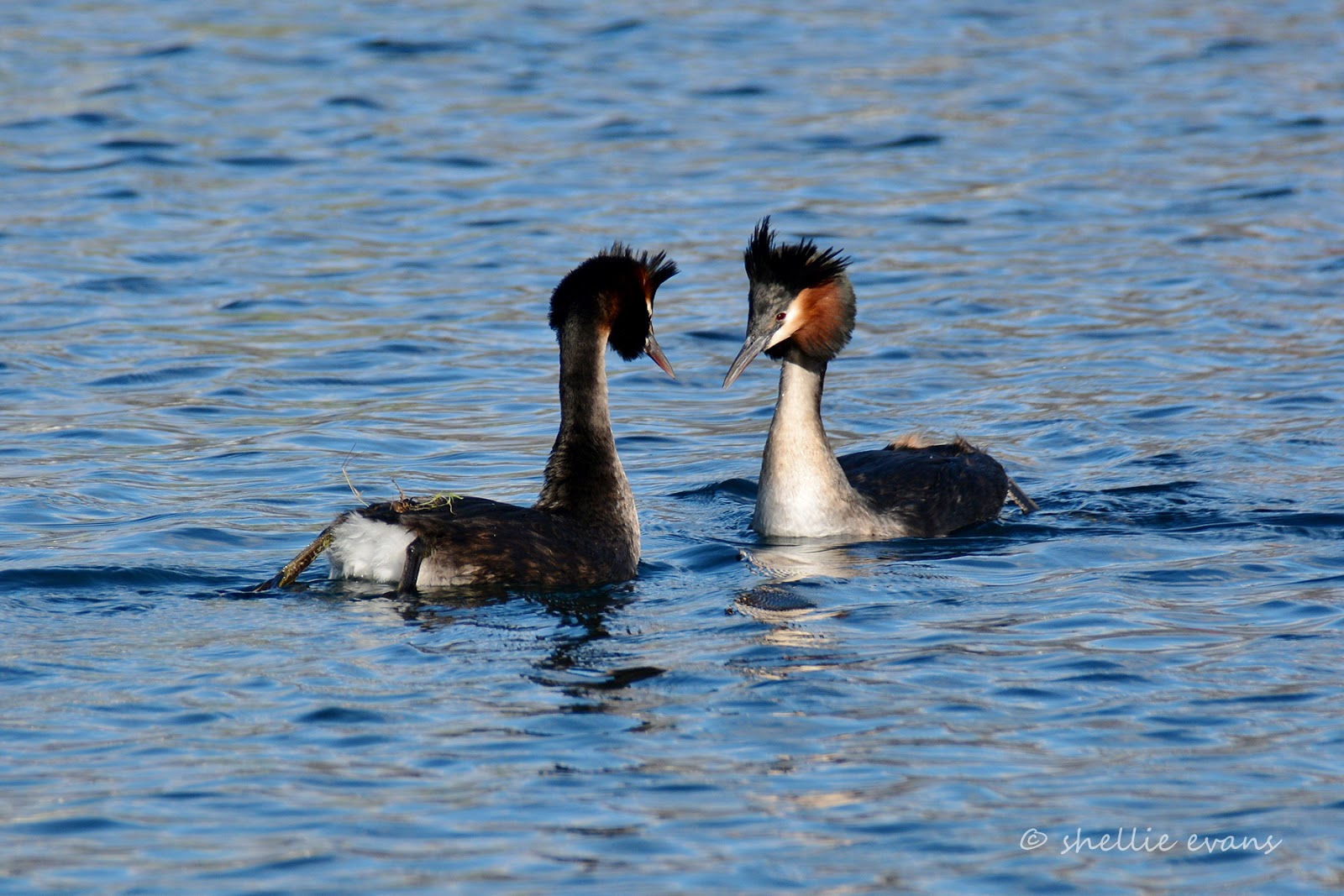
Grebes have a range of loud growling, grunting and barking calls that travel far across water but here my pair are calling to each other with soft grunts before greeting each other after one had left the platform.


And here’s a series of shots at the ‘changing of the guard’- after this, the one that had been sitting on the nest swam off out into the lake to feed, I presume. I liked the way they swam like synchronised swimmers, side by side (4th shot) quite fast for a short distance before pulling up and crossing bills together again.


A few days later and the compost pile is getting higher, of course it’s a Catch 22, the more they pile on, the more the raft sinks. The more the raft sinks, the more they pile on, trying to keep it out of the water.


Here's another courtship display- now you can see those weird legs ‘hinged’ on to rear end (in case you haven’t been following the blog- the legs are set well back to help with diving, these birds spend 99% of their time in water, only coming out to nest). The one on the left has brought part of the nest material with it.



With the greeting over, the returning bird swims over to the platform. And wouldn’t you know it, I was caught on the hop. I was expecting the bird to start collecting nest material again, like they had before, when instead, it launched itself most awkwardly out of the water and flopped onto the platform.  I didn’t have my shutter speed high enough to catch it clearly.

Mind you he does look rather funny, like Roadrunner perhaps?


Once up on top it’s a bit of a struggle to move about….


…and you can see why! With feet like this wouldn’t you? They are the strangest looking things I have ever seen. Like some alien growth, I think I’ve seen some sort of seaweed that looks similar.


Great for swimming no doubt, but just about useless on land, no wonder they spend all their time in the water.


Finally after much moving about, and tucking in of those ginormous feet, this beautiful crested grebe settles in for the afternoon. There are no eggs in the nest, it’s far too early for that, they are just making sure no one else takes over their renovations and nest preparations.


A few days later- the pile is still growing and there’s water lapping at the front door….


Friday, April 17

Cave Creek - Kotihotiho

Punakaiki is a very small settlement that services the 30,000ha Paparoa National Park which has a wide and varied landscape from the lush West Coast native rainforest that we’ve come to know & love, the long and wildly rugged beaches and coastline and the snow covered mountain range that forms the backdrop to this beautiful area.

There are many tramping tracks in the ranges and shorter walks along the coast. One of the most popular tramping tracks, the Inland Pack Track, is a 2-3 days 25km one way walk, unfortunately (though not for us, as we wouldn’t have walked it), it is closed and has been closed since Easter last year when Cyclone Ita blew through. There is a huge amount of windfall and the complete track is not likely to be opened again any time soon although you can walk a shorter middle section. We spoke to a DOC ranger somewhere in our travels and he mentioned that over 20,000ha of forest had been destroyed right along the West Coast.

He also said that people wanting to go tramping, can’t understand why the tracks haven’t been cleared before now- it’s not just a matter of a couple of guys and their chainsaws working their way along a track. There are so many trees down and many of them are huge, it could take a week for them to clear just one tree. Then there’s the root plates to move, the slips that have taken out sections of track and the tracks to repair too. When you see the devastation first hand you can understand why the clean up along the Coast will take many, many years.

The Inland Pack Track passes by the end of the Cave Creek- Kotihotiho Walk. There’s a 6km drive down a gravel track to the beginning of the Cave Creek Walk and, although it does have a name- Bullock Creek Road- I wouldn’t class it as a road. The scenery is once again stunning with towering white cliffs on the otherside of Bullock Creek and a swampy flax covered wetland on the track side. About 3kms along the track there’s a sign advising not to go any further if there’s been heavy rain as the area is prone to flooding. Well it’s been raining for days and the water is just lapping at the edge of the track so we think we’ll be fine driving on.


Eventually the track breaks out into wide open valley where I believe there was a farm a long while ago, the Inland Pack Track crosses here and heads off up the valley. A new gravel parking area has been formed recently near the entrance and there are also new gates that have been added to the beginning of the track- perhaps in time for a 20 year anniversary?


The rain started again and was torrential for about half an hour so we sat in the cab and ate our lunch- which was just as well as when we did open the door the local swam of sandflies invited themselves in. Eventually the sun came out and it was only then that we decided we’d to walk to Cave Creek.


We have walked to Cave Creek before, on our visit to Punakaiki 17 years ago just after the track re-opened, 3 years after a tragic accident- I say ‘accident’ but actually it was a tragic disaster. Most New Zealanders will know and have sad memories of Cave Creek. This beautiful and scenic walk will forever be tarnished because of an incident that happened there 20 years ago this April.


On 28th April 1995, 17 students from an Outdoor Recreation course at the Polytechnic in Greymouth, along with DOC’s Punakaiki Field Manager, crowded onto a viewing platform high above Cave Creek. The platform collapsed and fell about 30 metres into the chasm below. As a result 14 people lost their lives and another four were seriously injured -one became a tetraplegic. Other members of the party arrived at the platform moments after it’s collapse, two raced back up the track and along the road to the main highway to get help (after finding no keys in the vehicles at the carpark), others went to comfort the survivors and bring blankets from the vehicles. Because of the remoteness, it was a full 2 hours before outside help arrived in the form of one police constable from Greymouth. He quickly arranged for helicopters to lift the injured and dead out of the creek bed.

A poignant reminder and memorial of the disaster sits in a clearing not too far from the start of the walk and is adorned with many carefully chosen stones that people have brought with them on their return from the creek bed.


The 2km walk crosses a couple of small ridges before descending into a deep narrow chasm and ending at the Cave Creek resurgence.


The creek bed is full of large boulders and is mostly dry. Beautiful green moss covers the rocks and hangs from the overhanging trees like delicate green lace curtains. The large flat boulders looked like they’ve been tossed about by a giant’s hand and are quite slippery if you put a foot wrong while clambering over them to view the resurgence.


The stream emerges from underneath the rocks in several places but it mainly flows out from inside the dark cave we can see underneath the cliff upstream (left photo below). It is here that the platform landed after crashing down from the cliff 30 metres above. The right hand photo is looking back towards the end of the track which is just to David’s left. It’s not possible to enter the creek bed after heavy rain as the water rises quickly with a raging torrent passing the bottom of the stairway.


We climb back out of the creek bed, the steep wooden stairway turns a few times before we reach the top of the chasm. The area where the platform was located is now fenced off with warning signs about the cliff edge. But it looks like the curious will never take heed, there’s a well worn track around the end of the fence.

It’s a long haul back to the top of the ridge and unbeknownst to either of us we both carry a specially selected stone in our pocket.


I’m glad that the walk is still available, it would have been such a shame to have closed the track for good. Some might think it’s a little morbid but in reality it’s a stunningly beautiful spot and a place where you can take a minute or two to reflect on life and what might have been for fourteen young adults. And while there is no way on earth that they should have died like they did, it must be of some comfort for their loved ones to know that they passed on in such beautiful surroundings.

It is mostly because of this terrible tragedy that we now have so many (some would say too many) DOC signs warning us about the imminent dangers of a particular attraction or walk.
The Cave Creek disaster had a significant impact on New Zealand, 14 people lost their lives in an accident that could have easily been prevented. Although it was a tragedy, the legacy of the students who died and the Conservation Officer still remains and is significant to society today. The Cave Creek disaster was a pivotal point of change for New Zealand. Before this disaster, the Department of Conservation was very blasé about their responsibility to provide safe tracks and structures in parks throughout New Zealand. The Government also overlooked the department when allocated funding before the disaster. This all changed on April 28th 1995. It was only then that these weaknesses were addressed and the country could begin the process of change.- The Cave Creek Platform Disaster


Footnote- just a few weeks ago, I listened to the farming programme on the National Radio, they were interviewing the Stuart family who own Cable Bay Station outside Nelson, the farm that the Cable Bay walking track passes through. Which they instigated and maintain. You might remember we visited Cable Bay but the track was closed for lambing. The family have planted a native bush grove in a small valley near the track and on the coast overlooking Tasman Bay. It is dedicated to their son, Evan Stuart. Who lost his life at Cave Creek.