Showing posts with label pig. Show all posts

May 23, 2018

Lottin Point & Another Wharf- East Coast

Catch-up

We'd heard about Lottin Point a few times but hadn't managed to visit it on our last (one and only) road trip around the coast. Then, the road across the top from Waihau Bay to Hicks Bay, seemed to go on forever winding it's way through native bush and pine forest interspersed with sparsely populated farmland. And to be honest, we were in a hurry, we'd stayed in Waihau Bay and had to be in Gisborne the next night and visit East Cape and all the settlements down the coast along the way. Ha! Those were the days- 3 days off, lets race around the East Coast, that'll be a relaxing trip. Not. 

Now that we were based in Te Araroa for a few days we could take a leisurely tiki tour to check out Lottin Point. The road climbs sharply over Haupara Point at the end of the bay, we stopped at a break in the bush (it's actually a landslide under repair) to take a photo looking back along the magnificent coast to Te Araroa tucked under the cliffs at the far end.


...and then it's over the top and another stop at a lookout for a view out over Hicks Bay. We'll call into Hicks Bay on the way home. When we do day trips we find it best to head to the furthermost point first and then explore on the way home otherwise we either run out of time, the weather changes or we get tired and can't be bothered driving any further. 


It's 30kms to the Lottin Point turn-off at Potaka and another 5kms down a very narrow winding road and part gravel track to a bay at the bottom of the hill. We're not surprised when we see a familiar caravan ahead of us, it's Lyn & Sean from Greymouth. 

They'd been parked behind us at Moreporks Nest for the last few days and we'd said our goodbyes earlier in the day. They thought they might head to Lottin Point but were unsure. Looks like they have decided to go for it.


It's a surprise to see a Lottin Point motel sign and then the motel itself half-way down the hill. This is a long way from civilization but wow, what a spot to come to if you're looking for solitude or perhaps to go fishing or diving. There's a helicopter pad at the front of the lawn so I expect a few guests arrive that way. 


Once we get to the bottom of the hill  the road passes through farmland heading towards a little bay tucked into the elbow formed by Lottin Point.


Not far from the last drop down into the bay we have to stop to open a gate. I'm excited to see a small herd of water buffalo in the paddock beside the gate.  I say a friendly hello to the bull who has wandered over to see what I am doing and I reach back into the ute to get my camera. Just as I take this photo he decides he doesn't like me and bellows and jumps at me. 

I have never moved so fast in all my life, the trouble is David had pulled the ute in close (so the caravan could pass) and I couldn't get around the end of it because of a ditch. Thank God for the electric wire along the top of the fence because like many things on the Coast, the fence is pretty flimsy, he stops just short of the wire. And actually, I have moved as fast, when a large monkey baring a mouth full of very sharp teeth tried to climb in my car window in Langkawi- I ended up sitting on David's lap and the gear stick and he couldn't drive away! 


Lyn & Sean carry on through the gate but they wait for us to pass them again before they attempt the last stretch down to the bay. It's a very narrow gravel track through some large trees with overhanging branches and there's also been a wash-out. It would be touch and go for us to get the rig down here.


The finger of land that is Lottin Point reaches out into the Pacific Ocean, the track ends at a tiny rocky bay tucked into the bottom of the point. The water is a deep emerald green, crystal clear and sparkles in the sun. Great swathes of kelp attached to the rocks sweep back and forward in the tide, this would be the perfect place to fish, dive and kayak or just have a swim in the calm waters. A local lady is collecting seaweed for her garden.


Huge gnarly old pohutukawa trees line the shoreline, many with large clumps of the epiphyte Astelia (also know as Perching lily, Kahakaha, or Widow Maker) growing in their branches. Don't you love the 'Widow Maker' name, imagine the damage a clump of that would do hitting you on the scone! It's pleasing to see that one monster tree that has lost it's footing and been blown over, has many new shoots along it's truck and branches. But it's also sad to think of what Myrtle Rust may do to these beauties in the future. 


There's not much space to set up camp as much of it is uneven or deep gravel and there's also a small ford to cross to get to one area. There's a strip of grass along the back of the beach and a grassy area set back off the water behind the pohtukawa. A fisherman has left his vehicle on the only flat spot in one area, a house truck is behind the trees and Sean & Lynn find the last flat area in the middle.


We leave them to set up camp and drive down to the end of the bay to have lunch, they join us for a coffee afterwards and then we say our farewells once again. Easter is fast approaching and they think they'll stay put for the long weekend- wise people.


We head back up the road; here's another photo showing you the track through the trees and a little of the washout just in case you're thinking you might visit in your motorhome. Sorry, it's not quite in focus, I was holding on as we bumped our way up the track.


The water buffalo had moved on and had been replaced by a number of piglets of various sizes who were wandering about or sunning themselves along the side of the road. They weren't in a hurry to move either.


At the top of the road I took one last photo and it was then that I spotted another herd of buffalo...


...lazing about and wallowing in a water hole. Many of the cows had calves with them. 


We headed back towards Hicks Bay, on the way up I had noticed a sign on a gate 'Nipple Hill Farm', and thought that's a rather odd name to call your farm. There must be a story behind it. Well there is and here it is, Nipple Hill, which can be seen very clearly when you're heading east.


We turned off into Hicks Bay where it's interesting to see the signpost as we pass the school. Kura is short for Kura Kaupapa which is a Maori language immersion school. I'm sure there are a few around the country (and especially on the East Coast) but this is the first one I've been alerted to by the signpost.


At the end of the bay are the old freezing works ruins; one of the reason there's another old historic wharf here on the East Coast.


The road- or track because surely it can't be called a road- into the historic Hicks Bay Wharf hasn't improved one iota from our last visit here 7 years ago. It might not have improved but it certainly is no worse, it's still mostly mud and large water filled pot holes.


Access to the top of the rickety wharf is blocked off but you can wander around underneath it at low tide.


The rocky platform provides an ideal place to fish from too, can you see the guy up under the wharf near the edge.


But it's the nearby rocks that are obviously the best place to fish from, these locals told me they've been here for much of the day and they have a sack of fish. One of the guys tells me to select a fish or two from the bag, I don't know why, but I politely decline. They then show me the large kingie and huge sting-ray that are chasing their bait back and forward along the edge of the rocks.


We leave them fishing, one of them pulling in another kahawai, as we bump our way back over the track and head for home. Done for another day.


October 17, 2014

Wily Weka of Elaine Bay

First there was one…..with bright orange legs and a loud call- ‘coo-eet’ …….we thought it was a warning, telling other weka this was his patch……


But then there were two……a partner with a bung foot and grey legs. They were gathering excess food in their bills and disappearing into the bush. We thought they were greedy & shy eaters……


….until a day later up popped number three! But only when it thought we were out of sight inside the van. Our tinted windows are not only good for people watching….


And then not long after, out from under the flax came weka number 4! It took four days but eventually this weka family felt secure enough to venture out into the open, albeit the chicks on the margin of the undergrowth. The parents were cautious but curious to see what food items we might have for them. I had wondered why the crusts for the sparrows had disappeared so quickly.


The chicks quickly hid if they caught sight of any movement and usually waited in the undergrowth for a parent to return with food but occasionally I’d see one scampering about over the long grass quite a distance away.


A soft cluck-cluck would bring it running back, tripping over grass and it’s large feet on the way.


A few times, early in the morning, I’d happen to glance outside and catch sight of the family scurrying flat stick, necks outstretched, chicks in the middle, across the reserve and quickly disappearing under the cover of the scrub.


The family’s territory took in all of the DOC camp including the overgrown scrub along the edge of the bay. The parents worked non-stop all day searching for grubs and insects under the bush and scavenging around the camp sites. When they found something they’d quickly run from cover to cover until they got to where the chicks were hiding. Quite often that cover would be a camper’s vehicle or caravan. Most often the occupants would be totally unaware of a bird under their car. A few times we heard them under our van pecking & checking it out.


It was good to see that these two chicks were healthy & surviving well, with doting parents. While at Elaine Bay we saw two stoats, one racing along the rocks on the edge of the water and one on a walking track. Being flightless and ground nesters, stoats would be a number one predator for weka, eating both the eggs & chicks.


Another predator are wild pigs who also eat the eggs & chicks. Pigs compete for the same food too; grubs & roots. Staying in camp for a few nights were three young guys and their two pig dogs. They came home one morning with two pigs, one dog had to be tied up as she kept returning to them and nipping at and licking the carcasses. The other, a much younger dog, could not be budged, she didn't even open her eyes when I spoke to her. She was totally worn out after a successful hunt.


Never missing an opportunity, the weka were quickly attracted to the pigs. Parents and chicks were keen to check them out. After an initial close inspection, the chicks became wary and retreated into the bush but the parents started tugging at the bristles and checking out the heads and rear ends. One even pushed it’s head through the cut belly until it was chased away.


David was packing up the dinghy and had the gear from the back of the ute spread out on the ground when I called him in for lunch. When he returned the large bag that was storing our rubbish (usually under cover in the back of the ute) was ripped apart and rubbish scattered about. Those crafty & sneaky weka must have a very keen sense of smell. They also checked out the bowl of green lip mussel shells our neighbours put outside while we finished drinks.


Love them or hate them (as many locals do- they can cause havoc in vege gardens and around chickens, even steal the dog’s food from the bowl), you can’t help but admire a Weka’s resourcefulness. It was a thrill & a privilege to share our ‘backyard’ with a weka family even though the one with the limp (and the one I felt sorry for) stole the sandwich out of my hand when I wasn't looking.

At least it went to a good home……


May 16, 2014

Only a Face a Mother Could Love


Meet Horace & Horatio, two very friendly & comical looking 12 year old kunekune pigs who live in a paddock beside our next camp site in Clyde, Central Otago. The mornings were cold & dreary for our stay & these two mirrored their human neighbours; not surfacing from their warm & cosy hut until very late in the morning. And then only to look for food and a scratch …... hmmm…...


Kunekune in Maori means “fat & round” and these two certainly live up to that description. Kunekune are very sociable, placid pigs and love close human contact. They are intelligent and affectionate and are a unique New Zealand breed of pig. Their characteristic shape is short-legged, short snouted with high fat which gives them their rotund look. Although these two looked like they had raided the cookie jar a few too many times. Kunekune also have neck “tassels”, a small tassel of skin that hangs off both sides of the jaw. These two had them but they were hidden in amongst the bristles & folds of fat.


\
In early times Kunekune pigs had a close association with Maori, they tended not to roam & were valued for their meat & fat, the fat being used for preserving food. The breed was “rediscovered” in the late 1970s when there was estimated to only be 50 purebred kunekunes left in NZ. Since then the numbers have built up into the thousands, many of them kept as pets which suits their friendly nature & small statue.

Every day Horace & Horatio with their friend Lambie, a Whiltshire Pole sheep (they shed their wool), went walkabout from their yard, across the ground where we were parked and over to another yard behind a shelterbelt where they spent the day close to an orchard accommodation block and the workers who lived there. And more importantly near the cook who no doubt supplies titbits throughout the day. As soon as the gate was opened they were off, just one thing on their mind; and if there happened to be a fifth-wheeler parked across their route, no matter, they walked right on through, over the mat and through the gap between the van & ute much to David’s consternation!


Even when the “cook” stopped to talk to us they carried on, disappearing through the trees well ahead of her. And in the evenings back they came at a full trot ahead, this time because they knew she had their dinner with her. The lamb just followed the cook wherever she went, even down to the river for her daily walk, back & forward the motley procession paraded twice a day.


We had arrived at the CAP(costs apply parking) after leaving Lowburn on a wet, cold & dreary day. CAPS are properties that allow members of the NZMCA to stay overnight or for a few days at minimal cost (this one cost us $5 a night) and along with POPs (park over properties-no fee), there are hundreds located around NZ. They offer a secure & safe site to stay, often with extras like water, internet & laundry etc. We’ve found some great places to stay in our travels and always look forward to our next CAP/POP although often with a little trepidation as “you never know what you’re gonna get”

On our way through to the CAP site we stopped at the top of the Clyde Dam, the largest gravity dam in New Zealand.


The Clutha River was dammed just above Clyde and this section now forms a very long arm of Lake Dunstan. After much controversy the dam was completed and in 1992 the fill began. The gorge that was once “wall-to-wall” with people during the gold rush and more recently lined with orchards & farms, houses & pubs, roads, bridges & train tracks is now flooded with very little to remind people of its past.


Unfortunately it rained and the cloud hung low on both the days we stayed in Clyde so I was unable to  get any decent photos of this historic town. The last of the autumn colour was the only bright spot in an otherwise dismal couple of days.

Looking back up the Clutha to the dam wall from the Clyde Bridge-


Another red bridge over the Clutha, the steel arched Clyde Bridge was built in 1934 after the orginal wooden structure was swept away in 1878, just two years after it was completed. Only the cable & stone piers were left, the cable piers were removed but this bridge rests on the original stone piers.


Below is a small selection of the historic buildings dotted about the town of Clyde. We stopped in town for lunch, which we had in a café that has taken over the tiny former BNZ building.

Top left- Post Office 1865, the original Post Office was a calico tent, then corrugated  iron & wood before being replaced with this building in 1865.
Top right- Dunstan Times Building 1866, Clyde was the brithplace of the Goldfields Press with its first publication in 1862.


Bottom left- Henry Wong Gye’s house circa 1870s; married an English woman & had 14 children. Henry was fluent in English & a special constable with responsibility for the Chinese miners.
Bottom right-Tyrell’s House, a very old stone house, thought to be the earliest one built in the town. Mr Tyrell, a clerk of the court, built it for his family in the 1860s.

Unfortunately the weather wasn’t very conducive to doing much exploring of the Clyde & Alexandra area but no doubt we will be back in the area again during our travels and next time we will stay a little longer and venture further afield. We did take a drive down to Alexandra where we crossed another bridge over the mighty Clutha, this time the bridge is painted a beautiful powder blue. I'm now collecting Clutha River bridges!


The remnants of the old Alexandra suspension Bridge stand beside the new, I doubt whether any modern day vehicles would fit through the arches if it was still in use. Just below the bridge one of Clutha’s tributary rivers joins the flow and after the rain it is a dirty brown, here the weather has yet to affect the beautiful aqua colour.


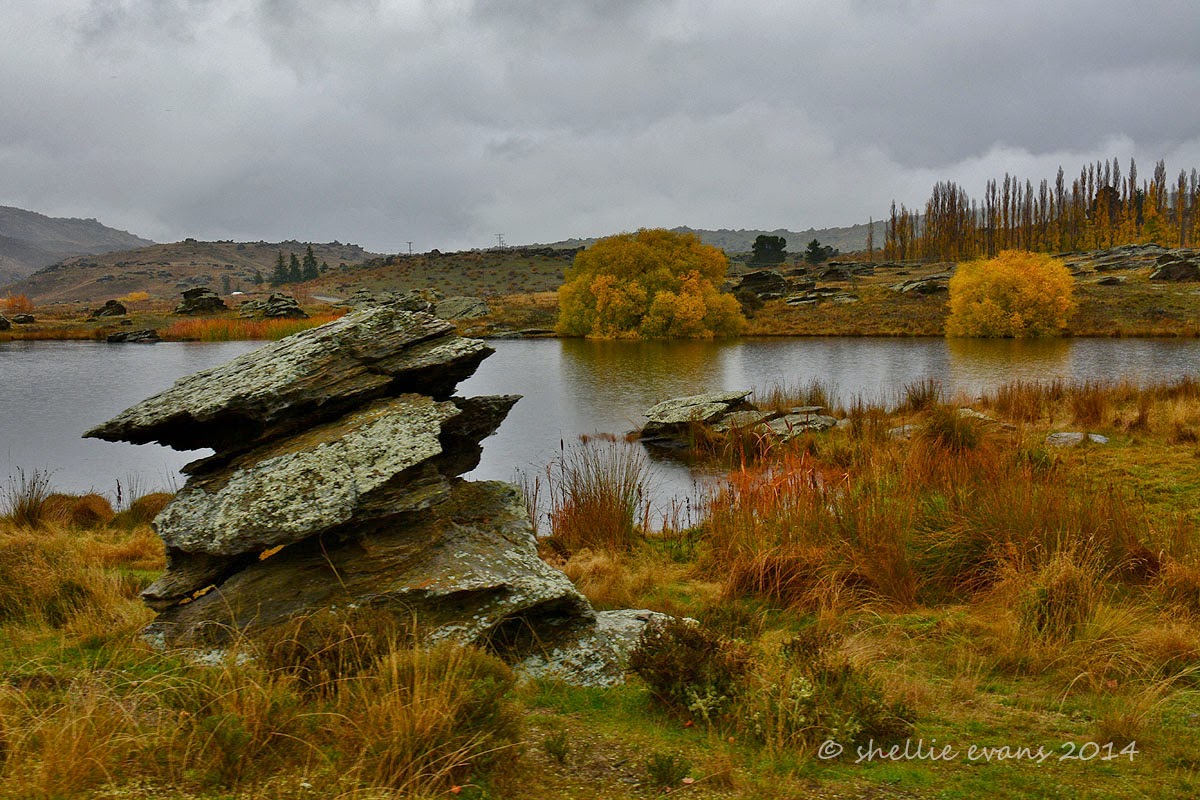
We drive east a little way to check out Butchers Dam which is a free camping area where we thought we might  stop for a night or two. The area is beautiful, surrounded by wonderful schist rock formations and the golden colours of willows, reeds and grasses. It’s a little exposed to the main road traffic and also there is a lot of mud around so we think we’ll give it a miss this trip. There’s good trout fishing to be had in the dam and also a few DOC walks so I’m sure the place will look a lot more welcoming next time we pass through.


The next day when we passed I stopped to take this photo of a motorhome parked up below the road, it had dried out a little but the tracks in were still slippery & wet and we’d decided to head on to Pinders Pond just south of Roxburgh.