Showing posts with label stone. Show all posts

April 12, 2020

Quartz Reef & Bendigo Historic Goldfields- Part 2

Catch-up

Continued on from Part 1

Further north along the range from the Quartz Reef Point tailings are the Bendigo Goldfields. The Bendigo Historic Reserve is a very large area and was made up of several small towns that sprung up on the lower slopes of the range as gold was discovered in the mid 1860s.

An old horse cart & Logantown ruins
We visited the very north end of the reserve when we drove through the Dunstan Mountains on the Thomson Gorge 4WD Track back in 2015, exploring the remains of the Rise & Shine and Come in Time Reefs and the restored ten stamp battery that is there. It was late in the afternoon when we exited the Thomson Gorge Track at Tarras so we decided we'd explore the rest of the Bendigo diggings another time. It's taken awhile but finally we're checking them out.


The road up to the top of the Bendigo Reserve is short and quite steep in places, it passes by the old Bendigo School site and finishes at a carpark in an area that was once known as Welshtown. During the 1860s Welshtown was a residential town which was supported by businesses in nearby Logantown at the bottom of the range.

Looking towards Wanaka, through that gap in the mountains at the back.
The views out over the Upper Clutha valley are wide & far reaching; vineyards and farmland fill the valley from the Pisa Range on the left to Lindis Pass and the Hawkduns at the far right and out of shot. I zoomed in on the interesting shaped effluent/irrigation pond on this dairy farm, not only an interesting shape, but it's huge!


There are quite a number of stone ruins left in Welshtown including a cottage whose walls are relatively intact. Many of the houses here were made of corrugated iron, these are long gone and they weren't necessarily left to deteriorate either. They were easy to dismantle and cart off to the next gold rush.


The size of the cottages is amazing though, some only had enough room for a bed & the fire and that's about it. I guess the men were working the gold fields most of the time and only needed a place to rest their heads overnight.


Families would have lived in some of the larger cottages including this house that belonged to the Pengellys, a prominent mining family in the district.  Can you see the remains of the house in the photo above? (click to enlarge) A close up is in the the photo below, top left. 


There are several walks of varying lengths that leave from the Welshtown carpark in all directions. I take the 1km Welshtown Matilda Battery track through the kanuka scrub heading downhill past grated mine shafts and the remains of several stone buildings including the Blacksmiths store (above, bottom right). 

Matilda battery
The twenty stamp Matilda Battery site opens up at the bottom of the track with a mine shaft and numerous stone foundations including a chimney still standing. In front of the battery are the remains of the mine office and further up the slope are the ruins of several small stone huts where miners working on the battery lived. There's also a collection on the office window sill of broken glass and metal bits & bobs that people have found while fossicking around the site.


It was getting late in the afternoon when I got back to the carpark and I really wanted to walk the 4km Aurora Creek Track but decided I'd come back later in the week to do it, then I wouldn't have to rush and David wouldn't have to wait around for me. But in the end he did come back with me- as my chauffeur- I left him in the Welshtown carpark and headed off across the gully...

The carpark, Welshtown ruins and a snow capped Pisa Range behind.
...around a ridge, through a large open area with masses of vegetable sheep...


...before entering the kanuka scrub and heading downhill. Once again the views out over the valley are magnificent.


It's not long before I reach Aurora Creek and the rocky gorge it flows through.


I find a gap in the rocks that overlooks the gorge and I can now see the old dray track that crosses the creek on a stone causeway which was built in a hurry and by hand in 4 months.


Once across the causeway the track starts to head down the range to the bottom of the gorge but not before it passes through another wide open space known as The Ballroom. 


On the 4th February, 1870 over 300 people made their way here from Welshtown & Logantown to celebrate the opening of the new 10 stamp Aurora Battery. After speeches, champagne & salute firing the crowd moved to the open air ballroom to dance the night away to the sound of violins with a warming fire burning in the purpose built fireplace.


I carried on along the track, which wove back and forward down the side of the hill alongside the gorge, stopping to take in the views whenever there was a rock platform or a gap in the scrub.


More ruins appear on either the side of the track as I near the bottom of the gorge.


And then the track disappears under the kanuka bush and down into the bottom of the narrow gorge...


...where there are a lot more stone ruins on both sides of Aurora Creek.


From the creek-bed the track heads along what once was the main street of Logantown...


 ...past the remains of at least three hotels, a butchery, bakers and more miners huts...


...to finally end at the old horse cart. And where my chauffeur is happily waiting for me. This saves me the walk back up the steep incline to the Welshtown carpark. 


We then head off back down to the loop road and home to Cromwell; Bendigo Goldfields done & dusted.


November 23, 2016

Pike 29 Memorial

Catch-up

I wanted to post this last Saturday, in time for the 6th anniversary of one of New Zealand's worst mining disasters, but unfortunately we had no internet connection on the day. 

At 3:44pm on the 19th November, 2010 an explosion happened deep within the Pike River Coal Mine located 46km north of Greymouth and where 31 men were working. Only two men came out alive, they were working in an access tunnel closer to the entrance than their workmates.

Emergency services and mines rescue crews worked around the clock for days, waiting for a 'window of opportunity' where gas levels were safe enough to enter and bring the 29 workers to safety. On November 24th, it was all over. A second explosion rocked the mine and any hope for the Pike 29, as they became known, was lost. Six years on, the Pike 29 remain entombed beneath the Paparoa Range.

We left Reefton heading for Greymouth turning off the main road just past Ikamatua to follow the Grey River down it's true right. The road is in excellent condition, with long straights, hardly any traffic and bordered by dairy farms for most of it's length. Along the way, I wanted to visit Blackball, a well known West Coast town. 


I hadn't realised the the Pike 29 Memorial was located near the road until I saw the sign. 


We found a place to turn around and returned to the memorial. We had a discussion about whether it was appropriate to visit the memorial, as the tragedy is still quite raw for many New Zealanders, and it did feel like we might be intruding. And especially as we had the 5th-wheeler on the back (I know, I know but if there had been others there, I know we would have carried on). But the sign on the gate made it clear that we were quite welcome, which helped.


And I'm glad we did stop and visit. This small corner of a dairy farm paddock-donated by a generous local family- has become a very special and sacred place for the Pike 29 families and friends, a place for quiet reflection and to remember their loved ones. 


A large rock strategically placed so you're overlooking the Paparoa Range while reading, holds the memorial to the men (click to enlarge the photos).


The Paparoa Range and Pike River Mine are 15kms further up the road beyond the rock. The mine portal is located in the range just to the left of the dying tree. The coal processing plant is to the right of the two large trees.


I have many photos of multi-sign posts from around the country but this one has to be the saddest one of all; the distance to each of the men's home towns.


The shelter held many poignant reminders of the tragic loss.


tag board with the identification cards of the 29 miners- a system used to keep track of who is underground at any given time.


And photos of the men. Also in the shelter were a visitor's book (sad reading), diagrams of the mine workings and the blast, photos of the Memorial landscaping and wired to the floor, a rock from the mine blast.


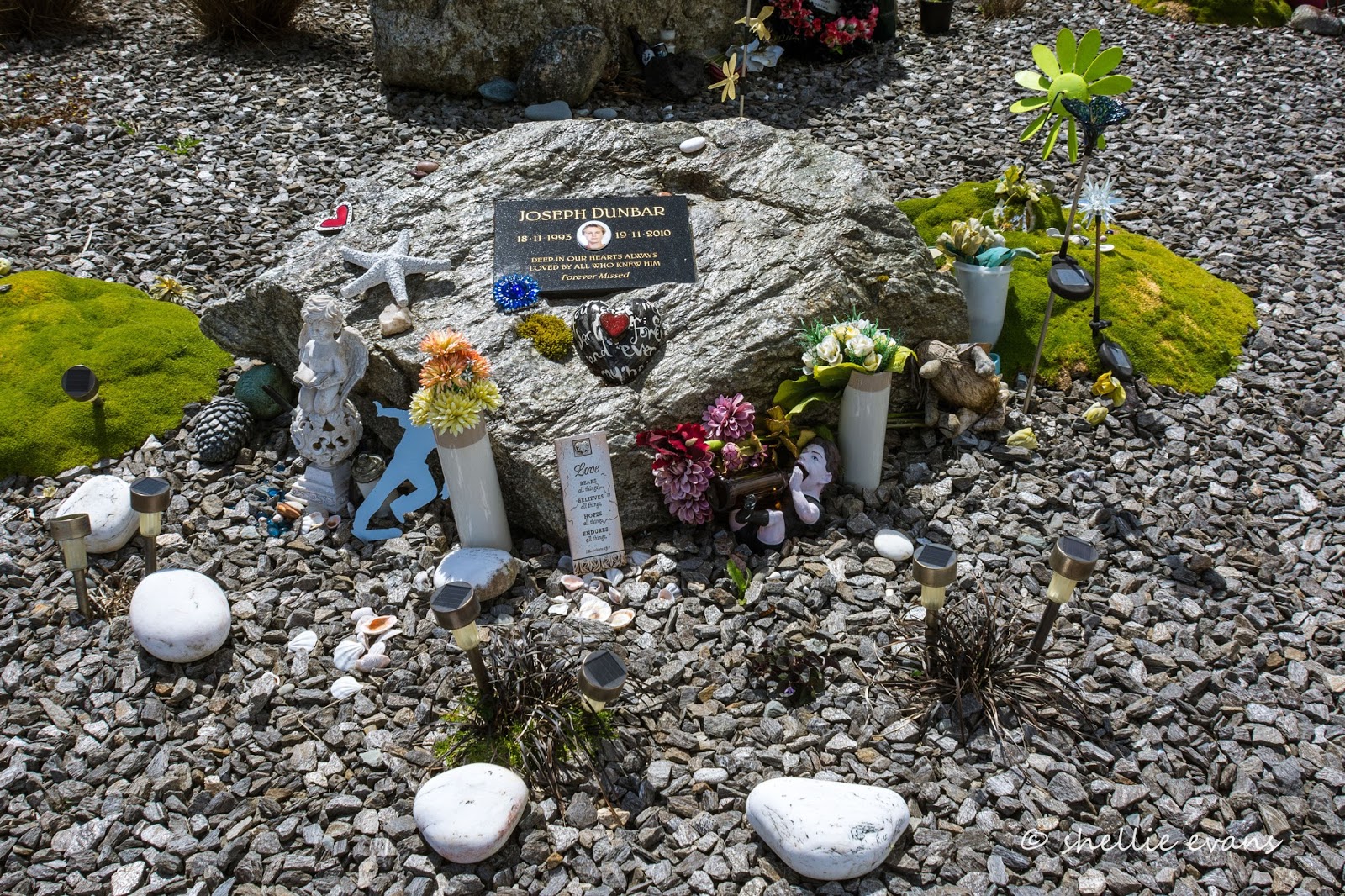
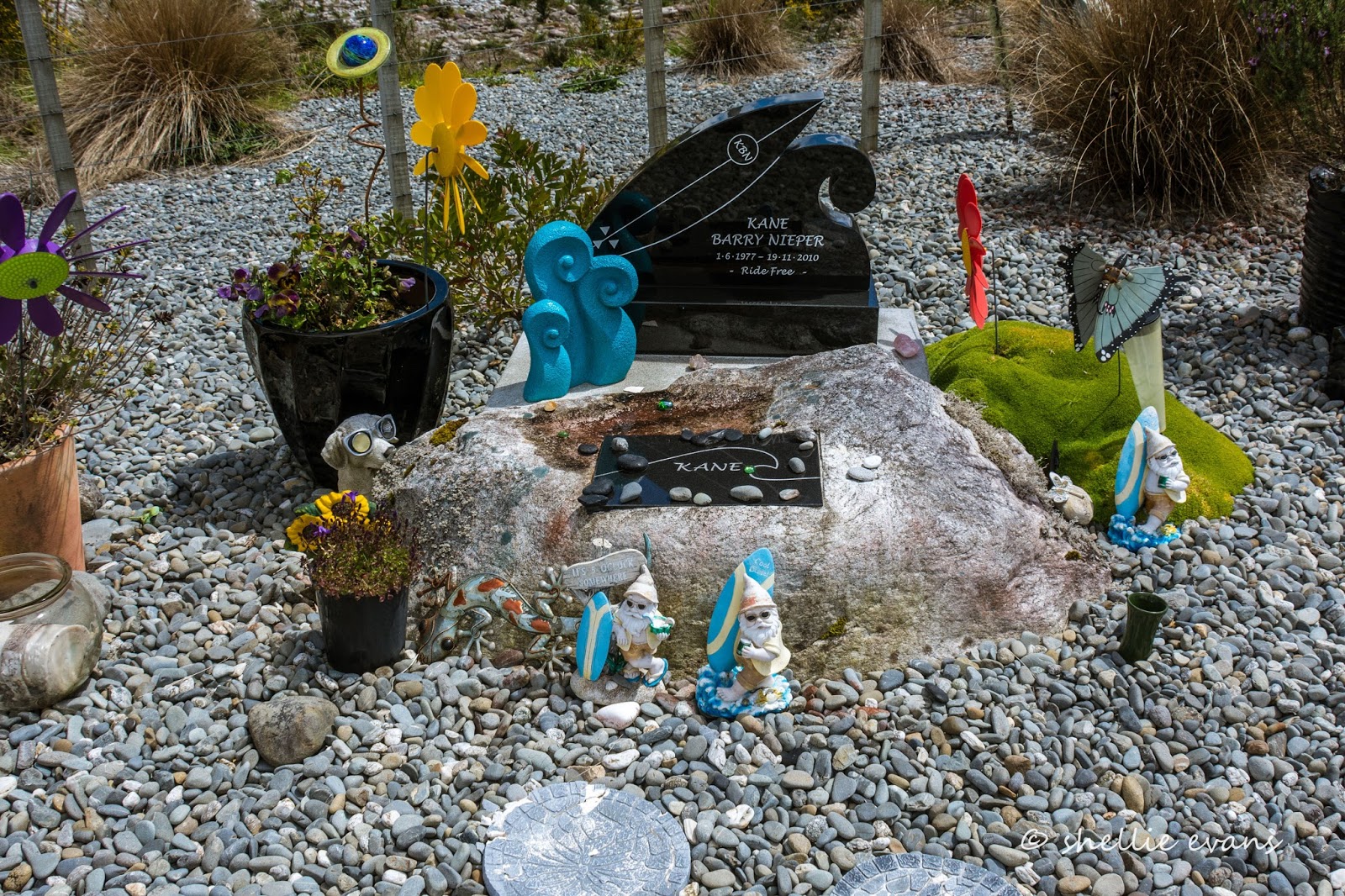
A gate opened to plantings outside the memorial fence and a gravel path led the way down to a small stream. It's a pity there's a substation blotting the landscape behind the memorial but I'm sure once the plantings establish themselves is will be a minor inconvenience. The memorial area has been very well done, with individual memorials to each of the men around the outside of the white stone gravel koru.


Initially I wasn't going to upload the personal memorials here but I've decided I need to. I know that the families of the Pike 29 don't want people to forget their men and the pain and loss that they have suffered. Perhaps there are families or friends that can't visit the memorial, maybe seeing their man's memorial here will help them sometime in the future as they're searching for solace or a memory.

Each of these memorials is very personal; a heartbreaking glimpse into the lives and character of the men and the people they left behind, a moving reminder of the loss of so many healthy, happy and loved people. There is little doubt that the Pike 29 will forever be remembered by New Zealand.


THE MEN OF PIKE 

They came from near and far away 
The men of Pike to work that day 
The afternoon shift way down deep 
Beneath the mountains oh so steep 
A long way in but further out 
The afternoon shift sets about 
A job not flash but hard and trying 
A job that holds the risk of dying 


From seventeen to sixty two
They start their shift to see it through 
For one his first, for all their last 
How could they know there’d be a blast? 
For all at once no siren whining 
Suddenly the worst in mining 
Dust and rubble fill the air 
A loader driver thrown clear 
Just one other finds the light 
The rest are hidden from our sight 


And so we learn as news is spread
The news that mining families dread 
It’s up at Pike there’s an explosion 
Faces drop and hearts are frozen 
Who, how many, where and why ---- 
Will they make it ---- will they die 


Fathers, husbands, brothers, sons
Coasters, Kiwis, Aussies, Poms 
Mates and friends who we are seeking 
Methane gas from coal seams leaking 
Vents exploded, phones unheeded 
Level heads and strength are needed 
The world above unites as one 
To bring the missing to the sun


Rescue teams are standing by
As holes are drilled and experts try 
To find a way that’s safe and sound 
To rescue those beneath the ground 
Could robots work where men are mortal 
To pierce the dangers of that portal 
But alas all effort fails 
The darkness of the mine prevail


A second blast of rock and thunder
Hope and prayers are rent asunder 
A nation weeps and Coasters mourn 
Pike falls silent, dark, forlorn 
A hole remains within the ground 
Devoid of joy, of life, of sound 


Another hole within the heart
Of those forever set apart 
From those they loved who went to toil 
Digging coal beneath the soil 
Those who gave their lives that day 
To work a shift for honest pay 
They wait at rest within their mine 
The men of Pike, the Twenty Nine

Sean Plunket


Lest we forget