August 31, 2013

Nikon- Customer Satisfaction

As most of you know I'm an avid amateur photographer. Last September after a lot of research I "jumped ship" from a Sony DSLR(Digital Single Lens Reflex) to Nikon, this was a major purchase because not only did I need to buy the camera body but lenses as well, you can't just swap glass between brands. I also purchased a few "necessary" extras.

I'm now officially poor but boy did I have fun!! :) by flyingkiwigirl

But this post isn't about what I bought last year, it's also not about the customer satisfaction of purchasing Nikon (although I am completely & happily satisfied with my choice) This post is about the excellent customer PR I received from the camera shop I dealt with. And what they did to retain my custom.

I became aware through various means that the D7000 body I had purchased new was in fact not, it had just over 2000 clicks(shutter count) already on board when I opened the box(which in the scheme of things isn't that many, but still, it was not new). And it wasn't as straight forward as it sounds but it took me a few months to query it with the shop. I sent an email to the manager/owner outlining the issue & almost immediately got a personal call back from him.

He was very, very apologetic & explained to me what he had found out. Basically without going into too much detail, the camera had been returned to the shop after about 2 weeks use by a long term customer  and had been left on the stock desk in its packaging with a note indicating it was second-hand and that's the last anyone can recall it. It went into the computer stock system as second hand & was in fact still showing as being in stock. It would seem that somehow the note went missing & it was placed in the new camera stock & it was picked as new. I was happy with the explanation & believe it to be genuine. The manager was unsure why it hadn't been picked up in the stock take that it was missing & has apologized but assures me it was a genuine mistake.

And now for the PR & customer satisfaction. He offered me a number of options to rectify the problem; a new replacement, return of my money, an upgrade with a price difference or discount off other goods. I decided to upgrade my D7000 to the D7100 body which came out in April. I had to pay the difference between the price I paid back in September & the D7100 retail price, this I was more than happy with. I also received some discount off another lens I required & when I opened the box they had thrown in a free 8gb memory card too.

Now that is the way to keep customers happy & returning. I won't mention the name of the shop because I don't believe it serves any purpose but it was a large well know shop in NZ's biggest city. It's pleasing to know that there are still businesses out there that are prepared to accept their mistakes & look after their customers 100%.

Taken with my phone & out of focus!  


August 28, 2013

Take Two

Here we go again. Our second attempt at throwing off the shackles of suburbia.

If you have been following along from the beginning you'll know that way back in May last year we sold our lovely home overlooking Tauranga harbour in preparation for when our fifth-wheeler arrived & we'd be able hit the road full time. When we finally sold our home the deal included a house which we knew would be fairly easy to move on after a little bit of a tidy up. As it has turned out we've held onto the house a little longer that we originally planned to. Our plans over winter changed due to some unforeseen circumstances, namely my father having a heart by-pass & me having surgery on my feet. I'm now into my seventh week post surgery & I've been very pleased with my progress, my feet are still quite swollen & I can't stay on them for too long but I can move about at a reasonable shuffle keeping the weight to the outside edges of my feet. I still can't wear any usual shoes so the black strappy number I came home from the hospital with are still in use. They weren't kidding with the three months recuperation.

Now that we are out the other side of winter we're both getting itchy feet (excuse the pun). Our tentative plan is to head to the South Island by no later than the end of October as we want to be in Invercargill by early December as we have a Christmas date with David's daughter & family. Then we'll stay in the southern part of the South Island over summer & move north as autumn & winter approach. We expect to be down south for at least 18 months to two years & do a number of circuits & a few criss-crosses of the island before we are done.

So we decided to get the house on the market as soon as possible and during the past couple of weeks we've been cleaning, polishing, gardening & part-packing the house in preparation for sale. Photos have been taken, ads are ready & the first open home is happening this weekend. And we're hoping for a quick sale although we've already decided that if it's not sold before the end of September, we'll pack up our personal gear, put that into storage & leave the house furnished & still on the market with our agent & we'll head off. When it does sell we can fly back from the South Island,  pack & store the remainder of the furniture & tie up the loose ends before returning down south.

Already we've had a steady stream of people through the house so things are looking good. Fingers crossed.

We'll certainly miss the great outdoor area of this home

August 03, 2013

Heat, Glorious Heat

This down time we've had in Tauranga has had a few benefits; David has been able to carefully research a few things that need to be done on the fifth-wheeler & ute before we are back on the road. First up and most importantly (after spending a cold night at Lake Okareka) was the heating system in the van for when we are off the grid.

The two choices were LPG or diesel. One of our concerns with LPG was the effect very low temperatures can have on the bottled gas & also we would be putting all our eggs into one basket by relying on one energy source for cooking, hot water & heating. On the other hand, diesel offered a considerably lower running cost albeit a more expensive installation & especially now that we have elected to run with two smaller units instead of one big unit.  After a lot of thought & discussion we now have two  Eberspacher Airtronic D2 (2.2KW )diesel heaters fitted.

Underneath inlet & exhaust installation

One has gone under the stove & vents out under the fridge to heat the galley & lounge area & the other is located in a below floor compartment under a side cabinet in the bedroom.


It vents out through the shoe storage box which forms the step up to the bed. We have lost a small amount of storage space but gained a drying container for the shoes from the small amount of transferred heat as it passes through the hose to the vent.  But best of all, we can use the shower box as a drying room by opening the door & directing the vent straight in there. In the future we may need to add a flexible hose to the vent & run that into the shower depending on how quickly things dry.


The heaters run independently so we only need to use them as & where we need the heat. There's a small amount of noise in the initial start up but nothing compared to the heater on the air conditioning unit when that is on and once the heater has reached temperature they are very quite.

The only area of concern for me so far is the small ticking noise as the diesel is pumped through, it's hardly heard when you're up and about in the van but I think you will be able to hear it in the dead of the night if the heater is running. Like a rain drip.......drip.......drip...... Maybe it'll put me to sleep, who knows but it'll be a small price to pay to have glorious warmth on tap! Especially next winter. Down south.


There is no noticeable diesel smell outside & again just a small amount of noise that drops right off once the temperature has been reached. A 20lt tank has been installed into one of the outside forward side storage cabinets & this can easily be filled each time we fill the ute. 


July 31, 2013

No Weight Bearing- *Warning* Graphic Photo

Due to unforeseen circumstances that have kept us in Tauranga over winter & as mentioned in this blog post I decided to have some surgery done on my feet. In fact originally it was just going to be the one foot but 6 days before the due date I decided I might as well have both feet done & get it all over and done with in one foul swoop. I knew in a year or so I'd need to have the other one done anyway & either way it was going to be a 3 month recovery with six weeks no weight bearing so having both done together made a lot of sense. Luckily the surgeon was in agreement & was able to fit me in & doing it this way also saved a lot on the cost too.

I was a little nervous beforehand as I've never had a general or been in hospital but it all went smoothly & I don't remember a thing! Both bunions were removed (sawn off!), my big toes cut in two & realigned & two toes on my right foot where the arthritis had started to take hold shortened & repositioned too. The cuts are done diagonally through the toe and then some of the inside area is shaved off & the toe slides back together with a pin to join & for support.

Such is the life of the female population, apparently it is very rare for men to have this type of surgery, & most often it is hereditary, passed from generation to generation. My grandmother & mother along with two aunties have all suffered to varying degrees. Two of my sister-in-laws & a girlfriend have also had similar surgery.

I had heard a lot of horror stories about this type of surgery but I can honestly say the pain hasn't been too bad, a good supply of painkillers took care of that & keeping my feet raised has helped reduce the swelling. David has pulled out all stops in looking after me, bringing me breakfast, lunch & dinner on a tray & copious amounts of tea & coffee. He also helps wrap my lower legs in plastic bags (I look like a modern day yeti) so I can shower without getting them wet. We have had a little practice at this though; seven years ago I broke an ankle and was in plaster for 6 weeks with no weight bearing either.


For the first week I could hardly hobble on my crutches to the loo but now it's not too bad and I can shuffle around for a short while in my fashionable black strappy sandals with the support of my crutches. The bruising has gone down and two days ago the stiches were removed which as it turned out has been the most painful part!

The arrows are in case the surgeon forgets what he is doing :)
I've had & still have plenty to keep me occupied; folders & folders of photos that have been waiting to be processed & sorted on my laptop, boxes of recipes I've been slowly going through, choosing to keep the simpler ones & ones that will suit our new lifestyle on the road. I've also got a couple of large boxes of NZ travel articles & photography magazines to sort into some sort of order so I can have easy access to when required.

So three weeks down & three to go before I can start to move about in flat comfy shoes. Then another three months before I'll be getting back to anything like normal. Hopefully it won't be too restrictive as by then we should be down South somewhere and keen to do some tramping. The whole reason why I had to have my feet done in the first place. And we can't wait!


Paparazzi-ed by Maddie
Using her Mum's phone our 4yo granddaughter Maddie decided she wanted to take a photo of Nana in bed.
And then add some processing to it!
"You're not sick are you Nana, you're just sore" as she galloped off on my shortened crutches.


July 02, 2013

Quarter Acre Pot

We purchased a Quarter Acre Pot at last year's Covi Motorhome Caravan & Outdoor Show which is held at the Epsom show grounds in Auckland. So far I haven't tried it out so I thought while we're parked up at home I'd trial it along side cooking the same dish in the oven.

Quarter Acre Pots are thermal cookers that require no power, a bit like a slow cooker that doesn't need to be plugged in. Because we'll be off the grid a lot of the time I'm hoping it'll be an ideal way to prepare a meal. I also like the fact that you can prepare the meal in the morning before you leave for the day & it'll be ready to eat when you get back or to when you pull into another site after a day of driving which is when you least feel like cooking dinner.

Here's the blurb from the link above-
The Quarter Acre Pot is a simple to use non-electrical multifunctional appliance that can be used as a Thermo Cooker, Cooler, Bain-Marie, Rice Cooker and Yoghurt Maker. Take your Quarter Acre Pot Camping, in the Caravan or Motor Home, Picnics & Outdoor Events .
I found a recipe in amongst a pile I was sorting & thought it would be perfect to trial in the Pot & to compare, in a casserole in the oven. I was hoping to include it here but I've now gone & misplaced it.

So in case you're wondering what it is, it was called a "Chicken, Chorizo & Butter Bean Bake"


Basically there are two "billies", a large one that fits inside the outer thermo container & a half size one that fits inside the bigger billy. After water is brought to the boil in the outer billy, the smaller one with the food ready to go is placed inside that. It sits in the top half of the bigger container above the boiled water. The lid is fitted & the outer thermo lid is closed and then the whole container is popped into the carry bag & put somewhere safe & secure to work it's magic. The boiling water transfers it's heat to the thermo outer & slowly the food is cooked. And that is that. Meats, casseroles, soups, desserts & cakes can all be cooked in Quarter Acre Pot.

And the verdict? I left it cooking for 8 hours & I was pleasantly surprised with the outcome. It was definitely tastier than the same casserole done in the oven, much more flavour and the chicken readily fell off the bone. Now I'm looking forward to trying it out on other recipes, maybe some of the less likely "slow cooker" ones. I'll let you know how they go.


June 22, 2013

Homeward Bound

When we originally discussed heading to Napier to help out my parents we thought we'd stay about ten days and then have three or four days at the Kuripapango DOC camp located on the Napier-Taihape Road at the beginning of a steep winding climb up onto the Central Plateau, this is colloquially know as the "Gentle Annie" and was once a gravel road. It's now sealed all the way through & a lot easier to tackle.

Unfortunately a significant "weather event" was forecast, a large cold front sweeping up from the Antarctic & due to arrive in the North Island on the day we were going to leave. Snow & gale force winds were expected especially through the Central Plateau and if we got stuck up there we'd have no way of getting home until the snow melted. The roads through the Plateau are usually closed as soon as there is a heavy dump of snow. That & the fact that we didn't have any heating were of concern so we decided to wait it out a couple of days before heading anywhere. Strong winds had already started buffeting the van even though is was relatively sheltered beside the house & rain had began to fall.

Going by all the road reports & news articles we were then worried that the road home, the Napier-Taupo was going to close due to snow as well. By Saturday we decided it was time to head out, we'd changed our plans & were going to stop for a couple of nights at Lake Okareka near Rotorua which is on the way home. The Napier-Taupo was open although the AA Report said to watch for snow. I was secretly hoping that there was going to be a good photo opportunity once we got up into the ranges but disappointingly this was the only snow we saw, way over on top of the Kawekas. The road was bone dry too so no chance of black ice either which was good.


We pulled into DOC's Lake Okareka campground late in the afternoon. This is a small campground surrounded by bush & right on the shore of the lake. It has just twelve camping sites, they are all marked out & you take your pick. We both decided we didn't really like the regimented way this camp site works, in the busy season it would be full every night, with everyone lined up alongside each other like sardines. It was fine at this time of the year though & pleasant enough for a night or two.

There was a tent (bloody hell, they must be hardy) already set up & only us on the hard ground. Five more vans of various shapes & sizes trickled in over the next hour and we were all settled in by the time the sun dipped behind the hill.


The campsite overlooks the small but beautiful lake and other than one small boat out trout fishing the lake was deserted.


Just on dusk we took a walk through the bush, along a track than followed the shoreline. It wasn't very well maintained and we had to brush past gorse & blackberry at one stage and climb over fallen trees. It didn't look like it was going to be of much interest until we startled a morepork (Maori name; ruru) out of a tree fern. Ruru are New Zealand's only native owl & while most of us would have heard their distinctive call not many have seen one.

First thoughts were that it was a blackbird but I knew from the silent 'whoosh, whoosh" & the bigger size that it wasn't. And sure enough, David had spotted where it landed & I was able to creep up on it and take this shot. It was very alert & was on the verge of flying every step I took.


Not only was I thrilled with this shot because it's without flash in the very dark bush on dusk & handheld at a low shutter speed. Which would usually make it nearly impossible to get a sharp focus. But I nailed it. And, it's my very first "Explore" shot on Flickr. For those that don't know, Flickr is a photo sharing site, I use it to upload, store & share my photos. Flickr receives around 6,000 uploads every minute - that's about 8.6 million photos a day. From this huge group of images, Flickr choose only 500 images to showcase for each 24-hour period. That's only one image in every 17,000. And my Ruru was one of those on June 24th! Here's the link if you would like to read the comments.

We continued on to the end of the track now acutely aware of any movement around us. There were no other birds let alone another morepork. The track ended on a small point that reached out into the lake with a big drop off into the water below. We were just in time to see the last sun of the day & return along the track before it was pitch black.


Once the sun disappeared the temperature plummeted & without heating in the van we quickly put on extra layers of clothes. But it didn't help much and by 7:30pm we were tucked up in bed with as many blankets as we had available piled on top. I'll spare you the details of the clothing I wore to bed suffice to say that only my nose got cold that night. It actually wasn't too bad until you had to get up for the bathroom. I checked the temperature gauge at 12 midnight & it was 7c inside the van & 1.7c outside! Here's what it was in the morning at 8:30am; 4.4c inside & 1.8c outside, along with a good coating of frost on the ute.


Needless to say we didn't get out of bed until around 10:30am, the most time I've spent in bed for a very long time! The fact that the sun didn't pop it's head above the hill next to us until after 11 o'clock hadn't help with warming up the campground either. When we finally made an appearance outdoors everyone else had left!

Once the sun reached us we had about half an hour of lovely sunshine & warmth & then the clouds rolled in & it turned bitterly cold again. We were thinking of stopping two nights when we arrived but this sudden change in weather helped us decide to head on home. Roll on the "central heating"

June 19, 2013

Lake Tutira Reflections

Before we left Napier David & I had wanted to visit Boundary Stream, a 702ha mainland island bird sanctuary & scenic reserve located on the eastern flanks of the Maungaharuru Range 60kms north east of Napier. The reserve is home to a number of threatened species including kiwi, kaka and kokako & the New Zealand falcon. You may recall back in February when we stayed at Glenfalls we travelled inland hoping to reach Boundary Stream but gave up after travelling over 10kms on a bone rattling & dusty corrugated gravel road.

We didn't leave until late morning & in hindsight we should have left much earlier to fit in one of the longer walks & a visit to Shines Falls which in the end we missed out on.  As it was we decided to stop & have a look at Lake Tutira on the way past, it was a brilliantly sunny & still winter's day & the lake looked stunning.


I also spotted a church up on a plateau that I wanted to take photos of & David also wanted to check out the fly fishermen we could see on the other side of the lake.

Is that the Loch Tutira Monster?
William Guthrie-Smith (an author, ornithologist & conservationist) settled in Tutira from Scotland in 1880. Tutira Station was once over 60,000 acres with 32,000 sheep, Guthrie-Smith subdivided some of his land after WW1 & gave it to returned servicemen. A man well beyond the times he wrote about the serious effect introduced species, both plant & animal, were having on native flora & fauna. Herbert Guthrie-Smith died on 4 July 1940 at Tutira where he is buried. The 2,000 acres that remained of the station were left in trust to the New Zealand public as an educational and recreation reserve. Thousands of Hawkes Bay children have many happy memories of Tutira school camps courtesy of Guthrie-Smith's generosity.

The Tutira Memorial Church had a prime position on a hill overlooking the lake, you can see the calm lake in this photo.
 

We arrived at Boundary Stream mid afternoon and chose one of the shorter walks to do, we hoped we'd have enough time to complete the walk & then drive around to the Shine Fall's car park 12kms away & do the short walk to the falls from there. It would have been a ten hour return walk to the falls if we'd done it from here & there was no way we had the time or the stamina to do that.

Boundary Stream Scenic Reserve
We met a DOC worker who was heading into the bush to do some kiwi tracking with his portable radio tracking device, if we had more time we wouldn't have minded tagging along to check that out. We completed the shorter walk & were pleased to see a falcon flying overhead & a number of rifleman, both quite rare. I didn't manage to get any photos though, it was just too dark in the bush & getting darker by the minute as storm clouds jostled for space in the the blue sky. Once we'd finished we decided there wasn't enough time to visit Shine Falls so we headed back to the main road & home.


Driving back past Lake Tutira, the lighting over the lake was fantastic as the setting sun was caught between the dark storm clouds & the high range it would shortly disappear behind. We drove around the lake edge to check out the DOC camp on the other side where we could see three or four vans parked up for the night.


It was the "right place, right time" for me to shoot a few dozen beautiful shots of the lake & the beautiful autumnal colours & the wonderful reflections. Within 10 minutes the sun had gone.

Here are a few for you to enjoy-


June 18, 2013

Living Memory

I've wanted to do a this particular photo shoot for awhile after reading about it in one of my photo magazines.  A "Living Memory" photo is a photo within a photo or in my case a photo within a photo within a photo.

Our family lived on the Hawkes Bay Hospital Board farm for over 20 years, Dad managed their dairy & pig farm located on the outskirts of Napier. Apart from the first two years of my life Park Island was my childhood home & I have many fond memories of farm life.

Before the devastating 1931 Napier earthquake, Park Island was a home for the "indigent elderly" run by the Napier Hospital & Charitable Aid Board. Over 100 people lived in the many buildings and worked in the gardens of the home on the hill. Most of these buildings collapsed during the quake, our farmhouse, once a manager's home was one of only a few that were left standing.

Here are some photos from the time; this first one is of the home & gardens taken in 1920. The house on the far right is the gardeners cottage & was another house that was left standing after the quake. The shell of the cottage became the farm's barn. Our farm house can't be seen here but it's located towards the back left below the dark row of trees.

Park Island Rest Home circa 1920

And this is immediately after the 1931 'quake, our farm house can now be seen, left standing amongst the devastation.


The Home was never rebuilt, the land was cleared and it became the farm that I grew up on.

In 1975 the local newspaper took a photo of my mother holding the first photo above. She was standing in the spot where it had originally been taken 55 years earlier. You can now see the gardener's cottage (barn) to the right and our farmhouse which by now had a veranda added to it, in the background. We're not sure what the purpose of the newspaper photo was.

Park Island Farm circa 1975
By 1980 the farm was sold to the Napier City Council, the outer suburbs were creeping closer to the hills of Wharerangi & Park Island. Down on the flat the farm land was being developed into sports fields for the ever expanding city. The two council cemeteries beside the farm were full and the city wanted Park Island for its new Western Hills Cemetery. I'd left home by then & Dad retired from being a farmer and my parents moved into town.

Which brings me back to my photo shoot. I wanted to take a photo of Mum holding the above photo in exactly the same place again. A photo of a photo of a photo. 38 years between the middle photo & this one & 93 years in total between the first & last photos.

Here is the result and there's our old house still in the background but now partly hidden by trees.


Park Island 2013

And here are some more photos taken from Park Island, this is looking out towards Napier City & the Airport & Ahuriri Estuary. Before the 'quake all this land was six foot under the ocean, that is why Park Island was called an Island, the sea came right up to the cliffs below.


Park Island- Western Hills Cemetery


There used to be a wooden tepee shaped trig station on this spot, it's now been upgraded to a concrete pillar. You can't swing on the cross bars anymore :(


June 10, 2013

Back to Napier in the Fifth-Wheeler

Once Dad was well on the road to recovery I returned to Tauranga with the promise that both David & I would return in the fifth-wheeler in a couple of weeks time so we could help with some of the outside chores that Dad wouldn't be able to do over winter.

We stayed once again at the NZMCA park over property in Taupo on the first night, cutting the four hour trip to Napier in two. There were only another four RVs parked up so we had the pick of positions to park, not that we got to see much as it was cold & bleak outdoors. As yet we have no heating in the fifth-wheeler unless we are plugged into power so this was going to be our first winter's night with no warmth. It wasn't too bad once we were all  rugged up in bed & we took our time getting up the next morning, waiting for the sun to reach our little spot. A hearty cooked breakfast also warmed the cockles.

We had an uneventful trip over the Napier-Taupo road stopping of at the Tarawera Café for coffee which was pleasant enough. I must have passed the café (or hotel as it used to be) at least 300 or 400 times in my lifetime & I don't ever recall stopping. The parking area of the café is also a NZMCA POP (Park Over Property) & would be a great place to stop if you weren't wanting to travel the road all in one go. Apparently there is great trout fishing in the stream close by & the owner (who wasn't there that day) is happy to show fishermen the rights spots.

We arrived in Napier in good time and set the fifth-wheeler up on the concrete pad next to Mum & Dads once again. We spent the next week on & off water blasting the house & paths, cleaning the windows, planting out the vege garden along with some flower plants & spaying weeds & moss along with a few other bits & pieces.  Dad was still progressing well but was getting a little frustrated that he couldn't help out.


I managed to get some more photography in, this time I had heard that there was a Royal Spoonbill & a White Heron feeding in a creek that ran alongside a suburban street. Both these birds are quite rare in NZ but small numbers tend to winter over in Hawkes Bay each year. There is a resident population of about 20 spoonbills that usually feed on the Ahuriri salt flats & estuary but this one obviously though dinner was better served from the creek in town. And sure enough I found them both there, the spoonbill was very obliging & allowed me to get quite close. Unfortunately it was a very dark & overcast late afternoon so the lighting wasn't that great.

Royal Spoonbill, Maori name Kotuku-nutupapa
White Heron, Maori name Kotuku

Once the house chores were finished we spent a bit of time tiki-touring around the Bay. We met family for lunch at the Puketapu Hotel which was very pleasant, the restaurant is very busy especially on the weekends as the hotel is at the turn around point of one of the local cycle trails. After lunch we took the back roads through to Paki Paki which is south of Hastings, I wanted to check out the Pekapeka Wetlands which I'd passed with Mum on our way to Wellington a few weeks ago. We passed these cute bee hives along the way.


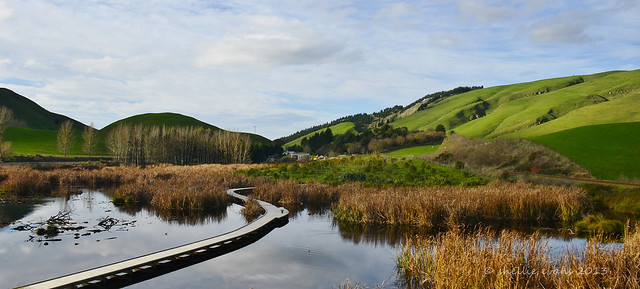
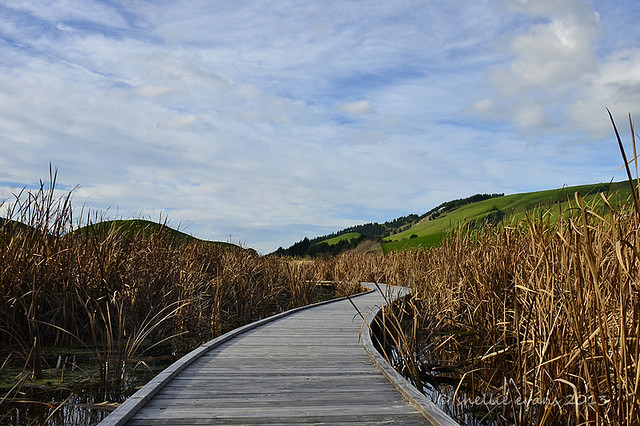
Pekapeka is a relatively small swamp, it has a rail line along one border & a major state highway on another. It has slowly been restored to it's former glory after years of neglect & abuse. The wetland had been used as an illegal dump over the years; the remains of a hotel are buried under the swamp somewhere and willows once infested & dried out the wetland where now raupo(bulrush) grows. There wasn't much birdlife to be seen other than a few swans and a couple of ducks but this is probably because it's duck shooting season & even though there's no shooting they've probably been scared away. It was a beautiful sunny day & a lovely walk around the boardwalks.