Tuesday, October 4

Beach Hop South- Herbertville & the Pipi Bank

Real-time

Not far from Porangahau and on the way to our next beach destination we pass an iconic NZ tourist attraction, a place that unless you've in the area, is a very long way from nowhere. At 85 characters, this is the longest place name in New Zealand (and some say the world but that is often disputed). It belongs to a small unassuming hill on private farmland and luckily there is a signpost and information panel letting you know you have arrived, otherwise you might just drive straight on past!


I had a couple of goes at pronouncing it and it wasn't actually too hard if I broke it down into syllables or known words- although I'm guessing I didn't break them down or pronounce them correctly, but still I gave it a go. The Maori name translates to "the place where Tamatea, the man with the big knees, who slid, climbed and swallowed mountains, known as 'landeater’, played his flute to his loved one."  Locals simply call it Taumata Hill.


I'd been waiting to visit our next destination since we started the beach hop south. I've never been to Herbertville but I feel like I know it very well. 


Life time family friends of Mum & Dad lived in Herbertville for over 20 years, they owned the hotel and the campground and also had (and still have) a few properties in the village. By all accounts I think the village should have been renamed Sunnexville because according to the current owners of the hotel, the Sunnex family were very instrumental in helping the settlement survive and thrive. 


We met Lorraine & Art Bloom, the current owners, when we stopped in for a coffee. The couple have turned the old hotel into a combined bar, restaurant, cafe & small general store. They also have accommodation available and I have the feeling that their establishment would be a hive of activity over the summer months. 

You might remember the courtesy car from the Patangata Hotel early on in our Beach Hop, well this is Herbertville's version. For real! Apparently as part of the conditions of their liquor license a courtesy car must be available. It all makes sense now, we've seen some rather random and unusual courtesy cars in our travels but I think this one takes the cake! 


Anyway, I'm getting ahead of myself because before we visited the village we drove straight on through and out the other side to the beach, and then followed the gravel road down the coast a few kilometres until we reached Pipi Bank Station- what a cool name for a farm. For my overseas readers, pipi (pronounced pip-ee) is a shellfish that lives deep in the sand along many of NZ's beaches and which can be dug for at low tide. Cooked and eaten in pipi fritters! They are often packed together in dense patches, hence 'Pipi Bank'.


I had called ahead to the Station to ask permission to camp along the foreshore. Permission was granted as long as we didn't mind that the station's cows and calves were grazing the area and we didn't have a dog. I'm afraid no dogs are allowed at any time of the year.


We drove right to the end of the road checking out the numerous suitable camping areas and decided on one not far back up the road after turning around- it was reasonably level, close to the ocean, and had a minimal amount of fresh cow pats. It would seem the cows preferred these areas too.


In the winter we usually park so our slide-out is facing the view, that way we can sit at the table and watch the activity or take in the scenery from the warmth of our van. In the summer we usually have the door facing the view, then we can sit outside drinking (sometimes literally) in the spectacular views and enjoying the summer sun. I can't wait for summer because my bedside window is on the door side and I like to have it open to hear the sound of the ocean waves or a river passing close by.

That is Cape Turnagain, a prominent headland, on the other side of the bay. The cape was named by Captain James Cook in 1769, he sailed south to this point before deciding to turn and head north around New Zealand, hence the name.


And, it's not always the ocean view we see out the window. When you're out in the middle of nowhere it's a surprise to suddenly see a vehicle roaring past. Perfect and purposely fitted out for fishing I'd say. And in fact we later learnt that it was Lorraine & Art from the hotel- they were heading for the rabbit wall to check out the fishing. The rabbit wall is a wall of rocks on the beach which were put there to stop the rabbits from getting through. Though I'm not sure from what direction.


What a fantastic place to stay, we had the whole place to ourselves (well nearly if you don't count the local shepherds and fisher-people tearing by), wild, remote and rugged we both felt immediately at home. I went for a few walks down the beach at low tide.


Once I'd spotted a couple of rooks landing on the beach and I was hoping to catch them off guard by creeping along in the dune grasses, but we all got a fright when I stumbled upon them digging under a log. Rooks are quite common in the Hawkes Bay area but these are the first I've seen on this trip. 


I followed them up the beach for awhile but they always spotted me coming and flew further on. In the end I gave up and just took photos of the beach.


I found a number of mussel nurseries on the large rocks exposed at low tide, some interesting rock formations and the remains of  a vehicle tucked under a sand bank.


I walked home, back along the road...


...passing a few neighbours keeping a wary eye on me along the way.


And in fact every time I stepped outside or went for a walk I felt a hundred eyes following my every move...


I loved this little guy, that's him above trying to hide behind the road marker, he was giving the marker a hard time,  backing off and then running at and butting it as hard as he could. Except of course it kept bending over. It would bounce back and hit him in the face and he'd try again.


I hid behind the ute and he crept up on the van at one stage but then his mother saw me and called him and he raced off, kicking his heels up on the way.


When we returned to the village to check out the hotel, I took a few photos along the way- this is the memorial to the Herberts, early settlers after whom the town is named.  


In the late 1800s/early 1900s Herbertville used to be a thriving community. It had a large hotel, several shops, a police station and a blacksmiths. Schooners were beached on the vast expanse of shallow sandy beach on high tides and passengers and cargo unloaded. The ships would be refloated on the next high tide and carry on up the coast. Horse drawn coaches then made their way towards Dannevirke, 68km away. A memorial stands on the side of the road for past settlers; I think the cemetery is long gone, I couldn't see it anywhere.


The angle is a bit off here, there was a fence in my way, but it's interesting seeing the occupations and ages of past residents. This was just one side of the memorial (remember to click on the photos to enlarge)


The campground is pet friendly and also has 'permanent' sites which at $2500 for unlimited nights, per year, would make an excellent base for those that live on the road fulltime.


I love this bach, I could quite easily own this cutie.


And this old woolshed makes another excellent subject.


On our way home I stopped to take a photo of this grand old lady, the Burnview Station homestead. Burnview Station is just before Pipi Bank along the coast road.


We hadn't lingered in Herbertville as we actually had an appointment to keep- yes, in this most remote place we were due visitors! Lynn & Max have an Ultima 5th-wheeler too and have been following my blogs for a long while. The most amazing thing is that, Lynn had to drive over from Kimbolton in the Manawatu and collect Max who works at Weber and then come on out to Herbertville. They must have been really keen to see us- that is a bloody long way on very winding roads! 


It was great to meet them both, and we were treated to a some lovely goodies too. I didn't think the home-kill lamb chops would have looked quite the part in this shot, but they sure were tasty too.


Before we left the beach we drove to the top of the hill up the road. There's a track that goes all the way to Akitio, the next beach on our list south. Of course we wouldn't tow the 5th-wheeler over this track(although the bit we did cover would have been ok) but we wanted to see if the gate between the Akitio Station and Pipi Bank Station was open- we'd heard people do use the track with permission. The gate had a huge big padlock on it so there was no access to the uninvited today. 

Quintessential New Zealand- cabbage tree, surf beach, farm track, Ford utility (Ok, I put that in there for the Holden lovers). The view back down to the beach.


We had a lovely relaxing time at Pipi Bank but eventually it was time to head onto our next beach. 

Of course there were a couple of stops along the way; this family cemetery which is still being used by the Franklin family.


And a photo stop (only) at another country pub, the Wimbledon Tavern.


Saturday, October 1

Beach Hop South- Blackhead Beach & Turkeys

Real-Time

While staying at Porangahau Beach we did a short tiki-tour north to visit Blackhead Beach and then looped around one of the back roads home again. 

Here's a first for the blog- it's not everyday the lead in photo is of a killing-shed (I think I can safely say it'll be the last time too). This is Porangahau Station's historic killing shed which would have been used to slaughter sheep and cattle for the station's families and as dog tucker. It even has it's own sign pointing across the paddock to it's location. 


I didn't know I had an audience watching my every moo-ve as I took photos of the shed until I turned around. I don't think they see too many people walking up their road with a camera; David had driven off to turn around leaving me to talk to these guys for a minute or two. 


This is the former Porangahau Station homestead which is now called Chapelwick and is a luxury bed & breakfast. 


Set on 18 acres, the estate has beautiful gardens and lawns, mature trees and an orchard, a swimming pool and tennis court along with the historic Station chapel where many weddings are held. And for any NZMCA members reading, Chapelwick is also a CAP (costs apply parking), although it is rather expensive at $20 per night. There I go, it's not THAT expensive but in the scheme of things when you're paying $5 or it's free elsewhere, it seems expensive. On the plus side, you can play tennis, swim in the pool, and walk around the beautiful gardens like you own the place! 


Chapelwick also holds regular events in it's grounds over summer; old English garden parties, garden fetes and craft stalls. 


With not much more to see other than farm stations and woolsheds along the road to Blackhead Beach I managed to convince David to stop for a couple of woolshed shots.


Blackhead Beach has a small settlement of baches and holiday houses at the south end of the beach.


They are reached by crossing a small bridge which I'm sure gives the owners a sense of security. It's like entering a 'gated' community, there;s sure to be a few pairs of eyes watching anyone crossing the bridge- a bit like Billy Goat Gruff- 'who's that tripping on my bridge?'


Blackhead Station woolshed takes pride of place in the middle of the bay...


...and along with a few more houses, the Blackhead Campground and reserve is at the north end where there's also public loos and picnic tables. There is quite a deep ford and a sharp turn into the camp which would mean camping here is out for us, we wouldn't be able to get the 5th-wheeler through the ford.


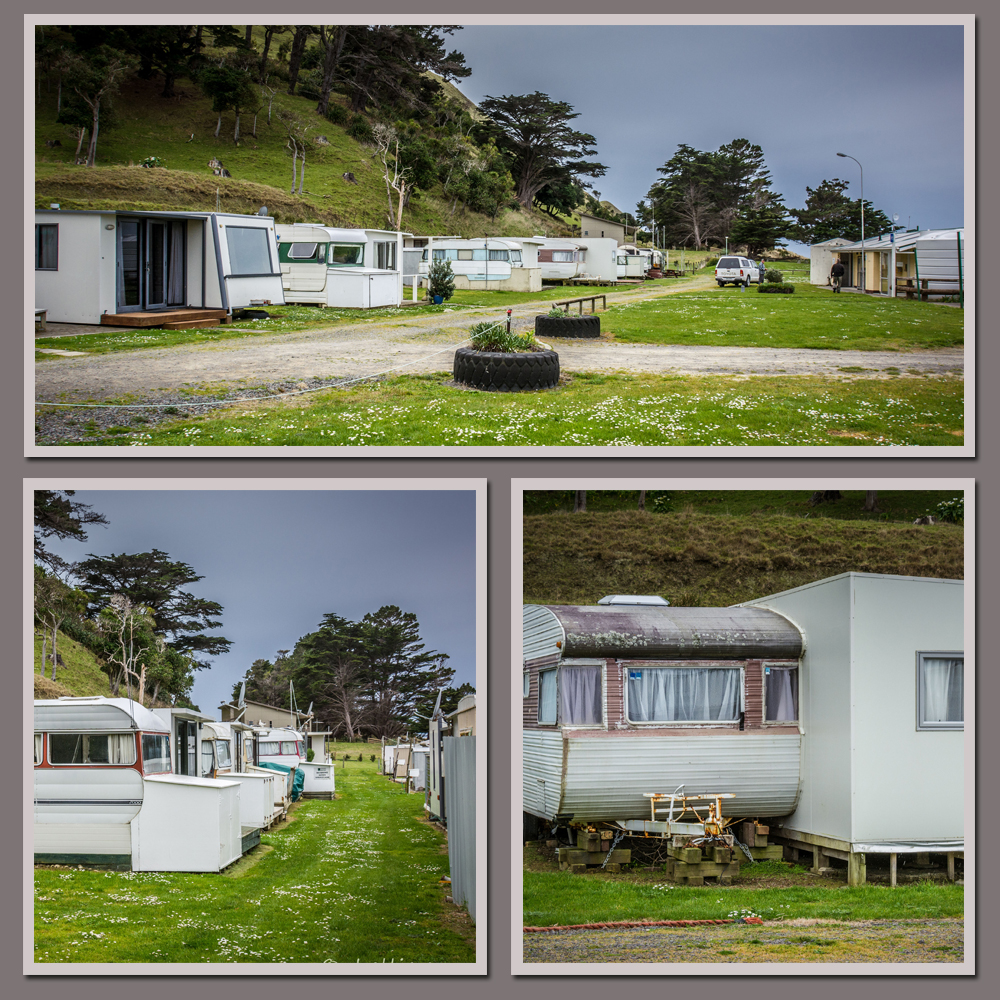
It's a small campground with a number of permanent caravans on site but with plenty of green space at the rear to park motorhomes and mobile caravans. The weather deteriorated just after we arrived and the rain started just as I laid lunch out on one of the picnic tables. We quickly gathered it together and drove to the top of the reserve and backed in underneath one of the large macrocarpa trees and had lunch sitting on the tailgate. We finished just as the first few big fat drops of rain found their way through the branches.


Blackhead Beach is at the southern end of the Te Angiangi Marine Reserve, and Aramoana is at the northern end of the reserve. You'll remember we missed getting to Aramoana because of the muck-up with Pourerere. There's just 2-3 kms of coastline between the two beaches, and yet by road it's about 40kms (on a rough gravel road) or about 80kms if you go via Waipukurau.


The reserve includes a large area of inter-tidal platforms- perfect for exploring at low tide, a boulder bank and a very sheltered bay ideal to people to learn to snorkel. We were going to walk up to Aramoana, well in fact we were going to drive the beach up to Aramoana but David decided that salt laden wet sand and a clean ute weren't going to work. And by the time we arrived the tide was on it's way back in, and it had started to rain. So we gave it a miss and put it on the 'low priority, must do sometime list' 


And if we do make it back, I've decided I want to check the reserve out in comfort & style. David can hook this up to the ute and I can invite a few others along for the ride!


After lunch we made our way back up Blackhead Road and rejoined the loop. I'd seen this woolshed on the way in when I made a mental note to stop and take its photo on the way out.


It was an added bonus to come around the corner and find a flock of turkeys (aka as a rafter or gang) wandering down the middle of the road in front of the shed. Of course when they saw us they took off, running down the fenceline while the dominant male (known as a Tom or a Gobbler) flew off into the middle of the paddock and set about remonstrating with them for not following suit. Some protector he turned out to be.


You wouldn't believe how many turkeys we've seen as we've made our way south along the coast through the lowland farms and stations. Dozens of flocks both large and small, although most seem to have around 10-12 birds. Many were feeding on the roadside and took off as soon as we approached. Others were hanging out around the yards and woolsheds like this group.


Once back on the Porangahau Road we took a short detour to Wallingford Station (Wallingford Homestead is another POP(park over property) where NZMCA members can park for free as long as they purchase a 2 course dinner and a tour around the historic homestead and gardens! Surely that's a CAP(costs apply parking) and an expensive one at that....there I go again!) Anyway, we pulled into Wallingford's woolshed drive but the shed was hidden. Then a movement in the trees caught my eye and...


...there in the trees on both sides of a fence were about three dozen turkeys- strutting, flapping, eating and gobbling! 


I have never looked at turkeys in great detail, they have always been a strange looking bird but, really, these guys take the cake. 


They- well, the males anyway- are the most peculiar looking bird I think I've ever seen. It would seem that there is more than one dominant male in this group. Either that or there's a power struggle going on.


There were a number of  younger males, known as Jakes, in the group and they seem to keeping close to the hens, not challenging the older males but keeping in sweet with them and keeping an eye on the harem. Just close enough to dive in when the Toms were otherwise occupied, I'm thinking. 


Most of the males were strutting their stuff- gobbling calls bouncing off the trees, bright red or pasty pink wattles wobbling on their throats, tails fanned, wings fluffed and down- challenging each other to a dance off- a type of synchronized waltz, they strutted forward and back, up and down, turning and pirouetting around each other. 


I can now see why Native American Indians had turkey feather headgear; they had a ready made fan.


Nature sure is a wonderful thing, but sometimes you've got to wonder if it got things a little wrong- I'm sure his mother loved him.


This very large swamp was right next door to the turkeys- you can now see the Wallingford Woolshed at the back on the right. A huge waterway teeming with birdlife and frogs! I opened the door and the sound of a thousand frogs filled the air. I gave a shout and it went deadly quiet. But not for long. I'm glad we're not parked beside this lot.


At regular intervals throughout the pond were a dozen or so large mounds of reeds and grasses and on top of each of them sat a black swan, incubating her eggs and patiently awaiting the arrival of her fluffy little bundles. We spend 10 minutes or so scanning the pond to see if there might be something unusual out there, but no it was just the usual suspects.


And just across the Porangahau River, not far from home I finished our day with a shot of this 'rustic' woolshed that is on it's last legs.