Showing posts with label Arthurs Pass. Show all posts

June 18, 2016

Retail Therapy

A quick up-date.

The rain finally got to us, and with wet weather forecast for the next week also, we reluctantly left the West Coast this morning heading east. We moved up to the NZMCA Park at Hokitika a couple of days ago and pulled out of there this morning.


Initially we were going to stop overnight at Arthurs Pass Village again, at the DOC camp, but it was very cold (expected) but raining there too, with snow forecast in the next day or two.


So we carried on, thinking maybe Lake Pearson/Moana for the night, but the sun was just about to sink behind the mountains...


...so we carried on past Castle Hill and through Porters Pass...


and down onto the Canterbury Plains where a very impressive sunset pushed us on...


and on...to our second home, the NZMCA Park at Weedons in Christchurch. It's time to do some retail therapy and a little van maintenance, re-gather our thoughts and decide on where to next.

We love the West Coast and while we were expecting rain, we weren't quite expecting so much- I don't think most West Coasters were either, they have had an above average rainfall for summer and autumn this year. I think we did great to get eight straight days of sunshine early in the piece when we were in South Westland, and we had mostly fine weather when we did the top of the West Coast last year so it's just been the middle bit that has caused a few problems. 

We will be back though, we still have plenty to do and we want to be on the Coast during the spring or early summer when the birds are nesting, the lakes are good for fishing, and the tracks are more accessible. 

And, I have to come back to shoot Lake Matheson without a pesky breeze in the corner.


May 31, 2015

Into the High Country

After spending the last two months on the West Coast surrounded by beautiful luxuriant rainforest dripping with emerald green mosses, followed by the last few days in the middle of the Southern Alps with steep mountains and bush clad slopes, it’s a surprise to find, as we head east towards Christchurch, that just 8kms from Arthurs Pass Village the countryside opens up into the wide scenic panoramas and big skies of the Waimakariri River Basin.


And after all the rain we experienced on the West Coast, it’s also a surprise to see how dry it is on this side of the Southern Alps. The Canterbury High Country is still in drought mode, there has been very little rain here for many months.

We stop on the side of the road so I can take a photo of the rig with the mountains behind, I’m sure these will now be covered in snow after the big dump a week or so ago. Ever patient David pulls up again after we cross the river so I can get another shot looking back up the valley past the long Waimakariri River bridge.


The road hugs the bottom of the Black Range mountains which form a backdrop to the huge expanse of the braided Waimakariri River, one of the largest braided river systems in NZ. It’s not long before we pull up again. The view is absolutely stunning, the willows below the lookout are in the the final throes of their autumnal colours, the swampy backwash of the river a vivid blue.


I stitched this pano together which is a little cramped (I should have used my phone, it does panos better than my camera), with the road on either side, but it gives an indication of the width of the river flats; across the river to the left is the Dome (1938m) and to the right The Pyramid (1608m). Click on the photo to see in enlarged.


Just before the road leaves the river near Mt Horrible (with Mt Misery behind- someone was obviously having a bad day when they dreamed up those names) there’s a a short side road to the historic Mt White bridge. The trans-alpine railway meets and runs alongside the river here on it’s way through Arthurs Pass.


The road over the bridge leads on deep into remote conservation land & the isolated Mt White Station.


The cold crystal clear waters of the Waimakariri pass underneath the bridge…


…and head east through numerous gorges before breaking free once again and crossing the Canterbury Plains before exiting into the Pacific Ocean, south of Woodend Beach near Christchurch. A very familiar river for my father’s family. Dad was originally from Woodend and his extended family still whitebait near the river's mouth whenever they are able to.


Leaving the river behind, the road stretches ahead of us, long & straight. I’m falling in love with the high country again!


And just over the brow at the end of the road above, is our next destination, the beautiful & tranquil hour glass shaped, Lake Pearson (or Moana Rua), resting in a hollow at the bottom of Purple Hill (1680m).


There’s a DOC camp here right on the lake’s edge, although with the drought the edge has receded quite a bit.


The camp site is a popular stop over for many people on their way back and forth, from east to west coast, through Arthurs Pass. There are numerous parking spots under the willows or in amongst the wild & spiny matagouri bushes. Most smaller vans & tents set up camp tucked under the trees, this gives them some protection from rain (not likely here), wind, and heavy frosts. The trees also provide a handy place to tie up a temporary clothes line, although I doubt this camper's clothes would have dried in the brisk air of the late afternoon.

We see plenty of Wicked Camper cars on our travels and nearly always shake our head in disgust at what is printed on their doors, we also wonder how some people get on driving them around the country. Imagine the hirer’s shock when they were presented with this van, they obviously couldn’t change the vehicle but came up with a novel way of showing their disapproval (I’ll let your imagination work out what was written underneath) the makeshift sign begins with 'Sexism Sucks....'


The site was also a popular rest stop for travellers passing by, often a car load of tourists would pull up, the doors flung open with people striding off in all directions taking shots of anything that moved; tree branches, autumn leaves, lake, ducks, 5th-wheelers-  click, click, click.


Often, it looked like the battle of the DSLRs. In most cases I don’t think there was anything considered in their shots- point & shoot with multi-thousand dollar cameras. Although I guess these shots were better than the usual ones of cheesy faces and peace signs.


May 28, 2015

Otira Valley, Arthurs Pass

One walk we were keen to do while in Arthurs Pass was up the Otira Valley, it’s here, high up towards the head of valley that a very small population  of very rare Rock Wren live (no more than 6-10 birds). Rock Wrens, as their name suggests, live in rocky and craggy areas high above the mountain bush line, they are New Zealand’s only true alpine bird never moving from their boulder home (Kea, our alpine parrot, move in and out of the bush).

You might remember, we’ve searched for Rock Wrens (Maori name Piwauwau) before, while in Fiordland at the Boulder Garden beside the Homer Tunnel, and at the head of Gertrude Valley, finding no birds in either location. We were going to be out of luck in the Otira Valley too.

The relatively easy track, leaves from a car-park beside the road, just east of Arthur’s Pass summit.


The track heads up a deep alpine valley on the northern side of Mt Rolleston climbing over an old glacial moraine (dirt & rock that has been formed or pushed along by glaciers as they move), and passing through subalpine scrub and tussock all the way to the Otira River foot-bridge. It’s not recommended walking the track during winter due to the avalanche risk higher up the valley and I guess there'll be plenty of snow up there now after the polar blast the country experienced a few days ago.


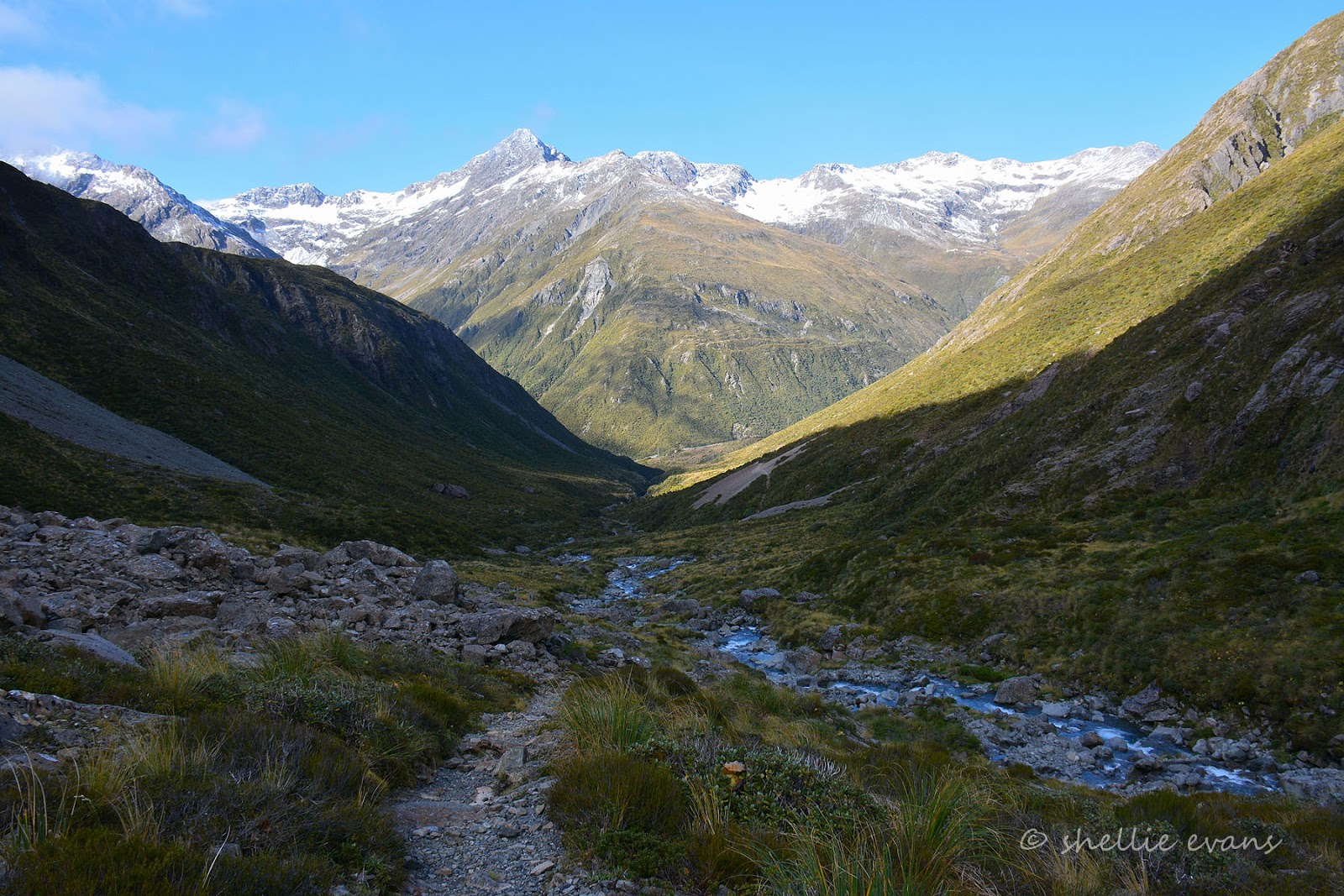
Looking back towards the carpark & road, we can see the Otira River which we've been following up the valley, once it reaches the road it turns west and heads down under the Otira Viaduct just around the corner.


It’s a steady and rocky climb up the valley, solid tramping boots with ankle support,and a walking pole are a major benefit when crossing some of the rocky streams that cascade down the mountainside and weave their way between boulders and rocks on their way to join the Otira River. We catch up to three fellow hikers who let us pass just before we cross Otira Slide a rather large rock slide that is part of the moraine.


It’s hard to give scale in the photos when there are no people but this one shows the angle of the track across the mountain side. We were lucky that DOC had recently cleared the summer growth from the track and it’s margins, it made it easier to walk.


Finally ahead of us we can see our target, the footbridge across the river. The Rock Wrens live in the area from just above the bridge to higher up towards the snow line at the top of the valley (or the Otira Face) which is about another hours walk further on.


I wait at the bridge for David to catch up, this last section before the bridge is very boggy and rocky with water seeping through to the river from all directions.


The bridge is bolted to the rocks and is most likely removed during winter due to the risk of an avalanche sweeping it away.


An unmarked route continues on from the footbridge and climbs rock scree and boulders to the head of the valley. This is recommended for experienced trampers only, there are a series of lightly marked poles and rock cairns to follow although for us there’s a well worn track after what has obviously been a busy summer.


We climb a little higher and find a suitable spot to have our lunch and rest behind a large boulder out of the cold wind. We can see, looking back down the valley, the three walkers we passed crossing the rock slide.


If you look up behind the walkers to the mountain across the highway you can see a few buildings. This is the Temple Basin skifield, a club skifield on Mt Temple, below are zoomed in photos of the buildings. Skiers access the skifield via a steep 45 minute walk from the highway. Most of the skiable areas are also accessed by hiking between the 3 rope tows.


I decide to carry on up the valley, leaving David to scan for the wrens in the rock gardens above the bridge. I have my notes from the bird forum and some members have found the wrens at least an hour further on. I’ll walk for another 30 minutes or so before turning around and taking my time coming back down. Stopping, watching and waiting every few metres. After crossing a large rocky scree, the route becomes more involved, climbing over and around the jumble of boulders as it tracks close to the river. On it's way down the valley, the river forms many deep cold blue pools and small rocky waterfalls.


Looking back down the valley, the footbridge is about centre, just below the sunny rock slide on the right (that’s the large one we crossed on our way up). You can see the path I’ve taken on the left as it crosses the scree.


It was here as I was admiring the scenery that I heard the faint but familiar ‘keeaa’ coming down the valley. It took me a while to spot the source of the noise, they really are just tiny dots in a vast landscape when flying. Four kea (mountain parrot) were flying high above me following the contours of the mountain side down towards the road.

I was surprised to see two of them land on a rock across the river from where I was. This was the juvenile and parent I mentioned in the previous post, the baby was begging and calling. Perhaps they had to stop here for a rest before continuing on. I didn’t see them leave, as I moved further on up but I did see (and hear) another bird approaching and managed to get a long distance shot of the beautiful colours under his wings.


I climb around a corner and above a larger waterfall to find I have the mountain to myself; no road, no power pylons. no wires & no people. The silence is deafening and the views around me are just spectacular.


I walk a little further on and find a place to sit and soak it all up (and scan for Rock Wren). Above me is the head of Otira Valley and even though it looks close it’s probably another 30 minutes climb to the snow line. Across the river,  a ribbon of water falls from high up Mt Rolleston. There’s a marker pole ahead of me and I decide that’s as far as I’ll climb. The sun is fast disappearing out of the valley floor and the air is cool and crisp.


I head back down, stopping every 20 metres or so to sit quietly on a rock carefully watching for any movement. I scan all the likely places the wren might be hiding, willing them to make an appearance. But nothing, it looks like the wren will remain on our ‘to see’ list. It’s not long before I catch sight of David, he’s climbed up the rocky wall behind the bridge and has found a boulder to stand on as he scans for the elusive little bird, he has no luck either.


In summer the valley, from here at about 1400 metres down to the carpark, would be full of flowering alpine plants including the Mt Cook Lily and Mountain Daisy. And perhaps the wren might be more obliging in the warmer weather.


I meet David back at the bridge, it’s now quite cold with the sun gone and the wind whistling down the valley so we make haste along the track and back to the ute.


A pity we didn’t find the wren once again but still, a great walk and spectacular scenery made up for some of the disappointment. Those elusive Rock Wren don’t have us beat just yet, we have the luxury of having time up our sleeve, we’ll be back this way again some time in the future.


May 26, 2015

Cheeky, Comical & Curious Kea- The Mountain Parrot

Kea are an endemic parrot found only in the South Island’s high country. They are the world’s only true alpine parrot and there are only an estimated 1000 to 5000 birds left in the wild. Kea nest on the ground and are highly vulnerable to introduced predators such as stoat and rats.


Kea are highly social, their loud cries of “keeaa” can be heard resounding around the bluffs and valley walls of their mountain home as they call to each other. Kea are renowned for their intelligent and inquisitive nature, however their endearing and mischievous behaviour can cause conflict with people.

You’ll remember this photo from one of my previous posts, this kea, Number 6, was keen to remove the towball cover from our ute. Kea have learnt that people and vehicles stop at the numerous carparks and lookouts along the Pass (and in other mountain areas), they fly in to check for things to play with and end up learning to beg for food because people feed them.

We found Number 6 a few days later at a different carpark. This time he was trying to suck up cracker crumbs that someone had left him. Not only is it illegal to feed kea (you can be fined $100,000), it’s also very bad for their health. They are omnivorous and human ‘junk food’ is not good for them, they can get addicted to sugar just like humans and they learn that they don't need to source food for themselves. This makes them vulnerable when there are limited visitors to the mountains and they have to fend for themselves. Kea come to play not to feed.


There were six kea at this particular carpark including Number 6, a juvenile and it's parent. Earlier in the day four birds flew overhead while I was walking high up the Otira Valley. Two carried on down towards the road,  the other two landed on a rock across the stream from me. I could see one of them crouched with it's wings outspread- begging and crying. After awhile they flew on down the valley, it was probably this parent & chick at the carpark.

This regal looking fellow is the parent, I’ve since learnt that it is the father- he has 3 toes(4 is the norm) and a fellow member of my bird forum was involved with banding the chick.


And this cutie is the juvenile, you can see his feathers haven’t turned the lovely glossy olive green that the adults have and he has yellow eyelids & ceres (soft fleshing swelling at the top of the bill), which fade to grey as the bird matures.


He is learning the tricks of the trade from the adults- sit on a rock and look endearing.


But he’s a bit unsure of himself when Dad flies off- ‘Dad, Dad….come quick, she’s getting a little too close for my liking’


Here he is begging his Dad and then when he’s ignored he follows the lead of Number 6 and tries to hoover up the cracker crumbs. He then receives a bit of reassurance from Dad and happy with that jumps across to another rock. Catching the scarlet underwings of Kea is every photographer’s goal but try as I might, this was the best shot I got of the under wing colours of a flying(jumping) bird, they are so quick. I love the colours just above the tail feathers, I hadn’t realised that the reds & orange colour showed here too.


Another one of Dad, showing off his fabulous patterned olive green and blue feathers.


This character landed on the roof of a van that pulled into the car park where he commenced….


….his warm up exercises, stretching his wing out to show me his colours……


…turning around and flexing his tail….


…lifting his leg and doing a wing over……


…before laying down and doing a full body stretch….


…and balancing act. And then, happy with his limbering up…..


...he roof surfed to the bottom of the hill! I couldn’t believe my eyes and I couldn’t stop laughing even though this is a highly dangerous activity for kea (just as it is for humans). Many birds are killed by vehicles because they become too familiar with them and don’t move out of the way.


Here’s the baby trying out the taste of rubber, I shooed him away twice as cars were backing up to leave- he could have easily been run over. And while he was underneath two other birds check out a visitor's bag.


I could have stayed watching and shooting all day, they are very obliging birds pausing for photos in amongst their hi-jinks. When they'd had enough they moved in under a low bush beside the rocks, when I looked underneath at one stage there were 4 birds roosting on the bare branches and a whole pile of rubber stoppers, pieces of wiper blades, drink bottle tops and other litter underneath them- toys stashed for a slow day on the circuit!


Number 6 had given up on the cracker dust and had moved onto the power pylon plinth where he set about pushing quite large rocks over the side. He’d manoeuvre the rocks to the edge and then give them one last shove leaning over to watch them land on the ground with a clatter. People would place them back on the top and he’s push them back over again.

Until he got fed up with that game and flew off across the valley. I missed a clear shot under the wings again.


Down at our DOC camp in the village, we were woken by loud screeching very early one morning. And it was just as well because we wouldn’t have been aware that a Kea gang had come to town to check out what we had to offer them. I caught two standing on the side of our shoe bin tossing things about before I shooed them away.

Another bird was having a good look at the underneath of the van and taking special note of a cable that hung low. Another couple were climbing into a car parked nearby, the camper had left her door open and she had groceries on the front seat (she had just released a mouse that had got caught in a bag, she’d heard it scratching about for most of the night, while she tried to sleep in the back). The kea were keen to pull a supermarket bag out the door.


This group of birds were different group to the ones we’d seen in the carpark, we saw these in the village during the late afternoons. One was walking down the centre of the road on one occasion and another bouncing across the lawn with a group of school kids who were on a camp in a lodge.

Kea remind me of monkeys as they jump and walk (waddle) across the ground, they only fly when they want to leave the area. Once they had finished checking our camp ground out they waddled off up to the top of the bank beside us and along the top to the trees at the end where they waited under the bushes for the rest of their mates. One bird, obviously Boss Bird, flew up to the sign board nearby and sat there waiting.

We saw this group of birds one last time at Klondyke Corner, a large open DOC camp ground located at the eastern end of the Pass. They were begging at a child's birthday party being held in the shelter, we watched as one ran after a wayward balloon until it popped on a briar bush and gave the kea a bit of a fright.

They certainly are very comical birds.