Showing posts with label Tapotupotu Bay. Show all posts

May 13, 2019

Te Paki Coastal Track- Cape Reinga

Catch-up

The Te Paki Coastal Track is a 48km rugged & scenic coastal track around the top of the North Island. The track leaves from Spirits Bay on the north eastern coast, passes through Tapotupotu Bay where we're camped, on around Cape Reinga, down along Te Werahi Beach, past Cape Maria van Dieman, along Twilight Beach and on to the giant sand dunes at Te Paki. And if you really want to make a walk of it you can continue on all the way to Ahipara at the south end of 90 Mile Beach.

There are several sections of the track that can be day walked, some are just a couple of hours, others are 9-10hrs and have entry points off the main highway. I decide to walk the 5km Tapotupotu Bay to Cape Reinga section but in reverse, getting David to drop me off at the Cape carpark so I can then walk back to camp from there. This proves to be fortuitous as in this direction I have two downhill sections and only one uphill!

The track starts twenty or so metres along the walkway to the lighthouse, it descends sharply off the manicured scoria track where visitors are leisurely strolling along. Some peer over the edge to see where I'm heading as I disappear out of sight. 


The track levels out for a short distance as it cuts around the edge of the bush-clad slope that finishes at the blue ocean far below. 


Once I round the bend the views along the coast are spectacular. From here it's straight down a small ridge, across another short shallow gully and then all the way down the next much longer ridge...


...the track & I, making a bee-line for a beautiful little bay tucked into the coastal cliffs ahead.


This is Sandy Bay, the bay I'd seen from the lookout up on the main highway a few days earlier.

From the lookout up on the main highway

And just in case you're thinking the track doesn't look that steep, this is looking back up towards Cape Reinga. It's probably about here that I'm patting myself on the back for deciding to walk in the direction I am.


Sandy Bay's shallow jade green waters look perfect for swimming, I'm sure many walkers have stopped to cool off here during the heat of summer. Uh-oh.... and I can also see the track rising sharply up the ridge on the otherside!


There are plenty of dramatic sea cliffs on the ocean side of the track...


...but all my attention is taken by the view down into Sandy Bay on the inside. What a stunning little cove.


The track narrows as it reaches the point and just as I take a photo I see a movement in my viewfinder. Another walker coming from the other direction has just popped up over the top of the point. He tells me he's walking there and back to the Cape from Tapotupotu Bay. I guess this the only option if you're by yourself and staying at the camp, it'll be at least a 6hr walk for him.


I reach the edge of the bay and clamber down a steep section of the track to the beach below.


While I'm taking photos, I get overtaken by a couple on a mission. They scare the living daylights out of me as I don't hear them approach and they don't say hello as they pass. They stride off towards the other side of the bay past a rocky area where it can be difficult to pass at high tide.


Once they reach the other side they cross the small stream and carry on around the beach towards the rocks and the overhanging pohutukawa trees where they settle down to have some lunch in the shade. I am sure they thought I was headed there too hence their hurry. I leave them to it and locate the entrance to the track, which isn't an easy as it sounds. There's no marker pole and others have worn a track up the edge of the stream either for a look or looking for the track start as well. 


I stop to take photos of the flax flowers along the edge of the track. Did you know that there are yellow, orange & red flax flowers? I've taken dozens of flax flower photos over the years and it has never registered that there were three colours until I was asked for a photo of a red flower for a study an organisation were doing on whether the colours were area specific. I never heard the outcome, I suppose with so many cultivars it would be hard to know which ones were natural. 


The views over Sandy Bay are just as spectacular as I climb higher...


...and higher. I'm also now racing ahead of a cloud bank I can see rolling in from the west.


The climb ahead is very steep, there are stairs some of the way and as much as I appreciate them, they make the climb twice as long as I have to do two steps for each one, as my stride isn't quite big enough to take them one at a time (although perhaps it's my legs complaining too much). 


There are several flights of stairs and as I zig-zag up the side of the hill, I stop often to take photos looking back over the bay.


The stairs give way to a narrow track that follows along the top of the cliff. I can now also see the Cape Reinga lighthouse on the far side and the track coming down the other ridge (click on the photo to enlarge).


It pays to keep alert and not look over the side if you have vertigo!


Finally I reach the top where the track heads off across a wide plateau through scrubby manuka and flax bushes. Across the water I can see the long white sandy beach of Spirits Bay, there's another DOC camp at the far left of the beach and that is also where the Te Paki Coastal Walk starts.


In the other direction I zoom in on a motorhome heading along the main highway to visit the Cape...


...and another one heading down into Tapotupotu Bay. 


Once through the scrub, the track opens up and turns towards the coast again and out to another point...


...above another beautiful bay; Tapotupotu Bay...


...with the DOC camp and home far below.


It's still a long way to the bottom and once again I am grateful I decided to walk in this direction. There would have been two very steep and long uphill sections coming the other way.


I'm walking along the edge of a cliff again and this time when I look over the side I see a flock of gannets playing follow the leader across the water far below.


The track follows the contours of the cliff edge all the way to a point just above the bay.


When I look back up the cliff I can see the couple who stopped for lunch have finally caught me up.


This time they don't give me a fright but they still pass me without saying hello. I call out hello to them instead and they answer with a wave & couple of grunts. It's a strange one that, I think foreign tourists do get a surprise at how friendly walkers are on our tracks, some do look at me in surprise when I say hello and they then offer a quick friendly response when they realise I'm talking to them. It's the Kiwi way afterall, isn't it? 


As the couple cross the sand I spot David walking along the beach towards me...


...he tells me I've been quicker than he thought, he was just going to climb up the track to meet me. Yeah right.


Footnote- I wonder who can guess what this blurry photo is of? Yes, I know, two piles of pebbles. But what do they represent? I took them out of my pockets at the end of the walk.


They're my new way of counting the flights of stairs, 11 flights up and 3 down this time. Remember my leaf numbers from the walk at Whangaruru where there were 45 flights up, I decided picking a pebble up at the top of each flight was quicker than making a number up each time out of leaf litter and then stopping to take a photo (hmm...I guess 45 pebbles would have weighed me down a bit though)


Zoom in at the top of the map & look for the green waypoints to track the walk.


April 22, 2019

Journey To The Top

Catch-up


We left Tokerau and the beautiful Karikari Peninsula heading north once again, north on our way to the very tip of the North Island. I'm sure every Kiwi has a pilgrimage to Cape Reinga on their 'must do once in a lifetime' bucket list. I know it's certainly on many overseas visitor's list going by the amount of tour buses, rental cars and campers we pass on the road.

The trip to the top for most people usually involves travelling part of the journey along 90 Mile Beach (which, despite the name, is only 55 miles long) but of course with the 5th-wheeler on the back this wasn't going to be an option for us. Although having experienced the beach and the access points later in our visit, we decided we could quite easily take the rig along the sand. We had a quiet chuckle imagining the looks on people's faces as we sailed by (literally if it was high tide!). 


We'd decided to drive to the top, stay in the DOC campground near Cape Reinga for a few days and then explore more slowly on our way back down the 100km long Aupouri Peninsula-the finger of land that forms the top of the North Island.

Of course this didn't mean we weren't able to stop along the way so I could add a few more church photos to my collection; the first one just outside Kaitaia; St Josephs Anglican Maori Church built in 1887.


The Seven Day Adventist Church at Te Kao has seen better days but I've included it here because I wanted to tell you a funny story about taking this photo. Well it is funny now, but at the time it wasn't, it was the most scariest thing I've experience on this journey of ours.

David had pulled up just off the road edge in front of a couple of rural houses. The church was on the other side of the road so I got out, crossed the road and took a few photos and then made my way back over the road and behind the rig to walk up to the front and my passenger door. As I walked around the back of the van this large barking, snarling, teeth bared mongrel of a dog burst out the open gate of one of the houses, charging straight for me.


I have never moved so fast in all my life, I took off down the side of the rig yelling for all I was worth and hoping David would see or hear me and do something, though I'm not sure what. As I reached my door I yanked it open but I was travelling too fast to leap inside so I kept running, pulling the door wide open and jumping behind it. I then shoved the door back & forward a few times like a shield, shouting and screaming at the dog.

By now a guy had also come charging out his gate shouting at the dog (which took not one bit of notice). David's looking at me through the gap in the door like, 'what the hell are you doing, crazy woman?', not having seen or heard anything until I wrenched the door open. Thank God the dog must have thought where did she go and stopped in his tracks and started sniffing around the rear tyre of the ute and then disappeared behind the ute and out onto the road. I leap into the ute and slammed the door and David quickly pulled out. I didn't look back but I can tell you the heart & adrenaline were pumping for many miles afterwards. Now instead of David calling out watch for traffic when I get out to take photos, he's taken to saying check for dogs too!


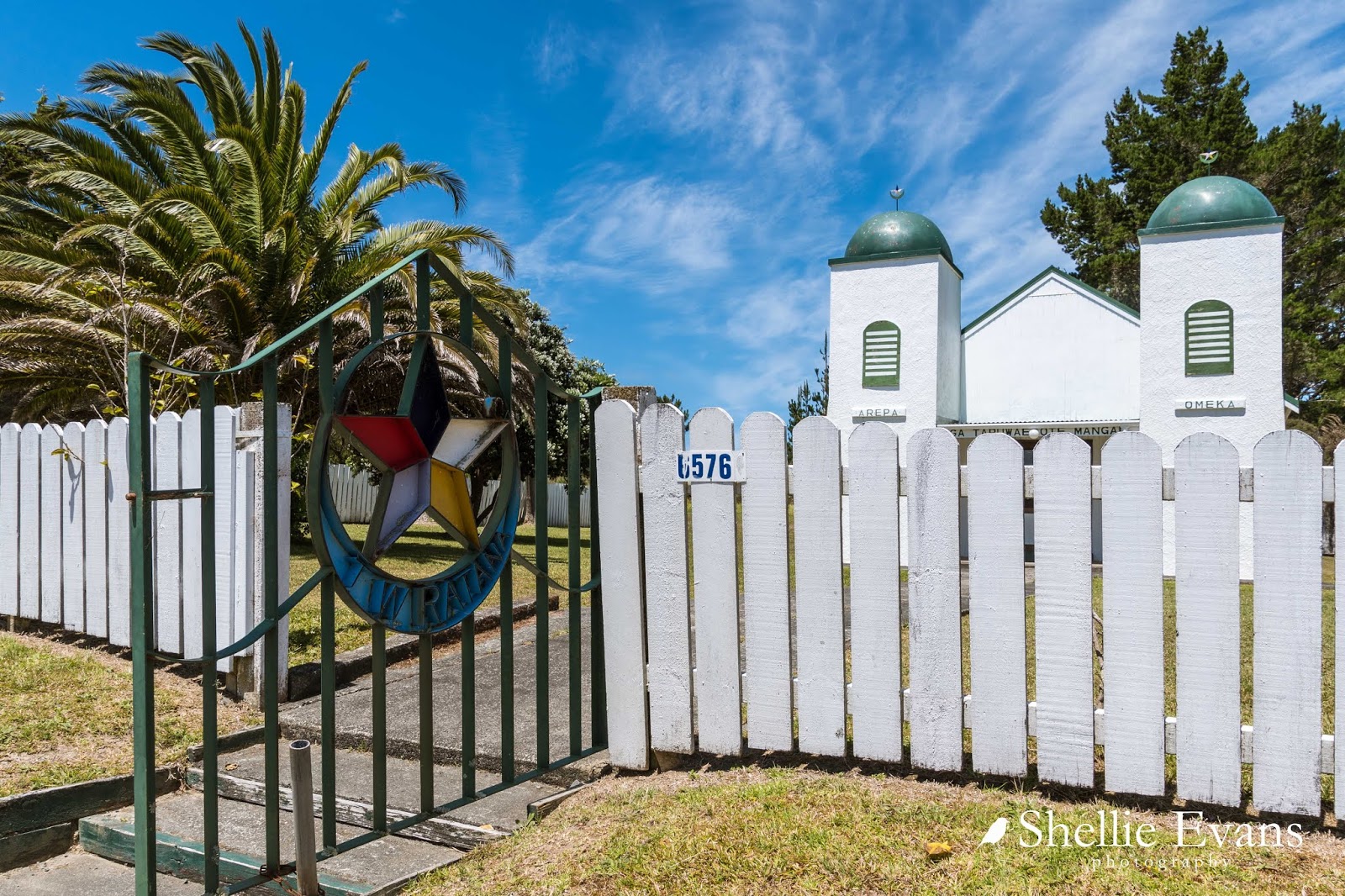
We stopped again just a couple of miles up the road when I saw one of my 'must have' churches ahead of us, the distinctive Ratana church at Te Kao. I've had this church on my list for a very long time and it was great to actually see it in the flesh. And this time I had a good look around before I opened the door.


Further on we had another exciting but much tamer encounter, an emu! An emu just walking along the fence line through a scrubby paddock beside the highway. Emu farming was a new enterprise back in the 1990s but difficulties in getting the birds slaughtered soon caused a decline in the industry. During that time some birds had escaped their fenced enclosures, others were kept as domestic pets and it has also been rumoured that some farmers released their birds to roam wild.

Sightings of random emus has been reported in many areas around Northland & the Far North and in fact this was my 3rd sighting of a bird. I'd seen one near Kawakawa and another near Tauranga Bay and although they didn't look fenced in, I couldn't be sure as it was a fleeting glance as we drove past. This one though was the closest I'd seen and in an area where it could wander at large so it definitely wasn't a captive bird.


As we drew closer to the top of  peninsula, the landscape opened up; big skies, rolling farmland intermingled with swathes of native scrub and bush, dune lakes, wetland swamps and out on the edges huge golden sand dunes. 


Five kilometres before we reach the top we turned right down a narrow dusty gravel road...


....that drops down through the manuka scrub into Tapotupotu Bay and the DOC campsite we'll be staying at for the next few days.


At the bottom we're greeted by small sandy bay and a lovely golden sand beach tucked in between two headlands...


...and two camping areas- I call them corrals- one for campervans and the other for tents.


I can understand the tent corral, this DOC Camp is on the 48km Te Paki Coastal Walk and at the start of the 3000km Te Araroa Trail so tenters need some space of their own...


...but I have no idea why the powers that be would want to corral all the campervans & motorhomes together because...


...carry on around the corner and there is a huge amount of open space to camp, right on the edge of the estuary.


Which is where we set up...


...and two or three other clever clogs! I thought it was Kiwis that followed along like sheep. In fact I think it's because foreign tourists are sometimes unsure of what to do and where to go and don't want to do anything wrong so follow the leader.


There was plenty to see parked on the side of the estuary, the tide range was so great we were able to watch the lagoon fill and empty with each tide, bird watch out the back window and watch boaties come and go...


...including this group of guys who had a lot of fishing gear set up on their jet skis. In fact they were doing some filming for a TV programme one guy told David as his drone whizzed about around the estuary.


We saw them later in the afternoon when we visit Cape Reinga, far out at sea. We watched them skirt around the outside of the islands off Cape van Diemen and then pass around Cape Reinga as they headed back to Tapotupotu Bay, again way out so as to miss the turbulent waters below us where the Tasman Sea meets the Pacific Ocean. You can see to tiny splashes of white, centre right in the first photo, they were just tiny dots and we would have missed them had we not known they were out there.


The camp, estuary, stream and mangrove margins were ideal for bird watching- here are a few of the usual suspects; clockwise- A Eurasian Skylark, an epic struggle between a male Sparrow & a Grasshopper, not a bird but just about as big, a Giant Bush Dragonfly, a female Ring-necked Pheasant, a Black Shag and a Welcome Swallow.


This rather plain but dainty little lily was flowering along the edges of the tracks, and through all the thick grasses, it's not a native and I've not seen it before. 


I was up early every morning to search out two specific and very secretive birds. The sunrises weren't quite as spectacular as I had been capturing but still lovely as the suited the subdued surroundings.


I had managed to spot two Banded Rail/Mioweka from the kitchen window, they were across a wide expanse of exposed sand feeding amongst the mangrove air roots along the edge of the stream that fed out to sea at low tide.


They were very quick to disappear into the mangroves and tussock behind at the slightest movement from our side of the estuary though.

Click photo to enlarge- two Banded Rail centre
I did manage to sneak up on them once but only took a fleeting photo as one of them flashed past. I didn't mind though. After my very first sighting and taking a couple of good photos at Whangaparoa's Shakespear Park, then another sighting at Sandspit, this was my third sighting up north so I was just pleased to see them once again.


I knew there were Fernbirds/Matata about when I heard their distinctive clicking calls as I was walking along the boardwalk and over the bridge near our campsite. 


Often heard but rarely seen, Fernbirds aren't quite as shy as the Banded Rail but they are just about as impossible to find because they move fast, skulking through the dense vegetation at ground level and seldom poking their head out of the greenery. 

'You looking for me?'
But they are nosy and if you sit quietly in the middle of their territory watching for the slightest of movements in the reeds or thick scrub around you they'll often poke their head out or jump on to an open branch nearby to check you out. But as quick as a flash they'll be gone again. 

If they have a mate nearby or feel threatened they can also call briefly from the top of a nearby bush, but they'll disappear just as quickly to appear again not much further on, atop the next bush. 


We explored along the boardwalk and track (part of the Te Paki Coastal Walk) up into the bush over the hill on the other side of the estuary a short distance...


...and then along a 4WD track that followed the Tapotupotu Stream deeper into the valley behind the camp. It would be great kayaking quietly up this backwater, we flushed a number of different birds but the dense undergrowth made it hard to spot them.


Each day, as the tide went out I also watched from the window a pair of beautiful steely grey Reef Herons/Matuku Moana stalking prey along the receding waterline. They were very wary too and I only got a little closer to them by putting a bush between them and me and then quietly sneaking up on them using the bush as cover.


Looking like stealth bombers, with wings flattened out to keep their profile low and to help them see fish in the shadow, they carefully paced up and down the water's edge...


...until they spotted a hapless fish which, with lightening fast speed, they caught and swallowed.


Even though I suspect the reef herons were a pair, one of them did not like the other to be within sight and they both did not like the local White-faced Heron/Matuku feeding or flying by either. The dominant Reef Heron spent a lot of his time chasing the other one away and they both chased any nearby gulls and the White-faced Heron away. He just flew up to his favourite tree stump and laughed at them.