Showing posts with label open day. Show all posts

Sunday, November 27

Gibbs Sculpture Farm

And the final blog from out Northland travels. Click on the photos to enlarge. 

You'll recall I was offered a free ticket to an open day at Gibbs Sculpture Farm by our neighbours at the Muriwai Holiday Park. They'd bought tickets for two days just in case the weather wasn't great on the first day. 

Gibbs Farm, Kaipara Harbour
They headed off on a lovely sunny day, the next day- my day- wasn't so good; overcast, grey & threatening rain but I hardly noticed. I was out the door early & one of first in the car queue through into a top paddock carpark (no surprises there). 

Rakaia 1996/1997. Peter Nicholls
Gibbs Farm is an expansive open-air sculpture park on the edge of the Kaipara Harbour, north of Auckland. It has the greatest collection of large-scale outdoor sculptures in the country with works by some of the world's most renowned artists. The sculpture park took 24 years to create & employs over 28 people.

‘Horizons’ (1994), Neil Dawson
I once heard Neil Dawson, the artist of  Horizons talking about his work. He said it like a curved piece of corrugated iron, from an old farm tank, that has sprung loose and blown in the wind to settle on the hilltop. And it sure looked like that. Added to the surreal scene, yaks & rare breeds of horned sheep grazed on the slopes below the sculpture.  Dawson is also famous for The Chalice in Cathedral Square, Christchurch.


‘Te Tuhirangi Contour’ (1999-2001), Richard Serra

Gibbs Farm, Kaipara Harbour
The park is only open to the public a few days each year and the owner Alan Gibbs (entrepreneur, businessman & art collector) generously allows local charities to run the open days & fundraise selling tickets.

Red Cloud Confrontation in Landscape 1996. Leon van den Eijkel

Pyramid (Keystone NZ) 1997. Sol
It was great to get there early to take photos before there were too many people swarming in, around & over some of the more popular sculptures. Although a few hundred people soon disappear in the landscape.
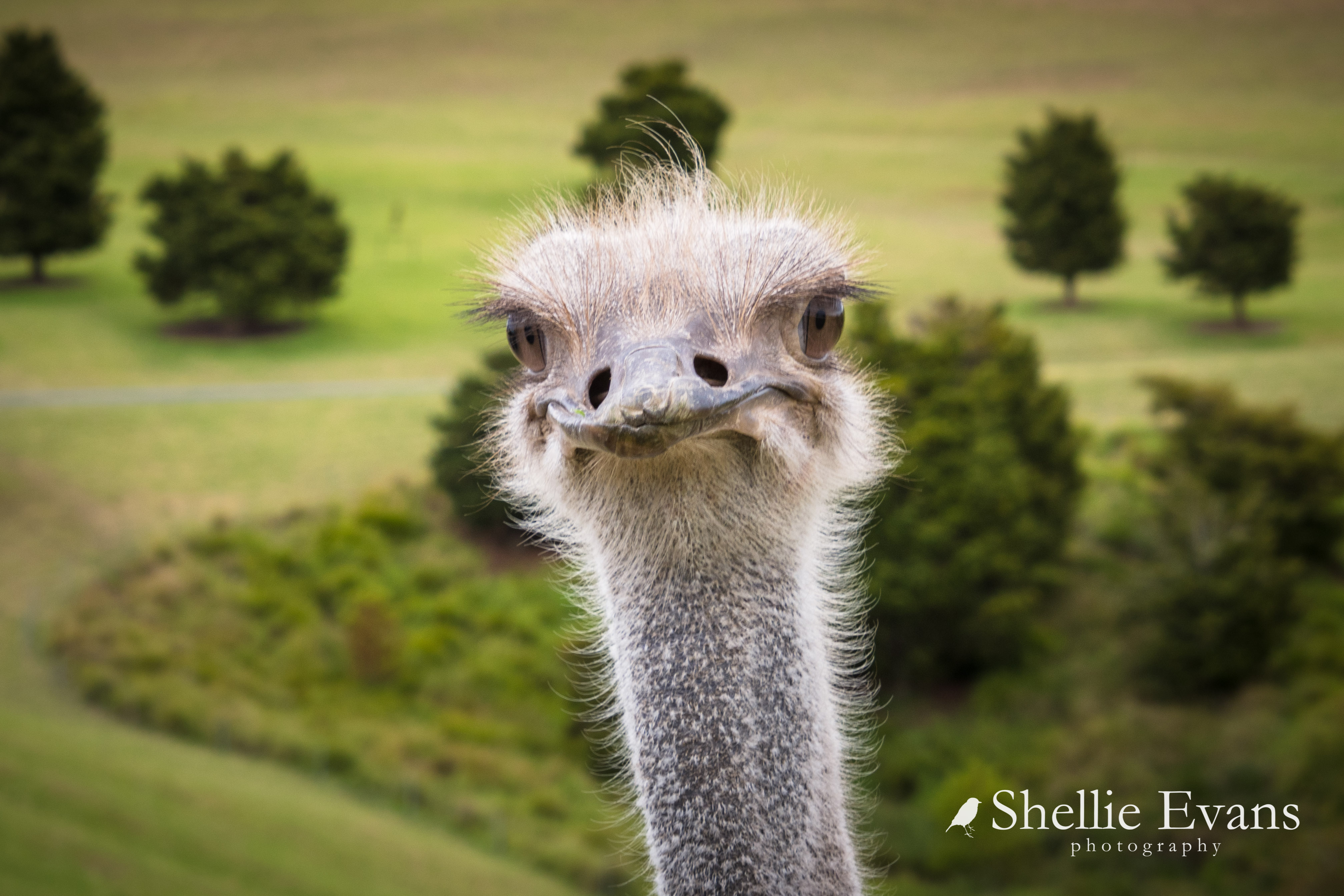
Tickets Please- Otis the Ostrich 2019 (I named him)
By far the most popular exhibit, going by the strung out rows of tiny ant like people making a beeline for it, was 'Dismemberment', looking like a gigantic red megaphone high up on a hill.

‘Dismemberment, Site 1’ (2009). Anish Kapoor.
The farm covers over 400 hectares of rolling hills & a good level of fitness and sturdy footwear are required if you want to get up close & personal with the sculptures.

‘Dismemberment, Site 1’ (2009), Anish Kapoor.
I wonder how many people noticed the art work 'Green & White Fence (1999-2001), Daniel Buren', it contains fence posts painted, well, green & white, & placed at 4 metre intervals and is 3.2km long. I found it pretty hard capturing the whole sculpture but you can see it in the two photos below! 😁

At the top of the hill- Sea/Sky Kaipara (1994) Graham Bennett


Sculptures are located high on hilltops, down on slopes, tucked into gullies and in paddocks beside the harbour. 

A Fold in the Field (2013) Maya Lin (yes, it's those mounds in the paddock)
There is no public entry to this part of the farm but it looks like there's a fair bit going on down there. I wonder if that is where the private full-scale wild west farm complete with saloon is located. Although it looks more like a island resort to me. Someone will know.

And there's that fence again.


It is a large farm and it takes at least four hours to follow the sculpture trail.

‘88.5° ARC x 8’ (2012), Bernar Venet
There are even a few sculptures located out on the Kaipara harbour mudflats that can be viewed from a few locations along the walk- I didn't manage to see any. 

Gibbs Farm, Kaipara Harbour

‘Te Tuhirangi Contour’ (1999-2001), Richard Serra.
The farm also includes quite a surprising number of exotic animals such as zebra, bison, buffalo, yaks, giraffe & an assortment of rare & unusual breeds of cattle, sheep & goats.

Buffalo- Mumma & her son
One of us is not like the other- Jeff the Giraffe gets a lick from the Gibbs Farm dominant real life male giraffe (salt forms on the sculpture from the salt laden Kaipara Harbour air). There are 3 male giraffes, they are big animals and very tall, it's just that Jeff is much taller!

Giraffe (2011-2012), Jeff Thomson
The giraffe are the only remaining Rothschild giraffe in New Zealand and Gibbs Farm is a registered zoo with suitably qualified staff taking care of all the animals.

I'm sure the animals hate open days- they are contained in smaller paddocks & yards
The ponds have fish in them and various types of waterfowl congregating lakeside. 

Easy K (2005) Kenneth Snelson & Red Square (1994), Richard Thompson
I had a fantastic time exploring the farm, visiting most of the sculptures and saying hello to some of the more friendly animals...
Umbrella Ostrich 2019
Towards the end I wanted to reverse my route & revisit some of the sculptures again, see them in a different light, capture them at a different angle but sadly time was up and groups of tired, bedraggled people dragging their feet (it had rained on & off), slowly made their way back up the hill to the top carpark. Those that were in the bottom carpark had already climbed to the top in the morning. 

‘Dismemberment, Site 1’ (2009). Anish Kapoor.
If you ever get the chance I'd highly recommend a visit to Gibbs Farm. The farm & artworks might be privately owned by a very wealthy businessman but he very generously shares this magnificent landscape with visitors through the open days. You won't be disappointed. 

And a huge thankyou to the lovely visiting Dutch couple who gave me one of their tickets, it was very much appreciated & enjoyed. 

‘Dismemberment, Site 1’ (2009). Anish Kapoor.

‘Jacob’s Ladder’ (2017), Gerry Judah.

Floating Island of Immortals (2006), Zhan Wang

What do you think? Did I managed to capture 3.2km of THAT fence?

‘88.5° ARC x 8’ (2012), Bernar Venet


Friday, April 24

A Riot of Colour- Fields of Tulips, Southland

Catch-up (October 28, 2019)

From Cromwell we headed back to Southland to look after our Winton family's house and cat while they were away for a couple of weeks. I was very pleased to find out that our visit coincided with an event that has been on my bucket list for a very long time.


On just one day a year- Labour Day- Triflor NZ Ltd, an Edendale tulip bulb exporter opens up one of their large paddocks for the public to visit and view an amazing display of flowers. The flowers aren't for picking though, they will cut and mulched and the bulbs will then be harvested soon after the open day.


It's 54km from Winton to Edendale and as I wanted to be there when the gates opened at 10am, I was up and ready to go well ahead of time.  I zig-zagged my way across Southland and was delighted to find several paddocks of colourful tulips along the back roads, about 20 kilometres before Edendale. I was ahead of schedule and had time to stop and photograph them as well.


There was plenty of parking at Triflor headquarters but it was filling fast when I arrived just before 10am. The event is used a fundraiser for the Edendale Presbyterian Church, Edendale Scouts and Wyndham Lions Club; there was a small market in progress inside one of the sheds and a queue forming for the guided tours (gold coin donation). 


Several small passenger vans took visitors on a tiki-tour around the local area; along country roads and down farm tracks and past many of the tulip fields that can't be seen from the road. Dairy cows, looking a little out of place beside the mass plantings of vibrantly coloured tulips, watched curiously from the other side of fences as the procession of vehicles passed by.


Five companies lease or own 350ha in Southland, growing and exporting 175 million tulip bulbs every season. Trifor, the largest company, have 100ha and exports around 55 million bulbs each year. Several companies lease land from local dairy farmers or swap land use with them as the bulbs need to be grown on rotation every 7-8 years. 


About 80% of the bulbs are exported the United States and the rest to Holland, Norway, Finland and Russia. Southland has excellent soils, good rainfall and cool weather which are all required to grow high quality tulips bulbs. 


The bulbs are harvested during January & February and sent to the northern hemisphere where they are raised in hot houses and timed to bloom during the northern winter when flower prices are higher.


Visitors to the open day aren't allowed to pick the flowers and they also need to stay near the beginning of the rows so the bulbs aren't damaged.  When queried as to why the flowers weren't picked for sale to the flower industry in NZ or exported, the grower answered 'Who wants 170 million tulip blooms?' and "When did your partner last buy you a dozen tulips?' 

The rows of blooms are inspected for imperfections and odd colours and those bulbs removed before harvest.


Although some unusual ones may make the grade. The 'cauliflower' looking tulip in the centre of the mosaic below was one such bulb a few years ago. It's protege have been painstakingly cultivated each season and now there are several short rows of the plant. 


It wasn't a surprise to see that not many people were stopping to admire it though. The brilliant colours of all the others by far and away overshadowed the muted tones and odd shape of this quirk of nature.


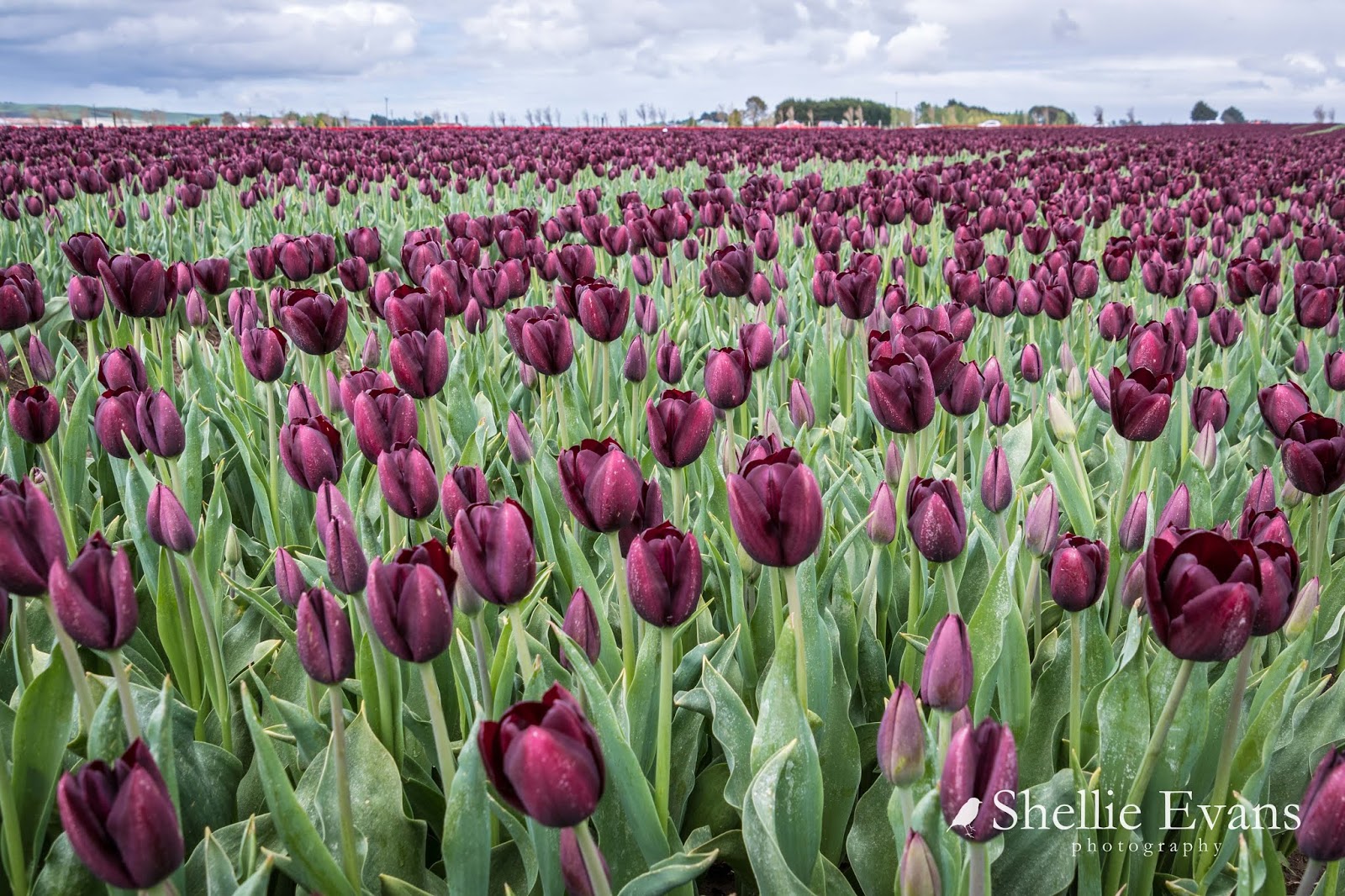
It was hard to choose a favourite colour, they were all stunning but I loved the deep wine colour of these ones. I imagine that they would be a very popular colour for bridal bouquets.


How to stand out in a crowd.


And talking about crowds, dozens of people had arrived at the sheds by the time our tour van arrived back at the display paddock, the large carpark was full and many vehicles now lined the narrow country roads outside the farm. Over a 1000 people visited the farm this year, the largest crowd ever.


Inside the shed the queue for the tours snaked back and forward across the floor and a lot of visitors had opted to walk straight down to the tulip paddock. And in fact, as a photographer, I would do this next time. The tour was good but there were no photo opportunities and it was over an hour before we came back to the display. 


There was still plenty of room for me to take photos in amongst the visitors taking their ultimate selfies or photos of their children dressed in their Sunday best.


There are many migrant families working on dairy farms in Southland & Otago and I know that bright colours and beautiful flowers are a feature in their cultures. I'm sure many photos of treasured grandchildren were sent to families overseas that night.

A Riot of Colour
If you haven't already, click on a photo to enlarge it and then use your direction arrows to scroll back & forward through the photos, the colours are just spectacular (or perhaps it's just me, but I can't get enough of looking at this amazing sight).


Of course I photographed each and every row and from several different angles until I finally reached the far side of the field and when I turned to head back to the sheds, there was still a mass of people arriving.


Further to the south the weather looked to be about to take a turn for the worse and I wanted to check out a couple of the paddocks we'd seen on our tour earlier in the day. Our driver had pointed out side roads where there were tulips that could be seen from the road.


This sea of pink took my breath away, what a fabulous colour (and possibly my new favourite) and as you can see I couldn't get enough of them. Anyone want 50 photos of pink tulips?


But I lingered a little too long at the pink tulip parade and when I next looked up I could see the weather front was just about on top of me. There was one more field (actually two) that I wanted to see before I headed home, this one of white tulips when the rain started to fall...


...and one back near the main road where the heavens opened up and all hell broke loose. I managed to grab a few shots but not before getting a total drenching in the heavy downpour. 

Afterwards as I passed Triflors on my way home, dozens of people were still arriving, walking along the road in their finery and without umbrellas or wet weather gear. Others were struggling back to their cars, some parked over a kilometre away, looking like drowned rats. It was such a shame the day ended liked that but I was so pleased I arrived early.


Several days later I was back in the area and thought I'd look in on the tulip fields (as you do) that I hadn't had the time to check out when it was raining.


These reds and oranges were very vibrant, it was just a pity I could only stand at the side of the road to take photos. Given half the chance I'd have been in their amongst it again.


I also stopped at the Triflors display tulip field, this time at the other end to where we'd all been just days earlier. A dairy herd was slowly wandering back to their paddock after milking, along the track we'd been on the other day. Even though I knew what the outcome was going to be it was still quite sad to see that the de-heading machine had been through and most of rows of glorious coloured tulips had been unceremoniously chopped!


Petals & broken blooms lay in the furrows between the plants. It was such a sorry sight to see after such beauty but at least they had had their one day of glory.