Showing posts with label pink. Show all posts

Friday, April 24

A Riot of Colour- Fields of Tulips, Southland

Catch-up (October 28, 2019)

From Cromwell we headed back to Southland to look after our Winton family's house and cat while they were away for a couple of weeks. I was very pleased to find out that our visit coincided with an event that has been on my bucket list for a very long time.


On just one day a year- Labour Day- Triflor NZ Ltd, an Edendale tulip bulb exporter opens up one of their large paddocks for the public to visit and view an amazing display of flowers. The flowers aren't for picking though, they will cut and mulched and the bulbs will then be harvested soon after the open day.


It's 54km from Winton to Edendale and as I wanted to be there when the gates opened at 10am, I was up and ready to go well ahead of time.  I zig-zagged my way across Southland and was delighted to find several paddocks of colourful tulips along the back roads, about 20 kilometres before Edendale. I was ahead of schedule and had time to stop and photograph them as well.


There was plenty of parking at Triflor headquarters but it was filling fast when I arrived just before 10am. The event is used a fundraiser for the Edendale Presbyterian Church, Edendale Scouts and Wyndham Lions Club; there was a small market in progress inside one of the sheds and a queue forming for the guided tours (gold coin donation). 


Several small passenger vans took visitors on a tiki-tour around the local area; along country roads and down farm tracks and past many of the tulip fields that can't be seen from the road. Dairy cows, looking a little out of place beside the mass plantings of vibrantly coloured tulips, watched curiously from the other side of fences as the procession of vehicles passed by.


Five companies lease or own 350ha in Southland, growing and exporting 175 million tulip bulbs every season. Trifor, the largest company, have 100ha and exports around 55 million bulbs each year. Several companies lease land from local dairy farmers or swap land use with them as the bulbs need to be grown on rotation every 7-8 years. 


About 80% of the bulbs are exported the United States and the rest to Holland, Norway, Finland and Russia. Southland has excellent soils, good rainfall and cool weather which are all required to grow high quality tulips bulbs. 


The bulbs are harvested during January & February and sent to the northern hemisphere where they are raised in hot houses and timed to bloom during the northern winter when flower prices are higher.


Visitors to the open day aren't allowed to pick the flowers and they also need to stay near the beginning of the rows so the bulbs aren't damaged.  When queried as to why the flowers weren't picked for sale to the flower industry in NZ or exported, the grower answered 'Who wants 170 million tulip blooms?' and "When did your partner last buy you a dozen tulips?' 

The rows of blooms are inspected for imperfections and odd colours and those bulbs removed before harvest.


Although some unusual ones may make the grade. The 'cauliflower' looking tulip in the centre of the mosaic below was one such bulb a few years ago. It's protege have been painstakingly cultivated each season and now there are several short rows of the plant. 


It wasn't a surprise to see that not many people were stopping to admire it though. The brilliant colours of all the others by far and away overshadowed the muted tones and odd shape of this quirk of nature.


It was hard to choose a favourite colour, they were all stunning but I loved the deep wine colour of these ones. I imagine that they would be a very popular colour for bridal bouquets.

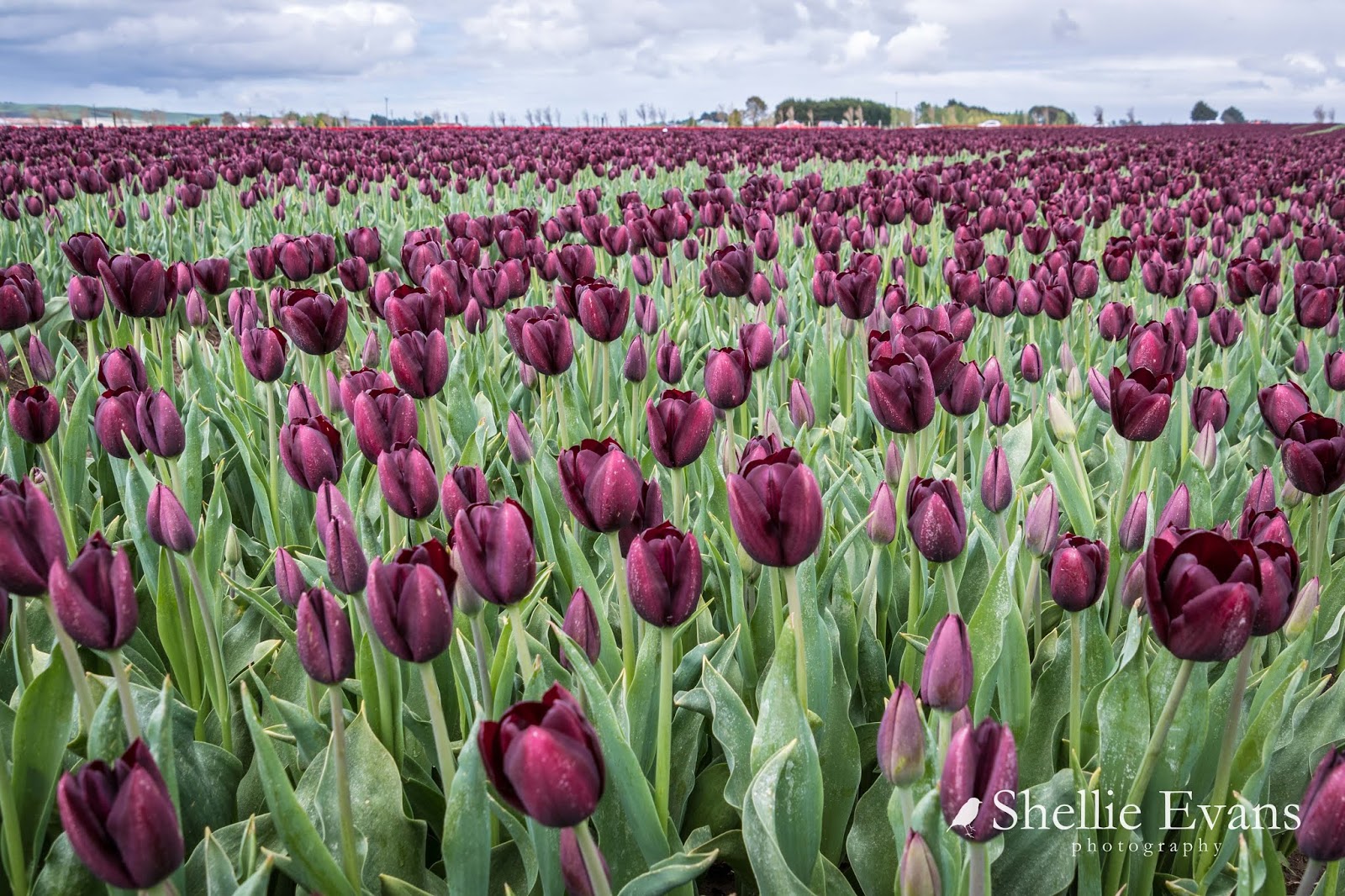

How to stand out in a crowd.


And talking about crowds, dozens of people had arrived at the sheds by the time our tour van arrived back at the display paddock, the large carpark was full and many vehicles now lined the narrow country roads outside the farm. Over a 1000 people visited the farm this year, the largest crowd ever.


Inside the shed the queue for the tours snaked back and forward across the floor and a lot of visitors had opted to walk straight down to the tulip paddock. And in fact, as a photographer, I would do this next time. The tour was good but there were no photo opportunities and it was over an hour before we came back to the display. 


There was still plenty of room for me to take photos in amongst the visitors taking their ultimate selfies or photos of their children dressed in their Sunday best.


There are many migrant families working on dairy farms in Southland & Otago and I know that bright colours and beautiful flowers are a feature in their cultures. I'm sure many photos of treasured grandchildren were sent to families overseas that night.

A Riot of Colour
If you haven't already, click on a photo to enlarge it and then use your direction arrows to scroll back & forward through the photos, the colours are just spectacular (or perhaps it's just me, but I can't get enough of looking at this amazing sight).


Of course I photographed each and every row and from several different angles until I finally reached the far side of the field and when I turned to head back to the sheds, there was still a mass of people arriving.


Further to the south the weather looked to be about to take a turn for the worse and I wanted to check out a couple of the paddocks we'd seen on our tour earlier in the day. Our driver had pointed out side roads where there were tulips that could be seen from the road.


This sea of pink took my breath away, what a fabulous colour (and possibly my new favourite) and as you can see I couldn't get enough of them. Anyone want 50 photos of pink tulips?


But I lingered a little too long at the pink tulip parade and when I next looked up I could see the weather front was just about on top of me. There was one more field (actually two) that I wanted to see before I headed home, this one of white tulips when the rain started to fall...


...and one back near the main road where the heavens opened up and all hell broke loose. I managed to grab a few shots but not before getting a total drenching in the heavy downpour. 

Afterwards as I passed Triflors on my way home, dozens of people were still arriving, walking along the road in their finery and without umbrellas or wet weather gear. Others were struggling back to their cars, some parked over a kilometre away, looking like drowned rats. It was such a shame the day ended liked that but I was so pleased I arrived early.


Several days later I was back in the area and thought I'd look in on the tulip fields (as you do) that I hadn't had the time to check out when it was raining.


These reds and oranges were very vibrant, it was just a pity I could only stand at the side of the road to take photos. Given half the chance I'd have been in their amongst it again.


I also stopped at the Triflors display tulip field, this time at the other end to where we'd all been just days earlier. A dairy herd was slowly wandering back to their paddock after milking, along the track we'd been on the other day. Even though I knew what the outcome was going to be it was still quite sad to see that the de-heading machine had been through and most of rows of glorious coloured tulips had been unceremoniously chopped!


Petals & broken blooms lay in the furrows between the plants. It was such a sorry sight to see after such beauty but at least they had had their one day of glory.


Sunday, November 24

Pink Ponds & the Salt Shaker

We didn’t move too far south after leaving Blenheim, just 45 kms down the road and passing through the fast expanding vineyards of the Awatere Valley on the way. No matter which direction  you looked on the road out of Blenheim it is evident that grapes are providing the Marlborough district with a very profitable income, there are many grand wineries & homes along the way. We will no doubt spend a bit more time in the area checking the wineries, their cellar doors & restaurants out when we are back this way later in the year.


In the end we had three nights at the Blenheim’s Top10 Holiday Park, each morning deciding to stay one more night. We’ve met quite a few people who spend time on the road & sing the virtues of  freedom camping; about the minimal costs associated with it, the excitement of finding the next overnight “spot” etc, and even though our membership with the NZMCA gives us access to hundreds of “park over properties” & “low cost parking” options we fully intend to take regular advantage of the many camping grounds & holiday parks dotted around New Zealand. Aside from the fact that many are in great locations with superb grounds & facilities we want to be able to hook up to the power, access the internet, have a shower without keeping track of our water use, do the laundry, wash the ute & do other chores, or even to just chill for a couple of days. We’ve a long time on the road ahead of us & this will also give us more of a balance in our new lifestyle.

There are a few places along the way, on this journey south to Invercargill, that I have earmarked for a visit. We will be back this way in time but possibly in a different season & some of the phenomenon’s only happen at certain times of the year & the rather alien looking salt flats at Lake Grassmere is one of them. This is where the bulk of NZ’s salt comes from, last summer over 88,000 tonnes of salt was harvested. The seawater is pumped into deep holding pens & then into the shallow crystallisation ponds & allowed to evaporate leaving great expanses of salt behind to be gathered & processed. At the end of the lake are the gorgeous coloured crystallisation ponds, the colour is caused by green algae bloom that changes to pink in the high salt concentration and the colour is usually very intense in spring & early summer.


Initially after stopping on the main highway I could see that I couldn’t get up close to the ponds from the road and while you could see the terraces of pink, I wanted to get right up beside them. So this morning I parked up beside the main rail line and walked down the rail line and over a bridge to the ponds. Being a Sunday there was no one around and I managed to shoot quite a few photos. Quite a few, now that’s an understatement if ever I heard one. Way, way too many to process. I keep saying it, I just need to learn to shoot less otherwise I’m going to be spending an awful lot of time indoors! But the setting was fantastic and the ponds really quite fascinating and one click lead to another and another and……….you get the picture. Well actually you get a few! You don't think I'm going to go to all that effort & let you get away with just a couple do you? :)


Beside Lake Grassmere and overlooking Clifford Bay are Marfells Beach & the DOC campground which is where we are now staying. There’s something about the seaside that gets your senses singing & it’s been a few months now since we’ve heard the waves crashing just below our bedroom window & smelt the sea in the air (I don’t count Mt Maunganui in this as we were set back off the beach a little & the waves you could only hear during the storm(s) or in the small hours after the city noise had died down). This place reminds us of Port Jackson, way up there at the top of the Coromandel. Beautiful curved crescent of white sand & blue water & nobody about (well nearly).


At the approach of low tide a steady convoy of wet-suited people on noisy quad bikes made their way past our campsite along the beach and under the white limestone bluffs of Clifford Bay & around the point and further on. We walked to the point, aptly named Mussel Point as it turns out, & that was as far as my feet would take me which was just as well as we would have missed this spectacular view of the Cape Campbell Lighthouse. 


The bikes and their occupants disappeared into the haze heading for the reef just off the cape where by the look of their bins and bags on their return they got enough paua (NZ abalone) & crayfish(lobster) to feed themselves & an army. David failed to work his charm this time, the people he did speak too were quite secretive & wary of giving too much information away. I would think that poaching is very much alive & well in all parts of NZ.

The foreign couple in a van staying next door to us walked to the lighthouse and were rewarded with two large paua by one of the divers. They weren’t too sure what to do with them so I gave them some tips & when I next looked out they were beating the hell out of the poor things. Later one of them said to me, we didn’t know when to stop, the centre is still tough! They sliced it thinly & stir-fried it quickly in butter & were quite impressed that it didn’t taste like leather.

At the point we were also rewarded. As the tide dropped away the exposed rocks revealed a bounty of huge green lip mussels which David gathered and we had for dinner cooked using my “world famous in NZ” recipe. We passed some onto the couple to have with their paua; I think they were more impressed with the broth that came with them (garlic, ginger, sweet chilli, lemon zest, spring onions & wine) which they added the paua too as well.

                                                                                                              "Just don't collect any mussels on the left there David"
David found this swarm of flies that were settled in a shady recess in the rock, the weren't your usual flies as you can see from the close up. We wondered what they are doing and why they're doing it there, when we disturbed them they stirred and flew in a big mass only to resettle when we moved back. I need to Google or ask my bug man photographer friend or perhaps some one out there can solve the mystery.... ETA- mystery solved by my Dad, they are Brine Flies, they live most of their life under water hatching out when the water warms in early summer but only lasting a few days as flies, just long enough to mate & lay eggs on the water surface. I guess the saltiness of lake Grassmere is an ideal habitat for them.


There are some beautiful rock formations at the base of the limestone cliffs on the way around the bay.

The tracks are from the quad bikes

We could also see some of the scars from the recent earthquake. On August 16th this year (it’s now Nov 24th) a magnitude 6.6 earthquake struck the region with the epicentre being directly under Lake Grassmere, several severe aftershocks struck during the next few hours. There was major damage in and around Seddon and out here at Marfells Beach where some of the limestone cliffs collapsed. The campground was closed as the only road into it was blocked by slips and cracks opening in the road. The quake was also one of the strongest to hit Wellington city, directly across Cook Strait from here, in recent time & shut the city down for a couple of days. 

The road in the middle was tarseal before the quake & is the last tight bend before reaching the beach & the campground.


And to celebrate this, my 100th blog post I'm going to leave you with some fluffy ducklings that were in the stream beside the Top10 campground back in Blenheim.