Showing posts with label yellow. Show all posts

Friday, April 24

A Riot of Colour- Fields of Tulips, Southland

Catch-up (October 28, 2019)

From Cromwell we headed back to Southland to look after our Winton family's house and cat while they were away for a couple of weeks. I was very pleased to find out that our visit coincided with an event that has been on my bucket list for a very long time.


On just one day a year- Labour Day- Triflor NZ Ltd, an Edendale tulip bulb exporter opens up one of their large paddocks for the public to visit and view an amazing display of flowers. The flowers aren't for picking though, they will cut and mulched and the bulbs will then be harvested soon after the open day.


It's 54km from Winton to Edendale and as I wanted to be there when the gates opened at 10am, I was up and ready to go well ahead of time.  I zig-zagged my way across Southland and was delighted to find several paddocks of colourful tulips along the back roads, about 20 kilometres before Edendale. I was ahead of schedule and had time to stop and photograph them as well.


There was plenty of parking at Triflor headquarters but it was filling fast when I arrived just before 10am. The event is used a fundraiser for the Edendale Presbyterian Church, Edendale Scouts and Wyndham Lions Club; there was a small market in progress inside one of the sheds and a queue forming for the guided tours (gold coin donation). 


Several small passenger vans took visitors on a tiki-tour around the local area; along country roads and down farm tracks and past many of the tulip fields that can't be seen from the road. Dairy cows, looking a little out of place beside the mass plantings of vibrantly coloured tulips, watched curiously from the other side of fences as the procession of vehicles passed by.


Five companies lease or own 350ha in Southland, growing and exporting 175 million tulip bulbs every season. Trifor, the largest company, have 100ha and exports around 55 million bulbs each year. Several companies lease land from local dairy farmers or swap land use with them as the bulbs need to be grown on rotation every 7-8 years. 


About 80% of the bulbs are exported the United States and the rest to Holland, Norway, Finland and Russia. Southland has excellent soils, good rainfall and cool weather which are all required to grow high quality tulips bulbs. 


The bulbs are harvested during January & February and sent to the northern hemisphere where they are raised in hot houses and timed to bloom during the northern winter when flower prices are higher.


Visitors to the open day aren't allowed to pick the flowers and they also need to stay near the beginning of the rows so the bulbs aren't damaged.  When queried as to why the flowers weren't picked for sale to the flower industry in NZ or exported, the grower answered 'Who wants 170 million tulip blooms?' and "When did your partner last buy you a dozen tulips?' 

The rows of blooms are inspected for imperfections and odd colours and those bulbs removed before harvest.


Although some unusual ones may make the grade. The 'cauliflower' looking tulip in the centre of the mosaic below was one such bulb a few years ago. It's protege have been painstakingly cultivated each season and now there are several short rows of the plant. 


It wasn't a surprise to see that not many people were stopping to admire it though. The brilliant colours of all the others by far and away overshadowed the muted tones and odd shape of this quirk of nature.


It was hard to choose a favourite colour, they were all stunning but I loved the deep wine colour of these ones. I imagine that they would be a very popular colour for bridal bouquets.

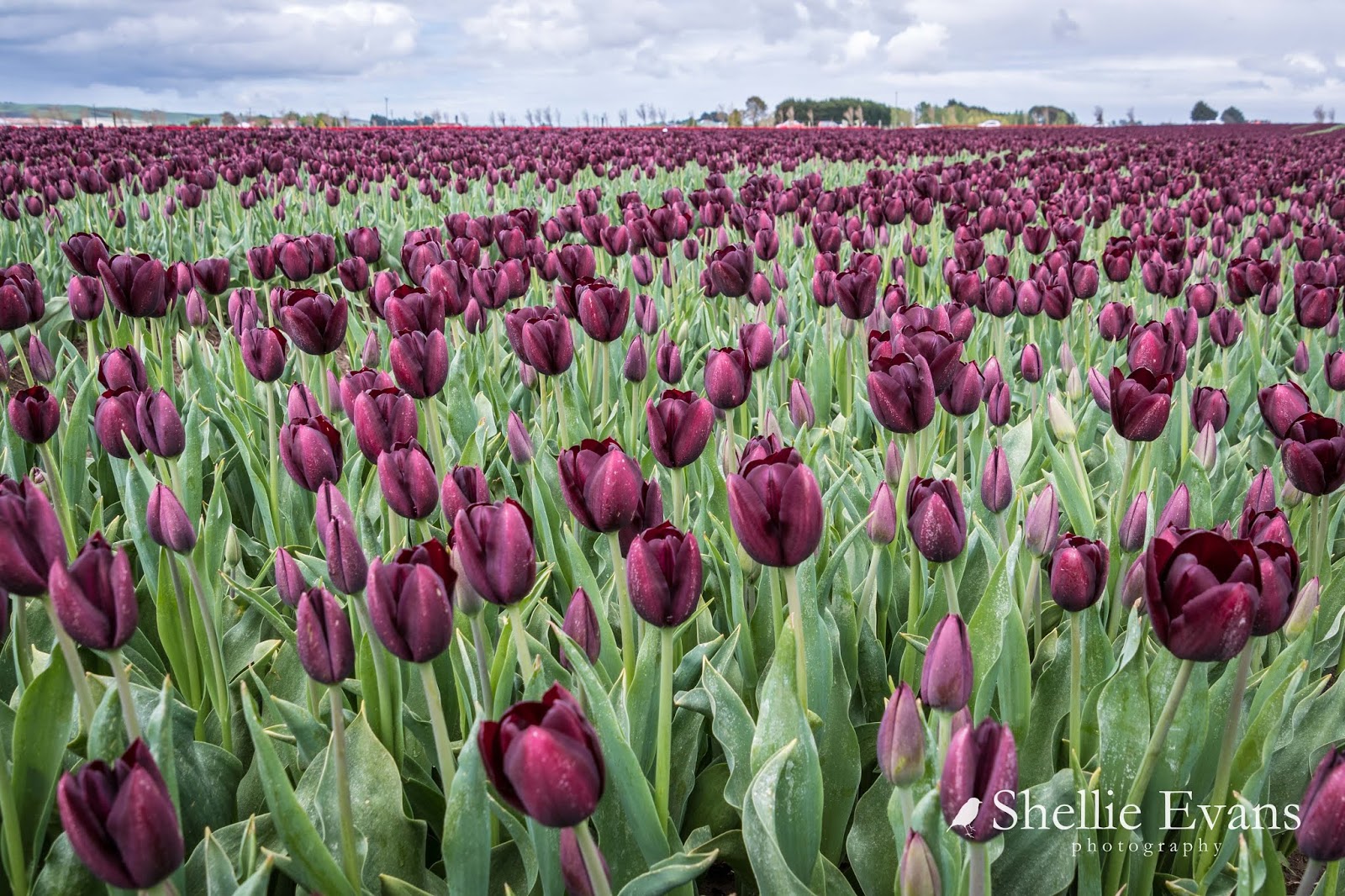

How to stand out in a crowd.


And talking about crowds, dozens of people had arrived at the sheds by the time our tour van arrived back at the display paddock, the large carpark was full and many vehicles now lined the narrow country roads outside the farm. Over a 1000 people visited the farm this year, the largest crowd ever.


Inside the shed the queue for the tours snaked back and forward across the floor and a lot of visitors had opted to walk straight down to the tulip paddock. And in fact, as a photographer, I would do this next time. The tour was good but there were no photo opportunities and it was over an hour before we came back to the display. 


There was still plenty of room for me to take photos in amongst the visitors taking their ultimate selfies or photos of their children dressed in their Sunday best.


There are many migrant families working on dairy farms in Southland & Otago and I know that bright colours and beautiful flowers are a feature in their cultures. I'm sure many photos of treasured grandchildren were sent to families overseas that night.

A Riot of Colour
If you haven't already, click on a photo to enlarge it and then use your direction arrows to scroll back & forward through the photos, the colours are just spectacular (or perhaps it's just me, but I can't get enough of looking at this amazing sight).


Of course I photographed each and every row and from several different angles until I finally reached the far side of the field and when I turned to head back to the sheds, there was still a mass of people arriving.


Further to the south the weather looked to be about to take a turn for the worse and I wanted to check out a couple of the paddocks we'd seen on our tour earlier in the day. Our driver had pointed out side roads where there were tulips that could be seen from the road.


This sea of pink took my breath away, what a fabulous colour (and possibly my new favourite) and as you can see I couldn't get enough of them. Anyone want 50 photos of pink tulips?


But I lingered a little too long at the pink tulip parade and when I next looked up I could see the weather front was just about on top of me. There was one more field (actually two) that I wanted to see before I headed home, this one of white tulips when the rain started to fall...


...and one back near the main road where the heavens opened up and all hell broke loose. I managed to grab a few shots but not before getting a total drenching in the heavy downpour. 

Afterwards as I passed Triflors on my way home, dozens of people were still arriving, walking along the road in their finery and without umbrellas or wet weather gear. Others were struggling back to their cars, some parked over a kilometre away, looking like drowned rats. It was such a shame the day ended liked that but I was so pleased I arrived early.


Several days later I was back in the area and thought I'd look in on the tulip fields (as you do) that I hadn't had the time to check out when it was raining.


These reds and oranges were very vibrant, it was just a pity I could only stand at the side of the road to take photos. Given half the chance I'd have been in their amongst it again.


I also stopped at the Triflors display tulip field, this time at the other end to where we'd all been just days earlier. A dairy herd was slowly wandering back to their paddock after milking, along the track we'd been on the other day. Even though I knew what the outcome was going to be it was still quite sad to see that the de-heading machine had been through and most of rows of glorious coloured tulips had been unceremoniously chopped!


Petals & broken blooms lay in the furrows between the plants. It was such a sorry sight to see after such beauty but at least they had had their one day of glory.


Saturday, March 23

Magnificent Maitai Bay- Karikari Peninsula

Catch-up

From Mahinepua we headed north by-passing Taupo Bay (we'll save that for another time) and Mangonui (we'll be back for their famous fish and chips), passing through Doubtless Bay's beautiful beach settlements of  Coopers Beach & Cable Bay, through a busy Taipa before turning right up the Karikari Peninsula. The Inland Road up the middle of the peninsula reminded me of the Mahia Peninsula; a dry landscape of  rolling sand dunes, dune grass and scrub, pine trees and sparsely populated barren farmland.

Tokerau Beach from Ramp Road Reserve
We stopped at the public reserve at the end of Ramp Road for lunch, just a few hundred metres south, and accessed by a rough sand track, is the Ramp Road freedom camping area (click on the photo, you can see some vans by the pine trees). We may come back here to stay but for now we're heading to the top of the peninsula.

There are a couple of rare yellow pohutukawa flowering in amongst the red flowering trees planted along the edge of the beach in the reserve. Yellow pohutukawa descend from a pair of trees discovered in 1840 on Motiti Island in the Bay of Plenty. The yellow species is a taonga (treasure) to Maori.


Rush hour- Tokerau Beach. 


Once again proving that we're just 2 degrees removed here in New Zealand, I posted the photo above on a motorhome Facebook page I belong to and the guy on the bike responded, "Hey, that's me!" He also mentioned that it was 9.2km to the top of the beach (below), he was heading back to the Ramp Road camp when I captured him.


There's a large dune lake at the end of Ramp Road- in fact it's beside the track to the freedom camping area- it's colloquially known as Coca Cola Lake because of it's tannin stained water. Dune Lakes don't have rivers or streams flowing in or out of them, the water seeps through the sands over hundreds of years, darkened by peat and tannins from the Manuka scrub and other leaf litter around them. Apparently the locals extol the beauty and health properties of the water but you wouldn't get me swimming in there; the water's too dark to see if anything is on the bottom! Like big fat eels.


We stopped at Lake Rotopokaka (it's official name) later in our stay but unfortunately the colour wasn't as easy to see on a cloudy day. Roto= lake, pokaka= native tree, and kaka is our bronze/brown coloured parrot.


We bypassed the seaside settlement of Tokerau Beach for now and carried on to the top of the Karikari Peninsula, passing through the middle of the 1200 hectare luxury Carrington Estate on the way. The estate includes top-end accommodation, the Karikari Estate Winery & cafe and a championship standard 18 hole golf course. I'm not so sure I'd want to stay here though if I didn't have my own transport, it's a pretty isolated area.

The views from the villas out over the protected wetlands to the white silica sands of Karikari Beach are spectacular. That's Mt Camel/Tohoraha you can see in the middle picture on the left. Mt Camel forms the north head of the Houhora Harbour way across the bay and on the way to the top of the North Island.


The last four kilometres of road are gravel and then with a sharp right turn we finally reached our destination, Maitai Bay DOC Camp, and while it looks like that's Maitai Bay ahead of us as we drive down into the camp, it's not. There are two small bays side by side and this one is Waikato Bay.


There are also two sections to the camp; the top camp and the bottom, we take the road to the lower level and find a site in a large grassy bay very close to the day car park with walking access to Maitai Bay. The camp is a large one and is very popular with families and boaties during the holiday season. Although being early December we have the whole place to ourselves until evening when a few tourist vans arrive for the night.


A little further on from our camp site the road ends at a small boat ramp into Waikato Bay.


Disappointingly for us, and in the way we do it, it's a little bit too far to tow the Takacat inflatable, so we reluctantly make the decision that there'll be no fishing for us here.


Waikato Bay, Karikari Peninsula, Far North
The decision is actually made easier by the fact that there is a rahui (fishing & seafood collection ban) on until March 2020 to allow fish & seafood stocks to recover from being overfished. The rahui covers most of Waikato Bay & all of Maitai Bay. While David could head out and fish up and down the coastline on either side of the bays he's not that comfortable going so far out and especially in rougher seas away from the sheltered bays.


Located between the bays and up on a rise, these two pou (carved wooden poles) were unveiled  to mark the start of the rahui. The pou represent Kahutianui and her husband Te Parata, tupuna (ancestor) of Te Whanau Moana and Te Rorohuri. The other side of the pou, facing the water, represent Hinemoana and Tangaroa, the female and male atua (gods or spirits) of the sea. 


With plenty of camping bays and shelter belts of trees around each bay, the bird life was prolific. I watched a cock pheasant strut around our bay and in and out of the trees for much of the day. Then when I heard a commotion and saw a flurry of action as he chased another cock around and around the grass before disappearing into the next bay, I carefully crept up on them to see that they were having a stand-off...


...before once again engaging in a full out war on each other! They weren't in any hurry to call it quits either chasing each other through the trees and into another bay before disappearing down a bank, each one still keen to get the upper hand. The photos are in order as they happened, left to right, click on the photo story to enlarge. 


I later saw the object of their affections and the cause of the fight sneaking past the van; female pheasants are very, very shy, and while they may come across as drab in comparison to their male counterpart, in my opinion their markings are superb. 


I did see my male pheasant the next day limping past the van, but still on the warpath.

A pukeko family also spent much of their day pulling grass clumps out of the nearby soft ground and stripping off the tender shoots. 


What a lovely sleek juvenile this one is, he (or she) was very wary of me as I stalked them along the bush line. 

'Mum, help Mum, she's after me!!'
And by now you're probably saying to yourselves 'So where is Maitai Bay?"
Well, this is beautiful, stunning Maitai Bay...


Of course I had to leave the best for last...


Maitai Bay is a perfectly shaped horseshoe bay with turquoise water and bordered by a golden sand beach.


A sheltered bay for safe swimming, rock pools for snorkeling, a large campground with new amenity blocks, bush walks, a handy boat ramp, blue skies and hot weather; I can see why families make the long trip to the Far North for their summer holidays. 


I can imagine the beach would be very busy over the holidays but for now there are just a handful of people enjoying the early summer sunshine. I took this photo with my wide angle lens to capture the whole bay in the one shot. 


 And this one is a panoramic capture of the bay; four photos stitched together.