Real-time
We went looking for giant lizards at Macraes Flat, instead we found a giant bird, a giant mine and a giant collection of pig skins!

We travelled through some new territory on the way to Macraes Flat, following the eastern end of the Otago Rail Trail which finishes (or starts, depending on which way you ride it) in Middlemarch. We stopped at the old Hyde Hotel where many bikers call in at the cafe for refreshments on their way through.

I also took the obligatory church photos (both now decommissioned) and one of the the old school, which is now a cyclists accommodation lodge.

A little further on we turn left and head up onto the rocky plateau ahead of us. We're on a bit of wild goose chase, one I don't hold out much hope in being successful in either. But we have all day ahead of us and nowhere we need to be in a hurry. And we have our home on the back, so we'll stop where and when the fancy takes us.

We're looking for Grand Skinks and their slightly larger brothers the Otago Skink, they are New Zealand's largest lizard at 300mm (11 inches) long. They are very rare, very endangered and found only in three or four small areas in Otago, including in the Macraes Flat conservation area.

We've only ever seen them at Orokonui Ecosanctuary in Dunedin where they are successfully breeding- that's a young lizard riding on a parent's back with two juveniles on the rock below. The baby is about the size of the usual skinks people see in NZ.

We've only ever seen them at Orokonui Ecosanctuary in Dunedin where they are successfully breeding- that's a young lizard riding on a parent's back with two juveniles on the rock below. The baby is about the size of the usual skinks people see in NZ.

I took these photos also at Orokonui- that's an adult top left and a baby bottom right and look how well camouflaged they are in the bush. You've probably guessed due to the lack of photos from elsewhere that we failed to find any skinks at Macraes Flat. Which actually isn't that surprising considering the fact that, in the end, we ran out of time and didn't even look!

Here we are crossing the Taieri River for the upteenth time on our travels. This isn't surprising given that the river is 318km long and flows from the upper reaches of the Maniototo Valley, makes a dramatic U turn around the northern end of the Rock & Pillar Range and flows down through the Strath Taieri Valley (where we are) all the way to the ocean.

We've crossed back and forward over the Taieri River numerous times while exploring the Maniototo and Otago, we've been to the top in the Maniototo Valley and seen the Upper Taieri Scroll Plain where the river begins its journey (click to enlarge) and to the bottom, staying at Taieri Mouth not long after we started this journey and everywhere in between.

This beautiful old iron lattice truss bridge over the Taieri was built in 1879.


We've crossed back and forward over the Taieri River numerous times while exploring the Maniototo and Otago, we've been to the top in the Maniototo Valley and seen the Upper Taieri Scroll Plain where the river begins its journey (click to enlarge) and to the bottom, staying at Taieri Mouth not long after we started this journey and everywhere in between.

This beautiful old iron lattice truss bridge over the Taieri was built in 1879.

It was a long, slow and steady haul up onto the plateau where the views back over the valley to the Rock & Pillar Range behind were absolutely stunning. The Rock & Pillars rise to 1450m and are named for the impressive tors along the ridge.

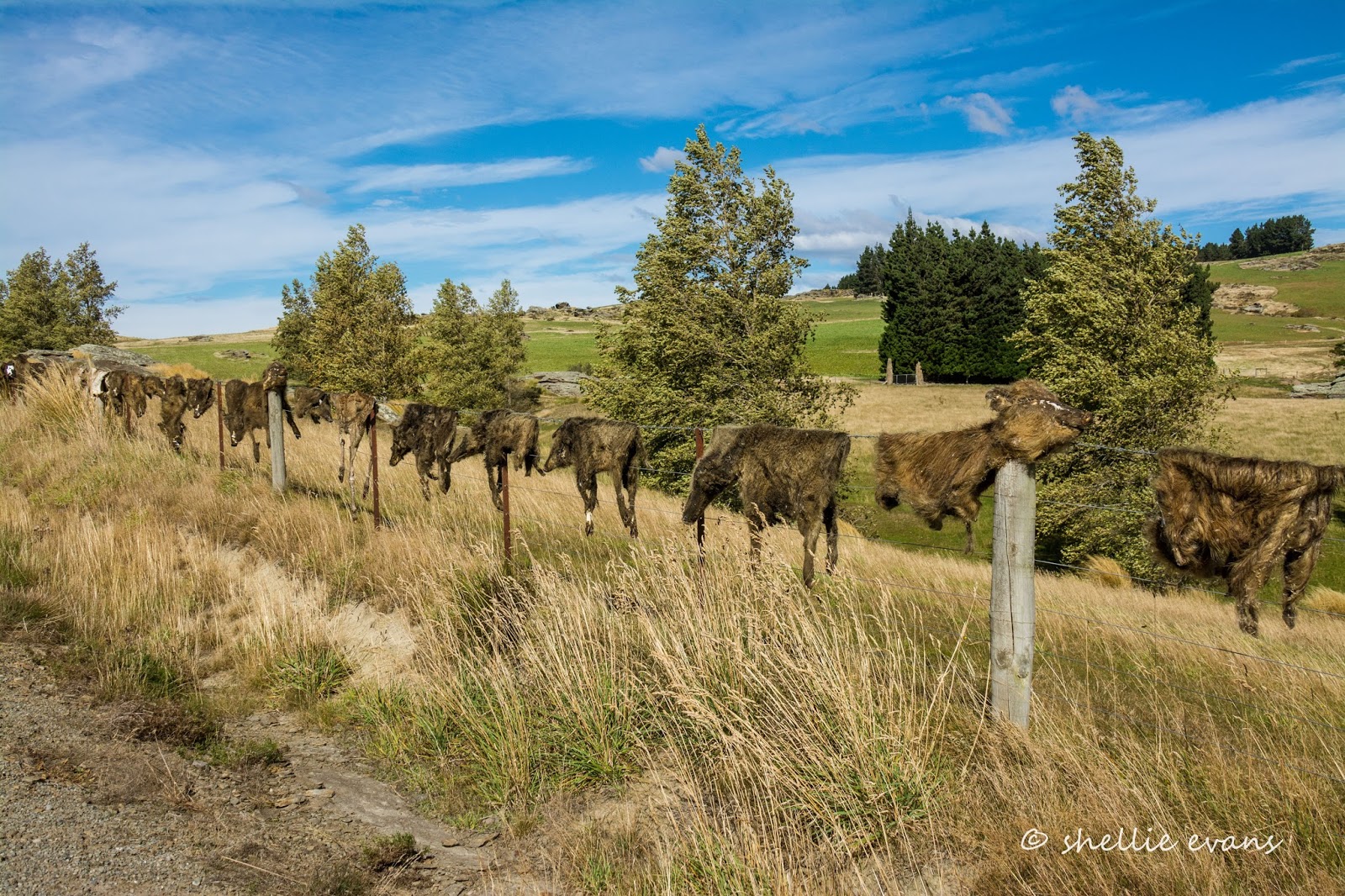
We pass many hundreds of tors on this side of the valley too, in fact we could still be in Central Otago as the landscape is so similar, and then travel on past farmland atop the Taieri Ridge. It took a few moments to register what we were seeing strung along the fenceline ahead of us as we passed here. As far as the eye could see ahead...

...and once we stopped, back behind us, at least a kilometre of animal skins! Collected over the past 20 years they are mostly wild pigs but deer, goat and wallaby skins are in there too, some complete with skulls. Eeuw!

There are many bizarre fences in New Zealand; Cadrona's famous bra fence, several shoe fences, a jandal (flip-flop) fence or two, bike fences, hubcap fences, number plate fences but now we've seen it all! No wussy collection here, this is a true Southern Man's fence!
Further on, and as we drop down into the a huge basin of Macraes Flat, far across the valley we can see some terracing on the hills and steam rising from chimneys near what looks like a very large mine site (I've zoomed in here). I wonder if we'll get close...

Eventually we pull into the old gold mining settlement of Macraes (pop. 54). where there's neither sight nor sound of people about, even though it's a holiday Monday. In 2014 the settlement changed its name from Macraes Flat to Macraes so as to distinguish itself from the surrounding district.

We have lunch parked beside the old stables of the historic Stanley's Hotel (1882) which is across the road.

Stanley's Hotel was owned by Oceana Gold, the gold mining company that runs the nearby mine. In 2015 it was returned to the community in exchange for some impressive artwork....well one piece of impressive art, I'm not so sure about the others.

Located behind where we're parked is the Macrae Heritage & Arts Park and wetland, originally given to the community by the mine it has now been exchanged for the hotel, other heritage buildings, land and money.

Eventually, I'm sure, the park will be given back to the community. I mean what's a gold mine going to do with a 9m high, 750kg big bird, a tussock planting and numerous large billboards (a very odd contribution if I must say so myself).

The bird on the other hand is a stunning sculpture and such a pity it's not seen by many people. You could drive straight through Macraes and not spot it, or even visit the settlement and not know of it tucked out the back.
With a 12m wingspan, it is of the long extinct Haast's Eagle, a bird that in reality weighed about 15kgs and had a wingspan of 3 metres. It was known to attack and eat moa, the sculpture is in attack mode here. As befitting a bird of this size the eagle was flown, beneath a helicopter, from sculptor Mark Hill's (son of jeweller Michael Hill) home in Arrowtown to Macraes in 2008. Now that would have been an impressive sight.
With a 12m wingspan, it is of the long extinct Haast's Eagle, a bird that in reality weighed about 15kgs and had a wingspan of 3 metres. It was known to attack and eat moa, the sculpture is in attack mode here. As befitting a bird of this size the eagle was flown, beneath a helicopter, from sculptor Mark Hill's (son of jeweller Michael Hill) home in Arrowtown to Macraes in 2008. Now that would have been an impressive sight.


I took a quick walk up the road to locate the local church, and as with many of NZ's abandoned or nearly abandoned country settlements, this is another church that has seen better days. This is the former St Patrick's Catholic Church, a Category 2 listed Historic Place building, now located in a horse paddock and in a sad state of disrepair.


