Showing posts with label possum. Show all posts

September 05, 2015

Beer & Skittles

I thought I better do another update on our whereabouts. I am steadily getting through the Maniototo posts with just a couple more to do. Actually I think three, one of them will be a two part-er. But just as I am about to catch up we move on to a new spot and do some more exploring! So if I don’t keep up with these short ‘here we are’ posts I’ll be forever coming up the rear.

Originally we were heading from Marfells Beach to Momorangi in the Marlborough Sounds for a couple of weeks of rest and relaxation (and fishing) but we had to make a detour and carry on over the big hill to Nelson to do some urgent maintenance on the 5th-Wheeler.

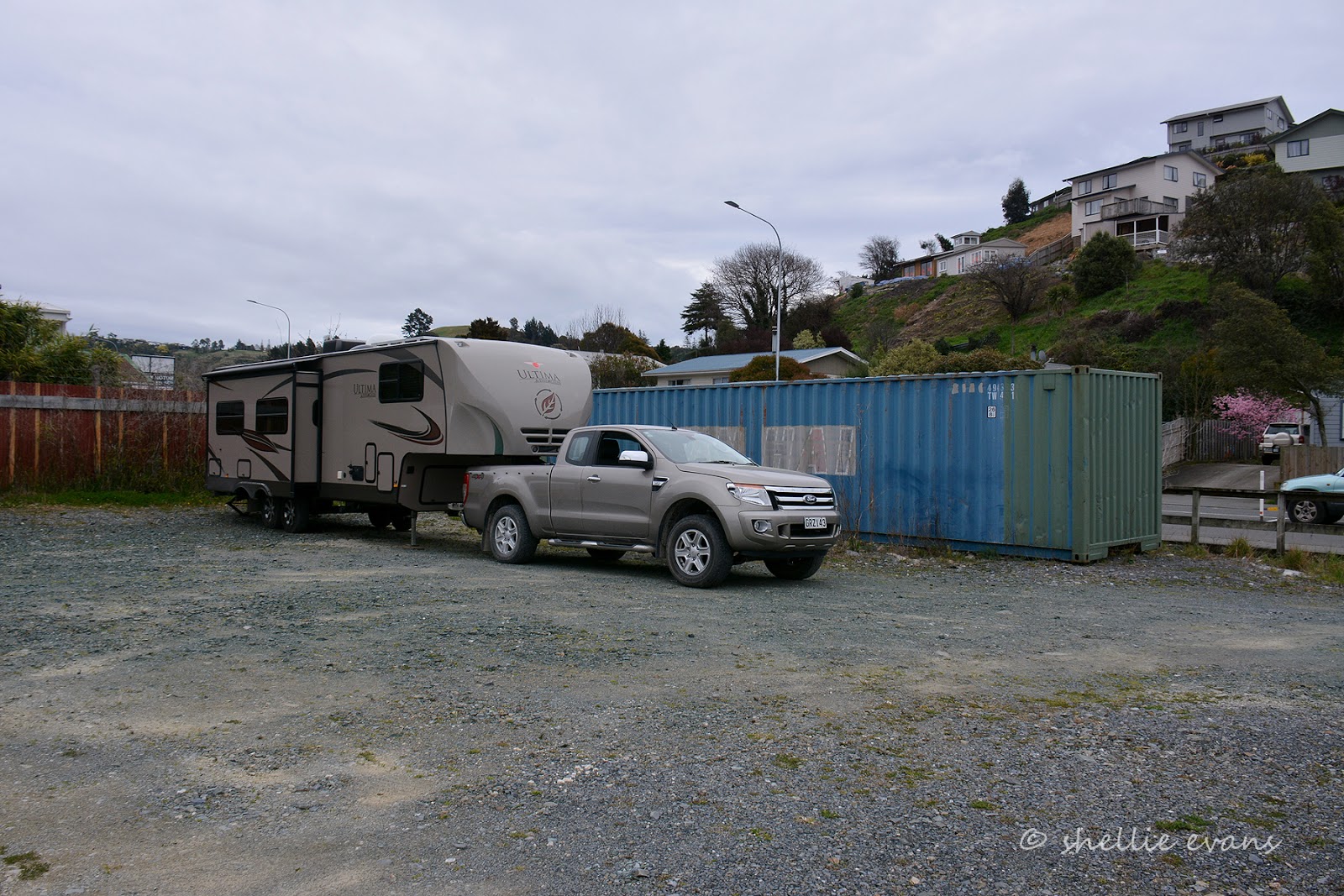
And as you can see it’s not all beer & skittles when you’re on the road- here we are parked up for the night in an overgrown empty lot with a shipping container and an old caravan for company and whole lot of dog sh*t;- David wanted you to know that after stepping in a few piles! The company who were doing the maintenance use the empty section and suggested we stay here so they could get an early start the next morning.

They offered the section again the next night but we decided to re-locate to the familiar and friendly Richmond Racecourse site where we’ve stayed a few times before. They were quite busy with a few permanents (max. allowed 3 months) and other full-timers passing through. We parked across a couple of sites and stayed hitched so we could pull out early the next morning.  It was a lovely surprise to be greeted by Shirley & Graham; they have been running the camp since the new year. We met them way down south in Manapouri last year when we were both staying at a great campground and where I took a helicopter ride to take photos of the campground.


We pulled out early the next morning and hauled ourselves back over the Rai Saddle and down into the Marlborough Sounds pulling into the DOC Momorangi Campground with enough of the day left to sit outside and enjoy the warm sunshine. That was after setting up the table and chairs for the first time this season and we also had our first taste of pesky sandflies for the season, or more to the point, they had their first taste of us. Summer is on its way!

I spoke to soon. We stayed at Momorangi for 7 days and had rain for 5 of them. It was heavy and steady for a couple of days and on and off for the rest. My hunter-gatherer decided he is a fair weather fisherman so the Takacat inflatable didn’t see the light of day & stayed tightly packed in the back of the ute. The weather, along with the fact that the blue cod fishery is out of bounds for 3 months sealed the fishing fate.


After Momorangi we headed into Blenheim to do a few chores, stopping at our regular stop, the Blenheim Racecourse. Another not so ‘beer & skittles’ park over, the grass areas were very boggy and rather than venture into our favourite spot between the grandstands and avoiding parking outside the Ballet School (where we had little girls swinging on the ramp bars just below our kitchen window and Mums parking their cars beside our front door) we backed in beside the tote office. Keeping well clear of doorway where the tractor is stored. Tractor? Too late. 7am the next morning the door is scrapped open across the gravel to stop right beside my bedroom window. The tractor roars & revs for about a minute before it bursts out the door on a mission. To be repeated again the following morning.


Chores done we were out of there and on our way to the DOC campground at Whites Bay. Whites Bay is located north east of Blenheim on the coast, at the bottom of the Marlborough Sounds but on the outside of the Sounds- if that makes sense.


If you headed north out of Picton on the Port Underwood Road, Whites Bay is towards the end, just over the hill is the beach settlement of Rarangi and the Wairau Plains. We came in from the Rarangi end- a steep and winding 6kms. No towing (not that, that stopped us on Queen Charlotte Drive into Momorangi) or large motohomes & vehicles are allowed further on past the bay on the Port Underwood road.


Whites Bay is a small sheltered bay (except for easterlies) that is obviously quite popular in the summer- there’s a surf club headquarters near the beach front and plenty of camp sites although all the top areas are closed off for the winter.
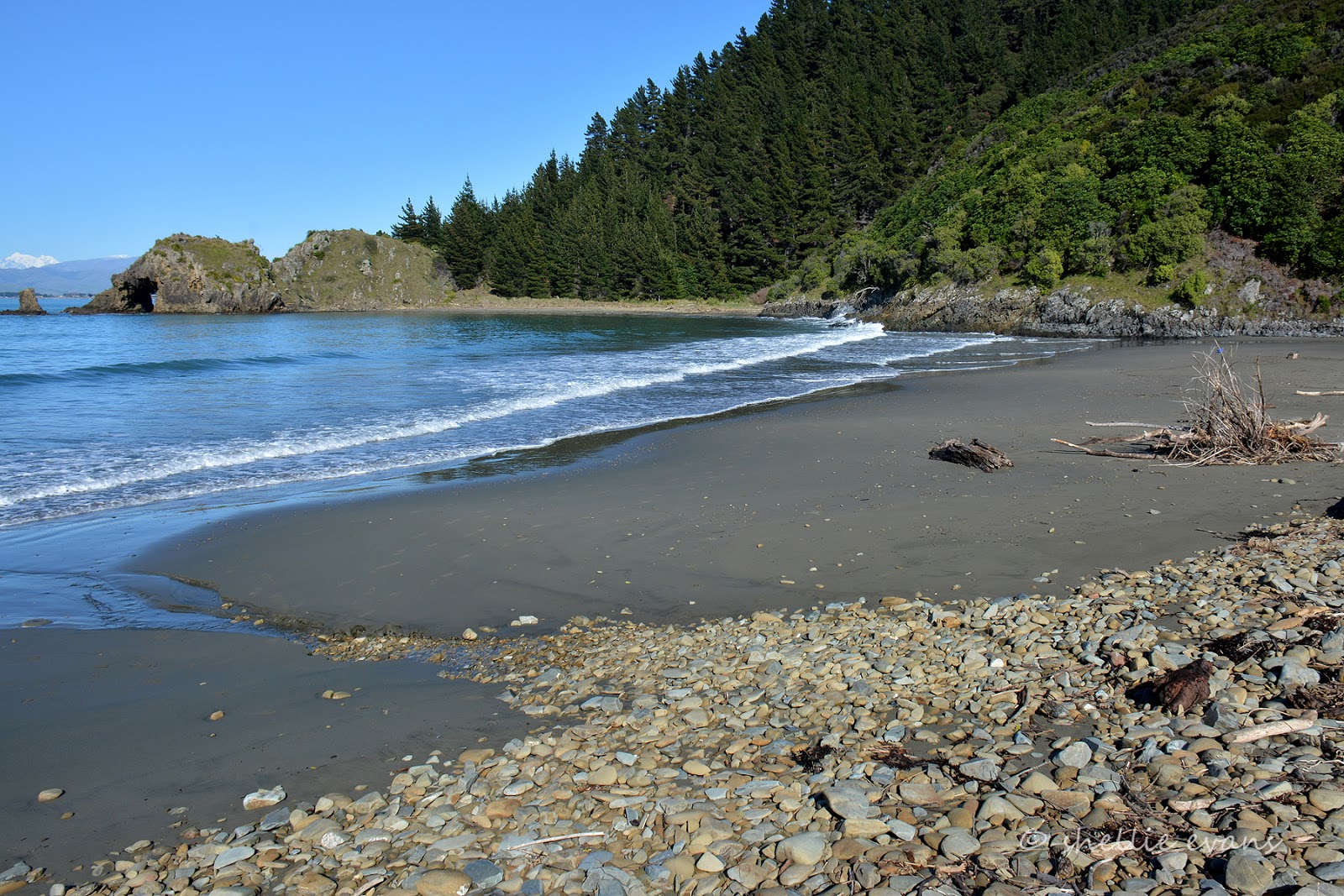

Across the bay is Cape Campbell and Marfells Beach. Whites Bay is named after Black Jack White, an American Black who deserted his whaling ship in 1828 and lived with Maori in the bay.


In 1866 the first of many telegraph cables between the North & South Islands was brought ashore at Whites Bay. The telegraphist's building that had been prefabricated in Australia was floated ashore and sits, preserved, in the middle of the DOC camp. 


Tonight while I was doing the dishes I heard the familiar sound of a couple of possums challenging each other just outside the van- it’s a weird noise and so loud that if you didn’t know what was making it you’d be quite worried and perhaps think a herd of cattle beast were about to rampage through the camp. David went out with his head torch on to locate them, he found them both close by. Well he found one and I heard the other one rustling about in the leaves at ground level. Beside me. Me without the head torch- that gave me a bit of a fright until it ran up the tree. David shone his torch on it while I shot it….with the camera  Cute eh?


Today we explored the Port Underwood Road (I’ll do a post on it later), initially we were just going to drive the road along the coast and turn around before it headed inland across to Picton but in the end we drove the whole loop- 80kms with about 50 of them on a narrow, gravel, very winding road, climbing up and over high ridges and down into tiny bays and then back up again.

There's a side road up one of the Sound arms with a monument towards the end that I had set my sights on seeing but when we got to the turnoff I had second thoughts. 14kms there and 14kms back on a similar or probably worse road just to see a monument- my head said “Don’t be silly”, the wanderlust in me said ‘Go for it”. This time my head won. David was pleased.

That got me thinking.....and so, I'm going to dedicate this post to my number one fan. A person who reads every blog post word for word and at least twice and probably 3-4 times and then asks when the next one will be posted. This person is the one who gave me the genes for my wanderlust and thirst for exploring the back-roads and byways, an extra special man who always took the long way home, despite the pleas from his wife and the whining kids in the back seat of the car.  Happy Fathers Day to my darling Dad xx


April 24, 2015

Kaniere Canaries

In this, the last post from Lake Kaniere, I wanted to share with you a few of the lovely bird shots I took. Our birds might not sing like canaries but they all have their own special tunes.

Of course my favourite little bird is first. This tiny adorable male South Island Tomtit (Maori name Miromiro) was full of spunk, he wasn’t afraid to let you know you were intruding in his patch. Just because he’d chosen part of the DOC campground as his territory didn’t mean he was going to vacate it when it became overrun with campers, dogs, cars, boats & caravans. He just had more things to hang from or use as vantage points in his hunt for bugs and intruders. Often I saw him sitting on the very top point of a gazebo or tent, on boat rod holders, camp tables and even the satellite dish on a bus.


I’d hear his sweet little song as he rested in the bush near our van and then his high pitched alarm call rang out when I stepped outside- this was good because I could then get a fix on him and follow him from spot to spot as he flew the circuit of his territory. He caught a number of caterpillars in this tree, bashing them on a branch to soften them up before swallowing them whole.


He kept up the attack on his reflection in any car mirror or shiny window as he had done on the day we arrived. Every day he would spend five minutes or so flapping at the reflection before giving up and moving on. Until his next circuit.

It must be a thing with Tomtits because you might remember we first saw it happen when a female Tomtit attacked the ute mirror when we were driving up the Arrow River to Macetown.


After all the rain we had, you would have thought that a tiny little bird would have had enough of water. Not this little guy, he had a ball (bath) in this muddy puddle for at least 5 minutes.


And here is his mate- well actually it’s not, but it is a female South Island Tomtit, they are much less confiding than their male counterparts. This one was very cautious and even though she came in close she made sure she always had a branch between me and her.


The camp was full of Bellbirds/Korimako feeding on the berries of the many sub-alpine trees that grew around camp. Usually the bellbird has a very melodious song but going by the weird squawking we quite often heard, the juveniles have a lot of trouble learning to sing in tune. They do practice alot though which helps me locate them in the thick branches. This juvenile wasn’t too worried about me standing underneath him, I think he was glad of the audience. In between trying to perfect his singing ability he was filling his belly with mingimingi berries.


There were also a number of large Mahoe (aka Whiteywood) bushes, they were usually full of noise as the Bellbirds, Tuis, Silvereyes, along with a few introduced bird such as Blackbirds had a feast feeding on the plentiful supply of small purple berries.


There were about ten weka around camp- although two died while we were there- we’re not too sure how, they could have been ill or it could have been one of the 15 or so dogs that were in camp over Easter. Once again the sign said ‘no dogs allowed’ and once again nobody took a blind bit of notice.

I know a lot of people think weka are pesky buggers (and they are) but I’m quite fond of them; they have a heap of character to go with their inquisitive nature. A solid beak (that they often poke where it’s not wanted) and strong legs (to carry them off faster than the shoe that whistles past their head).


One day after Easter and after the camp ground had cleared out, I happened to look out the back window and there down near the bottom of the road was a small black ball of fluff snuffling about on the grass verge. I couldn’t believe my eyes, surely not, not another possum out in daylight (you’ll remember we saw a possum on our walk at Cave Creek).

I grabbed my camera and crept down the edge hiding behind some rocks on the way. He didn’t move until I got within a couple of metres of him, when he got a bit of a fright and stumbled off into the undergrowth. He then tried to climb up the flax. Of course that didn’t work, he just shredded the leaves with his massive claws and slid back to the bottom where he just sat there staring at me.

I left him alone thinking he must be ill and would probably die in the next day or two. Especially after the torrential rain we had for the next two days, but no, the next day at about the same time I saw him out on the verge again. Then he slowly made his way up the road casually grazing along the way. He spent alot of time stripping the leaves off a large dock plant before moving on and then making his way down another path.


On the third day, he was starting to look like a drowned rat and he had lost the little bit of fear he had, not even bothering to stop eating as we approached. I gave David a piece of banana to feed him and he scoffed it, checking around for more as soon as it was gone. Ok, Ok, I know, don’t shout at me. But how could I not feel sorry for this cute little fellow even though I know he is one of the most destructive imported pests in New Zealand.


By the fourth day, he was following me up the road. And not stopping when I got down low to take a photo! Perhaps he had been someone’s pet? Although I think unlikely, his ears had a few war wounds so maybe he was just old and being nocturnal, his eyesight would have been impaired by the light.


We were leaving on the fifth day so I checked around by the flax bush where he had appeared each afternoon to see if I could see where he was asleep. I felt rather sad for him, he was curled up in a ball at the base of the flax, out in the open with the rain falling on him. He hadn’t even tucked himself in under the bush in the dark. At first I thought he was dead but he stirred when he heard me and then went back to sleep. So maybe he was sick……or it was too early to get up. We certainly don’t get bored on this journey, there’s always something unusual happening around us.

There are a number of short walks around the lake including the Canoe Cove Rimu Forest Walk which ended on a small beach with a sheltered cove tucked around the corner.


It was a thrill to find quite a number of Sky-Blue Mushrooms or Blue Pinkgill (Entoloma hochstetteri) alongside the track. While not rare they are more frequently found in the Coromandel (North Island) and West Coast (South Island) areas of New Zealand. A blue mushroom is quite rare in the world though, New Zealand, and of all places, India are the only countries that have this bright blue fungi.


With a conical shape it does look like something out of a fairy tale and the lush green backdrop of the moss simply adds to the expectation that a fairy or elf is about to emerge from behind one.


And while hunting for more Sky-Blues we found other fungi, not in such a brilliant colour though but interesting all the same. In the bottom left is the birds nest fungus- a tiny fungi no bigger than my little fingernail, the small brown dots are the spores(‘pills’) that have been splashed out of the ‘nest’ by rain once the top has fallen free. The white helmet fungus on the top right is also very small, & delicate. I have no idea about the weird coral looking fungus in the top left and in the bottom right the fungi were whiter than white, almost opaque.


Another short walk was the Kahikatea Forest Walk through virgin kahikatea forest. Kahikatea like having wet feet so some of the track is along a boardwalk over swampy land. Once the track leaves the boardwalk and moves deeper into the dark and damp forest, the trees are literally dripping in moss.


Towards the end the forest opens up again and we can see why, once again we see the destruction that has been caused by Cyclone Ita. Rather than the Beech trees we’ve seen elsewhere, it’s huge rimu trees that have been ripped out of the ground here. Back at the carpark we talk to a guy who is working at preparing the rimu to be lifted out by helicopter- it’s taken a year for consent to be granted to remove this valuable wood from conservation land and if they don’t start lifting it out soon it will spoil. He heads off into the bush with his chainsaw and we can hear another one off in the distance.


And a few days later and the night before we were due to leave, DOC arrived with a van load of road cones to block off our area of the camp. An Iroquois helicopter was going to start lifting out the logs the next day and it was going to be landing at the camp to refuel. As we were due to leave anyway, we stayed in our spot overnight and moved the cones into place the next morning for them.


We might have been tempted to shift the van over to another site and stay and watch but the weather was still not that great; David had to pack the boat up in the pouring rain. We decided it was time to move on. We both loved Lake Kaniere, is was one of the prettiest lakes we’ve visited, it was just a pity the weather wasn’t a little better given the two weeks we spent there.


April 19, 2015

Dorothy Falls, A Memorial & The Blue Gorge

We stayed three nights in Punakaiki and would have liked to have stayed a few more but the weather was too temperamental and Easter was fast approaching so we decided to head straight through to Lake Kaniere and get a good site at the DOC camp before the Easter onslaught.

We did have an unusual encounter on the Cave Creek walk, I didn't mention it on the last blog though as I thought it wasn't quite appropriate to add it to the end. As we were making our way back up the track, David spotted a small dark animal on the track quite a distance ahead of us. I zoomed in on it and could only see a dark ball of fur.

A wallaby? Don’t be funny, there are none of those on the West Coast.  A wild cat? Highly unlikely out this far, but still a possibility. A big rat? Run for your life Shellie! We crept up on it and as we got closer it turned to the side and I could see that it was a possum, grazing on the track grass. Possums are nocturnal and this was about 4pm so either he forgot to change the clock for day-light saving, or more likely it was sick.

We crept up on it and got quite close before it heard us and ran into the bush on the side of the track. We quickly zeroed in on where it disappeared and David poked about in the undergrowth and under a large flax bush but didn’t find anything. As we were walking away I looked to the tree behind the flax and there it was, down low and staring at me with little beady eyes and gripping the trunk for dear life. He stayed put for quite awhile until David moved closer and he shot off up the trunk to the top at full speed. Where he sat and stared down at us again before crossing over to a larger tree and disappearing. That was our first encounter with a possum in daylight (and it wasn’t going to be too long before the second one either). He was just lucky that we saw him and not someone with a gun.


Our last morning at Punakaiki dawned fine and clear and from our vantage point (zoomed in) I could see that a steady stream of people were already checking out the blowhole.


Not far south of Greymouth is the iconic Taramakau single lane combined rail and road bridge over the Taramakau River. I think this is last remaining rail & road bridge on the West Coast, there used to be one over the Arahura River and a very long one over the Hokitika River. I chuckled at the road sign, there wouldn't be too many places that you'd see a sign like that.


We stopped in Hokitika for provisions and headed out to the DOC camp at Lake Kaniere which is 22kms inland and surrounded on three sides by mountains. We arrived mid afternoon to find that we had the large camp to ourselves. And so it was for the next couple of nights and then as you know, all hell broke loose- here are the blog post links from Easter-

A Quiet & Sunny Easter- Part 1

A Wet & Noisy Easter- Part 2


Easter Sunday dawned fine and with the weather forecast for more heavy rain we decided to do a little exploring while it was clear. We’d also just about had enough of all the power boat noise and needed to get out for awhile. The road continued on and turned to gravel just past the DOC camp, it’s a lovely scenic drive to the top of the lake, through thick native bush with the odd glimpse of the lake and  a few small parking areas beside some of the stream mouths.

About half way along and right beside the road are the Dorothy Falls, a multi-tiered 64 metre waterfall that must look impressive after heavy rain….hmm, it has been heavy rain so either they clear quickly or in fact they’re just a trickle usually. You can just see a tiny tier up the top and behind the front tiers. We decided there must be a few more tiers hidden up there.


And this will give you an idea of the height of the falls, David standing on a boulder at the waterfall pool. I took this from the road bridge.


Across the road from the falls is the Dorothy Creek Walk, a short track leads you out to the lake’s edge and, surprise, surprise, there’s the seat we saw from the boat when we explored up the lake a couple of days ago. What a beautiful spot to sit, relax and take in all the wonderful reflections.


At the top of the lake we pass between two ranges and cross over the Styx River which flows from the Southern Alps and joins the braided Hokitika River system further down stream. I now know that there are Blue Ducks/Whio up this river too- captivity hatched & reared ducklings that were released here once they passed their 'stoat-proof’ weight.


The road now enters the fertile river flats of the Kokatahi Valley where dairy farming is the number one industry. We’re heading towards the Hokitika Gorge- the Blue Gorge, and the road zig-zags across the farmland; left, right, left we turn, the road turns at right angles often. Obviously the farms were in place before the road which has had to follow the farm boundaries.

We stop to view the Kowhitirangi Incident Memorial along the way, a huge rock mounted on a plinth with memorial plagues and cast bronze description plates at the side. This is the site of New Zealand's first mass-murder. In 1941 an unstable farmer, Stanley Graham, shot dead seven men -including four policemen, two home guardsmen and a civilian before he was shot 12 days later and died of his wounds, after one of the biggest manhunts in NZ’s history.


Beside the memorial is this plaque explaining the events as they happened (click to enlarge if you would like to read them & excuse the patch job!)-


This part of the memorial is rather unusual but makes you even more aware of what took place in this peaceful farming countryside a long time ago.


There’s a lot of traffic passing the memorial as we read, and it’s all heading towards the back of the valley on a dead end road. The Hokitika Gorge is one of the top tourist attractions in the district and really is well worth visiting even though it’s 33kms from the Coast road and Hokitika township.

The glacial water (aka glacial milk) that flows through the magnificent granite Hokitika Gorge is a vivid turquoise blue and is caused by rocks, high in the mountains, being ground into a fine powder by the movement of glaciers. The suspension of white powder- known as rock flour- in the blue water creates an intense turquoise colour.

From the car park (it was full so we had to park down the road) there’s a short 2min walk to a viewing platform where you first catch sight of the beautiful colour made more intense and contrasted by the deep green forest that surrounds the gorge.


You’ll have to forgive me, but there are quite a number of gorge photos-

A swingbridge is suspended across the middle of the gorge and there’s a continuous file of people crossing back and forward over it.


On the rocks behind more people are clambering about.


Five minutes further on the track leads onto the swingbridge where only 6 people at any one time are allowed on the bridge. A group of children raced ahead of their parents and past us as we approached the bridge. One was very concerned to count seven after they entered the bridge, he quickly ran back shouting to the others he couldn’t follow because the bridge might break. It was good to see that he was taking note of the signs.

This is looking up stream from the middle of the swaying bridge.


And a further 5 minutes on and we arrive at another platform looking upstream and over a small pool that has formed at the side of the river. The rocks below are covered with people taking photos, there’s a gate in the fence (with a child-proof catch) that allows people down to explore.


There’s also a life-saving ring in case somebody falls in.


Which isn’t surprising when you see some of the places people are posing!


I catch David up at the swing bridge where he’s patiently waiting for me, and watching…


A fisherman on a rock downstream, there’s actually two guys, one is tucked in behind the rock out of view. I’m not sure how they got there but it looks like an awesome spot to be, even if there are no fish.


Back in the car we follow the road further into the hills; it’s a rough track but we’re hoping we might be able to check out the river somewhere along the way before it enters the gorge. After 5-6kms it ends on a gravel patch and it’s a surprise to see so many cars parked up. There are a number of multi-day tramping tracks that leave from locked gate so maybe there are a few people spending their Easter tramping in the mountains.

There’s also an overgrown and boggy walking track that leads down to the river which is quite a distance away, we decide to back up a side track and sit on our tailgate to have lunch while enjoying the birdsong and the distant rumble of the river. Just as we’re leaving another car arrives and a guy gets out and, with a whole heap of gear slung over his shoulder, heads off down a different track through the trees; his gear consists of a shovel, a pick, a gold pan and some other gold finding paraphernalia. Now that was not what we were expecting at all.