Showing posts with label Whites Bay. Show all posts

October 07, 2015

One Brown Creeper, Two Swallows

The next couple of posts are all about birds; birds we saw at Whites Bay, Marlborough before we crossed over to the North Island and birds we saw at Zealandia in Wellington, after our visit with the most famous bird of all, Sirocco the Kakapo.

This is a Brown Creeper/Pīpipi, and some have said that this is the one of the hardest birds in New Zealand to photograph, and I would have to agree with them.


Brown Creepers are endemic and are found in a wide range of forest and scrubby habitats in the South Island only. I saw my first and, up until now, last Brown Creepers when we visited Weatherstons goldfield near Lawrence a year or so ago. They are a small, noisy flocking bird seldom seen but often heard as they pass through the forest canopy high above. They rarely stop for long as the noisy chattering flock moves quickly on through the forest, feeding.


I was lucky enough to spot half a dozen birds making their way through the bush near the van & at window height, while we were parked in the DOC camp at Whites Bay- one of the advantages of having dark tinted windows is people & birds can’t see in.


At first I was thinking what are those birds, they don’t look familiar. Then I couldn’t believe my luck as it dawned on me, they were Brown Creepers! I was out the door and following their chatter over to a stand of bush on the inside of the campground. I spent the next couple of hours trying to get the ‘money shot’. I got plenty of ‘bum shots’; they are quite shy and hide their heads well. They are also fast moving and with the dark bush it was hard to catch them, and in fact I had a fair few empty frame shots or shots with just the last couple of centimetres of their tail feathers as they disappeared out of frame.


Brown Creepers are insectivorous, but do eat some fruit. Their main prey are beetles, spiders, moths and caterpillars and I think they were catching insects attracted to flowering Five-finger (Pseudopanax arboreus) here. And that's what held them in the area for awhile, a plentiful food source. They were certainly cute little birds, I loved their bandit eye stripe and long legs.


Quietly moving about on the ground around me while I was targeting the Brown Creepers was another very shy bird, the introduced Dunnock or Hedge Sparrow who has the most beautiful song. This one wasn’t as shy as most I’ve come across and followed along as I moved around the bush. It stayed nearby all the time I was looking up but when I looked down at it, it would quickly move into the undergrowth until I moved on. Then it would appear again. I think it was probably catching the insects I was disturbing.


There were a couple of puddles of water & mud on the track at Whites Bay with two Welcome Swallows doing circuits collecting mud for their nest building. In fact there were three couples trying to collect mud but one pair spent most of their time chasing the others off. I tried to catch them a few times but they were disturbed easily and I couldn’t get close enough for any decent shots. Even after I re-filled their puddle with water when it dried out.

So I was thrilled to find another pair collecting mud from a puddle beside the road at Rarangi when we moved over the hill to the DOC camp there.


And this pair didn’t have any competitors so they were free to spend all day flying back and forward from their nest site to the puddle without any interruption.


Which meant I could lay in wait for them knowing that they would be back every 5 minutes or so. They were flying a large circuit from a rock wall near the beach, across a carpark, then the campground to the road edge. And this time I had a couple of small bushes to hide behind while I waited for their return. They could see me when I stepped out to take the photo but they didn’t seem to be too fazed.


They took an occasional brief rest together on a large piece of driftwood on the beach but then they’d be quickly back to the task at hand, always arriving at and leaving the puddle together, keeping in contact all the way with quiet chattering.


Welcome Swallows are a self introduced species from Australia, they first appeared in the North Island in the late 1950s and increased greatly through the 60s and 70s until now they are very common throughout New Zealand.

If you look closely you can see that the mud is collected on the top of the bill, they sort of head-butt the mud pushing the bill through so it mounds up on top, which is much faster than trying to peck at it and carry it home. They would also collect a lot more doing it this way.


And as most would know that have tried to catch the swallow in flight, it’s a very hard thing to do. They are tiny and extremely fast flyers weaving and ducking and diving. I did have the advantage of knowing that they would be leaving or arriving at the puddle but it was still very hard to lock the focus on them as they flew in and out. Most of these photos were taken at a shutter speed of 1/2000 to 1/2500 and still the wings are a little blurred. Still blurred wings gives a sense of movement so I’m happy with them.


Don't forget to click on the photos to enlarge, if you want to have a closer look.


October 03, 2015

Exploring Port Underwood

We stopped in Blenheim for a couple of days to catch up on a few chores and then headed to Whites Bay, just a short 20minute drive east to the coast and very near to the entrance to Port Underwood. The 6km steep, narrow, gravel road over to the bay from Rarangi gave us a taster of what was to come when we set out to explore the Port Underwood Road later in our stay.


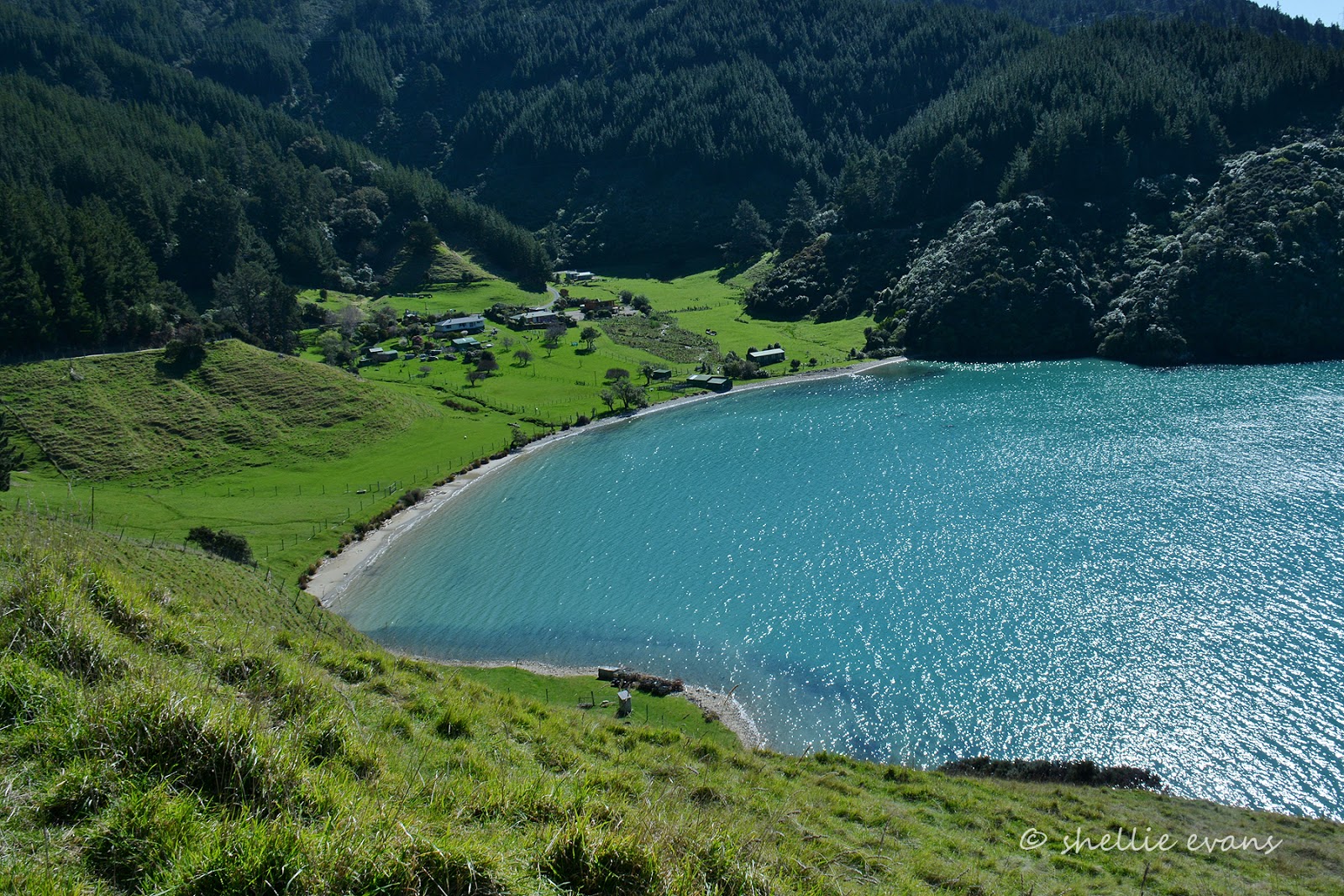
White Bay is a gorgeous wee bay surrounded by bush with a large DOC campground and we were the only ones there.


I did a ‘here’s where we are’ blog post on Whites Bay at the time, here’s the link which has more photos from Whites Bay including the possum that climbed the tree above our van.


We’d been waiting to explore the Port Underwood Road since we stayed at Whatamango Bay last October. Whatamango is at the other end of the road close to Waikawa Bay & Picton. We opted out of Whatamango after a day and didn’t get a chance to drive the coast road.

We’re now exploring the road from the other end, beginning at Whites Bay, and have about 50kms of narrow winding gravel road to drive (80kms for the round trip), climbing up and over sharp ridges and winding down & around beautiful tiny clear bays.

The first lookout point is looking out over Cloudy Bay (of wine fame) towards the entrance to Port Underwood on the far left, Cook Strait in the middle ground and the North Island on the horizon. There’s a distinct line of froth and colour that runs out from the coast, I’m not sure, but I think this is the meeting of the deeper cooler water of Port Underwood and the Strait meeting the discoloured warmer water of Cloudy Bay.


Looking south you can see the discoloured water entering Cloudy Bay near the cliffs in the background, this is from the huge Wairau lagoon and river system and the recent heavy rain- the rain that plagued us for a week at Momorangi. Once again we can see Clifford Bay, Cape Campbell and the lighthouse in the background (last seen from Yealands Winery).


The first bay we stop at is Robin Hood Bay, where there’s a small DOC Campground (no fees) for tents and smaller campervans; it’s not recommended that larger vehicles drive the road although I’ve seen photos of big motorhomes lined up along the foreshore.


There were a few tourist vans in the camp and a couple of guys fishing from the gravel bank. As we pulled up, there was a lot of excitement with people running about trying to take photos, they’d caught a large octopus which they’d hauled in before it dropped to the stones and was making a hasty retreat back to the sea.


Here’s a panoramic photo of Robin Hood Bay taken from the northern end, it’s a bit distorted- I really need to get my tripod out to take these. This is 4 photos stitched together, to have it in proportion I probably need at least 10-12 photos carefully taken moving the camera on the tripod, inch by inch, across the scene instead of my rushed snap, snap, snap, join and patch! All the same, it makes a pretty picture.


At the end of Robin Hood Bay sits a historic cottage (with a new chimney), this ‘stud & mud’ cottage was built in 1854 for a whaling captain and his new wife. It is one of the four oldest buildings in Marlborough.


We climb out of Robin Hood Bay stopping at the top so I can take another photo looking back over it, you can see the DOC camp in the back corner behind the pylon and the road winding it’s way down the hill behind.


We round a corner and ahead of us up on a high point is one of the large pylons that track through the bush along the coast. Climbing over it are six men with paint tins and brushes, they look like ants from afar. You’d have to have a head for heights but what a view!


Further on as we start to wind our way down into another bay we come across three goats who had been grazing on the edge of the road (blurry photo but you get the idea). They take off in front of us, going hell for leather around the corners, left, right they run. As we appear around one bend they disappear around the next. We slow down hoping they’ll run off into the scrub on the side but no, they stick to the gravel. As they disappear around another corner we stop to give them a chance to slow and look for a gap in the bush. We wait a couple of minutes and then crawl forward, around the first bend, no goats, around the next, still no goats, around the third bend and there they are standing still in the middle of the road! They take off again, the road is getting steeper and they are running faster.


We stop again so I can take a photo looking down into Ocean Bay. Surely by the time we start rolling they’ll be gone this time.


Nope! It looks like Mum & the kids are now having a lunch break! We slowly approach them and away they race again. We can see that they have collars & tags around their necks so they either belong to someone up the top of the hill or someone down the bottom. Either way they’re along way from home. We speed up to try and force them into the undergrowth as we pass but no, the sides of the hill are too steep, up and down. Finally after at least a couple of kilometres we come to a sharp elbow in the road and they head off into the trees. I wonder how long it took them to walk to the top of the hill because I think they bet the downhill speed record for goats, coming down. And I thought sheep were crazy.


The road runs very close to the water in Ocean Bay, I’m sure it would get a pounding in a strong easterly wind. There’s just a woolshed, a couple of farmhouses and this old whaling pot in the bay. There were many whaling stations along the Marlborough coast during the 1830-47 whaling era, the whales passed close by on their migration north through Cook Strait to warmer waters.


At the top of another ridge I spot a sign post pointing out over Port Underwood to an island across the water. There is no other information which is a pity for passing tourists as I’m sure they wouldn’t know what it was for or why it must be important.


I have a brochure to tell me and our TomTom map also mentions why this is a very important island. When I zoom in on the island I can see a white plaque on the island’s headland obviously marking the spot of the Treaty of Waitangi signing. The island is also an old Maori Pa.


The next bay is Kakapo Bay and it’s where the first shore based whaling station in the South Island was built, by John Guard.


John Guard was a former Australian convict, his son John Jnr was the first European child born in the South Island. His descendants still own the land here and the cemetery (private & no access) holds members of the whalers’ families.


Tom Canes Bay is one of the more charming little bays along the road and there is public access to the waterfront too. A narrow vehicle track leads down between iconic kiwi baches to waters edge.


A large reserve with picnic tables & a loo are to the left in front of the baches and a narrow track leads around the water to another table under a tree on the far side. What a treat, we decide to have lunch here, sitting in the winter sunshine soaking up the scenery and peace & quite with not another person in sight. Although a nearby van & empty boat trailer remind us that we’re not alone. We often comment on what the rest of New Zealand might be doing while we’re having lunch in the most perfect setting…..we just feel so lucky and we never take our life-style for granted.


The last bay before we head inland over the range to Picton is Oyster Bay. Oyster Bay! Another favourite wine of many but I’m afraid not a vineyard in sight.


Oyster Bay was also another on-shore whaling station and is now a safe boat harbour and wharf for the many fishermen and mussel farms on this side of the Sounds. This house boat was tucked into the side of the bay, it looks like a small car under the cover but I think it’s more likely to be a BBQ or spa pool perhaps; one day when we’ve finished exploring the land we might just find us a house boat to hire for a few months to explore the Sounds.


We climbed up out of Oyster Bay and stopped for one last photo looking back over Port Underwood where we can now see Horahora Kakahu Island in the centre, protected from the wilds of Cook Strait by the finger of land that forms the other side of Port Underwood.


It was about here that my head won out and I decided we didn’t need to travel a 28km round trip on another narrow gravel road towards that finger to see a memorial. We continued on over the range, the road turning to tarseal not long afterwards, to complete the 80km loop back to Whites Bay via Picton. Another interesting and informative day with some stunning scenery.


September 07, 2015

We’re on the Move

We woke up in stunning Whites Bay to a chilly frost and sunny skies this morning. David woke up with itchy feet.


Once again we feel like we’re marking time before we cross back over to the North Island and head to Tauranga & then Napier to catch up with family and friends- it happened last year before we returned for Christmas too.

So with the weather forecast looking good for a smooth crossing tomorrow, we’re now booked on the new Bluebridge ferry, the Strait Feronia for a 2pm sailing. I was keen to check out the new ferry so the timing worked out well. I also just happen to have a photo of the ship- taken the other day when we passed through Picton, that's it in the foreground.


We decided to shift over the hill to the Rarangi DOC campground for our last night and then drive the 30kms or so to Picton in the morning. It must have been the shortest shift ever- 5 winding kilometres from Whites Bay to Rarangi! We stopped at the top of the hill so I could take a photo looking out over the Rarangi Beach.


The DOC Camp at Rarangi is the exact opposite of Whites Bay, this one is very regimented. It has six fenced hardstand fingers in the centre of the reserve available for RVs, tents are pitched on the grass area. It reminded me of a cow stall in a milking shed, we had to carefully back in and allow enough room for the slide-out to clear the knee high fence.

I guess it’s better than some of the commercial campgrounds where you’re parked right alongside your neighbour, there’s plenty of space between the fingers. It could be quite a gathering in the summer when all the fingers are full, you could have a street party in the middle. Or the movanners equivalent of a street party- hmm....that's called Happy Hour isn't it. And some disappointed people too as I’m sure the fingers would fill quickly.


Excuse the wires, but here’s a photo looking down on the camp, you can see the fingers clearly here, we’re parked in middle one on the left.


We’ll be in Wellington for a couple of nights, one of the reasons I was happy to cross this week is because there’s a very special ‘something’ that is only in town until the weekend and this’ll be one of the few chances we’ll ever get to see ‘it’. Something I've had on my bucket list for awhile….but you’ll have to wait to find out what it is.

See you on the other side of the ditch...


September 05, 2015

Beer & Skittles

I thought I better do another update on our whereabouts. I am steadily getting through the Maniototo posts with just a couple more to do. Actually I think three, one of them will be a two part-er. But just as I am about to catch up we move on to a new spot and do some more exploring! So if I don’t keep up with these short ‘here we are’ posts I’ll be forever coming up the rear.

Originally we were heading from Marfells Beach to Momorangi in the Marlborough Sounds for a couple of weeks of rest and relaxation (and fishing) but we had to make a detour and carry on over the big hill to Nelson to do some urgent maintenance on the 5th-Wheeler.

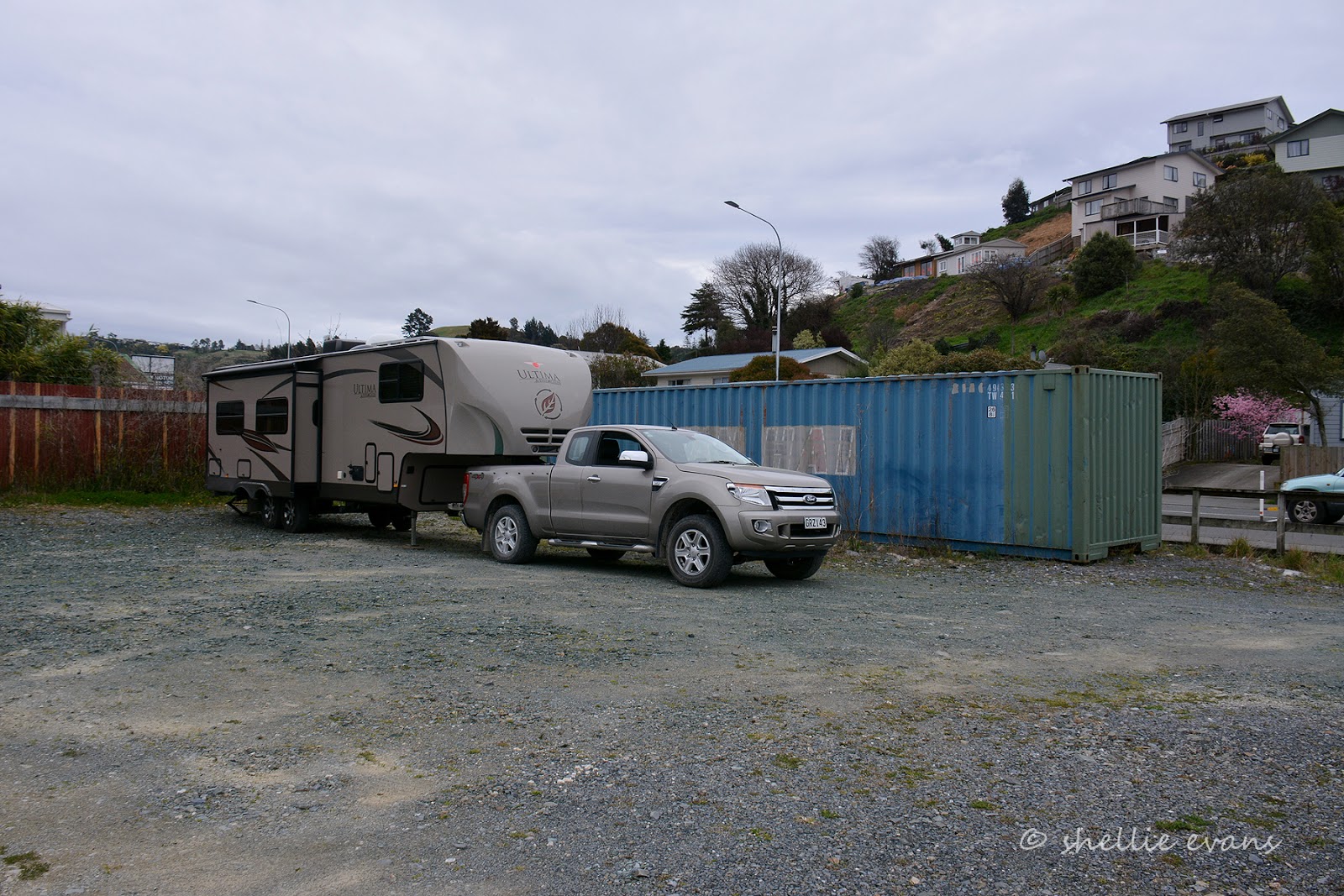
And as you can see it’s not all beer & skittles when you’re on the road- here we are parked up for the night in an overgrown empty lot with a shipping container and an old caravan for company and whole lot of dog sh*t;- David wanted you to know that after stepping in a few piles! The company who were doing the maintenance use the empty section and suggested we stay here so they could get an early start the next morning.


They offered the section again the next night but we decided to re-locate to the familiar and friendly Richmond Racecourse site where we’ve stayed a few times before. They were quite busy with a few permanents (max. allowed 3 months) and other full-timers passing through. We parked across a couple of sites and stayed hitched so we could pull out early the next morning.  It was a lovely surprise to be greeted by Shirley & Graham; they have been running the camp since the new year. We met them way down south in Manapouri last year when we were both staying at a great campground and where I took a helicopter ride to take photos of the campground.


We pulled out early the next morning and hauled ourselves back over the Rai Saddle and down into the Marlborough Sounds pulling into the DOC Momorangi Campground with enough of the day left to sit outside and enjoy the warm sunshine. That was after setting up the table and chairs for the first time this season and we also had our first taste of pesky sandflies for the season, or more to the point, they had their first taste of us. Summer is on its way!

I spoke to soon. We stayed at Momorangi for 7 days and had rain for 5 of them. It was heavy and steady for a couple of days and on and off for the rest. My hunter-gatherer decided he is a fair weather fisherman so the Takacat inflatable didn’t see the light of day & stayed tightly packed in the back of the ute. The weather, along with the fact that the blue cod fishery is out of bounds for 3 months sealed the fishing fate.


After Momorangi we headed into Blenheim to do a few chores, stopping at our regular stop, the Blenheim Racecourse. Another not so ‘beer & skittles’ park over, the grass areas were very boggy and rather than venture into our favourite spot between the grandstands and avoiding parking outside the Ballet School (where we had little girls swinging on the ramp bars just below our kitchen window and Mums parking their cars beside our front door) we backed in beside the tote office. Keeping well clear of doorway where the tractor is stored. Tractor? Too late. 7am the next morning the door is scrapped open across the gravel to stop right beside my bedroom window. The tractor roars & revs for about a minute before it bursts out the door on a mission. To be repeated again the following morning.


Chores done we were out of there and on our way to the DOC campground at Whites Bay. Whites Bay is located north east of Blenheim on the coast, at the bottom of the Marlborough Sounds but on the outside of the Sounds- if that makes sense.


If you headed north out of Picton on the Port Underwood Road, Whites Bay is towards the end, just over the hill is the beach settlement of Rarangi and the Wairau Plains. We came in from the Rarangi end- a steep and winding 6kms. No towing (not that, that stopped us on Queen Charlotte Drive into Momorangi) or large motohomes & vehicles are allowed further on past the bay on the Port Underwood road.


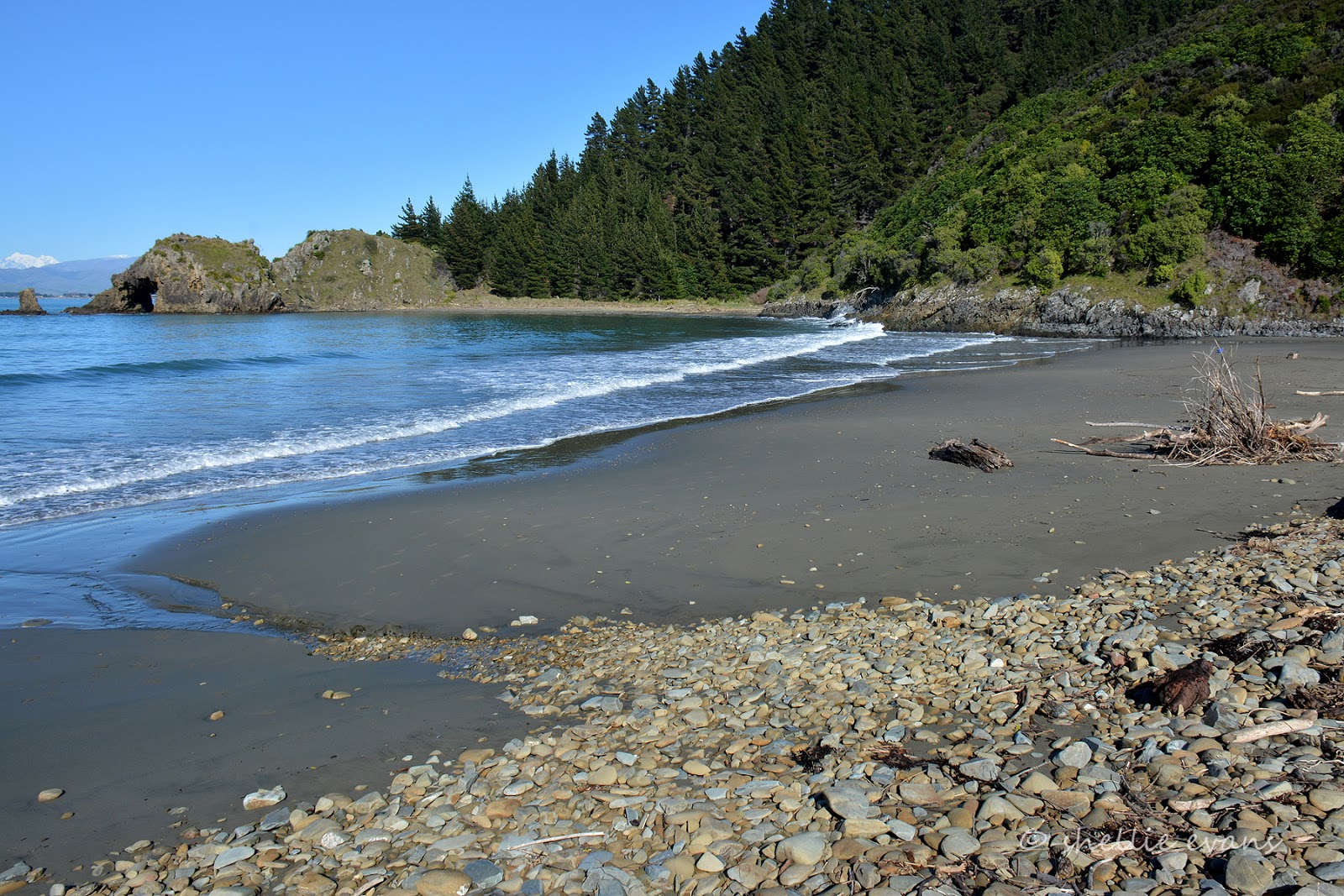
Whites Bay is a small sheltered bay (except for easterlies) that is obviously quite popular in the summer- there’s a surf club headquarters near the beach front and plenty of camp sites although all the top areas are closed off for the winter.


Across the bay is Cape Campbell and Marfells Beach. Whites Bay is named after Black Jack White, an American Black who deserted his whaling ship in 1828 and lived with Maori in the bay.


In 1866 the first of many telegraph cables between the North & South Islands was brought ashore at Whites Bay. The telegraphist's building that had been prefabricated in Australia was floated ashore and sits, preserved, in the middle of the DOC camp. 


Tonight while I was doing the dishes I heard the familiar sound of a couple of possums challenging each other just outside the van- it’s a weird noise and so loud that if you didn’t know what was making it you’d be quite worried and perhaps think a herd of cattle beast were about to rampage through the camp. David went out with his head torch on to locate them, he found them both close by. Well he found one and I heard the other one rustling about in the leaves at ground level. Beside me. Me without the head torch- that gave me a bit of a fright until it ran up the tree. David shone his torch on it while I shot it….with the camera  Cute eh?


Today we explored the Port Underwood Road (I’ll do a post on it later), initially we were just going to drive the road along the coast and turn around before it headed inland across to Picton but in the end we drove the whole loop- 80kms with about 50 of them on a narrow, gravel, very winding road, climbing up and over high ridges and down into tiny bays and then back up again.

There's a side road up one of the Sound arms with a monument towards the end that I had set my sights on seeing but when we got to the turnoff I had second thoughts. 14kms there and 14kms back on a similar or probably worse road just to see a monument- my head said “Don’t be silly”, the wanderlust in me said ‘Go for it”. This time my head won. David was pleased.

That got me thinking.....and so, I'm going to dedicate this post to my number one fan. A person who reads every blog post word for word and at least twice and probably 3-4 times and then asks when the next one will be posted. This person is the one who gave me the genes for my wanderlust and thirst for exploring the back-roads and byways, an extra special man who always took the long way home, despite the pleas from his wife and the whining kids in the back seat of the car.  Happy Fathers Day to my darling Dad xx