Showing posts with label railway. Show all posts

Monday, June 1

Exploring the High Country Lakes

Along with Lake Pearson, there are a number of other small lakes not too far away from our camp. We were on another mission; to find yet another fairly rare bird which makes it’s home on the high country lakes of the South Island.

The Australasian Crested Grebe/Kamana is a beautiful diving bird which is rarely seen on land except when they clamber onto their floating nests near the shore. Their legs are located right at the back of their body, this allows them to dive but makes it near impossible to walk. The grebe has a slender neck, a long sharp black bill and very distinctive head gear- a black double crest with bright chestnut & black cheek frills. These it uses in an involved and rather bizarre greeting & mating display. The grebe are also unusual in that they carry their young around on their backs.

Lake Grasmere was just up the road; access was through a farm gate, along a grass track across a paddock to a small DOC reserve on the edge of the lake. 


We saw our first Grebe, a juvenile on the waterfront in Queenstown last year, we now wanted to find an adult bird, to see their unusual plumage and hopefully a little of their courtship display.

Queenstown Juvenile Australasian Crested Grebe
The lake was a mill pond, the mountains behind reflected in the still water.


Any birds we could see were down the far end of the lake milling about. Looking through the binocs and spotting scope they turned out to be Canada Geese, Mallard Ducks and NZ Scaup- probably taking refuge from the duck shooting season on a protected lake.

Grebe tend to hang out by themselves and after a long sweep around the edges and over the lake we finally spotted two grebes swimming and feeding off to the side. There was no way I could pick them up with my camera so we decided to return the next day now that we knew grebes were in residence.

David searching for grebes with the spotting scope
The reserve’s tied-down (it must get windy around here) long-drop with the skull emblem on the door made a great subject with the Craigieburn Range behind.


We went back to the lake the next day but unfortunately the grebes once again stayed out of range. I took a shot just in case this was last we were to see of them- this is zoomed in and cropped to within an inch of its life but at least you can see, it's a grebe.


I was also unable to find any grebes at our end of Lake Pearson but there were smalls flocks of Australian Coot with their oversized feet, and NZ Scaup including this male (bright yellow eye) who I thought was nesting rather late in the season. Most scaup are usually quick to depart if you get near them but this one stuck it out while it’s mate did mad circles just off the edge and the rest of their friends swam away. So it was a surprise to see the next day that there were no eggs in the nest at all (hardly surprising when I thought about it) so I’m not too sure what it was up to- just lazier than the others and couldn’t be bothered moving when I approached.


We stopped in at the tiny Cass settlement not too far from our camp, Cass is little more than a handful of houses and a railway shed. But this is not just any shed, it’s a very important & iconic railway shed in New Zealand’s history (thanks Francis). There is an iconic painting by a famous New Zealand artist, Rita Angus, of this colourful little shed.


Before the line ran through Arthurs Pass to the West Coast, Cass was the railhead. Sadly, despite the paint job, the shed has seen better days; half a dozen swallows vacated the interior as I approached & it looks like dry rot has set in on one side. Unfortunately the sun was in the wrong position, so I couldn’t shoot it from the same POV (point of view) as Rita painted it.


These two quietly watched me as I walked about shooting the shed, I went across to talk to them and give them a pat. The younger horse at the back took exception to my visit and tried to bite me while I was talking to his friend; he got a short shift.


Not too far from Cass we took a side road in search of Lake Sarah, another small perfectly formed lake tucked below a large hill. Again there were a good number of water fowl on the lake and again, mostly over the far side. We settled down to have some lunch looking down over the lake and were rewarded when we spotted three grebes swimming by themselves, front centre of the lake. But once again they were too far out for my lens.

I decided to give my wide angle landscape lens a whirl which allowed me to capture the whole lake in the frame. The following two photos were also taken with the lens. I should use it more often but because we’re always on the move and I never know from one moment to the next what I’ll be shooting I find my zoom lens much more user friendly, if somewhat heavier!


We drove another few kilometres up the road, deciding to turn around once we could see that the scenery was not going to change much and that the road looked to go on forever.


The views were spectacular, big mountains, huge skies & a wide open spaces with the Waimakariri River off in the distance- this is further east from where we’d last seen it.


I took this photo of the sign on the door of a small shed beside the railway and near the lake; it’s was either a fishing hut or belonged to the Canterbury University who had ‘Keep Out’ signs along the road- perhaps they farm the land. Whoever owned the shed, they’d obviously had enough.


Monday, November 10

The Other Lake- Lake Rotoroa

It’s 42kms by road to Lake Rotoroa, the other big lake in Nelson Lakes National Park. Even though, as the crow flies (down to the bottom of our lake and over a mountain range), it’s only probably about 15kms. Arriving at the lake edge it looks very similar to Lake Rotoiti; a long narrow lake surrounded by mountains with a snow capped range at one end. Lake Rotoroa is a lot bigger than Rotoiti and we hear the fishing is better too; with both rainbow & brown trout, unlike Rotoiti which only has brown.


The lake has a similar jetty with a water taxi waiting and also protects the eels that live underneath the jetty. The water taxis transport trampers to & from the trail-heads at the far end of the lakes. There are quite a number of multi-day tramping tracks through the valleys and over the mountain ranges that join up both lakes.


This jetty has a picnic table on the platform at the end and a few tables scattered about on the lake front. Unless you are a fisherman or a tramper there’s not a lot to do at this lake although there are a couple of shorter walks for day visitors though one had a closed notice because of all the windfall on the track.


We wanted to have a look at the DOC campground as we thought we might bring the 5th-wheeler over here for a few days later in the week or stop off on our way to the West Coast next year. And just as well we did as we weren’t very impressed at all. The campground was located on a wide untidy grassy berm across the road from a few baches(holiday homes) and one road back from the lake. I don't think we'll be stopping here any time soon.


I thought this was the remains of a Maori waka (canoe) but in fact it belonged to Peter Johansen, a recluse who lived in solitude & eked out a living on the lake back during the 1920s & 30s.


You can click on the photo if you'd like to read more information-


After a speedy lunch on the lake front, and before we were eaten alive by sandflies, we decided to check out the Porika 4WD Track, a steep track that zig-zagged up the hillside beside the lake. Originally (and still) a service track for pylon maintenance it’s also a walking track and 4WD track with some magnificent views over the lake once you reach the top. Or should I say if you reach the top.


We only made it about a quarter of the way up before deciding to turn around and head back. It was too rocky and washed out for our "shiny’ and as the track was 10kms long we just didn’t want to bump & lurch our way all that distance there and back. We still got a nice view of the settlement down below and a little of the lake before we turned around. There were plenty of signs at the bottom telling us there were no turning areas but we managed to back into an elbow on one of the sharp corners without running off the edge.


Aside from a few baches there is one very grand lodge lakeside, Lake Rotoroa Lodge, a luxurious fishing lodge built in the 1920s and where the room rate for a couple is over $1000 a night. If you’re a keen fisherman you can be helicoptered anywhere in the park with a guide to help land you a big one. For a price of course. If you don’t fish then I think you might get a little bored out in the middle of nowhere.


Back on the road and heading home we stopped at the historic Kawatiri Railway Station site at the junction of SH6 (from Nelson) & SH63 to look at the old bridge and read about the railway station that used to be there.


For quite a distance along the Buller River valley the hills are swathed in yellow as the broom spreads out of control. Imagine the seed that going to come off this lot! Another introduced pest wreaking havoc in our countryside- but all the same, what lovely colours; the yellow broom, the green willow, the blue river & the rust red of the bracken.


Sunday, June 15

A Drenching in Dunedin

We said our goodbyes  to the family & left Invercargill behind once again. Next stop, Dunedin, where we planned to catch up with my nephew Zak who is in his 2nd year at Otago University. Zak hails from Whangarei, which is right up the top of the North Island, so he is a long way from home. I haven’t seen Zak in a couple of years and I was looking forward to catching up with him and I’m sure he was keen to see some familiar family faces too. Being the good auntie that I am, I made him a couple of casseroles and took him two large bags of groceries which he was very appreciative of. I think his five flatmates may have been pleased too. After a brief tour of a typical student flat, we left to have dinner in town where we also managed to watch the first All Blacks test against England albeit without a commentary.

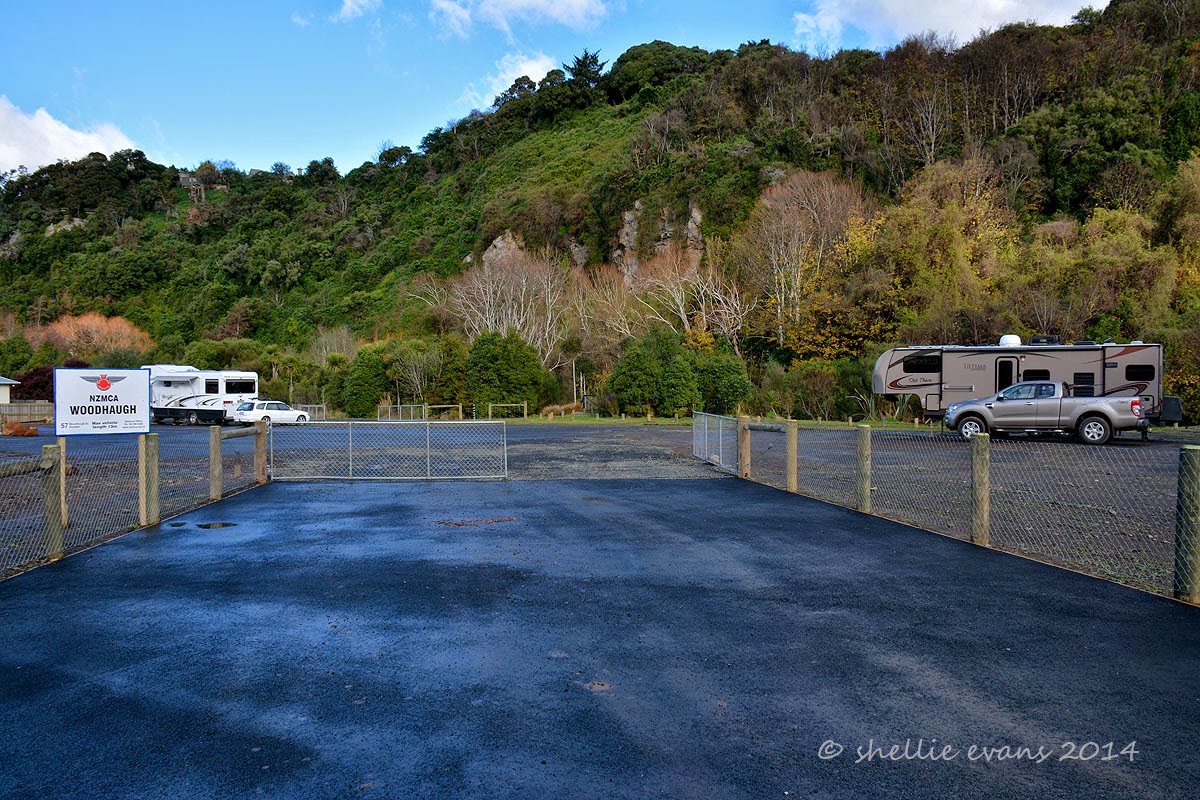
The NZMCA (Motorhome & Caravan Association) have a new Park in Dunedin, it opened just after Easter, we decided to park there for a couple of days while we caught up with Zak. At $3 per person per night it’s excellent value for NZMCA members. The Park is located in Woodhaugh and as it turned out is an ideal location. It’s just 4kms from the city centre & was only 1.8km from Zak’s flat near the university. The local NZMCA club members have a couple of working bees ahead of them to complete the site including some landscaping around the boundary and a concrete path to the water supply. The site is surrounded on three sides by houses but has a lovely stream and walkway on its rear boundary.


There were a couple of caravans parked up when we arrived but both left the next day and then for the next 5 days we had the site to ourselves. Yes that’s right. Five days. In fact we stayed the maximum 7 days allowed in the end because of the rain. We had rain & it was very cold for about 4 days solid but it was nowhere near as bad as the north of us was getting. We decided that there was no point in heading into the atrocious weather so we sat tight in Dunedin. A good decision as it turned out; Christchurch & Marlborough had severe flooding & gale force winds.
The rainy days proved ideal for us to catch up on computer work in the van during the morning and then in the afternoon we headed into the city to explore. We both thought the city centre and shops were great and enjoyed visiting some of the bigger arcades & department stores.

We spent one of the afternoons at Toitu Otago Settlers Museum. The museum recently reopened after major renovations that cost over $38 million dollars. This is the oldest and most extensive social history museum in New Zealand and what a fascinating place it was. You could quite easily get lost in nostalgia and spend many hours reminiscing about the good ol’ days here.

The Smith Portrait Gallery- Dunedin’s early settlers & pioneers


This beautiful gleaming black 1947 Buick 8 Roadmaster had a paper thin ply caravan on the back (designed & built by  Ralph Thompson in 1948) The height of sophistication in its day I would think.


I loved the way the cabinets were organised & backlit, displaying some great & unusual items from the past. You know you’re getting old when you recognise a lot of the exhibits, there were too many “blasts from the past” for my liking; a twin-tub washing machine just like the one I owned when I first went flatting, an aluminium frypan & Sunbeam cake mixer that were wedding presents.  And the black mobile phone; we had one at work & used to call it “the brick”.


There was even a cabinet with information on the long continuing debate between Australia & NZ about who invented the Pavlova, with the first recipe shown and when it was published (1929). The conclusion was that both countries named a meringue cake Pavlova in the same year, 1926 (the Russian ballerina Anna Pavlova was touring then) but NZ was the first to print the recipe with the name in 1929. Personally I think the squabble will continue, NZ definitely was the first!


I had to laugh when I saw the section on the introduction of microwave, there was my Alison Holst Microwave Cookbook! The very one I still use occasionally today, even if the silverfish have eaten a few pages! And the plastic muffin baking tray too, just like the one I had. Was it that long ago? It just seems like yesterday.


Typewriters, facsimiles, early computers & floppy disks!


And there was our first work computer, an IBM AT (Advanced Technology), the very first AT in Hawkes Bay that cost over $20,000 in the early ‘80s. And that did not include the screen which was an extra and then you only had a choice of green or amber writing. (Think what $20 grand could buy today). Oh and the storage capacity? It had an “impressive” 20mb. That’s right, 20 megabytes! To think that nowadays one of my photos alone is 24mb.


I’d highly recommend visiting the museum, but make sure you put aside a good few hours to explore, there’s much to see.

Beside the museum is the iconic and beautiful Dunedin Railway Station building. The sun was dropping (the one & only day it shone) but I managed to get a few shots just before the shadow moved onto the building.


As previously mentioned we also went to the Otago Museum (a natural history museum) to find Sultan & Sonia, the Lawrence Lions. They were up in the Animal Attic surrounded by hundreds of stuffed animals & birds from around the world. Something else in amongst the display had me carefully studying it, first in shock & disbelief and then a weird kind of fascination had me returning a couple of times to look at it further.

If you are a bit squeamish don’t read any further & definitely don’t look at the last photo………..

In a jar of formaldehyde was a Rat King. I wonder how many of you know what a Rat King is. They are actually not that common.

This from Wikipedia-

Rat kings are phenomena said to arise when a number of rats become intertwined at their tails, which become stuck together with blood, dirt, ice, faeces or simply knotted. The animals reputedly grow together while joined at the tails. The numbers of rats that are joined together can vary, but rat kings formed naturally from a large number of rats are rarer. The phenomenon is particularly associated with Germany, where the majority of instances have been reported.

Historically, there are various superstitions surrounding rat kings, and they were often seen as a bad omen, particularly associated with plagues.

Click on the photo to increase the size.
I think my fascination with the Rat King had a lot to do with a collection of similar subjects that Mum had when we were kids, not a Rat King but we did have single rats & mice along with pigs, calves, lambs, cats, dogs, possums and other mammals & even un-hatched birds. Unborn animals that were stored in jars of formaldehyde on a shelf in the kitchen cupboard.

That may seem a bit strange but it was the norm for us on a farm & there was a ready supply of subjects that came about by various means and from various people. I even remember taking the collection to school for a science project once, all the city kids totally intrigued and amazed at seeing unborn animals. I even think I won a prize. Anyway, if you’ve got this far then you’ll be ready to see Otago Museum’s Rat King.


All together now...... "EEUW!!"


Friday, January 3

Invercargill's Heritage Buildings & More

The light was just right later in the afternoon of New Years Day, bright with no sun to cast deep shadows, so I took the opportunity of clicking a few photos of the beautiful heritage buildings located around Invercargill city. And an added bonus was that there was virtually nobody about & hardly any vehicles to clutter my photos, the only negative being Christmas decorations that still adorned some buildings & streets. With Invercargill being a very small city I only had to move a block or two & then a street or two before stopping for the next photo, I would estimate that all these buildings are located within a 3km square. And they are pretty impressive for an often maligned southern provincial city. 
 

St Mary's Basilica- opened in 1905 & once described as Australasia’s “prettiest church” the neo-Classical architectural style Basilica is a dominant Invercargill landmark with it’s copper clad dome.

 
The Basilica is located across the rail line from the Otepuni Gardens where a lovely meandering path winds its way down the side of the creek & through the formal gardens.
 
 
Fleming & Company Flour Mills- opened in 1886 on the site of a wooden flour mill that was destroyed by fire, it remained operational until 2006 & is on the NZ Historic Places register. The mill is just a street away from our camp ground & just along the road from the Basilica.


Civic Theatre- The Civic Theatre is one of the most significant historical buildings in Southland & is designed in the Edwardian Baroque style. It was built in 1906 as municipal offices & has undergone a $15.8million upgrade to turn the rather tired “grand old lady” into a beautiful performing arts & events centre.


St Johns Anglican Church is next door to the Civic Theatre & designed in the Gothic Style by the same architect.

 
And just a block further down the road is the First Presbyterian Church which was designed in the Italian Romanesque style. The First Church contains over one million bricks, it was opened in 1915 at a cost of £18,181. This is one of the premier examples of church architecture in NZ, the bell tower rises 32 metres above the street & draws attention to the elaborate patterns of brickwork. Imagine following that while you're laying bricks metres off the ground. You would only have to get one wrong for it to stand out like a sore thumb.

 
Railway Hotel- Built in 1896 this beautiful building incorporates elements of Victorian, Edwardian & Baroque revival architectural styles. The hotel is one of the last remaining in NZ still being used for it’s original purpose.


Bank Corner & Trooper’s Memorial- the memorial  was erected to remember those that served in the African Boer War.

 
The former Bank of New South Wales stands on the site where Invercargill’s  commercial activity began in 1856. 
 
 
On one corner is a feature wall which has been constructed  to represent the Maori & Celtic roots of the city.
 
 
Historic buildings & facades of Invercargill City- there are many styles of heritage buildings within the inner city precinct from Arts & Craft & Nouveau/Deco to Victorian.

 
More bright & colourful city buildings including the Grand Hotel which certainly looks grand on the outside but a bit dubious on the inside!


I suppose we should be grateful that they don't demolish these old buildings but I can't for the life of me understand why the powers-that-be allow such garish paint jobs & advertising on such a lovely building. It'll be that all important dollar that does it.
 

WEA Building- The three storyed WEA building was built in 1912 as a Coffee & Spice Mill for David Strang & built in front of the original (& recently rediscovered) 1885 mill. Strang invented & patented soluble coffee powder.


The impressive Invercargill Cenotaph, c1986. This city doesn't do things in small.


Water Tower- This is a much better photo of the Water Tower than the one I posted a few days ago. The busy main road that runs along the front of the tower is closed to traffic at the moment (major road works) but I was able to pretend I was a resident & park there while I took photos.
 
The foundation stone for the tower was laid in 1888, the cupola was removed in 1934 & replaced in 1988 with the assistance of NZ Aluminium Smelters. The tower contains 200,000 common bricks, 80,000 red pressed bricks, 15,000 yellow pressed bricks & 4,000 pressed black bricks.


Southland Masonic Centre- The Masonic temple was opened in 1926 at a cost of £14,116 and is in the Graeco-Doric Style with a red brick & smooth plastered portico, supported by 6 fluted columns. The Lodge is regarded as one of the most impressive lodges in the Southern Hemisphere  & received a silver medal in 1934 from the NZ Institute of Architects.

 
And the final photo is one of the abandoned church that we can see over the back fence of the camping ground. I haven't managed to find out any history on this yet although there is someone living in there as I've seen a light on in the middle of the night. The windows are boarded up and the grass needs to be mown.


There is one more grand neo-Georgian style building I need to shoot but that will have to wait until we visit the park with the family. In the meantime I hope you enjoyed your virtual tour around lovely Invercargill City.