Showing posts with label bank. Show all posts

August 17, 2015

Historic St Bathans

After 6 nights we reluctantly decided it was time to move on from our comfortable parking spot behind the Commercial Hotel in Omakau.


And not least because we had sampled just about every dish on the pub menu! You would think that our expenses would have been less parked up in the countryside, but I think we had dinner at the pub four out of the six nights. Great for me not to worry about cooking after coming in from a long day of exploring and good for the hotel that we were repaying them for their generosity; free POP = meals in the hotel (although usually a CAP, over winter there is no power available). And I’d have to say that the meals were definitely a cut above the usual pub fare, probably because they do feed a lot of the Otago Rail Trail cyclists during the season. We also enjoyed the company of the locals and regulars each night and had a few good laughs with them.


Our next stop was at the DOC camp at St Bathans' Domain, just 34kms up the road and tucked into a corner below the Dunstan Mountains, St Bathans Range & Hawkdun Range (no wonder it was cold!).  It’s a huge camp ground and we were the only ones there for two of the three nights we stayed. That's if you don't count the hundreds of rabbits running about and the dozens of finches (and a nosy magpie) including the not often seen Green Finch. At one stage I counted 25 Green Finches feeding behind the van. It helped that I fed them a few handfuls of wild bird seed every morning.


Top- Green finches, male & female, centre- Yellowhammer(female), bottom left- Magpie, bottom right- Chaffinch(male)


On the last night another ute arrived and they set up a tent near the entrance, it rained overnight and they were gone early. We actually saw them again in Ranfurly later that day, where they booked a cabin for the night, probably because of their wet tent and the freezing cold weather.


Other than the occupants of the tent, we had St Bathans to ourselves. With a population of just 6 it’s not hard to see why. A track from the camp ground led past the rugby field and it’s rustic posts to the famed Blue Lake and the tiny settlement of St Bathans. Returning via the road we passed an old goat shelter with a new life- when we drove past here on the first day, we thought someone had hung out their underwear. Instead they had cut up their underwear and made flags out of them. And finally we caught a glimpse of spring, two cute lambs in a small home paddock.


We explored St Bathans main street on the first afternoon, it didn’t take long as it’s only  about half a km long. Present day St Bathans, now part of the Otago Goldfields Park administered by DOC, is a remnant of an old gold mining town originally named Dunstan Creek. Gold was discovered here in 1863 and over 2834 kilos of gold was extracted from the three largest mining operations. By 1864 1000 people lived in Dunstan Creek with a further 1000 in surrounding area including around 50 Chinese miners who lived in caves excavated in the local cliffs.


Dunstan Creek was changed to St Bathans in 1866 after miners requested the original name, given by the first surveyor of the district, be re-instated. By the late 1860s St Bathans was well established with 15 hotels, a number of gambling and dance halls and many businesses. Nowadays the local landmark, the Vulcan Hotel is all that remains of the hotels.

The shamrock on the front facade is a relic from the times of rivalry between the mainly Irish settlers from St Bathans and the Welsh settlers from Cambrian just down the road. The rivalry was known locally as “The War of the Roses” and at one time the acrimony between the villages was quite bitter. In the 1990s the hotel was put into a trust with shares owned by locals who lease out the hotel. There is also purported to be a friendly ghost in Room 1 of the hotel.


With nobody about and the welcome mat out at the Vulcan we decided to have lunch there. Well in fact we thought we might go for dinner but when David asked about booking for dinner the rather terse landlady said they were fully booked! ‘Really?’, he said with a raised eyebrow thinking of the masses of people he had seen in the last few hours. Not. I don’t think she liked David asking that. Luckily she was heading home (5 steps out the back door) and the barmaid who took over was very pleasant. We later learnt that there was a car or motorcycle club booked in for dinner.


Jack, the old Labrador kept a watchful eye on arrivals and departures and would barge his way through the front door whenever it opened. He’d then sit out on the road or across in the beer garden waiting for the next chance to return to his cushion in the lounge bar where he would wait to repeat the process all over again. I think Jack owns St Bathans, over the next couple of days I found him lounging on his back in the carpark, waiting for a tummy scratch (if I hadn't passed by he'd have been waiting all day), waddling down to the lake, and sitting on a bench seat up the road.


Unfortunately the weather was not the best while we were at St Bathans so there are no blue skies in these following photos of the historic buildings around town.


This is the most unusual Post Office building I’ve seen in a small town, and rather an imposing one at that. This one opened in 1909 and replaced an earlier small ‘dog box’ that began business in 1864. The building is now owned by DOC.


The Bank of New South Wales building was one of 3 banks in town and opened in 1864. It was also known as the gold office. It was moved to Oturehua (Idaburn Dam area) in the 1970s and the restored building was brought back to St Bathans by DOC in the 1980s.


Below is a selection of cottages and buildings from the main street of St Bathans including a couple that are replicas of old miners cottages that were on the same sites. They’re now used as holiday homes or are rented out for accommodation.

Top right is the ‘School House’, the large centre photo is ‘Rowan Cottage’,  owned by the local builder and timber merchant who built many of the houses in the district during the mining days. Second down on the left is the ‘Billard Room’ which was completed in 1881. It was part of the original Vulcan Hotel complex and was used as a temporary bar when the hotel burned down. Hay was stored in the loft and there were stables at the rear of the building. Bottom centre is the Pipe Shop which opened in 1866, it made sluice pipes for mining and later became a blacksmiths forge.


This cottage has a colourful history with the last occupier coming to St Bathans in the 1930s for his health. He had TB and St Bathans  had a reputation for ‘miracles’ because of the wonderful air. He was a cook for local shearing gangs and known for his short temper. He often got into arguments and would jump out of the truck and walk home, once returning with his shotgun to sort things out.


St Patricks Catholic Church was built in 1892 after the original church was destroyed in a storm. It is one of the few churches left with a surrounding graveyard and many of St Bathans early settlers are buried there.


At the other end of town is the St Alban of the Martyr Church and another favourite to add to my list. The original church blew down in a severe gale in 1870 and it’s replacement met a similar fate in 1883 (the wind must really blow in these parts).


Frederick Dalgety, founder of the stock and station agency Dalgety & Co, and then owner of Hawkdun Station bought the quarter acre section on which the church stood. He then arranged for a new church to be shipped out in sections from Britain, one of the first prefabricated buildings in New Zealand. He imported every item for the church including altar cloths and kneelers. Yet looking at the church and it’s corrugated iron exterior you would swear it was totally kiwi.


St Bathans main street looking down towards the Vulcan and the Blue Lake- through the trees at the end.


These are the old school ruins- the land and the ruins are for sale if you fancy building a home around them. The school was built in 1875 and enlarged in 1885 to cope with the growing population. Cracks appeared in the building after a large earthquake in 1943 forcing the school to close. Classes were held in the Post Office building until 1949.


On one of my walks back to the van, I decided to walk along Cemetery Road, a gravel track with a farm gate across the entrance. The road was not far from our camp at the Domain and I thought it might only be a short distance along the track to the cemetery. It turned out to be about 1.5kms along a rough farm track. I passed the remains of an old stone cottage along the way and being just before dusk there were dozens and dozens of rabbits running in all directions as I approached, it’s the most I’ve ever seen in this rabbit infested interior. The surrounding land alongside the track and throughout the cemetery were pitted with rabbit holes. Some areas were so bad it felt unstable walking over the top.

This is the public cemetery, and it’s where St Bathan’s non-Catholics were buried. It’s still in use today.


And I know you've probably been waiting to see photos of the main attraction at St Bathans, the Blue Lake. You'll have to wait just a little longer, the lake deserves it's own blog post.


April 27, 2015

A Cool Little Town- Hokitika

I stole the slogan for Hokitika because, well, it is a cool little town! We both have taken a liking to Hokitika, it a lovely place with plenty to see and do in town and the surrounding area.

Our next stop after Lake Kaniere was at the Shining Star Beachfront Accommodation at the northern end of Hokitika, this was so I could do a whole heap of laundry (there was no way I was going back to THAT laundromat) and dry things out after all the rain we had had at the lake. Shining Star is a combined campground with cabins and motel units set in spacious grounds with a small animal park and access to the beach. The sites were rather small but we managed to squeeze into one at the end of a row. It was a busy place, not only were all cabins & motels full every night, most of the powered sites were taken too- a lot of hire vans just in for the night.


Right outside our door was a flowering bottlebrush which a Bellbird/Korimako visited frequently- he was a little hesitant at feeding on the van side of the bush but I managed to grab a couple of good shots of him before he departed. I'm sure he is in his 'happy place' in the first shot.


Across the main road from the campground, up a short gravel track and tucked into a damp dark cliff face is the Glow-worm Dell, a free and popular attraction that has been there for many years. During the day it’s a dark alcove with a beaten up fence, moss and creeper covered walls & a small waterfall. But come night fall, the surrounding walls came alive with thousands of tiny lights from the glow-worms; it looked like a sparkly Milky-Way (yes, really. Look hard). I failed in my attempt to shoot the glow-worm lights, just a few faint sparkles.

Unfortunately I left it too late, it was far too dark and there were too many people arriving to try for a longer exposure. In such a small place I was worried my tripod was going to get bumped and people were waving their torches all over the show which turned the glow-worm lights off. I thought I might try again the next evening but guess what? It rained! And the next night too. So I’ll have to wait until the next ‘Dell’ we come across to try again.


We stayed at Shining Star until the rain stopped and then re-located to the south end of town, to the NZMCA Hokitika South Bank Park which is located funnily enough on the south bank of the very wide Hokitika River. Out in the countryside but still very handy to town. This was also a new record for moving sites, just 2kms down the road!


It’s just a long walk across the bridge and you’re in town. That’s the Park on the right at the end of the bridge. The ‘kiwi’ was located in a shingle pile beside the gate- someone with a sense of humour and a little vision- I thought it was a shoe cleaning brush from a distance! The old cow shed is in the paddock behind the Park and makes a lovely silhouette as the sun sets.


I had some family business to do in Hokitika; my father’s maternal aunty and her husband lived in Hokitika all their adult lives (before they passed on) and I wanted to visit Dad’s first cousin who still lives nearby in Ruatapu. I remember from my childhood Dad telling us about his auntie's house at the end of the Hokitika road-rail bridge and watching a 1960's home movie of cars waiting for a train to pass through. The old Hokitika Bridge was replaced in 1991 by this bridge- it followed the same course- and after talking to Roger (Dad’s cousin), the NZMCA Park is just up the road from where the house was located- the house was destroyed in a fire a number of years ago.

Roger told us of a trick he and his mate used to play at night. They would cycle into town over the bridge- I think he said it was nearly a mile long- they would cycle beside each other with their lights on and the people in the cars at the other end, who had to give way on the one way bridge, would think it was a car crossing and they’d wonder why it was taking so long until the boys got within sight when a lot of cursing and fist waving went on.

It certainly is a long bridge, with expansive views of the river down to the mouth and across to Sunset Point. I walked into town to take some photos of the beach and historic buildings.


The iconic HOKITIKA driftwood sign appears at the end of the walkway, from the main street to the beach. It appears on all the promotional material for Hokitika and usually with the brilliant colours of a stunning sunset behind it. I’ll have to see if I can replicate it later in the week.


On the beach in front of the sign are the remnants of the annual driftwood sculpture competition which was held about 6 weeks ago. Only the sturdier works-of-art have survived the battering of a west coast beach. A memorial concrete ‘comfy’ chair sits nearby- visiting tourists use it as a prop as they take photos of the sign and beach.

The ‘Before I Die’ bucket list is a worldwide art initiative that encourages people to contribute the things they want to achieve before they depart this world. I like the wag who contributed the second to last entry on the board- Before I die I want to....buy a rain poncho-  they were obviously here the same time as us! One of the other entries said they wanted to buy waterproof shoes.


I did come back for sunset but missed the best night of all when the sky was a blaze of fiery reds and golds- I’ll save them for another post. And I even missed the boat on this shot, arriving seconds after the golden ball disappeared below the horizon. The trick is to catch it in the centre of the 'o'.


The Whitebaiter’s Walk is located on a grass reserve at the entrance to the town, it's a visual history of whitebait.


There are 26 large boards with whitebait facts, figures, sayings and photos of the tiny little delicacy known as ‘white gold’.


I expected there to be a big whitebait mounted on a stone pile; a bit like the big salmon or big carrot in other towns. After all, Hokitika is the home of the whitebait but then again it’s the home of jade (greenstone or ponamu), home of the Wildfood Festival & home of the Driftwood Sculpture so it would probably get a little crowded with all those vying for attention at the entrance to the town. The best way to celebrate whitebait is to walk across the road from the Walk and buy yourself a whitebait fritter from the fish ‘n chip shop.

The right hand photo on the second row shows registered whitebait stands on Mokihinui River, not necessarily current). That's a very short stretch of river, the road on the right bank is the one we traveled down when we stayed at the Gentle Annie campground on our way to the top of the West Coast. This was just one of the rivers shown on the board, others were just as crowded.


I've posted this board separate so you can read the impressive size of the catch back in 1944. It's a wonder there are any whitebait left (click to enlarge).


Hokitika’s Memorial Clock Tower takes centre stage in the town. The clock tower also serves as the South African War Memorial and was unveiled in 1903. Hokitika celebrated its 150th birthday back in December.


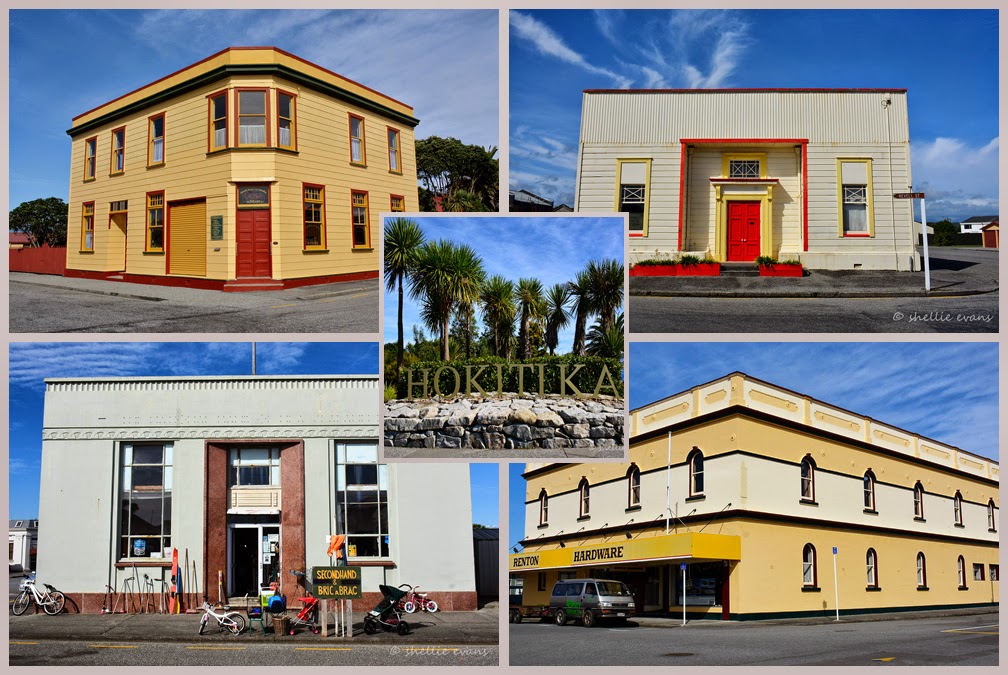
Some of Hokitika’s historic buildings- three former banks and a movie theatre.


From left to right- the art deco Regent Theatre, former Government & Courthouse Building with a statue of Sir Richard Seddon (NZ Prime Minister 1893-1906), former Custom House on the banks of the Hokitika River, the museum is housed in the historic Carnegie Library Building, opened in 1908 and funded by US steel magnate Andrew Carnegie. And the precious little Revell Street Cottage.


Another wit in town- this was across the road from the All Saints Anglican Church I was photographing.


And once again I say, this will likely be the last post for a few days. We're moving on into Arthurs Pass later today.....if the rain stops! 


January 03, 2014

Invercargill's Heritage Buildings & More

The light was just right later in the afternoon of New Years Day, bright with no sun to cast deep shadows, so I took the opportunity of clicking a few photos of the beautiful heritage buildings located around Invercargill city. And an added bonus was that there was virtually nobody about & hardly any vehicles to clutter my photos, the only negative being Christmas decorations that still adorned some buildings & streets. With Invercargill being a very small city I only had to move a block or two & then a street or two before stopping for the next photo, I would estimate that all these buildings are located within a 3km square. And they are pretty impressive for an often maligned southern provincial city. 
 

St Mary's Basilica- opened in 1905 & once described as Australasia’s “prettiest church” the neo-Classical architectural style Basilica is a dominant Invercargill landmark with it’s copper clad dome.

 
The Basilica is located across the rail line from the Otepuni Gardens where a lovely meandering path winds its way down the side of the creek & through the formal gardens.
 
 
Fleming & Company Flour Mills- opened in 1886 on the site of a wooden flour mill that was destroyed by fire, it remained operational until 2006 & is on the NZ Historic Places register. The mill is just a street away from our camp ground & just along the road from the Basilica.


Civic Theatre- The Civic Theatre is one of the most significant historical buildings in Southland & is designed in the Edwardian Baroque style. It was built in 1906 as municipal offices & has undergone a $15.8million upgrade to turn the rather tired “grand old lady” into a beautiful performing arts & events centre.


St Johns Anglican Church is next door to the Civic Theatre & designed in the Gothic Style by the same architect.

 
And just a block further down the road is the First Presbyterian Church which was designed in the Italian Romanesque style. The First Church contains over one million bricks, it was opened in 1915 at a cost of £18,181. This is one of the premier examples of church architecture in NZ, the bell tower rises 32 metres above the street & draws attention to the elaborate patterns of brickwork. Imagine following that while you're laying bricks metres off the ground. You would only have to get one wrong for it to stand out like a sore thumb.

 
Railway Hotel- Built in 1896 this beautiful building incorporates elements of Victorian, Edwardian & Baroque revival architectural styles. The hotel is one of the last remaining in NZ still being used for it’s original purpose.


Bank Corner & Trooper’s Memorial- the memorial  was erected to remember those that served in the African Boer War.

 
The former Bank of New South Wales stands on the site where Invercargill’s  commercial activity began in 1856. 
 
 
On one corner is a feature wall which has been constructed  to represent the Maori & Celtic roots of the city.
 
 
Historic buildings & facades of Invercargill City- there are many styles of heritage buildings within the inner city precinct from Arts & Craft & Nouveau/Deco to Victorian.

 
More bright & colourful city buildings including the Grand Hotel which certainly looks grand on the outside but a bit dubious on the inside!


I suppose we should be grateful that they don't demolish these old buildings but I can't for the life of me understand why the powers-that-be allow such garish paint jobs & advertising on such a lovely building. It'll be that all important dollar that does it.
 

WEA Building- The three storyed WEA building was built in 1912 as a Coffee & Spice Mill for David Strang & built in front of the original (& recently rediscovered) 1885 mill. Strang invented & patented soluble coffee powder.


The impressive Invercargill Cenotaph, c1986. This city doesn't do things in small.


Water Tower- This is a much better photo of the Water Tower than the one I posted a few days ago. The busy main road that runs along the front of the tower is closed to traffic at the moment (major road works) but I was able to pretend I was a resident & park there while I took photos.
 
The foundation stone for the tower was laid in 1888, the cupola was removed in 1934 & replaced in 1988 with the assistance of NZ Aluminium Smelters. The tower contains 200,000 common bricks, 80,000 red pressed bricks, 15,000 yellow pressed bricks & 4,000 pressed black bricks.


Southland Masonic Centre- The Masonic temple was opened in 1926 at a cost of £14,116 and is in the Graeco-Doric Style with a red brick & smooth plastered portico, supported by 6 fluted columns. The Lodge is regarded as one of the most impressive lodges in the Southern Hemisphere  & received a silver medal in 1934 from the NZ Institute of Architects.

 
And the final photo is one of the abandoned church that we can see over the back fence of the camping ground. I haven't managed to find out any history on this yet although there is someone living in there as I've seen a light on in the middle of the night. The windows are boarded up and the grass needs to be mown.


There is one more grand neo-Georgian style building I need to shoot but that will have to wait until we visit the park with the family. In the meantime I hope you enjoyed your virtual tour around lovely Invercargill City.