June 12, 2014

Old Cromwell Town & Lowburn Colours

The construction of the Clyde Dam and filling of Lake Dunstan in the 1980s brought major changes to Cromwell. Two narrow gorges with their wild rivers, many acres of orchards & Cromwell’s original commercial centre were all drowned by the new Lake Dunstan.

The old town centre & historic bridge were not forgotten though, many of the original buildings were deconstructed & rebuilt further up the road to form part of a historic precinct at the end of Melmore Terrace and overlooking the Lake Dunstan. Other buildings already at the high end of the terrace were restored.

Resited- Jolly’s Grain Store- built pre 1880


Resited- London House- (Belfast Store) built 1880

 
I wonder how many children have clambered over Toby & his cart.
 

The Masonic Lodge was built in 1901 & still stands on it’s original site which was once the top end of Melmore Terrace.


Lake Dunstan, the Kawarau River arm, looking towards Bannockburn & the Carrick Range which we crossed over when we drove the Nevis.


Cromwell was once known as “The Junction” being that the Clutha & Kawarau Rivers met here in two deep & rugged gorges. As it turned out, an ideal site for a hydro lake to form behind the Clyde Dam which is many kilometres downstream.

And the historic bridge? A bridge that crossed the Clutha River & one I can’t add to my Clutha River Bridges because it’s 11 metres under water! It’s beneath the clear water in the top right photo below. There is a urban myth that there’s still a Mkl Zephyr parked on it. The new Cromwell Bridge can be seen at the back of the top left photo below.


Most of the buildings in the old town & surrounding area were demolished to make way for the new lake, others like the facade from the old Athenaeum in the bottom right photo were left as they were & filled in with soil. This gives a good indication of how far Melmore Terrace of the old town has been buried, only the top half of the building is exposed. Some of the stone work from the old school also remains (centre photo).

Where once the wild Kawarau River flowed there’s now a calm & beautiful recreation lake with the vineyards of Bannockburn reaching up the dry & rocky hills behind.


Cromwell has many orchards along with the vineyards, these Y shaped apricot trees provided me with some good colour along with plenty of leading lines.


You may remember that we stayed at Lowburn on the shores of Lake Dunstan twice while in the area. The autumn colours were showing on our first visit but by the time we returned three weeks later the yellow of the poplars had intensified to a deep rich gold and looked stunning against the blue skies.

On some mornings the fog rolled in early and then lifted, once the sun came up, to reveal these golden poplars & willows across the other side of the lake.


There was also a row of poplars along the back fence of a paddock over the road from the camp site that always looked fabulous backlit in the late afternoon sun.


And even more stunning from the sunny side. I loved the decreasing height of the trees as they moved up the hill.


Just along the road from the campsite and up a side road is the (new) settlement of Lowburn, you’ll remember from my "Collecting Water” blog that there’s a spring beside the hall that we use, this is the small pond, complete with white ducks, near the hall with “Sugarloaf” behind.


The dam construction affected Lowburn too, much of the original Lowburn flat was inundated by the creation of Lake Dunstan. The church and hall were relocated to this higher site, but the old bridge, the camping ground and the hotel are forever under Lake Dunstan.

June 11, 2014

Gibbston Valley Gold

It’s not only wine that brings “gold” into the valley.


This vineyard has gone into receivership, the grapes left on the vines for the birds to enjoy, which they were; the birdsong was deafening. We know this because we had to wait at a road stop for about 30 minutes while they were blasting rock off the bluff over the gorge road. The stop/go lady filled us in on why the grapes were uncovered & still on the vines.


The grapes have been harvested, the vines uncovered on this vineyard.


Approaching the Nevis Bluff corner, this is where the Nevis River enters the Kawarau River. We crossed a much smaller Nevis River when we drove the Nevis Road. I find it fascinating when I look at a map how close, as the crow flies, it is between different areas we have visited.


Autumn in the Kawarau Gorge


Roaring Meg Power Station reserve, Kawarau Gorge


Goldfields Mining centre, Kawarau Gorge, Cromwell


The Victoria Bridge over the Kawarau River

AutumnAPR_3268

Poplar sunbursts


Chard Farm Vineyard in the Gibbston Valley is located on a spectacular narrow terrace above the Kawarau River Gorge and on the other side of the main highway through the gorge. The poplars line the road into the winery.

   
Chard Farm Winery, Gibbston Valley, Queenstown


Old Town Cromwell & Lowburn next......

June 10, 2014

Backup a bit…Arrowtown & the Lower Shotover

Backup a bit to those gloriously sunny blue sky autumn days that now seem a long while ago. I’ve only just managed to process the dozens of photos I took during the few weeks we were in Arrowtown & Cromwell so I thought I’d do another couple of blog posts as I didn’t want you to miss out on seeing some of them, especially the spectacular autumn colours. Central Otago is certainly the region to experience autumn in all it's glory. I’ll try not to “talk” too much otherwise I’ll be here for the next few days typing so here is a pictorial tour of Arrowtown & the Lower Shotover valley.

These first three are from the farm that we stayed on for the Arrowtown Autumn Rally. The farm had many old carts and wagons dotted around the paddocks. The caravan didn’t look like it had been used for many years.

The old & the new


Woolshed longdrop (kiwi for outhouse)- a room with a view


A neglected cart near the front gate.


I left my visit too late in the afternoon to the Lower Shotover Road historic bridge, the bridge & river were disappearing into the shade. Built in 1909 this former main highway bridge, now fully restored, is used as a pedestrian & cycle bridge over the Shotover River.


Looking towards The Remarkables with the replacement highway bridge in view.


And towards Coronet Peak-


The Crown Range behind Arrowtown & the first snow of the season.


Shotover River Valley, near Arthurs Point


Arthurs Point, Queenstown


A quirky cluster of letterboxes at Arthurs Point, Queenstown.


Edith Cavell Bridge, Arthurs Point, Upper Shotover River – Built between 1917-1919, it is a “parabolic rib arch design” and one of the most iconic sights of Queenstown, the Shotover River & Skippers Canyon.


The season’s first dusting of snow on Coronet Peak, look closely for the chairlifts and the buildings at the base of the ski-runs.


Next up...Gibbston Valley Gold

June 09, 2014

The Final Chapter- The Lawrence Lions

Of course after all the intrigue created by my discovery of the existence of the Lawrence Lions there was just one more thing I had to do to complete the story; visit the lions at the Otago Museum’s Animal Attic in Dunedin.

This is where Sultan & Sonia now “live”, in a glass case surrounded by hundreds of stuffed animals, birds & bugs from around the world. Really quite a grotesque sight, but morbidly fascinating all the same. Those Victorians have a lot to answer for.


Footnote- the internet really is an amazing place. I received a comment on my blog post (link above) from the daughter of the man who shot the lions.

From Sarah Lodge;
Hi, it was my father who shot the lions. He is a real animal lover and hated killing such magnificent creatures. However, Craig the 6 yr old boy had been quite badly injured along with his mother by Sonya the female, so it had to be. 

Collecting Water

We’ve been asked a few times how we go about collecting water for our fresh water tank while we’re on the road. Our tank holds 160 litres and we use on average 40 litres a day so basically we have four days of water available after filling. The 40 litres includes; daily showers, hand washing, toilet flush and dish washing and while we are cautious with our water use, we are not paranoid. The 40 litres does not include drinking water, we collect & carry that separately. When there is water available on our site, usually at a fully serviced camp ground, it’s not a problem we fill via our hose direct into the tank. Occasionally we’ll in fact by-pass the tank & water pump, connecting the hose to the van permanently (while on site), which supplies the water, under pressure, directly to the taps in our van.

On some of the sites that we have stayed at there is a potable water tap available but usually some distance from the van. On other sites like the DOC (Department of Conservation) camp sites or when we're freedom camping, there is always a river, stream or lake not too far from the van with good clean water available. And of course when it rains there is an excess amount of the crystal clear stuff falling off every corner of the fifth-wheeler and the awning which is usually extended & tied down (providing there is not gale force winds of course). Often one corner is tied lower than the other to help with the flow & increase the amount collected. The awning is also a good shelter & protects the ground in front of our door from becoming too boggy.

Some RVs have a hose connector & funnel system in the corner of their awning with a hose attached which is then fed directly into the tank. Great for when it's raining but how do they fill the tank when it’s not raining? This is how we do it. And it’s an inexpensive set up too!


One 40 litre flexible rubber bucket from The Warehouse $6
One plastic hook with sucker pad from Payless Plastics $3
One large funnel with bendy nozzle from Payless Plastics $6
One strong man.

The rubber bucket can be used to collect rainwater off the end of the awning (after a suitable wash down period has elapsed). In a heavy downpour it fills in less than 5 minutes. It can also be used to collect water from the stream, lake or nearby tap. Being flexible is very important, it aids with carrying it over rough terrain and also bends to fit between rocks etc when filling it out of a shallow stream.

We actually have two rubber buckets and we keep them for their intended use only so there is no contamination. Even though we don’t drink the tank water we still do use it to clean our teeth, cook vegetables & do the dishes. The blue one is for fresh water only & I also use it to cart dry &/or wet laundry. Our black one is used to carry any grey water we may need to empty before moving off site (emptying it in the appropriate place of course), it’s used by David to wash the vehicles & I guess in an emergency it could be used for black water. Luckily that emergency hasn’t happen yet….*touch wood*

For our drinking water we have a 7 litre Rubbermaid water container with a tap that sits on our bench & three 10 litre containers that we top it up with. We rotate two of them & keep the third for emergencies. We fill these with rain water, tank water or spring water as we come across supplies. As a last resort I will buy 10 litres of water from the Supermarket at around $7. I am not a fan of treated city water & can taste (and smell) chloride & fluoride from 100 paces.

We have found some excellent water supplies on out travels, two that spring to mind (no pun intended) are at Weir Beach Reserve in the Catlins & the spring outside the community hall in Lowburn, Cromwell where for a gold coin donation you can fill your tanks. Both have crystal clear spring water.


Weir Beach Reserve, Catlins

Lowburn Community Hall
 

June 05, 2014

Great Kiwi Kid Pastimes

It’s nearly time for us to leave the family & this cold southern winter behind and head for warmer climes. And wouldn't; you know it, right on queue, the sun has now decided to made an appearance. But we will not be tricked, I know it’ll only be for a day or two, we’ve had nearly 3 weeks of cold, windy, wet &/or overcast days with just the odd day of sunshine thrown in. It hasn’t mattered too much as we’ve had another lovely time catching up with the family, although as it’s not the school holidays, we’ve had a bit more time to ourselves tucked up in the cosy warmth of our little home on wheels. This has been fine as we both had a list of chores to do while in the city and I’ve also managed to sort out a lot of my photos and a few issues on my laptop. No cabin fever so far!

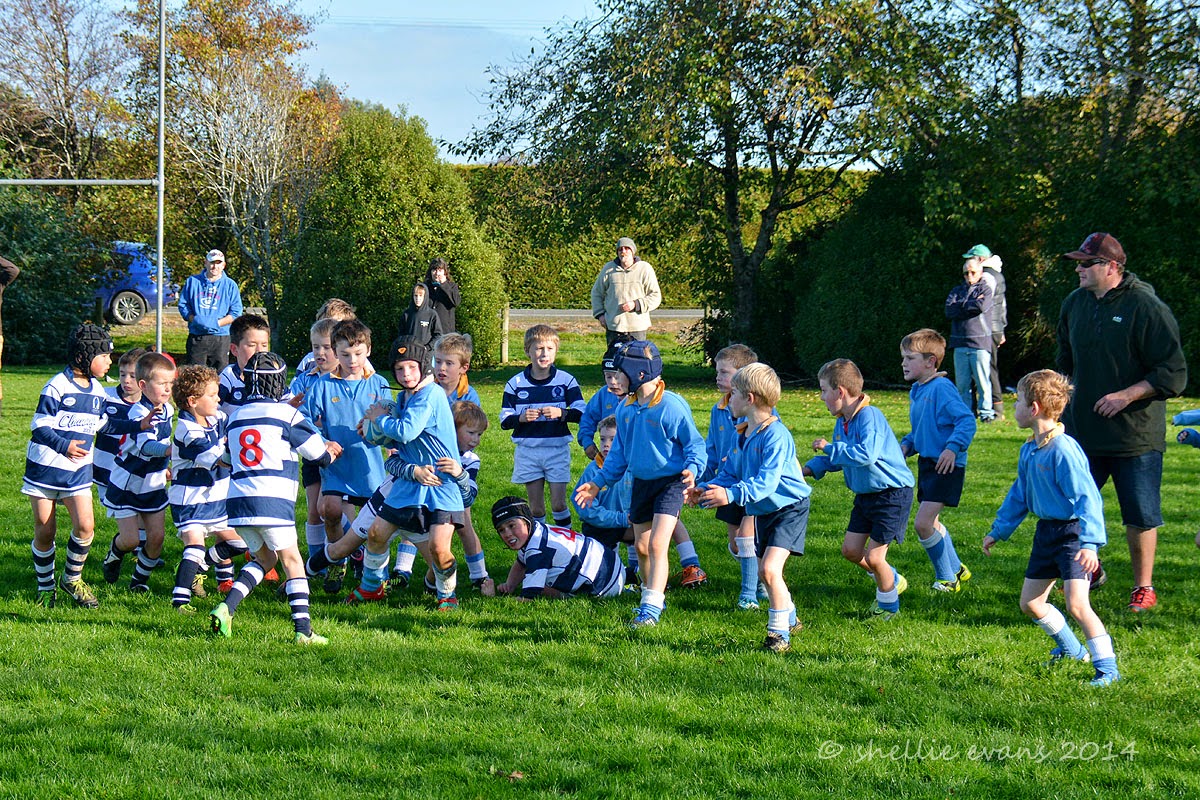
Ollie & Ruby are now into winter sports and we went along to watch them play rugby one Saturday morning. This is “grass-roots” rugby, where future All Blacks begin their dreams of the big time. Ruby is 4 years old and there are 6 girls in her team. The coaches & referee just about out number the players on the field while proud parents & grandparents watch & encourage from the sideline.

The small fry play “Rippa Rugby”, it’s very safe and non-contact and easy to play for both boys and girls. It's great for their ball skills & running exercise. The players wear material tags that are velcroed to a belt, one at each side. The opposition players pull the tag off rather than tackle the player with the ball, which is then passed onto the opposition. I’m not sure some have grasped the concept though as I did spot one little guy rip the tag off his own team mate. The kids look so cute in their miniature uniforms with oversized shirts & huge numbers. I give it a 10/10 for the entertainment factor alone; watching the kids run the wrong way, take their time to pick up the ball, chat to a friend on the sideline, compare clothes or walk off to talk to Mum or Dad had me laughing out loud for most of the game,

Team talk


“GO RUBY, run Ruby!”


Missed & it’s a try! Ruby scored three tries during her game.


Dreaming of the try line…..


The Opposition

Comparing boots (it's a girl thing). Kicking for goal.


High fives for the opposition, learning the etiquette of team sports.


Next up was Ollie who is now playing the real game, although a little tentatively. This game was meant to be eight aside but I think the boys on the bench were keen to not miss out (from both sides!)


“Go Ollie” – I like the parent on his cellphone in the background or maybe it was an All Black selector in disguise checking out the up and coming talent.


No subtlety in the line out, Ollie says “Yeah, give it to him”, the boy behind says no “Me, me, me!”


This past weekend we all went fishing, Ollie & Ruby had new fishing rods that they were eager to try out. Over Easter they had been fishing with handlines off the wharf on Stewart Island and had caught a bucket load of fish, including Blue Cod. They’d now moved up to rods and Ollie especially, was keen to go fishing. Monday was a holiday and unfortunately it dawned wet & cold but Ollie was determined to go and when the rain cleared later in the morning we packed up lunch and headed to Riverton, about 30 minutes south of Invercargill.

Embracing the great outdoors! A picnic lunch done the Southern way; wrapped up warm in many layers. The wind was very cold & the rain promising to return. This is at the mouth of the Riverton estuary.


Poppa set up the rods with spinners on them and the kids had a few casts. Ollie managed it very well but Ruby soon lost interest preferring to play in the water and beachcomb. We had to explain to them that catching a fish was nowhere near guaranteed and some days you wouldn’t catch anything but I think they still thought that the fish would just jump out of the water & land at their feet like they did on Stewart Island.


After awhile, with nothing caught but seaweed, we decided to move to the Riverton wharf. We stopped at the shop to buy some bait and Poppa changed the gear over on the rods & they were set to fish again. Ollie had success on his first wind in; a pipi (NZ shellfish) liked the look of his bait and in turn became bait itself.


Unfortunately the rain then set in and the bitter cold wind turned into a bitterly cold wind.


Just after we said 10 minutes more and we’ll call it quits, Ollie couldn’t wind in his line. Poppa took over & he nearly couldn’t wind it in either. There was a dead weight on the other end, was it snagged? No, it moved a little. The rod nearly bent double & David thought it might break but slowly & surely he wound it in accompanied by much excitement & encouragement from us all. As Rachel was leaning over the edge trying to manoeuvre the tiny net around its tail the hook and weights went flying and the fish disappeared back into the murky water. Lucky escape!

The rain was getting heavier but the hunt was on, we’ll fish for another 20 minutes. And sure enough within 5 minutes there was another dead weight on the line. This time it was netted. But what was it? It seemed to be a very big fish to be catching off the wharf. I only ever remember catching sprats. This was a fish a kid could be proud of.


We thought it might have been a catfish at first but then realised it was more likely to be a red cod. Which in fact it was. We decided to return it to the water, a good exercise in “catch & release” for the kids & more importantly & the truth being known, no need for a smelly mess if Poppa had to fillet it. We’ve since found out that Red Cod aren’t that nice to eat, being bottom feeders they are often full of worms, their flesh turns to mush when cooked too. They are also “despised” because they don’t put up any fight or resistance when hooked, hence the dead weight & non-movement. We didn’t mind though, they provided a whole heap of excitement on an otherwise miserable day.

And of course the kids now think you do catch a fish everytime you go fishing.