Showing posts with label oparara basin. Show all posts

Sunday, April 12

Moria Gate Arch- Oparara Basin

The 30 minute walk to the second arch in the Oparara Basin is through some stunning scenery, the rainforest is an enchanted wonderland; a large variety of mosses in all shades of green cling to and drape off every available trunk, branch & twig. Soft green ferns cover the forest floor and taller tree ferns spread their feathery fronds overhead. There’s also alot of birdsong and the odd alarm call, as flashes of movement catch our eye as birds fly from tree to tree.


A lot of foresight, money, hard work & volunteer hours has gone into making the Oparara Basin the jewel in the crown of the northern West Coast’s ecotourism attractions. It’s a pity that the road can’t take bigger tour buses & motorhomes as many people miss out on seeing this spectacular area (actually, that in fact might just be a good thing after seeing the over-run carparks surrounding Punakaiki Rocks later on in our trip).


More enchanted forest and a natural moss topiary.


The track eventually led to this rocky hole in the ground. We were thinking this can’t be the Moria Gate Arch surely? Then David spotted a chain rope down the side of the rocks and after clambering through we inched our way down over the boulders into darkness.....


…to be greeted by this amazing sight- the Moria Gate Arch! The arch was named in 1984 after the mythical gate to the dark world in the Lord of the Rings trilogy.


And just to show you the shear size of the cavern, there’s David standing on the rocks to the side, looking for blue ducks again.


The Moria Gate Arch is viewed in 3D, there's the arch above- looking into the cave- then the one below looking down stream from inside, the rocks in front are about where David is standing in the photo above.


And the third one, looking back in the other direction, up-stream.


And up-stream again, with David silhouetted to put things in perspective.


Moria Gate Arch is spectacular and by far the loveliest of the two arches, a visual treat and an amazing feat by Mother Nature. Absolutely stunning.


We clamber back out through the opening in the rock meeting another couple finding their way inside. If you ever visit Moria Gate, don’t be put off by this odd entrance, it’s quite safe with the chain to help you up and down but sturdy shoes are a must to help with grip on the slippery rock surfaces.


The Moria Gate Arch Track forms a loop crossing over the Oparara River and passing the Mirror Tarn on it’s way back to the carpark. I decide to walk the loop- it’s another hour back to the carpark, David retraces his steps and will then drive to the Tarn carpark and meet me there. It is a shame as just a little further on the forest becomes even more beautiful- if that is possible- I could explore out here for hours, studying every little plant, moss and insect I came across. There are so many beautifully formed miniature mosses & lichen. I’m not sure the short bit of track with the moa print paving stones over the top of the arch is quite the look but I guess it’s providing protection.


It’s actually a surprise when I come to a short side track that leads to a lookout with a view back towards Moria Gate Arch. At this stage I hadn’t realised that those moa print pavers actually led me over the top of the arch. You couldn’t see down either side, it was just a track through thick bush. Clever idea and it does protect the arch.


The arch was stunningly beautiful from this angle too, and that tannin stained Oparara River just adds to the beauty and mystique of the place.


As I said the track just gets prettier and prettier, this has to have been one of the most beautiful walks I’ve done. I just wish David had done it with me.


I caught sight of movement a few steps ahead of me and found this beetle scurrying across the path. This is a native Stinking Ground Beetle, the Maori name Kurikuri means dog-like. It can give a sharp nip- one look at those pincers tell me that- and also emit a powerful stench if disturbed. I was unaware of that defense. I carefully transferred it to the end of this stick, took some photos and then poked the stick in a log, which the beetle quickly disappeared into. He must have been happy with me, no stench detected!


I stopped once again at the Mirror Tarn, the sun had come out a little since my earlier visit and the reflections were not so sharp. I found a henna painted WWOOFer with a weird hairdo contemplating life beside the tarn and taking up most of the tiny viewing space. He told me he’d brought a car load of backpackers up to the Basin for the day and they were off walking. He just wanted to soak up the beauty and I got the impression I was disturbing his peace with my clicking! Smile


I left him to his solitude and headed back down the track which was running along side the Oparara River again. I met David about halfway, he’d brought the car up and was walking in to meet me.


We had an awesome day exploring the Oparara Basin, seeing amazing limestone arches, unusual caves and the most beautiful scenery- my highlight was the Mirror Tarn followed a close second by Moria Gate. I’d highly recommend a visit to this very special place if you are in the area. If you’re in a motorhome though, I’d beg, borrow or steal a car so you can get there safely. Or arrange a tour from Karamea.

I have a little story to share before I leave the Basin-
I very nearly lost my phone to the Oparara Basin- now that would have been a disaster & you’d most probably still be waiting for blog posts. I’d be lost without my phone’s ‘hotspot’ (yes, I could have used David’s, but he’s rather protective of his data).

You’ll remember I very nearly killed my phone when we walked the Sawcut Gorge, forgetting that I had it in my back pocket as we waded through a deep pool. After some tender loving care and much swearing and frustration David managed to nurse it back to health. Phew many $$$$ saved.

So it was with great alarm and an awful sinking feeling when I heard a ‘kurplunk’ as I rearranged my clothing after visiting the loo before we left the carpark for home. ‘Oh no, bloody hell’ I thought (or words to that effect) and without any hesitation (which really does surprise me) I reached into the bowl to retrieve my submerged phone. YUK, YUK & DOUBLE YUK. All I can say is thank God it was only number ones and double thank God that it was a regular toilet and not one of the usual DOC loos with the balance plate that empties into the tank as the weight goes on, or worse still, a long drop. It really would have been a gonna then.
I raced outside to the ute where David was waiting, clutching my dripping cellphone. All kudos to my ‘knight in shining armour’, he didn’t hesitate in whipping the cover and the back off and was straight into trying to rid it of the moisture. The phone died immediately (who wouldn’t), but he quickly smothered it in tissues & dried it as best he could then we wrapped it in tissues and I sat on it(!) to try and keep it warm to get rid of more moisture. Then we waited. 
The hand sanitizer and wet-wipes we keep in the glove-box were certainly put to good use that day.
Later, after a few false starts, some weird noises & crossed messages my phone burst back into life. And in fact a couple of quirky things it had been doing after the first save have now gone. It’s like new again! I wonder how many lives a phone has.....

Saturday, April 11

Mirror Tarn Reflections- Oparara Basin

These stunningly beautiful reflections come from an amazing little pond deep in the Oparara Basin rainforest; the Mirror Tarn.


A forest pool of dark, tannin stained water surrounded and sheltered by tall trees, creates a surface reflection so perfect it’s difficult to see where the land ends and the water begins. It’s also hard to decide which way is up with the photos.


We can thank the foresight of a local bushman who saved the surrounding tall rimu trees from being felled, he saw the beauty in the pond and fought to save the tarn from being destroyed.


Can you see the face quietly watching?


The sun poked it’s head out for brief moment and lit up the bush in this corner.


With just the birdsong for company, this is a place for reflection and of reflections.


The Mirror Tarn was the absolute highlight of my visit to the Oparara Basin, it’s hard to imagine that such amazing beauty can be contained in one tiny pool of water.


Friday, April 10

Crazy Paving & Box Canyon Caves- Oparara Basin

The caves carpark is 3km further up the road and the caves, only a short 5 min walk away. It’s part of the Honeycomb Hill cave system and the only part accessible to the public without having to take a guided tour. A torch is a must, otherwise you can’t see a thing once you’re past the opening (which actually might be a good thing if you don’t like spiders or wetas!)


This track has taken a beating from Cyclone Ita and once again we see how much destruction has taken place with huge mature trees uprooted along a small ridge above the track. The root plates are monsters, with a 4 or 5 metre diametre and we can see how easily they were ripped out of the ground. Most are very shallow rooted and have been ‘peeled’ off the rocky base they are growing on.

There would have been a huge amount of work to do to get the tracks back to working (walking) order and we know that there are still many back country tramping tracks closed because of windfall. I'm sure it would have been heart-breaking for DOC workers & volunteers to see the carnage around them and so much work ahead of them too.


The first cave is the Crazy Paving Cave, it has a wire fenced walkway and paving stones inside to protect the unusual formations on the floor.


Beneath the low overhangs on the side of the cave (and only visible with a torch) is the ‘crazing paving’ that the cave is named after. Crazing paving- they look more like large chocolate squares to me- has formed across the floor of the cave, it’s very old and very fragile and is thought to occur where deep fine sediment has dried out very slowly.


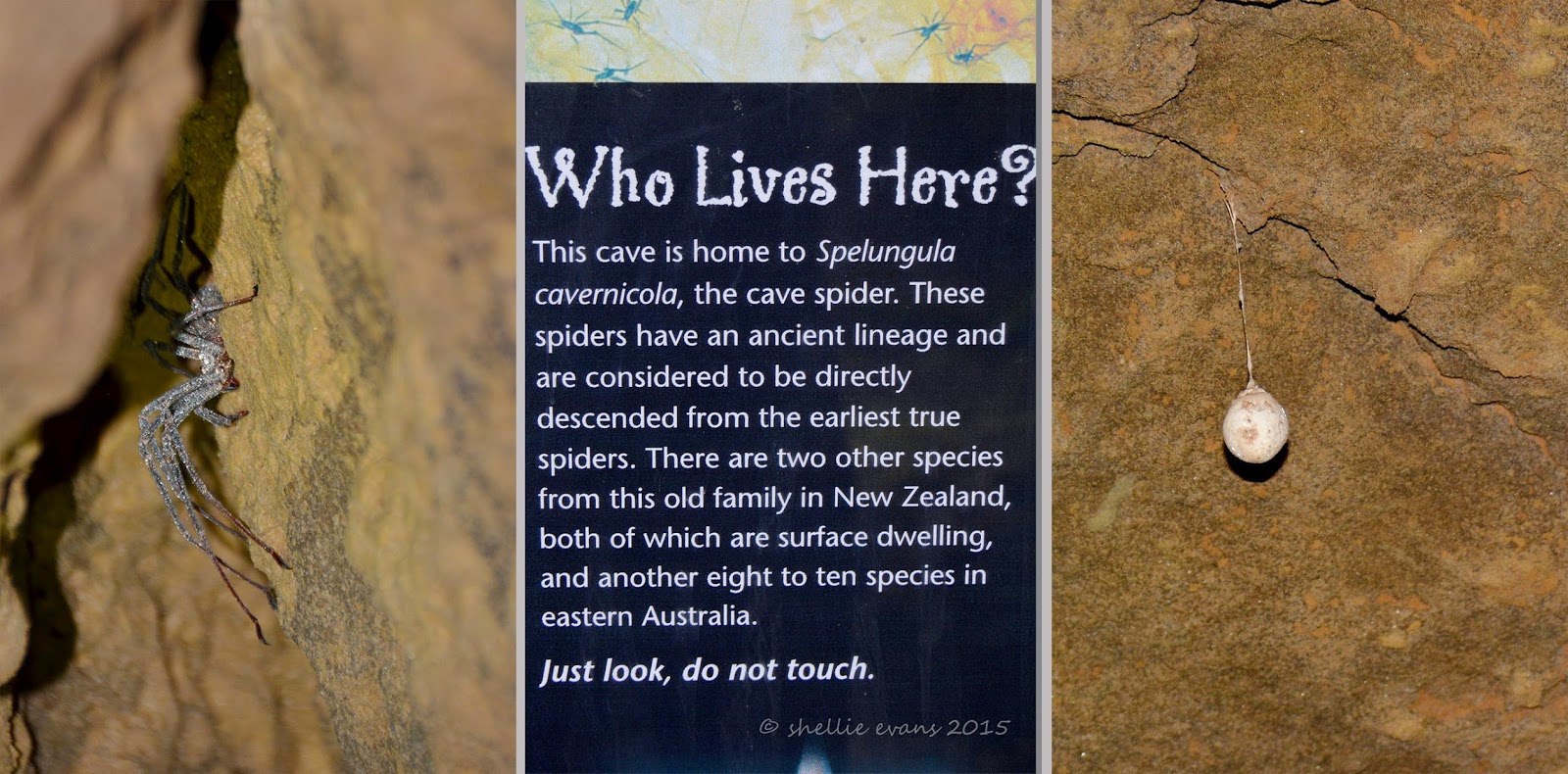
The cave is not very high, perhaps two metres or so and slowly decreases in height as you move into it. Shining the torch into the cracks and gaps in the ceiling not a few inches from our faces reveals the largest spiders you ever saw! Very special spiders, the information panel at the beginning tells us. Large egg sacks also hang from the ceiling.

Remember that it’s pitch black in here and I have to keep up with David whose keen to check out every nook and cranny for wetas & more spiders. Everytime he turns away I’m left in darkness, then he points the torch and there’s a spider or a  weta scurrying away right near my head. I am not happy. Thankfully the wetas are nowhere near as large or as numerous as the ones we found in a cave on the Coromandel.

As if I would!

We make our way to the next cave which is up a stairway to a the level above.


A wooden staircase leads down into the cave.


Box Canyon is one humongous cave, deep, tall, wide and dark. Very dark. From this angle you can also see how the cave got its name.


There are a number of side passages and David’s off exploring again. He squeezes through a passage opening and disappears around a corner. I’m left in darkness and I’m not impressed. Considering David’s aversion to small spaces, I’m surprised he’s so keen to check out the back recesses of the cave.


I take a photo looking back towards the entrance before we round a corner and move further on into the cave looking for glow-worms. There are no wetas or spiders back this far, they tend to like living around the entrance where there’s a bit of light and moisture to attract their prey. Once we’re around the corner we turn off the torch to check the ceiling for glow-worms.

It’s pitch black, not an ounce of light anywhere, you can’t see your hand in front of your face but as our eyes adjust and we look up at the ceiling we see a sprinkle of tiny pin-head sized lights spread across like a miniature Milky Way. Glow-worms! It’s always a delight to come across these tiny treasures when we explore. One day I’ll make the time to set up my camera & tripod to capture them in their natural state. If we turn the torch on them they switch off their lights so it'll need to be a long exposure in the darkness.


It’s too dark for me at the back so I stumble back towards the entrance, checking the sides for anything interesting. I find a tide line, at about my head height, on the stalactites that hang down from the top of the cave. I can’t say that’s very reassuring. It would be some huge downpour to fill this cave, imagine that, one monster swimming pool. At least there's a ladder to help you get out.


We climb back out of the cave, very impressed with what we’ve seen and this is only a small portion of what has been found and explored in the Honeycomb Hill cave system.


Thursday, April 9

Lost World- The Oparara Basin

Ten kilometres north of Karamea is the turnoff to the Oparara Basin, a hidden valley 14kms up another narrow, rough gravel road (an old forestry road) and inside the Kahurangi National Park. Yet again we are visiting Kahurangi, the largest National Park in New Zealand and one we have visited many times on our journey around the top of South Island.


I’ve said it before and I’ll say it again, the distance travelled on a gravel road always feels at least twice as long as it actually is, probably because of the slow speed (it took us 45 minutes) and the bumping about inside the cab. This road was no different. It started out well but steadily got worse with many corrugations and washouts and a few steep sections where there was no gravel or dirt, just bare rock where the road had been cut through.

All the same it was a lovely drive with thick rainforest bordering & sometimes forming a tunnel over the road with occasional glimpses of a rocky creek bed down below the road. Splashes of red from the flowering rata vines grabbed your attention here and there. It’s been a good summer for the rata, they are still flowering long after there usual season. Possum control must have also helped.


It was a great surprise, after not seeing another person or vehicle on the way in, to finally arrive at the end of the road and find this information shelter and a quite a few cars. What a lovely welcome to the Oparara Basin this is; toilets, shelter, interpretation panels and picnic tables.


The Oparara Basin has been called the ‘lost world’ and is one of the finest features of the Kahurangi National Park. Along its course through the basin, and over 35 million years, the Oparara River has carved out three massive limestone arches and numerous cave systems.

At the end of the road and just a few kilometres further on from the public carpark is the highly fragile Honeycomb Hill cave system; a 13km maze of tunnels with over 70 entrances & only first explored in 1980. This cave system contains the remains of over 50 species, including the extinct moa and New Zealand eagle and is only accessible by guided tour to protect the fragile and unique environment. Within this protected area is the Honeycomb Hill Arch, the basin’s third and remotest arch.

There are two arches we are allowed to visit & we decide to visit the Oparara Arch first, the largest natural rock arch in the Southern Hemisphere. The 1km walking track follows the Oparara River upstream. We keep an eye out for Blue Ducks/Whio, there’s a breeding population located in the basin but once again we miss out on seeing them.


The walkway is well formed and very picturesque with ferns and moss growing everywhere and over everything. David sets his track timer going and we’re off….


We pause at the edge of the river where it’s very still and reflective. The dark tannin stained water turns a rich gold colour as it flows over the shallow edge. Cup of tea anyone?


Thick moss and lichen encrusted branches overhang the river and the track like ghostly arms and David is sure James Cameron’s inspiration for the movie Avatar must have come from here- or in fact Weta Workshops inspiration. He feels like he’s walking through a movie set and large blue people will spring out at him at any moment.


And here’s our first glimpse of the huge arch, a land bridge over the top of the river.


And directly underneath, looking up.


The track leads us up into a huge cavern where there’s an old sign with the measurements. Apparently these are not quite right though- DOC’s measurements put the arch at 219m long, up to 79m wide, and 43m high.


We make our way down to the river bed….


Where we can now see the other end of the tunnel….


We wade through the river, (wearing our Tevas was a good idea- most people had walking shoes or tramping boots on), crossing it a couple of times before reaching the other end.


The water is cold but not too deep….


Until the last crossing where it’s quite swift and there’s a deep pool. The rocks are also slippery so we decide we’ll not risk getting wet. A pity because I’m sure there would have been some blue ducks up further! The boulders and rapids we can see  around the corner look like ideal blue duck territory.


We head back towards the entrance…


And I take a photo of David standing below the impressive arch.


Back along the track I stop to take some close ups of the rich green mosses and the stunning moss covered rocks that surround a stream which flows down into the river.


And stop by the river again where I spot these rocks with their contorted faces & hair tuffs.


Back at the carpark we see that our foreign neighbours(with their very young daughter) from the Karamea Domain Campground have parked beside us. In their hire motorhome. Hmm....they obviously can’t read and we’re not sure how on earth they managed to manoeuvre their van over the road without doing some serious damage.


And I can’t imagine what they would have done had they met anybody coming from the opposite direction. The width of the road would have been little more than the van itself and there were very few areas to pass or pull over should another vehicle approach. But there you go, they made it there and back, and were tucked up safe and sound on their site by the time we returned. We heard that the grader was due through the road the next day, I wonder what would have happened had anyone met that on the road let alone a large campervan.

Still to come from the Oparara Basin-

Crazy Paving  & Box Canyon Caves
Mirror Tarn
Moria Gate