Thursday, September 10

How a Dud Became a Stud

And no, I’m not talking about David!

I wonder how many guessed what or who the very special something was we planned to see in Wellington? This ambassador for his species is also a well known media star. He has had a guest appearance at Zealandia Sanctuary in Wellington for the last six weeks and we were lucky enough to get some of the last bookings to see him before he returns to his island life this weekend.


I am of course talking about Sirocco, the world famous Kākāpō and champion bird for the New Zealand Kākāpō Recovery programme. Sirocco is one of only 125 kākāpō left in the world, all in New Zealand and all living on predator free islands. Not too long ago there were just 18 birds left and they were fast heading for extinction.


The kākāpō is a large, flightless nocturnal ground dwelling parrot and is endemic to New Zealand. A combination of traits make the kākāpō unique among its kind; it is the world's only flightless parrot, the heaviest parrot, it is nocturnal and herbivorous, has no male parental care and is also possibly one of the world's longest-living birds.


Sirocco had an uncertain start to life, suffering a respiratory illness at three weeks old while being raised by his mother, Zephyr. Rangers moved Sirocco to their hut for treatment and he became the first ever male kākāpō to be hand-raised. Kākāpō chicks put on most of their adult weight during the first few months and by the time he was 52 days old he had recovered enough to be released, ready to survive on his own.

But Sirocco had other ideas. It would seem that the call of the wild wasn’t so loud for him and it soon became apparent that, as a result of the intensive hand-raising and lack of kākāpō company, he had been imprinted on humans. The Kākāpō Recovery team realised he was unlikely to be an effective breeding bird, but instead an extremely good advocate for his species, providing the best opportunity for people to meet a live kākāpō.


Sirocco remains a wild bird, he does not live in captivity but has visited several places in the last few years – on tour as an ambassador for his species. He has proved to be an ideal bird for kākāpō advocacy and seems to thrive on all the attention.

But it was a unique encounter with zoologist Mark Carwardine, who was filming a BBC documentary with British actor Stephen Fry, which rocketed Sirocco into the global spotlight. Footage from the program Last Chance to See which showed a rather ‘frisky’ Sirocco attempting to mate Carwardine’s head was posted on YouTube and the kākāpō star was born. Here’s the link to that YouTube clip-

Shagged by a Rare Parrot

Obviously being a nocturnal parrot, our tour to meet Sirocco, was at night. We were in a group of around 20 people and our tour began with a talk & viewing a short film on Sirocco. It also included all the ‘Dos & Don’ts’, the most important one being no camera flashes or focusing lights allowed- this was reiterated about half a dozen times by the various tour guides and Sirocco’s handler before we reached his enclosure.

We left the Zealandia’s reception, passed through the predator proof fence control gates and out into the sanctuary to walk a couple hundred metres up the path until we reached Sirocco’s headquarters- which looked a little less glamorous in daylight. This was taken when we visited the sanctuary the next day to see the rest of the birds.


Sirocco was in a large area under subdued lighting and behind perplex- I knew we wouldn’t have been able to see him ‘in the flesh’, it would be far too stressful and risky for such a precious bird. As it is he has to go into quarantine before he is returned to his island home so he doesn’t take any nasty diseases back with him.

Sirocco loves humans though and we were told to move in close so he could see our faces and be as vocal and as silly as we wanted without banging or tapping the perplex. He loves bright hats & scarves and people being animated and singing. I guess our group were a little too inhibited as he just sat on his log in the corner preening for quite a while (Mum, Rachel…we needed you!).


And because everyone wanted a photo of Sirocco and everybody crowded in so he could see them, that along with a very slow shutter speed & not much light,  it was extremely hard to get any decent shots of him. The reflections were atrocious as can be see in the photo up above with people crowded around the window. But I managed to take a few that I’m reasonably happy with and I can now say I’m one of the very few people in the world to have seen a live kākāpō and especially a famous one named Sirocco.

Sirocco did move off his perch, he made his way down to the other end and back again along a horizontal branch, squawking loudly just the once and doing a huge poo mid pole. The tour guides 'helpfully' had a plastic bag with them and a recent poo inside so people could smell it (herbaceous) and feel the weight. Not so heavy for such a large poop and bird.

Sirocco is 18 years old and has many years ahead of him- it’s not know how old he'll actually get to but it’s thought well into his 80s and possibly over 90. He weights just under 4kg, which is the usual weight of an adult male although he’ll fatten up a little more over spring and summer in preparation for the harsh winter.


All too soon the tour came to an end and Alicia, Sirocco’s handler & minder, moved into the enclosure to reassure him and answer any further questions. She also had a pocket full of treats- pine nuts. Here he thinking I’m sure she’ll give me one soon…


It was a privilege and a thrill to finally meet Sirocco and what a beautiful, endearing character he is- I just wanted to stroke his back and give him a cuddle. Long may he go on being number one kākāpō ambassador supporting his highly endangered family.

Footnote-
I was very sad and rather poignant to hear the next day that Gary 'Arab' Aburn the "man with a beard right down to his dog" and passionate kākāpō conservationist passed away the night we visited Sirocco. We have so much to thank him for:


From the 1989 BBC radio documentary series and its accompanying book, written and presented by Douglas Adams and Mark Carwardine-
A few minutes later Arab himself arrived. I had no idea what I expected a freelance kakapo tracker to look like, but once we saw him, it was clear that if he was hidden in a crowd of a thousand random people you would still know instantly that he was the freelance kakapo tracker. He was tall, rangy, immensely weather-beaten, and he had a grizzled beard that reached all the way down to his dog, who was called Boss. He nodded curtly to us and squatted down to fuss with his dog for a moment. Then he seemed to think that perhaps he had been a little over curt with us and leant across Boss to shake our hands. Thinking that he had perhaps overdone this in turn, he then looked up and made a very disgruntled face at the weather. 
With this brief display of complete social confusion he revealed himself to be an utterly charming and likeable man. Nevertheless, the half-hour helicopter trip over to Codfish Island was a little tense. We tried to make cheerful small talk, but this was rendered almost impossible by the deafening thunder of the rotor blades. In a helicopter cockpit you can just about talk to someone who is keen to hear what you have to say, but it is not the best situation in which to try to break the ice. `What did you say? I just said, "What did you say?... 'Ah. What did you say before you said, "What did you say?... 'I said, "What did you say?"' `I just said, "Do you come here often?" but let it pass.'

And here is a link to the Otago Daily Times and a recent article on-  The Life of the Kakapo Man


Monday, September 7

We’re on the Move

We woke up in stunning Whites Bay to a chilly frost and sunny skies this morning. David woke up with itchy feet.


Once again we feel like we’re marking time before we cross back over to the North Island and head to Tauranga & then Napier to catch up with family and friends- it happened last year before we returned for Christmas too.

So with the weather forecast looking good for a smooth crossing tomorrow, we’re now booked on the new Bluebridge ferry, the Strait Feronia for a 2pm sailing. I was keen to check out the new ferry so the timing worked out well. I also just happen to have a photo of the ship- taken the other day when we passed through Picton, that's it in the foreground.


We decided to shift over the hill to the Rarangi DOC campground for our last night and then drive the 30kms or so to Picton in the morning. It must have been the shortest shift ever- 5 winding kilometres from Whites Bay to Rarangi! We stopped at the top of the hill so I could take a photo looking out over the Rarangi Beach.


The DOC Camp at Rarangi is the exact opposite of Whites Bay, this one is very regimented. It has six fenced hardstand fingers in the centre of the reserve available for RVs, tents are pitched on the grass area. It reminded me of a cow stall in a milking shed, we had to carefully back in and allow enough room for the slide-out to clear the knee high fence.

I guess it’s better than some of the commercial campgrounds where you’re parked right alongside your neighbour, there’s plenty of space between the fingers. It could be quite a gathering in the summer when all the fingers are full, you could have a street party in the middle. Or the movanners equivalent of a street party- hmm....that's called Happy Hour isn't it. And some disappointed people too as I’m sure the fingers would fill quickly.


Excuse the wires, but here’s a photo looking down on the camp, you can see the fingers clearly here, we’re parked in middle one on the left.


We’ll be in Wellington for a couple of nights, one of the reasons I was happy to cross this week is because there’s a very special ‘something’ that is only in town until the weekend and this’ll be one of the few chances we’ll ever get to see ‘it’. Something I've had on my bucket list for awhile….but you’ll have to wait to find out what it is.

See you on the other side of the ditch...


Saturday, September 5

Beer & Skittles

I thought I better do another update on our whereabouts. I am steadily getting through the Maniototo posts with just a couple more to do. Actually I think three, one of them will be a two part-er. But just as I am about to catch up we move on to a new spot and do some more exploring! So if I don’t keep up with these short ‘here we are’ posts I’ll be forever coming up the rear.

Originally we were heading from Marfells Beach to Momorangi in the Marlborough Sounds for a couple of weeks of rest and relaxation (and fishing) but we had to make a detour and carry on over the big hill to Nelson to do some urgent maintenance on the 5th-Wheeler.

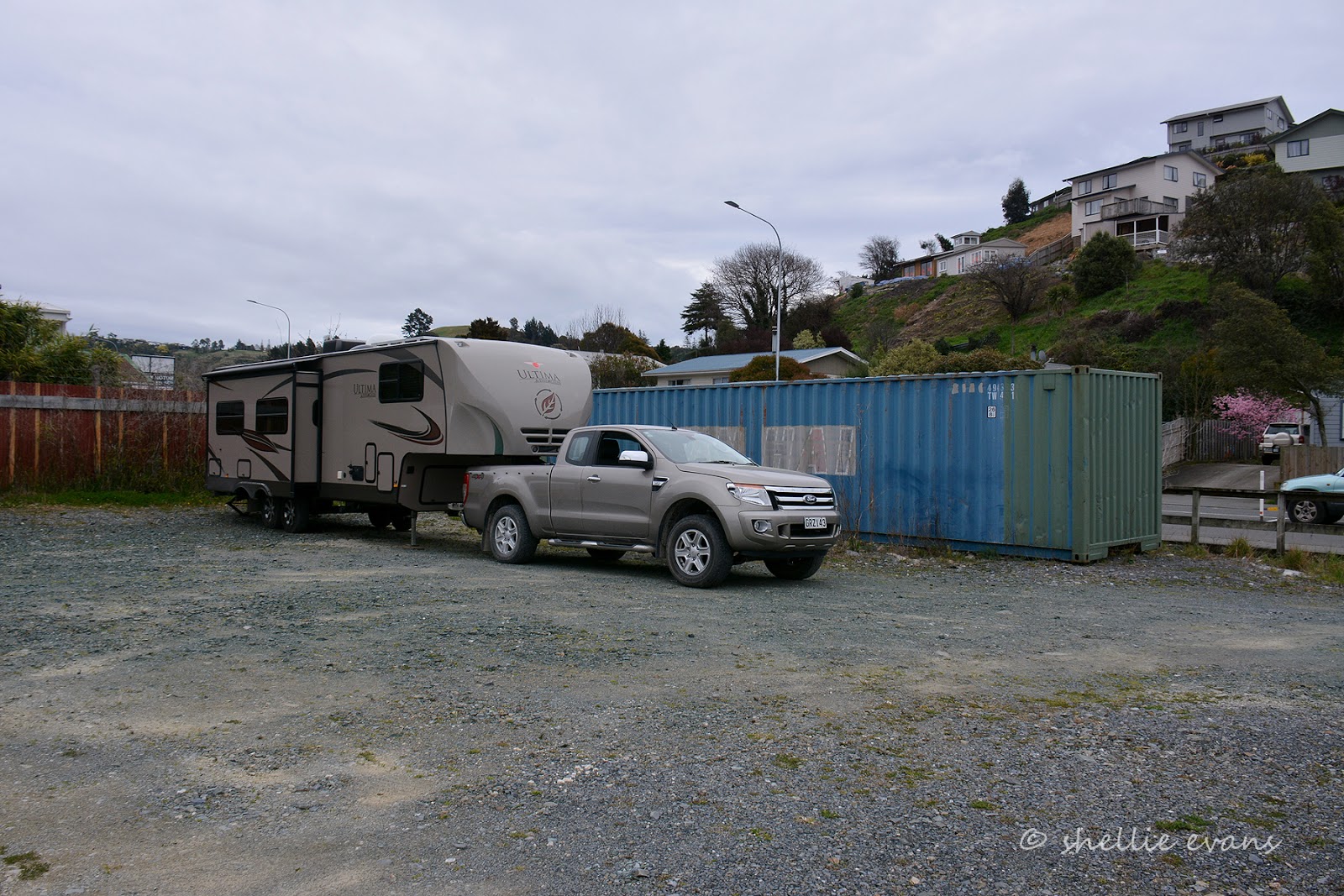
And as you can see it’s not all beer & skittles when you’re on the road- here we are parked up for the night in an overgrown empty lot with a shipping container and an old caravan for company and whole lot of dog sh*t;- David wanted you to know that after stepping in a few piles! The company who were doing the maintenance use the empty section and suggested we stay here so they could get an early start the next morning.


They offered the section again the next night but we decided to re-locate to the familiar and friendly Richmond Racecourse site where we’ve stayed a few times before. They were quite busy with a few permanents (max. allowed 3 months) and other full-timers passing through. We parked across a couple of sites and stayed hitched so we could pull out early the next morning.  It was a lovely surprise to be greeted by Shirley & Graham; they have been running the camp since the new year. We met them way down south in Manapouri last year when we were both staying at a great campground and where I took a helicopter ride to take photos of the campground.


We pulled out early the next morning and hauled ourselves back over the Rai Saddle and down into the Marlborough Sounds pulling into the DOC Momorangi Campground with enough of the day left to sit outside and enjoy the warm sunshine. That was after setting up the table and chairs for the first time this season and we also had our first taste of pesky sandflies for the season, or more to the point, they had their first taste of us. Summer is on its way!

I spoke to soon. We stayed at Momorangi for 7 days and had rain for 5 of them. It was heavy and steady for a couple of days and on and off for the rest. My hunter-gatherer decided he is a fair weather fisherman so the Takacat inflatable didn’t see the light of day & stayed tightly packed in the back of the ute. The weather, along with the fact that the blue cod fishery is out of bounds for 3 months sealed the fishing fate.


After Momorangi we headed into Blenheim to do a few chores, stopping at our regular stop, the Blenheim Racecourse. Another not so ‘beer & skittles’ park over, the grass areas were very boggy and rather than venture into our favourite spot between the grandstands and avoiding parking outside the Ballet School (where we had little girls swinging on the ramp bars just below our kitchen window and Mums parking their cars beside our front door) we backed in beside the tote office. Keeping well clear of doorway where the tractor is stored. Tractor? Too late. 7am the next morning the door is scrapped open across the gravel to stop right beside my bedroom window. The tractor roars & revs for about a minute before it bursts out the door on a mission. To be repeated again the following morning.


Chores done we were out of there and on our way to the DOC campground at Whites Bay. Whites Bay is located north east of Blenheim on the coast, at the bottom of the Marlborough Sounds but on the outside of the Sounds- if that makes sense.


If you headed north out of Picton on the Port Underwood Road, Whites Bay is towards the end, just over the hill is the beach settlement of Rarangi and the Wairau Plains. We came in from the Rarangi end- a steep and winding 6kms. No towing (not that, that stopped us on Queen Charlotte Drive into Momorangi) or large motohomes & vehicles are allowed further on past the bay on the Port Underwood road.


Whites Bay is a small sheltered bay (except for easterlies) that is obviously quite popular in the summer- there’s a surf club headquarters near the beach front and plenty of camp sites although all the top areas are closed off for the winter.


Across the bay is Cape Campbell and Marfells Beach. Whites Bay is named after Black Jack White, an American Black who deserted his whaling ship in 1828 and lived with Maori in the bay.


In 1866 the first of many telegraph cables between the North & South Islands was brought ashore at Whites Bay. The telegraphist's building that had been prefabricated in Australia was floated ashore and sits, preserved, in the middle of the DOC camp. 


Tonight while I was doing the dishes I heard the familiar sound of a couple of possums challenging each other just outside the van- it’s a weird noise and so loud that if you didn’t know what was making it you’d be quite worried and perhaps think a herd of cattle beast were about to rampage through the camp. David went out with his head torch on to locate them, he found them both close by. Well he found one and I heard the other one rustling about in the leaves at ground level. Beside me. Me without the head torch- that gave me a bit of a fright until it ran up the tree. David shone his torch on it while I shot it….with the camera  Cute eh?


Today we explored the Port Underwood Road (I’ll do a post on it later), initially we were just going to drive the road along the coast and turn around before it headed inland across to Picton but in the end we drove the whole loop- 80kms with about 50 of them on a narrow, gravel, very winding road, climbing up and over high ridges and down into tiny bays and then back up again.

There's a side road up one of the Sound arms with a monument towards the end that I had set my sights on seeing but when we got to the turnoff I had second thoughts. 14kms there and 14kms back on a similar or probably worse road just to see a monument- my head said “Don’t be silly”, the wanderlust in me said ‘Go for it”. This time my head won. David was pleased.

That got me thinking.....and so, I'm going to dedicate this post to my number one fan. A person who reads every blog post word for word and at least twice and probably 3-4 times and then asks when the next one will be posted. This person is the one who gave me the genes for my wanderlust and thirst for exploring the back-roads and byways, an extra special man who always took the long way home, despite the pleas from his wife and the whining kids in the back seat of the car.  Happy Fathers Day to my darling Dad xx


Wednesday, September 2

2000ft Above Worry Level

So says the welcome sign for the tiny little historic village of Naseby- not only has the town been left behind but they’ve not moved their slogan into metric measurements either! Then again I suppose ‘610 metres above worry level’ doesn’t quite have the same ring about it. Naseby is nestled in a forested valley in the foothills of the Mt Ida Range and is just 14kms from Ranfurly.


Naseby is another town that came into existence with the beginning of the gold rush in 1863, the rush was short lived but gold mining on a more commercial scale continued for over 50 years and the town grew to become a thriving rural town. Unfortunately after the railway came to Ranfurly it gradually took over as the centre of the Maniototo and Naseby became a quiet backwater and holiday destination with many of the old mining cottages and houses sold, restored and used as cribs (holiday homes). The surrounding forest has many walking and mountainbike tracks and there are plenty of dams for swimming in during the summer and ice skating on over winter.


Naseby is also the curling capital of New Zealand, and while the Bonspiels have been held on the Idaburn Dam since 1932, the latest tournament was held in Naseby just two weeks before we arrived in the Maniototo- I was very tempted to drive up from Winton to catch the spectacle. The curling rink shown in the middle left photo below was the one used for the tournament, but it was well on the way to melting when we stopped to check it out. The indoor Maniototo International Curling Rink was across the road, along with the indoor curling rink there’s also an outdoor skating rink and a luge.


The village was virtually deserted which isn’t surprising given that there are only a hundred or so permanent residents and it’s the middle of the winter. The Royal Hotel was open, the publican was out sweeping the snow away from the path and front doors. The Royal opened in 1863 and was one of 22 hotels in the town at the height of the gold rush. There are just two left now. It became a Cobb & Co stop in 1869 and an accommodation wing was added on the right, giving ‘ladies’ an entrance to the hotel.


Across the road from the Royal is the old Mt Ida Chronicle newspaper office. Snow had fallen the night before although we hadn’t had any down in Ranfurly, that was yet to come. We had been warned by one of the locals back at Omakau, not to camp up at Naseby in case we got snowed in but as it turned out, the camping ground at Naseby was closed anyway.


Next door to The Royal Hotel is the old Council Office which is now a museum. Unfortunately it was closed for winter too so I was unable to have a look at the local history.


With no traffic on the road and nobody about I was able to wander through the village taking photos of all the historic buildings. I wasn’t quite by myself, this lovely dog was sunning herself against the wall and watching me carefully through half closed eyes as I moved up and down the street. She came out to greet me on my way back and then went back to her wall. I think she belonged to the nearby dairy.


The two most iconic Naseby buildings are the Watchmaker’s Shop & Boot Manufacturer. The watchmakers shop opened in 1868 and the owner Robert Strong turned his hand to repairs of any precision tools of the day. His son ran the shop until 1959 when he was 80 years old.  The Boot Manufacturer shop is a recreation of the 1863 original building on the site.


A German Field Gun, a war trophy, sits near the War Memorial. It is one of very few that remain in rural NZ towns.


David was delighted to spot a Trekka sitting outside the local garage. It’s been a long time between sightings and we hadn’t found any more on our travels since finding two on the Coromandel a couple of years ago. David was once the sales manager for Five Star Motors in Auckland, a retail outlet of Motor Industries, and sold many of the 2500 Trekkas that made it onto our roads.


Not only did he find one Trekka, but he found another one out the back. He also found the guy who owns them and so they spent the next half hour or so reminiscing…


…which was great because I could carry on clicking! This was the Union Church where Protestants worshipped, built in 1865. It was also used as a temporary school and a teaching centre for mining classes before becoming the Athenaeum and library in 1873.


The Naseby Post Office is another huge building for a small town, it was built in 1900 and is typical of government architecture of the day. The building now houses the Information Centre which I found closed too.


Alongside the post office are the Masonic Hall & the Court House (bottom). The Masonic Hall was built in 1869 of  mud and tussock for the Mt Ida Masonic Lodge. It was later used by the Oddfellows Lodge. The Court House was built in 1875 with its last hearing held in 1961.


This rather pink building, the All Nations Store was built in the 1870s from mudbrick and timber and like many buildings of the day had a fancy wooden facade to make an impressive frontage. It has been added to and altered over the years.


There are numerous tiny miners cottages and grander settlers houses around the village-


..including the Monkey Puzzle House (bottom right) obviously named for the very large & very old Monkey Puzzle tree in the front garden. This was the Borough Clerk’s house, the current owners have restored it to its former glory and it is now a B&B.


Once David had run out of Trekka facts and figures to discuss and I had returned from down the street we popped over the road to have lunch at Black Forest Cafe. The snow was melting fast and a curtain of water was dripping off the old roofs of the cafe building which has housed, at various times, banks, bakers, drapers and others long forgotten.


One excellent piece of inside information I did get from the Trekka man before I left them talking was the location of a tiny curling dam used by the locals.


Known as the mini Mt Ida dam it’s just a handkerchief sized shallow boxed square located in the forest behind the village.


A place where the sun don’t shine and the ice don’t melt.


Although David was less than keen to be the guinea pig and walk out on it for me after I pointed out a few slushy edges. Later I saw a photo of the dam in the summer- a large grassy square which looked to be all of a foot deep.


I wondered who would keep a dog in such a cold kennel, then I realised it was the wood box! Duh!! And I had the feeling that this little scene was going to be the full extent of the ‘hoar frost’ I've been looking for in the Maniototo.


It was about now that I wished the museum or i-Site had been open. Beside the dam sat this very old hut(complete with dog kennel too) with a sign attached which you couldn’t read other than it was built in 1905.


I wanted to know it’s history. It looks like a sentry box, although I think that thought was helped along by the words- ‘1883 Colour Royal B—‘ . I might just have to call the museum.


On our way home we stopped at the Naseby Golf Course- no chance of playing golf here for awhile.


We drove back through Naseby a few days later and stopped for lunch at the Royal Hotel. We met a very interesting fellow at the bar….but, you’ll have to wait to hear about that…